
A rechargeable battery should be evaluated as part of the complete beauty device, together with its actual functions, charging design, controls, documentation and approved production version.
Buyers should verify more than the stated battery capacity. A rechargeable beauty device battery must be assessed as a complete system: battery identity, voltage and energy, runtime in each operating mode, charging input, protection behavior, temperature rise, status indicators, storage recovery, transport documents and change control from the approved sample through production.

Why Does Battery Capacity Alone Not Predict Performance?
Battery capacity in milliampere-hours is useful, but it cannot independently predict how long a beauty device will operate. A 750 mAh battery is not automatically better than a 500 mAh battery when the products use different voltages, functions and operating modes.
Battery energy can be estimated using:
Battery energy (Wh) = nominal voltage (V) × capacity (Ah)
For example, a 3.7 V, 750 mAh battery has a nominal energy of 2.775 Wh. A 7.4 V, 400 mAh battery has a nominal energy of 2.96 Wh. Although the second battery has a lower mAh rating, its calculated energy is slightly higher because its nominal voltage is different.
Even watt-hours do not provide the complete answer. Actual runtime also depends on:
- motor, pump, ultrasonic, EMS, warming and vibration loads;
- output level and operating mode;
- power-conversion efficiency;
- battery internal resistance;
- low-voltage cutoff settings;
- product control logic;
- ambient and battery temperature;
- battery age and charging history.
Buyers should therefore compare usable performance under an agreed test method rather than compare capacity figures in isolation.
What Battery Information Should Be Confirmed First?
Battery evaluation should begin with the exact product and battery version. A report for a battery with the same capacity does not necessarily apply if the manufacturer, model, voltage, chemistry or construction is different.
| Item | What the Buyer Should Confirm |
|---|---|
| Product identification | Exact device model and commercial version |
| Battery identification | Battery manufacturer, model and construction |
| Chemistry | Confirmed lithium-ion, lithium-polymer or other chemistry |
| Electrical rating | Nominal voltage, rated capacity and watt-hours |
| Charging limit | Required charging voltage and current |
| Protection design | Protection circuit and relevant protection thresholds |
| Physical configuration | Dimensions, connector, wiring and installation method |
| Product load | Functions and modes powered by the battery |
| Document revision | Report number, issue date and applicable battery version |
The product specification, approved sample, battery specification and supporting reports should all describe the same configuration. If the product specification lists only “rechargeable battery” or gives only a capacity value, the battery definition is incomplete.
Why Should Runtime Testing Follow the Product Load?
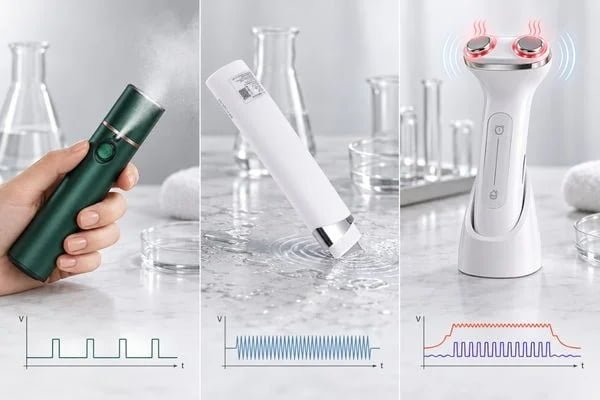
The current home beauty device range includes rechargeable products with very different load profiles. A fine-mist sprayer, ultrasonic skin scrubber and multifunction beauty device should not be evaluated using one generic runtime test.
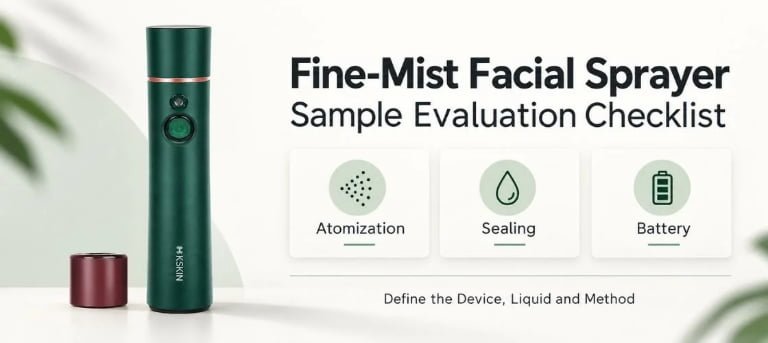
KD88SA Fine-Mist Sprayer
The KD88SA portable fine-mist facial sprayer uses a 7.4 V, 400 mAh rechargeable battery with a 5 V/1 A charging input. Its main electrical load comes from the fine-mist atomization system during press-and-hold operation.
Relevant checks include:
- continuous spray runtime;
- repeated short spray cycles;
- mist stability as the battery discharges;
- low-battery shutdown behavior;
- red charging and green full-charge indicators;
- charging recovery after storage.
A visible mist cloud is not enough to judge battery performance. Output should remain stable within the approved test conditions until the defined low-battery point.
KD8023 Ultrasonic Skin Scrubber
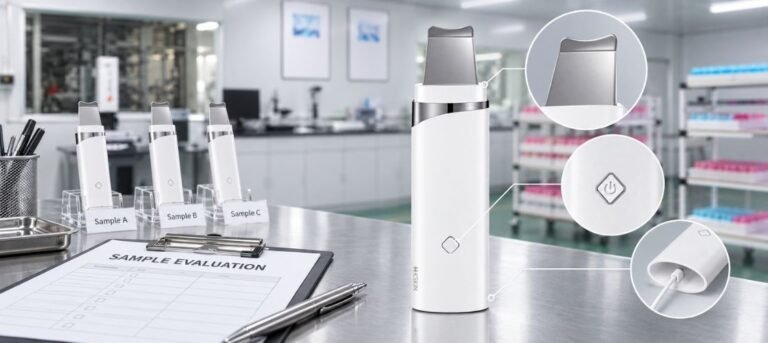
The KD8023 ultrasonic skin scrubber combines Cleansing, Infusion and Lifting modes. Its current commercial parameters specify a 5 V/1 A charging input, 3 W rated power and an approximately 10-minute reference session.
Runtime should be tested by mode because ultrasonic and EMS operation do not necessarily draw the same current. Buyers should record:
- runtime in each operating mode;
- number of complete 10-minute sessions;
- mode and indicator behavior near low battery;
- output consistency across repeated sessions;
- charging time after a defined discharge condition.
A statement such as “15 days of use” has little value unless it also identifies the daily session length, operating mode, starting charge and shutdown criterion.
KD8086 Multifunction Beauty Device
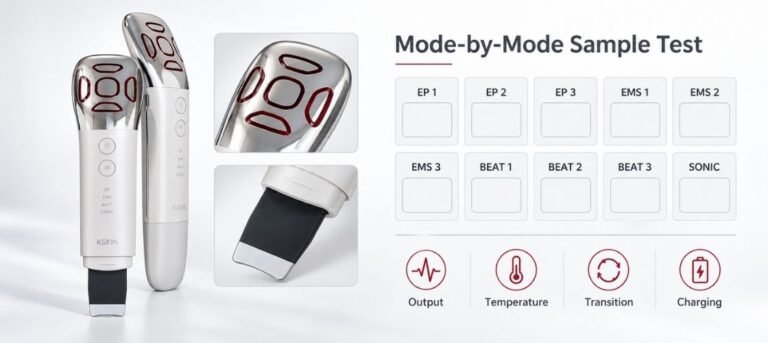
The KD8086 dual-head multifunction beauty device uses a 750 mAh rechargeable platform with EP, EMS, BEAT and SONIC modes. EP also activates warming and vibration, while the other modes use different functional combinations.
A single average-runtime claim cannot represent every mode. Testing should cover:
- EP mode with warming and vibration;
- EMS mode at each intensity level;
- BEAT mode at each intensity level;
- SONIC spatula operation;
- repeated approximately 10-minute sessions;
- automatic shutoff and restart behavior.
One approved KD8086 manual version gives reference values of approximately 2.5 hours for charging and approximately 40 minutes of use. These figures still need to be verified against the exact sample, mode sequence, cable, adapter and commercial version being approved.
How Should Usable Runtime Be Tested?
Runtime testing requires a written method so that results from different samples or suppliers can be compared. “Used until the battery ran out” is not an adequate test description.
A practical procedure is:
- Record the product, firmware and battery version.
- Charge the product using the specified input, cable and adapter.
- Define how a full charge is identified.
- Allow the sample to stabilize under the agreed room conditions.
- Select the operating mode and intensity level.
- Run the product according to its normal session logic.
- Record session duration, rest periods and restarts.
- Note the first low-battery indication.
- Record any reduction in output or abnormal behavior.
- Continue until the defined shutdown point.
- Measure housing and battery-area temperature at agreed intervals.
- Recharge the sample and repeat the test.
Using three to five samples per configuration, with at least three repeated tests per sample, provides a more useful engineering comparison than testing one unit once. This is a practical sample-evaluation approach, not a universal regulatory sample-size requirement.
Define the Runtime Endpoint
The buyer and supplier should agree on what “runtime” means. Possible endpoints include:
- time from full charge to automatic shutdown;
- time from full charge to the first low-battery warning;
- time until the product can no longer maintain the required output;
- number of complete standard treatment sessions;
- number of cycles before a specified output limit is reached.
For many home beauty devices, the number of complete standard sessions is more useful than a continuous runtime figure.
Record the Test Conditions
A runtime result should identify:
| Test Condition | Information to Record |
|---|---|
| Sample | Model, version and sample quantity |
| Battery | Manufacturer, model, voltage, capacity and energy |
| Environment | Temperature and relevant conditioning time |
| Starting condition | Full-charge definition and rest time |
| Function | Mode, level and active features |
| Cycle | Operating time and rest interval |
| Endpoint | Warning, output limit or shutdown |
| Result | Minutes, completed sessions and sample variation |
| Temperature | Measurement location and maximum value |
| Abnormalities | Reset, unstable output, unusual heat or failed restart |
Without these conditions, runtime figures from different products are rarely comparable.

What Should Buyers Verify During Charging?
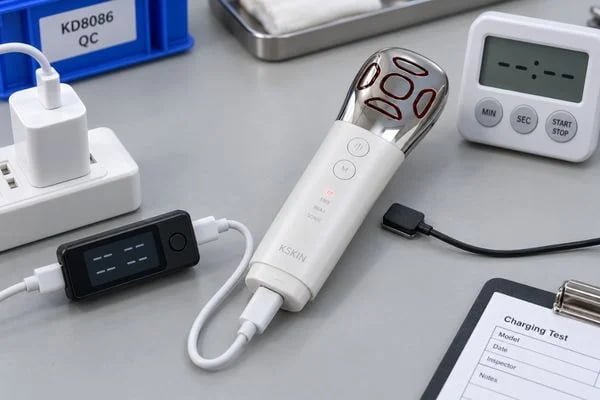
A charging check should cover more than whether an indicator turns on. The complete charging path includes the connector, cable, adapter requirement, charging circuit, battery and status logic.
Buyers should verify:
- specified input voltage and current;
- connector type and mechanical fit;
- supplied or approved charging cable;
- compatible adapter requirements;
- charging time from a defined discharge state;
- input-current behavior during charging;
- charging and full-charge indicators;
- product operation while connected to power;
- housing and battery-area temperature;
- response to an unsuitable or unstable power source;
- recovery after deep discharge or extended storage.
A USB or USB Type-C connector does not prove support for fast charging or USB Power Delivery. Those functions require confirmed protocol and circuit support. The instruction manual should state the permitted input clearly instead of implying compatibility with every phone charger.
For the KD8086, the approved manual states that the operating functions stop when the charging cable is connected. This is a model-specific charging interlock. It should be confirmed on the sample rather than treated as a rule for every rechargeable beauty device.
Which Protection and Temperature Checks Matter?
A rechargeable battery system should respond predictably during normal use, low-battery operation, charging and foreseeable electrical faults. Buyers should review the battery specification and protection design, then confirm the relevant behavior in the assembled product.
Important review points include:
- overcharge protection;
- overdischarge protection;
- overcurrent protection;
- short-circuit protection;
- charging-temperature control;
- low-voltage shutdown;
- abnormal charging response;
- cell and housing temperature;
- restart behavior after protection is triggered;
- recovery from a deeply discharged state.
The term “BMS” should not be applied automatically. Small beauty devices may use a protection circuit or protection IC rather than a complex battery-management system. The supplier should identify the actual protection design and the evidence supporting it.
Temperature should be measured at defined locations under the highest relevant load and during charging. A skin-contact temperature measurement does not replace a battery-area or charging-circuit temperature check.
What Should Be Checked After Repeated Cycles and Storage?
An initial runtime result does not establish battery life. Before making a cycle-life claim, the buyer needs a defined charge-discharge method, environmental conditions, sample quantity and end-of-life criterion.
A practical sample review can begin with:
- several repeated full charge and discharge cycles;
- runtime comparison between the first and later cycles;
- charging-time consistency;
- indicator accuracy;
- temperature comparison;
- inspection for swelling, odor, leakage or housing deformation;
- functional restart after low-battery shutdown.
Storage behavior also matters for products that may remain in a warehouse, retail channel or consumer drawer for months. The test plan should consider:
- storage state of charge;
- storage temperature and duration;
- self-discharge;
- recovery charging time;
- battery dormancy behavior;
- runtime after storage;
- recommended maintenance-charging interval.
The KD8086 manual, for example, instructs users to recharge the product periodically during extended storage. This illustrates why storage instructions must match the actual battery and charging design.
Which Battery Documents Should Buyers Request?
Battery documents serve different purposes. One report should not be treated as a substitute for every other requirement.
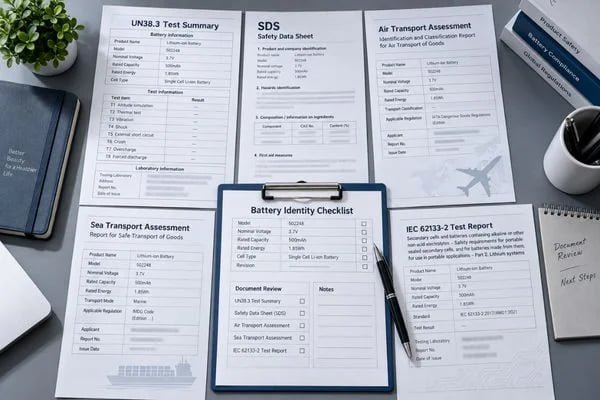
| Document | Main Purpose | Key Scope Check |
|---|---|---|
| Battery specification | Defines construction and electrical limits | Manufacturer, model, voltage, capacity and revision |
| UN 38.3 test report | Records transport tests for the identified battery | Exact tested model and configuration |
| UN 38.3 test summary | Summarizes battery identity and T1–T8 results | Report number, issue date and model match |
| SDS | Provides composition, hazards and handling information | Same manufacturer and battery model |
| Air, sea or road assessment | Supports a specific transport route and shipment condition | Valid period, battery form and packing condition |
| Drop or stacking report | Supports specified package and transport checks | Packaging configuration and tested quantity |
| IEC 62133-2 report | Addresses safety requirements for applicable portable lithium cells and batteries | Exact battery model, standard edition and report holder |
A useful UN 38.3 test summary should identify the battery model and specification, watt-hours, applicant or manufacturer, test laboratory, report number, issue date and results of the applicable T1–T8 tests.
The UN Manual of Tests and Criteria provides the official framework for lithium-battery transport testing under subsection 38.3. The test summary must correspond to the battery actually installed in the approved product.
Transport requirements also depend on whether batteries are shipped alone, packed with equipment or contained in equipment. Current air-shipping conditions should be checked against the IATA lithium battery guidance and applicable carrier requirements.
IEC 62133-2 addresses safety requirements and tests for applicable portable sealed secondary lithium cells and batteries. An IEC 62133-2 report for a battery model does not, by itself, certify the complete beauty device.
The document package should be reviewed against the exact product, battery, destination market and shipping method. Our certifications and credentials overview also explains why product-level records must be matched by model, configuration, market and date.
Why Does Battery Change Control Matter?
Battery-related changes can affect runtime, charging, temperature, assembly and document validity even when the product model name remains unchanged.
Changes requiring review may include:
- battery manufacturer;
- battery model;
- cell chemistry;
- nominal voltage or capacity;
- cell or pack dimensions;
- protection circuit;
- wiring and connector;
- charging-control components;
- charging cable;
- low-battery cutoff logic;
- firmware controlling operating modes;
- product functions or output levels.
A controlled change process should require the supplier to identify the change, submit the revised specification and explain which tests or documents are affected. Runtime, charging, temperature and protection checks should then be repeated where appropriate.
The battery used in production should remain aligned with the approved sample, bill of materials, specification and supporting reports. This forms part of broader manufacturing and quality control, not a paperwork check performed only before the first order.
Rechargeable Beauty Device Battery Approval Checklist
| Approval Item | Buyer Acceptance Question |
|---|---|
| Product version | Is the tested sample the version intended for production? |
| Battery identity | Does the installed battery match the approved manufacturer and model? |
| Electrical rating | Are voltage, capacity and watt-hours confirmed? |
| Runtime | Does every relevant mode meet the agreed acceptance limit? |
| Charging | Do input, time, cable and indicators match the approved specification? |
| Temperature | Are charging and operating temperatures within agreed limits? |
| Protection | Does the assembled product respond correctly to applicable conditions? |
| Low battery | Are warning, output and shutdown behavior predictable? |
| Repeatability | Are results consistent across samples and repeated cycles? |
| Storage recovery | Does the product charge and operate normally after storage? |
| Documents | Do reports match the installed battery and shipment configuration? |
| Change control | Do battery substitutions require review and approval? |
Pass/fail limits should be defined for the specific device and project. A runtime, charging-time or temperature limit from one product should not automatically be applied to every beauty device.
Frequently Asked Questions
Is a Larger mAh Rating Always Better?
No. Buyers should also compare nominal voltage, watt-hours, usable runtime, product load, size, weight, charging time and protection behavior. A higher capacity may add little value if the product cannot use the available energy efficiently.
Can Two Beauty Devices with the Same Battery Capacity Have Different Runtime?
Yes. A warming function, pump, ultrasonic system, EMS output or vibration motor can create a different load. Control logic, intensity level, conversion efficiency and low-voltage cutoff also affect usable runtime.
Does a USB Type-C Connector Mean the Device Supports Fast Charging?
No. USB Type-C describes the connector. Fast charging requires compatible charging hardware and a supported protocol. Buyers should verify the stated input and test the approved cable and adapter combination.
Is a UN 38.3 Test Summary the Same as Finished-Product Certification?
No. It summarizes transport-test information for an identified cell or battery. It does not certify the complete beauty device for sale in every market, and it does not replace route-specific shipping checks.
Should a Beauty Device Operate While Charging?
That depends on the approved design. Some products disable operation during charging, while others may use different control logic. The behavior should match the product specification, safety design and instruction manual.
Conclusion
A rechargeable home beauty device battery should be approved using model-specific evidence. Capacity, voltage and watt-hours provide a starting point, but usable runtime depends on the actual mode, output level, charging system, temperature, protection design and shutdown logic.
Before production, buyers should connect the approved sample to one controlled battery identity and a matching document set. Runtime records, charging tests, battery specifications, transport reports and subsequent component changes should continue to describe the same commercial product version.
For your next product review, explore fine-mist sprayer battery and sample checks.