Battery capacity alone does not show whether a cordless straightener brush will deliver suitable runtime, reliable charging or practical transport readiness in its intended market.
A proper battery evaluation should measure usable runtime at every required temperature setting, charging time and input behavior, temperature rise, low-battery protection, repeat-cycle consistency and transport-document alignment. Every result must be tied to the tested product version, battery pack, charging cable, adapter, control program and intended styling workload.

Why Battery Capacity Alone Cannot Predict Runtime
Battery capacity is useful, but it is only one factor. Two cordless styling tools with different capacities cannot be compared by mAh alone because their voltage, rated power, heating area, temperature settings and control logic may also differ.
Battery energy is calculated from the battery pack’s nominal voltage and amp-hour capacity:
Battery energy (Wh) = nominal battery voltage (V) × capacity (Ah)
Even watt-hours cannot provide a reliable finished-product runtime figure. Heater demand, temperature-control duty cycle, heat loss, the battery-protection threshold and operating conditions all affect usable runtime.
A higher temperature setting may require more energy during initial heating and more frequent reheating. Contact with hair can also change heat loss compared with an unloaded bench test. Runtime therefore needs to be measured on the complete approved product rather than estimated from the cell specification.
Lock the Product Version Before Testing
A runtime result has limited value if the battery or charging configuration tested does not match the product being purchased.
Record the following information before testing:
- product model and specification revision;
- sample number, production date or batch;
- battery manufacturer and battery model;
- nominal voltage, rated capacity and pack configuration;
- PCB or control-program version;
- rated power and available temperature settings;
- charging input specification;
- charging cable and adapter;
- low-battery indication and shutdown logic;
- automatic shutoff behavior;
- intended commercial market and packaging version.
The specification, sample, rating label, instruction manual, bill of materials and transport documents should all describe the same technical configuration. If these records conflict, clarify the version before runtime testing begins.
K6 and KD382B: Two Different Cordless Platforms
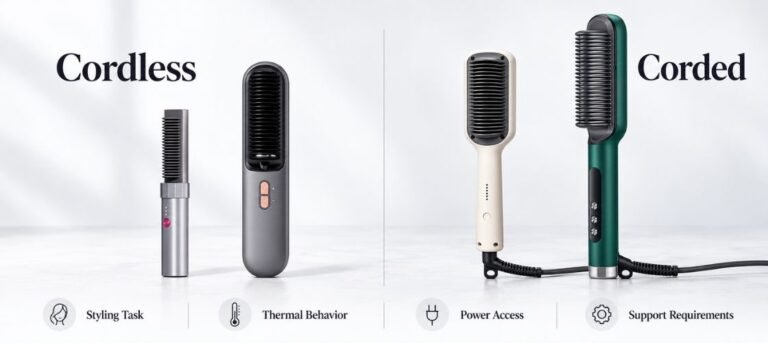
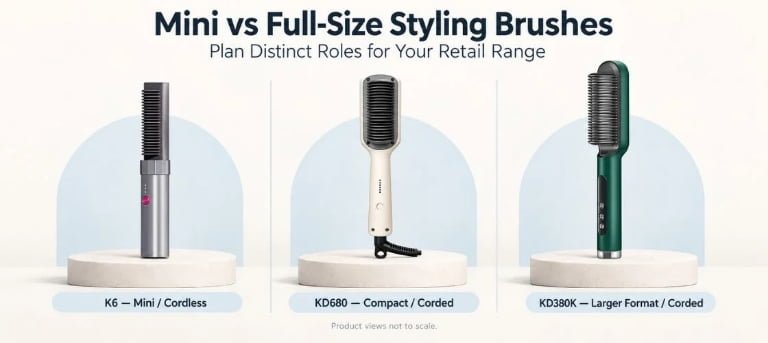
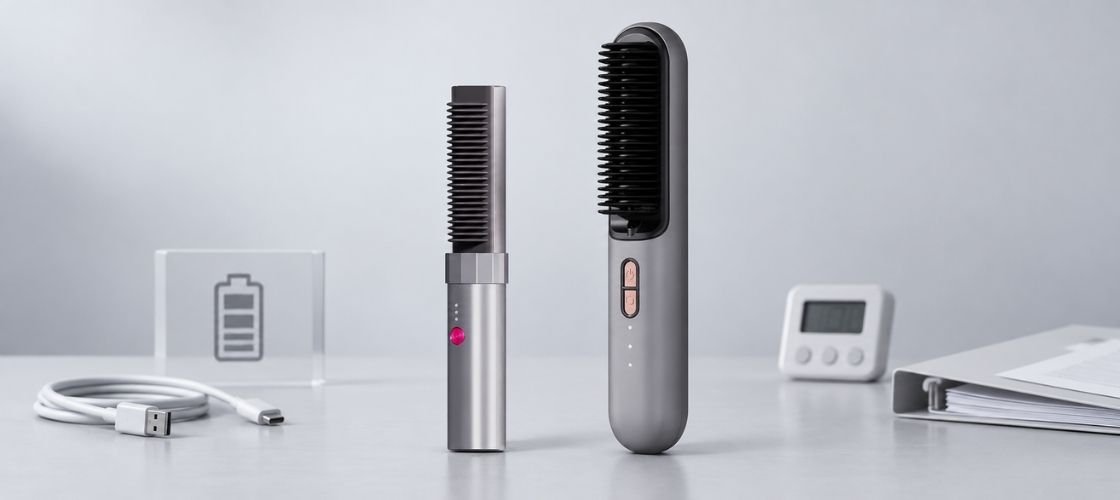
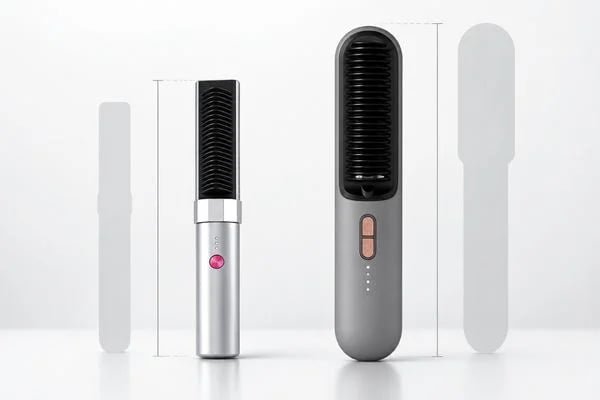
K·SKIN Global’s current hair styling tool range includes two cordless brush platforms designed for different product roles.
| Evaluation Point | K6 | KD382B |
|---|---|---|
| Product direction | Mini brush for bangs, fringe and small styling areas | Full-size ionic brush for straightening and inward or outward shaping |
| Published battery capacity | 800 mAh | 2500 mAh |
| Rated power | 10 W | 25 W |
| Charging format | USB Type-C rechargeable, 5 V input | USB Type-C rechargeable, 5 V and up to 3 A input |
| Temperature settings | 140°C, 160°C and 180°C | 160°C, 180°C and 200°C |
| Product size | 156 × 24 × 27 mm | 199 × 43 × 49 mm |
| Net weight | Approximately 80 g | Approximately 276 g |
| Intended workload | Bangs, fringe, side areas and portable touch-ups | Broader straightening, curling and touch-up routines |
| Runtime decision | Verify on the approved sample | Verify on the approved sample |
The K6 Cordless Mini Bang Styling Brush should be evaluated as a targeted styling tool, not as a smaller substitute for a full-size straightening brush.
The KD382B Cordless Ionic Hair Straightening and Curling Brush has a larger styling surface, higher rated power and a higher temperature range. Its expected workload is therefore different.
These published parameters establish the test conditions. They are not runtime results and do not prove that one platform is more efficient than the other.
Define the Intended Styling Session
A useful runtime requirement begins with the intended consumer routine.
For a mini brush, one session may involve bangs, inward-curled ends or a few small sections. For a full-size brush, the requirement may involve medium-length hair, larger sections or a complete touch-up routine.
Before testing, define:
- target hair length and representative hair type;
- section size and number of passes;
- selected temperature setting;
- whether the product remains on between sections;
- expected session duration;
- number of sessions required per charge;
- acceptable low-battery behavior;
- whether the requirement concerns one continuous session or cumulative use.
Without this definition, “20 minutes of runtime” has little commercial meaning. Twenty minutes of unloaded heating is not equivalent to twenty minutes of styling under a repeatable workload.
How Should Runtime Be Tested?
Runtime should be divided into separate measurements instead of reported as a single number.
Time to Ready
Measure the time from startup until the product indicates that the selected temperature is ready for use.
This stage consumes battery energy and reduces the time remaining for styling. Record it separately for every temperature setting.
Continuous Session Time
Measure the operating time from a confirmed full charge until one of the agreed endpoints occurs:
- low-battery warning;
- automatic standby caused by low voltage;
- protective shutdown;
- inability to maintain the agreed operating condition;
- scheduled automatic shutoff.
Record why the test stopped. Otherwise, a safety timer may be mistaken for battery depletion.
The KD382B, for example, has a 10-minute automatic shutoff. This function limits a single operating cycle, but it does not establish the battery’s total usable runtime.
Cumulative Usable Heating Time
When a product has a timed automatic shutoff, restart it according to the approved operating instructions and accumulate the heating time until the defined low-battery endpoint is reached.
Report both values:
- maximum time in one uninterrupted operating cycle;
- cumulative usable heating time across permitted restarts.
This distinction gives buyers a more accurate view of both the user experience and battery endurance.
Bench Runtime and Styling Runtime
Where practical, use two separate methods.
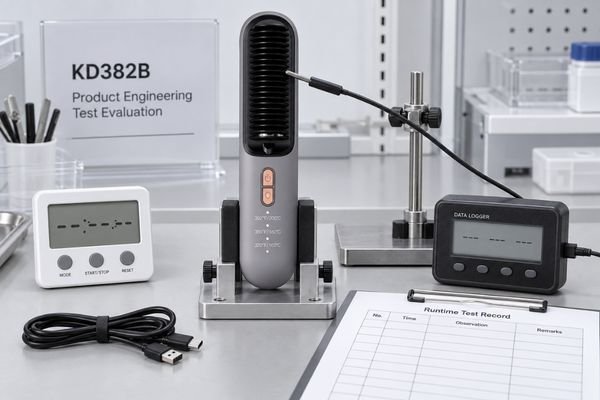
An unloaded bench test helps compare samples under controlled conditions. A styling test uses a defined hair bundle, section size, pass speed and waiting interval to represent intended use.
Do not combine the two results. Bench runtime is useful for engineering comparison, while styling runtime is more relevant to finished-product claims.
Recommended Test Controls
A useful sample-approval study normally begins with at least three units of the same version. Test each temperature setting from a confirmed full charge under the same conditions.
Record:
| Test Field | Required Record |
|---|---|
| Model and version | Exact tested configuration |
| Sample number | Individual sample identification |
| Battery information | Manufacturer, model, voltage and capacity |
| Adapter and cable | Exact charging equipment used |
| Ambient condition | Temperature and relevant humidity |
| Temperature setting | One setting per test |
| Time to ready | Measured from startup |
| Automatic shutoff | Time and reason |
| Low-battery indication | Indicator behavior and timing |
| Cumulative usable time | Total defined operating time |
| End condition | Low voltage, protection, temperature loss or other endpoint |
| Abnormal behavior | Restart, indicator, heating or housing issue |
Set the acceptance limits before testing. There is no universal runtime tolerance for every cordless straightener brush.
What Should Be Checked During Charging?
A charging check should cover the entire power path, not simply confirm that the indicator turns on.
Input and Cable Compatibility
Confirm the approved input voltage, maximum current, connector and cable configuration.
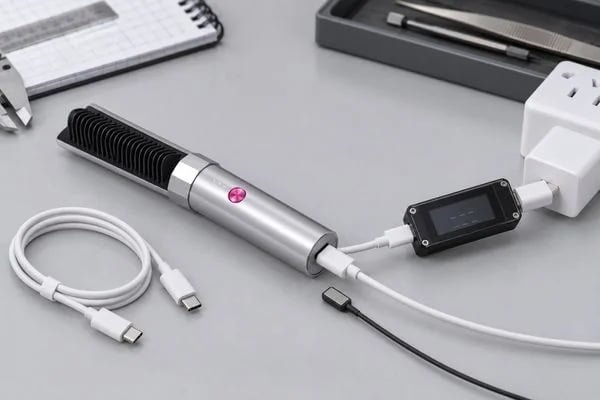
Test the cable and adapter intended for the commercial package. If alternative adapters are permitted, define them before testing and record each configuration separately.
A USB Type-C connector does not automatically mean that the product supports USB Power Delivery or every Type-C cable and charger. Claims such as “PD fast charging” require separate protocol and compatibility evidence.
Inspect:
- connector insertion and retention;
- intermittent charging when the cable is moved;
- port alignment and housing condition;
- cable temperature;
- adapter compatibility;
- USB-A-to-C and C-to-C operation where applicable;
- recovery after a power interruption.
Charging Time and Completion Indication
Begin from a repeatable low-battery condition and record:
- start time;
- input voltage and current;
- indicator sequence;
- time to the stated full-charge indication;
- input behavior after the full-charge indication;
- product operation after the cable is removed.
A charging time stated in the manual can be used as a comparison point, but the commercial sample still needs to be verified with the approved adapter, cable and ambient conditions.
Charging Temperature
Monitor temperature near the charging port, battery area, handle and adapter. Any internal measurement should follow an approved engineering method that does not damage the protection system or alter normal heat flow.
Buyer sample testing should not include improvised short-circuit, overcharge, puncture or other destructive battery tests. Such tests belong in qualified laboratory programs conducted under the applicable safety requirements.
Operation While Charging
Check whether connecting the charging cable disables the heating function.
Some cordless products are intentionally designed not to operate while charging. This behavior can reduce misuse risk and protect the charging system, but it must agree with the manual, control logic and customer-facing instructions.
Do not assume that one model behaves the same way as another.
Evaluate Protection and Repeat-Cycle Behavior
Battery evaluation should include how the complete product behaves near its operating limits.
Check:
- low-battery warning visibility;
- transition from warning to standby or shutdown;
- temperature behavior as battery voltage decreases;
- restart behavior after low-battery shutdown;
- automatic shutoff timing;
- indicator accuracy during charging and operation;
- charging interruption and recovery;
- unexpected resets or temperature-level changes;
- charging-port and housing condition after repeated use.
A sample that runs for an acceptable length of time but shuts down unpredictably is not ready for approval.
Repeatability Is Not the Same as Cycle Life
Short-term sample testing can show whether runtime and charging remain repeatable across several cycles. It cannot prove long-term battery life.
For repeatability, compare consecutive cycles for:
- charging time;
- time to ready;
- runtime at the selected setting;
- low-battery endpoint;
- housing and port temperature;
- indicator and shutdown behavior.
A formal cycle-life claim requires a separate protocol defining the charging and discharging conditions, environment, measurement intervals and end-of-life criterion. A fixed figure such as 300 or 500 cycles should not be published without a corresponding test method and version-specific record.
Which Transport Documents Should Buyers Verify?
Cordless hair styling tools containing lithium-ion batteries require transport review. The necessary classification, packaging, marking and documentation depend on the battery configuration, shipment method, quantity, destination and current carrier rules.
Lithium cells and batteries offered for transport must be of a type that has passed the applicable tests in Part III, subsection 38.3 of the United Nations Manual of Tests and Criteria. The UNECE Manual of Tests and Criteria resources provide the underlying international framework.
A supplier statement saying “UN38.3 compliant” is not the same as a complete test summary. The US Pipeline and Hazardous Materials Safety Administration explains that the test summary must contain specified traceability and test information and be made available through the supply chain.
Transport Document Checklist
| Document or Check | What Should Match |
|---|---|
| UN38.3 test summary | Cell or battery manufacturer, battery model, test laboratory, report reference, nominal voltage, Wh rating and tested battery type |
| Battery specification | The battery assembly installed in the approved product |
| SDS | Correct battery chemistry, supplier and product identification |
| Product specification | Battery capacity, voltage and pack configuration |
| Production BOM | Same battery and protection configuration as the approved sample |
| Packing configuration | Battery contained in equipment, packed with equipment or shipped separately |
| Product and carton markings | Current shipment type, quantity, route and destination |
| Carrier instructions | Current air, sea, road or courier requirements |
| Commercial version | Same product, battery, PCB, charger and housing covered by the supporting records |
An SDS does not replace a UN38.3 test summary. CE, FCC, UKCA or RoHS documents also do not establish lithium-battery transport compliance.
For air shipments, confirm the current requirements against the applicable IATA battery guidance, carrier instructions and a professional dangerous-goods review.
K·SKIN Global’s credentials and compliance page explains why product documents must be matched to the exact model, technical configuration and destination market.

Common Red Flags Before Product Approval
Pause approval if any of the following occurs:
- Battery information differs between the sample, specification, manual and test summary.
- The supplier provides only a generic UN38.3 declaration.
- Charging-input voltage is used as the battery voltage when calculating watt-hours.
- Runtime is tested only at the lowest temperature but promoted without qualification.
- Automatic shutoff time is reported as total battery runtime.
- One new sample and one cycle are used to represent production consistency.
- A USB Type-C port is promoted as PD fast charging without protocol evidence.
- An SDS is presented as a substitute for the UN38.3 test summary.
- Product compliance reports are presented as battery transport documents.
- The battery cell, protection board or pack configuration changes without document review.
- The product is described as “airline approved” or “safe for all flights.”
Battery Approval Decision Matrix
| Decision Area | Approve When | Hold When |
|---|---|---|
| Version control | Sample, specification, label, BOM and battery records match | Battery or version information conflicts |
| Runtime | Agreed use case is met at the required temperature settings | Only a capacity estimate is available |
| Charging | Approved cable and adapter charge consistently | Compatibility depends on an unspecified accessory |
| Thermal behavior | Recorded temperatures and shutdown behavior meet project limits | Abnormal heating, reset or indicator behavior occurs |
| Repeat cycles | Results remain within approved variation limits | Runtime or charging changes without explanation |
| Transport | Complete version-matched records are available | Documents are generic, incomplete or tied to another battery |
| Commercial claims | Claims reflect the tested conditions and limitations | A single result is presented as universal performance |
Questions Buyers Often Ask
Does a larger battery always provide longer runtime?
No. Runtime also depends on nominal battery voltage, rated power, temperature setting, heating area, control logic, protection threshold and styling workload. Compare finished products using the same defined method.
Should runtime be tested at every temperature setting?
Yes, if every setting will be offered to customers. Testing only the lowest setting does not show how the product behaves under its highest heating load.
Does a USB-C port mean the brush supports USB-C PD fast charging?
No. USB Type-C describes the connector. Power Delivery support and fast-charging claims require compatible electronics, an approved protocol and test evidence.
Is an SDS enough for lithium-battery transport?
No. An SDS provides battery and hazard information, but it does not replace a complete, version-matched UN38.3 test summary or a shipment-specific transport review.
Can a cordless straightener brush be packed in checked baggage?
Passenger rules vary by country, airline and battery configuration. In the United States, the TSA states that cordless hair straighteners containing lithium batteries are allowed only in carry-on baggage, with precautions against accidental activation. Brands should not turn one jurisdiction’s rule into a global travel claim.
Conclusion
A cordless straightener brush should not be approved based on battery capacity or a single runtime claim. Buyers need a controlled evaluation covering time to ready, usable runtime at each relevant temperature, automatic shutoff, charging compatibility, thermal behavior, protection logic and repeat-cycle consistency.
K6 and KD382B serve different styling routines, so the right choice depends on the intended workload and commercial position. Share your target market, styling scenario, runtime requirement, charging configuration and transport route with K·SKIN Global to identify the appropriate sample version and supporting document scope.