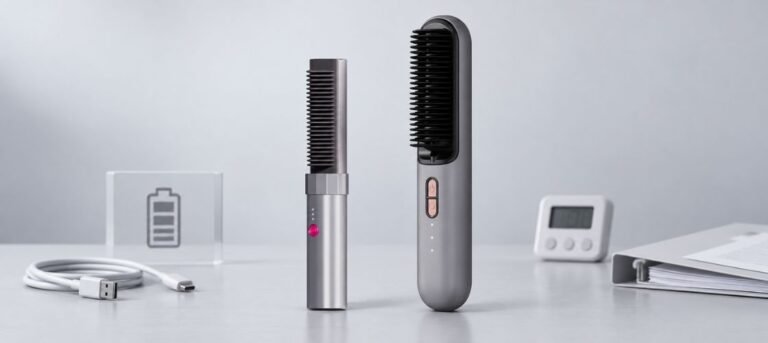
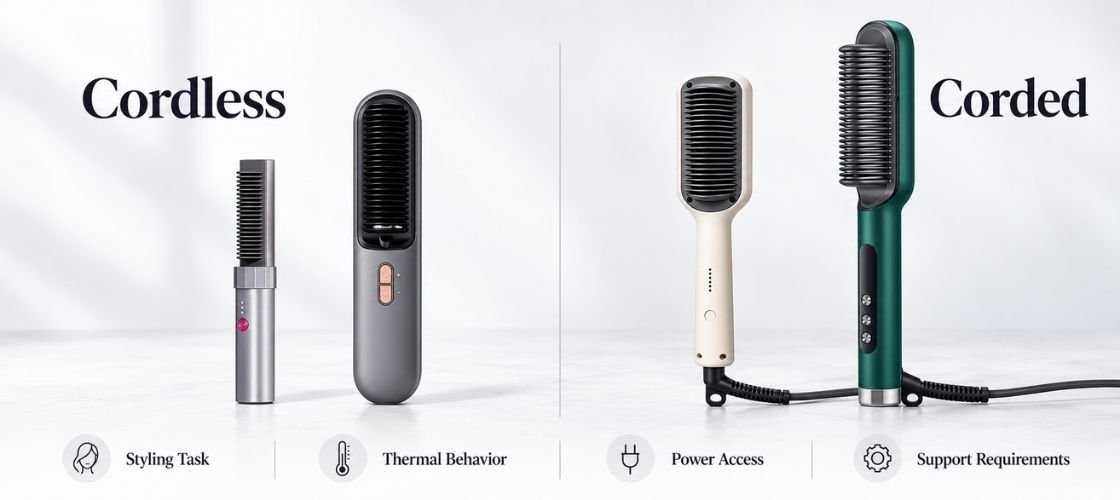
Choosing a power format starts with the customer routine. Buyers need to decide whether outlet-free handling justifies charging requirements, or whether a corded platform better fits the intended styling session, channel and support model.
A cordless vs corded hair straightener brush comparison should start with the styling task, access to power and expected session length. Cordless models offer outlet-free operation within their verified battery limits; corded models require a compatible supply during use. Compare actual heat performance, handling, charging or cable requirements, packaging and support costs before assigning either platform a commercial advantage.

Match the styling task before comparing power formats
Define the styling task
A mini brush for bangs and a larger brush for broader styling can both be cordless, yet address different needs. Comparing them only by battery capacity or rated power overlooks their different styling roles.
Define the intended task first: targeted fringe shaping, a short touch-up or a broader straightening-and-shaping routine. Record the representative hair sections, expected handling time, storage arrangement and access to an outlet. Treat these as project requirements to validate, not assumptions about every customer in a sales channel.
Compare the role of each product platform
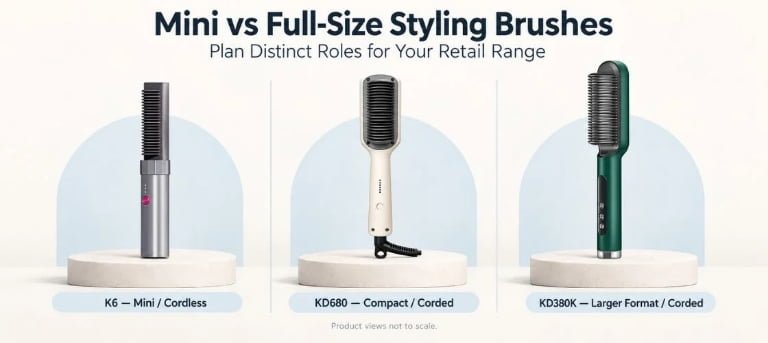
Four K·SKIN platforms illustrate the selection choices:
| Model | Power format | Documented product direction | Main selection question |
|---|---|---|---|
| K6 | Rechargeable cordless | Mini format for bangs, fringe and small-area touch-ups | Does the slim styling area fit the intended task within verified usable runtime? |
| KD382B | Rechargeable cordless | Larger straightening-and-shaping brush with an ionic function | Does the approved configuration deliver the required handling and thermal performance through the planned session? |
| KD680 | Corded | Compact hair straightening brush | Does the compact corded format fit the styling task and target-market electrical configuration? |
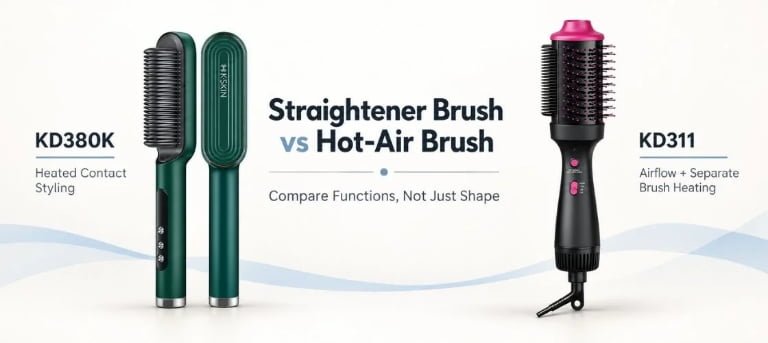
| KD380K | Corded | Ionic straightening-and-shaping platform | Does its brush geometry and handling suit the intended routine near an outlet? |
The K6 mini styling brush is a targeted tool for smaller sections. It should not be presented as a direct full-size replacement simply because both products heat hair.
Similarly, compare the KD382B cordless brush against the task it is intended to perform. Evaluate whether its additional features suit the intended hair types and retail proposition; neither styling superiority nor a price premium follows from the feature list alone.
Separate power source from styling performance
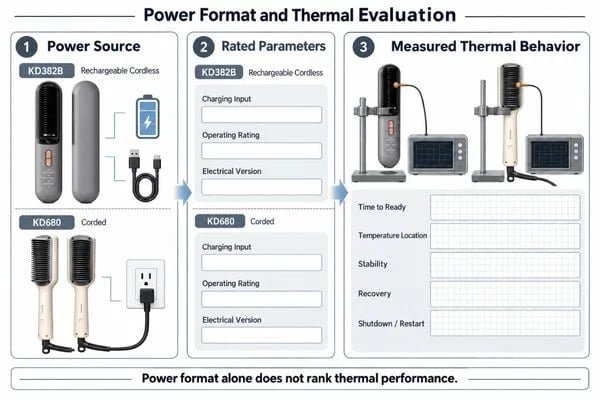
Distinguish the power source from rated parameters
Corded operation supplies the appliance from a compatible outlet. Cordless operation uses stored battery energy during the styling session. That distinction affects preparation and operating constraints, but does not by itself rank temperature accuracy, hair glide or styling results.
Rated power is also not a complete performance score. Ask what the stated value describes and how it relates to the approved electrical configuration. For rechargeable products, distinguish charging input from operating power. Do not compare an adapter rating with another model's heater rating as if they were the same measurement.
Evaluate thermal behavior under comparable conditions
For a meaningful thermal comparison, request records covering:
- Time to reach the defined ready condition.
- Actual temperature at specified measurement locations.
- Stability during the intended styling sequence.
- Recovery after the agreed hair-contact sequence.
- Behavior at relevant battery conditions for cordless models.
- Shutdown and restart behavior within the operating instructions.
Use representative hair samples and a documented method when the decision depends on styling performance. Keep section size, preparation, pass sequence and evaluation criteria controlled where appropriate. A smaller styling surface may require a different task definition, so do not force unlike products into a misleading comparison.
The KD680 compact corded brush is a useful candidate for evaluating compact handling with outlet power. Its corded format does not prove faster styling or unlimited operating time. Confirm the exact version's settings, session limits and instructions.
Compare usable runtime with the intended session
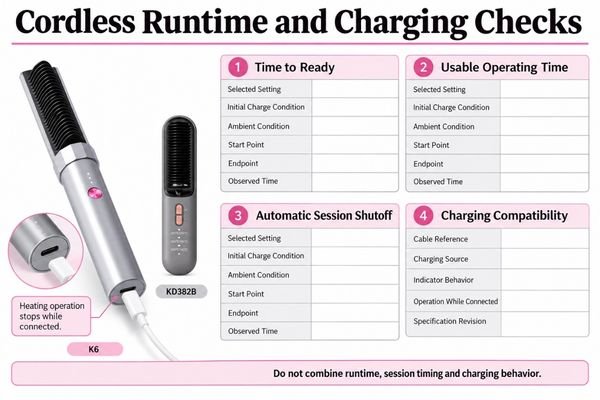
Define the runtime measurement and endpoint
For cordless selection, the useful question is whether the sample completes the intended task under defined conditions. A runtime figure without its method is difficult to use in a purchasing decision.
Ask whether reported time includes warm-up, idle heating, actual styling or repeated sessions. Record the selected setting, initial charge condition, battery version, ambient conditions and the criterion used to end the measurement.
Separate three observations:
| Observation | What it tells the buyer | What it does not establish |
|---|---|---|
| Time to ready | Preparation time under the recorded conditions | Total usable styling time |
| Usable operating time | How long the device meets the agreed functional criterion | The number of complete routines for every user |
| Automatic session shutoff | When the control ends a session | Battery exhaustion or total runtime |
A brush may end a session because of its timer while charge remains. Conversely, an indicator remaining lit does not prove that the agreed styling temperature is maintained. Define the endpoint before comparing samples.
Keep session limits separate from battery runtime
For corded products, review the permitted session and any required cooldown or restart procedure. Removing the battery-runtime constraint does not remove the product's operating limits or establish continuous professional-use suitability.
Avoid converting a bench runtime result into “days of use” without a stated routine and supporting evidence. Keep the published claim close to the conditions actually evaluated.
Include charging convenience in the cordless decision
Verify the supplied charging configuration
A cordless brush still needs access to a suitable charging source between uses. Review the supplied cable, required input, charging indication and whether a charging adapter is included in the proposed package.
The connector shape alone does not confirm compatibility with every cable, charger or charging protocol. Ask for the approved combinations and test the configuration that the customer will actually receive.
Check revision-specific charging behavior
This matters when revisions change charging behavior. The reviewed K6 A2 specification records a change concerning startup and C-to-C cable compatibility. Match the sample to its applicable specification and manual rather than applying an older instruction sheet to a revised unit.
The reviewed K6 specification also states that connecting the charging cable exits heating operation and enters charging. Do not describe that configuration as a corded-and-cordless hybrid or promise styling while charging. Check the permitted behavior separately for every other model.
For the buyer, charging evaluation should answer practical questions: can the expected routine be completed, can the product be recharged using the specified accessories, and are the indicators and instructions clear enough to support that routine?
Assess corded configuration and cable handling
Confirm the destination-market electrical version
For corded models, confirm and record the voltage, frequency, plug, cord and label configuration before approving the order. A familiar model number or an interchangeable plug shape does not establish compatibility with a different electrical supply.
Assess cable movement and supporting verification
Review cable reach and movement in the intended setup. Observe whether the cord interferes with the styling sequence, how the product rests between permitted uses and how the cord is stored after cooling.
Inspect the sample's cable entry, strain-relief arrangement and any specified swivel function. Request the applicable mechanical and electrical verification records rather than inferring durability from a brief handling demonstration.
Where different market versions exist, keep their documents and samples distinct. Do not merge a single-voltage manual, a wider-voltage catalogue reference and another version's label into one commercial specification.
Measure portability as a complete package
Compare the complete carrying set
Cordless and portable are related concepts, but portability involves more than removing the operating cord. Compare the complete carrying set that the customer needs for the intended use.
Record device dimensions and weight separately from the cable, protective accessories and sales packaging. Confirm which items are included and which the user must supply. Review the permitted cooling and storage sequence before making a convenience claim about packing the product away.
Use finished-package data for logistics
For retail logistics, compare the finished sales pack and shipping carton. A smaller device does not necessarily produce the lowest landed cost once accessory protection, package quantities and transport arrangements are included.
Use the same reporting basis across quotations:
- Exact model and commercial version.
- Main-unit net weight.
- Included cable and accessories.
- Individual package dimensions and gross weight.
- Carton quantity, dimensions and gross weight.
- Required labeling and instructions.
Keep estimated packaging values marked as estimates until the order configuration is confirmed. Do not use a bare-unit weight as the shipment weight.

Review shipment and market requirements before positioning
Match battery records to the product and shipment
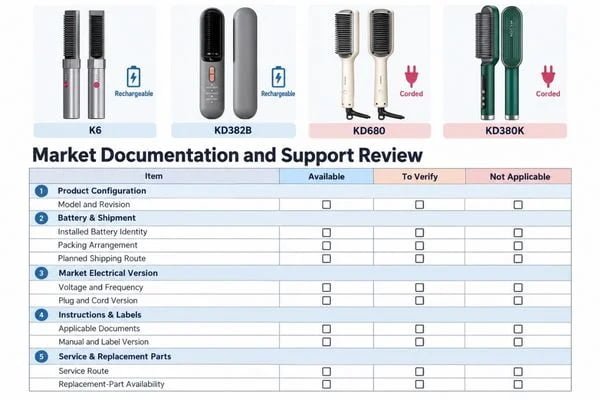
A rechargeable platform adds battery-related documentation to the purchasing review. Ask the supplier and qualified logistics provider to confirm which records apply to the installed battery, finished-device configuration, packing arrangement and planned route.
Match the battery identity in supporting records to the approved product configuration. A file supplied for another cell, battery assembly or product is not interchangeable evidence. Product compliance, battery transport documentation and permission for a particular shipment are separate checks.
Avoid a blanket “airline approved” or “suitable for all travel” statement based on cordless design. Any passenger-travel claim requires a separate current review of the relevant rules and carrier conditions. This comparison does not establish such permission for any listed model.
Confirm destination-market and supply conditions
For both power formats, confirm destination-market requirements, applicable documents and any commercial territory or channel restrictions before committing to a launch. An online product page is a starting point for an inquiry, not a guarantee of unrestricted supply or approval in every market.
Compare support workload and commercial costs
Define instructions and service requirements
Cordless products need support materials that explain charging accessories, indications, session timing, storage and battery-related service questions. Corded products need clear electrical-version information, cable handling and operating instructions.
Ask the supplier to define authorized service routes and replacement-part availability. Do not promise user-replaceable batteries, universal chargers or interchangeable cords without support for the actual design.
Compare quotations with equivalent commercial scope
When comparing price tiers, request quotations for equivalent commercial scope. Include branding, packaging, accessories, market documentation, inspection requirements and the agreed delivery terms. Use current freight quotations and the buyer's own service assumptions in the cost model.
Neither format inherently guarantees a higher margin, fewer returns or stronger demand. Treat those as commercial hypotheses to validate through channel feedback and actual sales and service data.
Use a decision sequence to narrow the shortlist
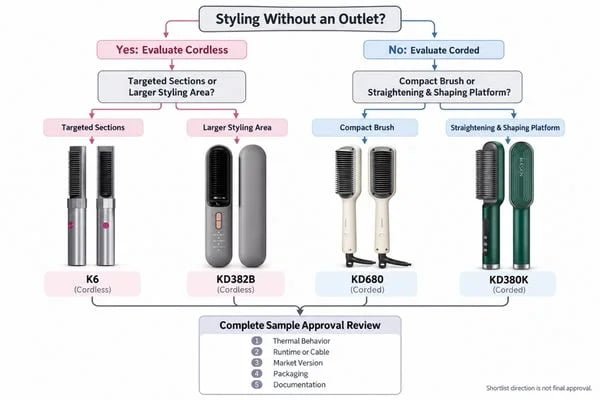
| Buyer requirement | Initial direction | Condition before approval |
|---|---|---|
| Styling without an outlet during use is essential | Evaluate cordless | The sample must complete the defined routine within verified usable runtime |
| Use occurs beside a compatible outlet and charging is undesirable | Evaluate corded | Electrical configuration, cable handling and permitted session must fit the use case |
| The task is limited to bangs or small sections | Consider a targeted compact platform | Styling-area fit must be demonstrated; do not assume full-size capability |
| The range needs broader straightening-and-shaping coverage | Compare appropriate larger platforms | Verify hair handling, thermal behavior and routine duration on representative samples |
| Shipment route or market documentation remains unresolved | Keep the commercial decision open | Confirm applicable records and shipping arrangements before an order commitment |
Record the reason for each shortlisted product
After this first filter, compare the remaining candidates against the same purchasing requirements. Reject a cordless candidate if it cannot complete the defined routine. Keep a corded candidate off the approved list until its electrical configuration matches the destination market.
Record why each shortlisted product remains under consideration. This helps purchasing, product management and quality teams agree on the same role for the SKU.
Sample approval checklist
Confirm task, configuration and performance
- Define the styling task, intended user routine and target channel.
- Identify the model, revision and destination-market configuration.
- Confirm brush geometry and handling on representative hair sections.
- Review measured thermal behavior under documented conditions.
- For cordless models, verify usable runtime and the approved charging arrangement.
- For corded models, verify the electrical version and cable handling.
Confirm instructions, documentation and shipment readiness
- Check session limits, shutdown, restart and storage instructions.
- Confirm the supplied accessories and finished packaging data.
- Match supporting documents to the product and battery configuration where applicable.
- Confirm shipment arrangements, supply conditions and unresolved restrictions.
- Retain the approval sample, agreed specification and open-item record.
FAQ
Is a cordless brush always less powerful than a corded brush?
Do not rank products from power format alone. Compare the exact rated parameters and measured heating behavior using a suitable method. A wattage figure does not establish styling speed, temperature stability or results on a particular hair type.
Can a small cordless brush replace a full-size model?
Only if it meets the defined styling task. K6 is positioned for bangs and smaller areas. Its compact format should not be used to promise the same coverage or routine time as a larger brush without supporting evaluation.
Can users continue styling by attaching the charging cable?
Only where the exact product's instructions permit it. The reviewed K6 specification switches from heating to charging when connected. Confirm the behavior of each model instead of treating all rechargeable products as hybrid devices.
Does corded operation mean unlimited use?
No. The appliance's permitted operating sequence, automatic shutoff and other instructions still apply. A continuous electrical supply does not establish an unlimited duty cycle or suitability for repeated professional service.
Which format should a new private-label brand launch first?
Choose the format that satisfies a clearly defined customer routine and can be supported within the project's cost, documentation and service requirements. If both remain suitable, test the distinct commercial propositions before committing to overlapping inventory.
Select the platform that fits the complete routine
Compare styling-area fit, measured thermal behavior, access to power, session requirements and the support needed for the finished product. Portability is valuable when the selected configuration can deliver the intended task within its verified limits.
Use the K·SKIN hair styling tool range to identify candidate platforms, then confirm the target market, available version and matching sample records. Approve the product and commercial configuration together before turning a power-format preference into a purchase order.
For your next product review, explore hair straightener brush project options.