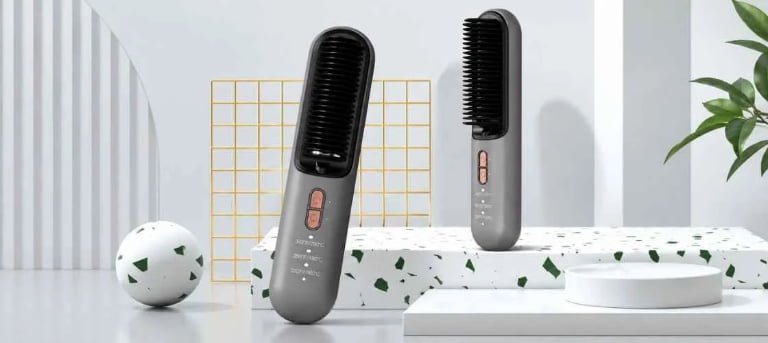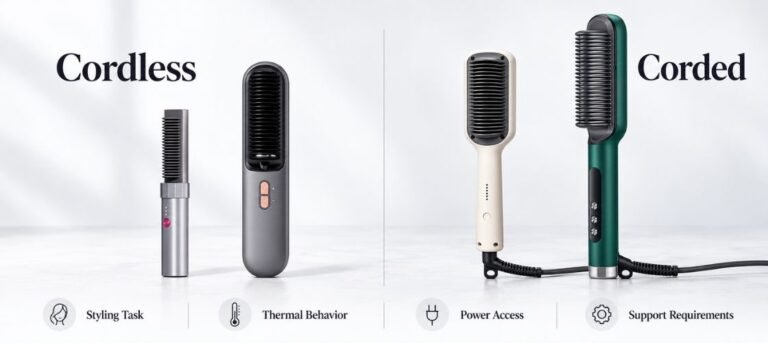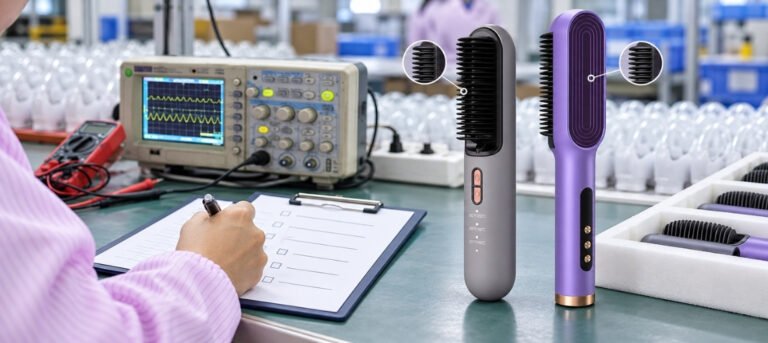

Brush-shaped styling tools can sit side by side in a product range yet need quite different demonstrations and support. Understanding how each delivers heat helps buyers compare samples, quotations and retail positioning on a clearer basis.
A hair straightener brush styles through contact with heated brush surfaces, while a hot-air brush adds an airflow system. Some platforms combine airflow with a separate heated-brush function. For B2B buyers, this changes what to assess in sample evaluation, instructions, packaging and after-sales support. The right choice depends on the intended routine and the use conditions confirmed for the selected configuration.
How Do the Two Products Deliver Heat?
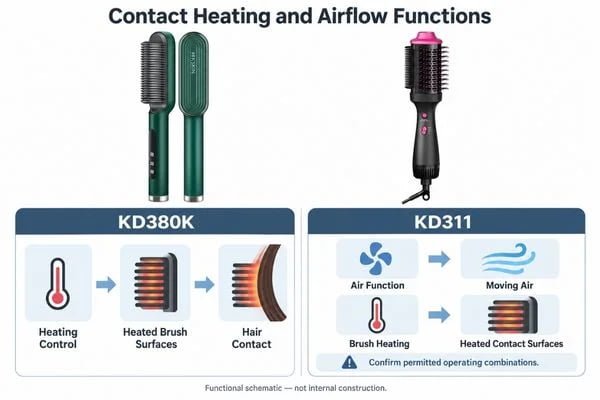
The main difference is how heat reaches the hair: through contact with heated surfaces, through moving air, or through a combination of the two. Looking at the controls and documented functions often reveals more than the product name, particularly when a brush combines several modes.
Heated Brush Surfaces: The KD380K Reference
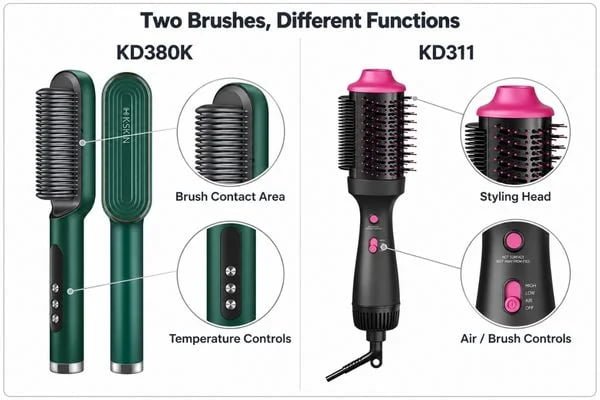
The KD380K ionic hair straightening and curling brush is presented as a PTC-heated brush for straightening and shaping. Its reviewed manual describes heated comb teeth, temperature controls and use on dry hair.
In this styling workflow, the heated contact area, tooth layout and temperature control are central to the sample review. Handling trials can then show how the brush moves through a prepared hair section. The displayed temperature is useful information, but it does not describe the temperature at every surface or establish the styling result on its own.
Airflow and Separate Brush Heating: The KD311 Reference
The KD311 high-power hot-air straightening brush combines an airflow function with heated-brush styling. Its reviewed English manual identifies separate air-brush and hair-brush controls, an air inlet and an air outlet.
For a combined platform, a simple mode table helps explain the product: which control runs the airflow, which controls the heated brush, and which combinations the approved instructions permit. That distinction also gives retailers a clearer demonstration than describing every setting as “hot-air straightening.”
PTC heating alone does not distinguish the two categories. The reviewed materials for both models describe PTC heating; the role of the airflow system is a more useful point of comparison.
Which Components Change the Evaluation Work?
Both platforms need thermal and electrical review. An airflow platform also brings in parts and operating conditions that a contact-heating demonstration cannot assess. A functional description of the quoted configuration helps the buyer turn that difference into a practical inspection plan.
| Evaluation area | Heated straightening brush | Hot-air or combined brush | Buyer action |
|---|---|---|---|
| Heat delivery | Heated surfaces contact the hair during styling | Airflow contributes to the routine; a combined platform may also have heated contact surfaces | Identify each heat source and its operating mode |
| Controls | Temperature selection, display and power controls | Airflow controls and permitted combinations with brush heating | Map every control position to a documented function |
| Styling head | Tooth spacing, surface finish and access to heated areas | Also includes outlet locations and the hair section's position around them | Compare the sample with the approved product drawing |
| Air system | Relevant only if the configuration includes one | Inlet, outlet, fan operation and specified maintenance access | Review cleaning instructions and inspect access |
| Routine inspection | Heating response, controls, teeth, housing and cord | Adds airflow operation, unusual noise and inlet/outlet condition | Agree a model-specific inspection sheet |
| User information | Permitted hair condition, contact heat and handling | Air modes, heated modes and restrictions for each | Keep packaging and instructions consistent |
These differences guide the inspection work. Any conclusion about safety, speed or durability still needs evidence for the exact configuration and the particular claim being considered.
What Hair Condition Is Actually Permitted?
The term “hot-air brush” does not establish wet-hair suitability. This matters especially for a combined device, where a condition permitted for one function may not apply to its heated-brush function or to every operating combination.
Check the Mode-Specific Instructions
The reviewed KD380K manual requires dry hair. For a combined platform such as KD311, clear mode-specific instructions are needed to establish the permitted starting hair condition for each function.
If preparation guidance mentions towel-dried hair while another warning requires dry hair, that wording needs clarification before a wet-hair demonstration or claim is approved. Selecting the more convenient sentence leaves an important use condition unresolved.
A useful supplier clarification identifies the mode, starting hair condition, permitted settings and prohibited combinations. Until those points are settled, a broad “suitable for wet-to-dry styling” claim goes beyond what the instructions establish.
Match Demonstrations to the Approved Routine
Retail demonstrations and sample trials should follow the instructions that will accompany the shipped product. Recording the starting hair condition and selected mode helps reviewers understand what the trial actually shows.
When the intended retail proposition depends on an unconfirmed routine, the buyer has two practical options: narrow the proposition to the verified use conditions, or investigate a configuration that supports the required routine. A successful demonstration alone does not expand the product's intended use.
How Should Buyers Compare Sample Performance?
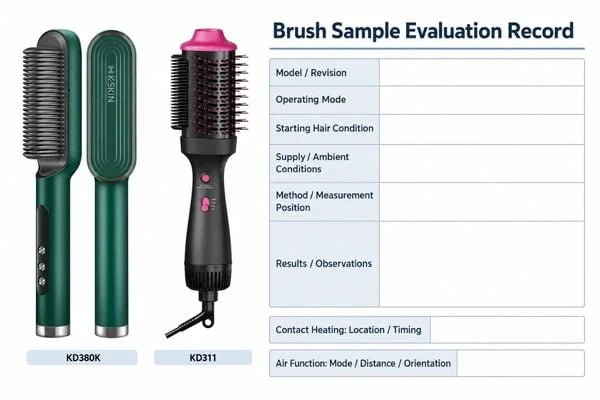
A shared sample record makes the comparison easier to follow, while separate tests address each platform's functions. Contact-temperature checks, airflow checks and handling demonstrations answer different questions. Agreeing those questions before samples arrive keeps the review focused.
Review Contact Heating Separately
For heated-brush operation, agree the measurement locations, instrument and sample position. The record should identify ambient conditions, supply voltage, selected setting, warm-up sequence and observation period so that later readings can be interpreted on the same basis.
Keep displayed settings separate from measured values. Where temperature distribution matters, measurements at defined locations give a more informative picture than one reading treated as representative of the whole styling head.
Handling trials add a different kind of information. With prepared hair sections and an agreed procedure, reviewers can record section characteristics, starting condition, pass count and observations. The result applies to those conditions; it does not establish a universal outcome for every hair type.
Review Airflow by Operating Mode
For a hot-air or combined platform, record the selected air mode and whether separate brush heating is operating. First check that each control produces the documented function, then collect the relevant performance readings.
Air temperature and air speed measurements need defined probe positions, distances, orientations and methods. Normal operating checks should keep the outlet area clear. Specialist safety tests involving abnormal conditions require qualified personnel and an applicable method rather than an improvised buyer demonstration.
A single air-speed reading is not an airflow-volume measurement. Where a quotation includes airflow volume, the supporting record should explain how that quantity was measured.
| Test question | Record to request or create | Limit on the conclusion |
|---|---|---|
| Do controls match the specification? | Mode table and observations for each permitted setting | Confirms operation of the inspected sample, not all production units |
| Does the heated area behave as specified? | Temperature readings with locations, instruments and timing | Applies to the measured points and recorded conditions |
| How does the air function behave? | Air-mode records, defined measurement positions and method | Does not establish drying time without a separate routine evaluation |
| Does the sample support the proposed demonstration? | Approved instructions and a documented handling trial | Does not authorize a broader use condition |
| Can later batches be checked consistently? | Inspection items, acceptance criteria and change controls | Requires production verification; sample approval alone is insufficient |
These are proposed buyer checks rather than comparative test results for KD380K and KD311. Numerical temperature, airflow or drying-time comparisons need their own supporting records.
Why Do Noise and Air-Inlet Access Matter?
Fan operation, inlet access and cleaning guidance become part of the evaluation when airflow is involved. Reviewing them alongside styling performance helps buyers prepare both product demonstrations and after-sales support before launch.
Compare Noise Under Defined Conditions
Videos and informal listening can draw attention to a noise question, but they are a weak basis for a “quieter” claim. A useful comparison identifies the operating mode, room conditions, microphone position, distance, recording method and background condition, along with the sample tested.
The operating task also matters. Heated-brush-only operation and high-airflow operation are not equivalent duties, so a difference between them should not be presented as a like-for-like noise ranking. A quieter reading does not independently establish better styling or longer service life.
Check Cleaning Access Without Assuming Removable Parts
The reviewed KD311 English manual calls for regular inlet cleaning and states that the inlet part is not detachable. This illustrates why the actual maintenance instructions are more useful than assuming that a removable filter comes with the product.
For the ordered version, confirm unplugging requirements, permitted cleaning tools and restrictions on water. Washing or disassembly steps should only appear in demonstrations where the applicable instructions permit them.
After-sales guidance should also help staff distinguish routine cleaning questions from suspected faults. Supplier instructions for unusual noise, reduced airflow, damaged teeth or control problems can clarify when service is needed and when use should stop.
How Do Packaging and Cost Comparisons Change?
Quotations become easier to compare once the product and packing scope are clear. Price differences may reflect market versions, included items, retail packaging or inspection requirements. The number of functions alone says little about whether an offer suits the project.
Review the Packed Sample
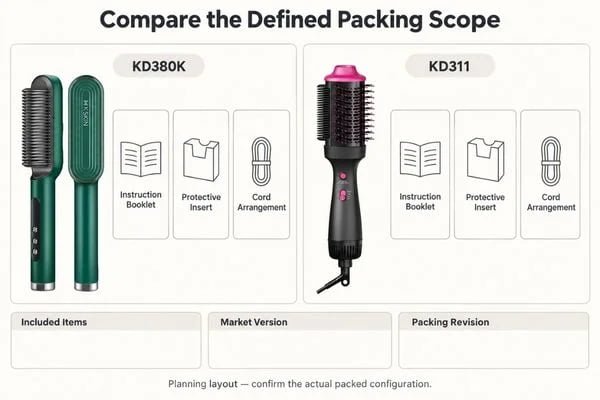
Look at how the insert supports the styling head, protects teeth and manages the cord. For an airflow product, inlet and outlet condition should also be part of the unpacking check. Photographs taken before packing and after an agreed handling or transport evaluation help document any changes.
The packing list should settle what is included. Images showing several styling possibilities do not necessarily mean that interchangeable heads, cleaning tools or other accessories are supplied. Retail-box illustrations should match the items in the ordered configuration.
Labels, manuals and carton information need to refer to the same market version. Using approved packing data avoids carrying old marketing dimensions or information from a different electrical version into the release record.
Compare Defined Cost Items
A useful quotation identifies the model revision, electrical version, plug, finish, included items, retail packing, quantity basis and inspection scope. Where customization is proposed, showing it separately makes the added scope easier to assess.
After-sales terms deserve the same clarity: how faults are reported, what evidence is required, which remedies apply and whether replacement parts are available. A distinct component, such as a fan, is not necessarily a user-replaceable part.
| Commercial item | What the buyer should confirm |
|---|---|
| Product configuration | Exact model, revision, electrical rating and controls |
| Packaging | Included items, insert, retail-box dimensions and carton arrangement |
| Customization | Approved changes, validation needs and quotation coverage |
| Inspection | Functional checks, records and agreed acceptance criteria |
| After-sales support | Fault documentation, service procedure and contractual remedy |
Which Platform Fits the Planned Product Range?
Start with the routine the brand intends to offer, then consider which platform can support it under verified use conditions. This gives the comparison a commercial purpose without turning it into an absolute ranking of the two product types.
| Product-range objective | Platform to investigate | Evidence needed before selection |
|---|---|---|
| Heated-brush finishing on dry hair | A contact-heating brush such as the KD380K reference | Approved dry-hair instructions, thermal specifications and handling evaluation |
| An airflow-assisted styling routine | A hot-air platform such as the KD311 reference | Permitted starting hair condition, air-mode instructions and sample records |
| Separate air and heated-brush functions in one product | A verified combined platform | Clear controls, permitted combinations and mode-specific warnings |
| A compact packing proposition | Compare the actual packed configurations | Approved product dimensions, retail pack and carton data |
| A noise-sensitive positioning | Evaluate the proposed operating routine | Comparable noise records and carefully bounded copy |
| Sale through a salon retail channel | Either platform, depending on the proposition | Intended-use confirmation; retail placement does not establish professional-duty approval |
A sales channel does not define permitted duty. A product sold through salons may still be intended for home use. Where repeated professional use is part of the project, explicit confirmation and supporting documentation are needed.
For product line planning, a short role statement for each proposed SKU can be helpful: the routine it serves, its distinction from adjacent products and the support material retailers need. If two SKUs lead to the same demonstration and indistinguishable claims, it is worth examining whether both have a clear place in the range.
What Should Be Confirmed Before Sample Approval?
Sample approval brings the comparison back to a configuration that can be ordered and inspected. One record for the selected version helps connect the product, instructions, test observations and packing. Unresolved points can be assigned to a responsible person and kept out of released claims until confirmed.
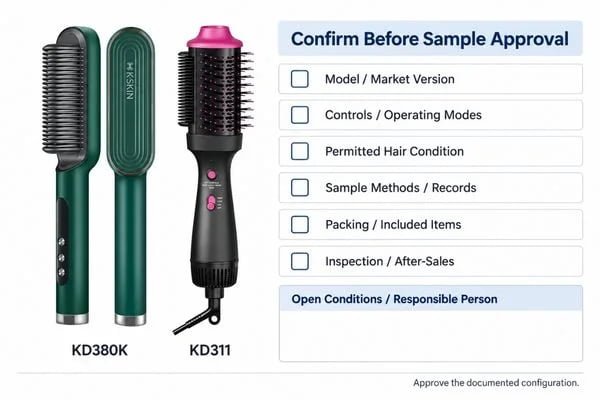
- Record the exact model, revision, target market, voltage, frequency and plug.
- Obtain the approved specification and matching instruction revision.
- Map heated-brush and airflow controls to their documented functions.
- Confirm permitted hair condition and operating combinations in writing.
- Check that demonstrations, packaging and online copy describe the same routine.
- Record temperature and airflow observations with their methods and limits.
- Request comparable noise evidence before approving a noise claim.
- Inspect teeth, housing, inlet/outlet access, cord and included items.
- Approve the packing list, insert, labels and retail-box artwork.
- Review relevant reports for model scope, tested configuration, applicant and manufacturer; the selling company should not be assumed to hold every document.
- Agree production inspection items and the process for configuration changes.
- Confirm after-sales instructions, contractual remedies and any stated parts availability.
K·SKIN's manufacturing and quality information provides a starting point for those supplier discussions. The next step is to request records relevant to the selected configuration, since a general process description is not a completed inspection record for an order.
Sample approval and supplier qualification are separate decisions. For a broader review of engineering responsibility, production controls, document scope and commercial commitments, see our guide to evaluating a hair styling tool manufacturer before private label production.
FAQ
The following questions cover points that can still affect selection once the difference in heat delivery is understood.
Does PTC Heating Mean a Brush Has an Airflow Function?
PTC describes a heating element, not the complete styling system. The reviewed KD380K and KD311 materials both describe PTC heating. Whether airflow is part of the product is established by its controls, instructions and functional description.
Does a Higher Power Rating Mean Better Straightening?
A rated input value does not establish the styling result. Its meaning depends on the functions it covers and the electrical version. Performance comparisons are more useful when they follow the approved routine and record the sample conditions rather than rank products by wattage alone.
Can a Product Demonstration Replace Temperature or Airflow Records?
A demonstration helps assess handling and the intended routine, but it does not provide a controlled measurement record. Numerical temperature, airflow or noise claims still need a separate method and results that support the figures used in the listing.
Can One Report Cover Both Product Types?
It can only do so where its model and configuration scope covers both. Similar appearance, shared heater terminology or the same supplier does not establish coverage. The model list, electrical configuration, report scope and legal entities all need review before the document supports a claim.
Can Private-Label Changes Be Approved After the Product Sample?
Sample approval applies to the documented configuration. Later branding, label, instruction and packing changes need a defined scope. Changes to controls, outlets, heating parts or other functional elements also require review of their effect on the approved product and supporting evidence.
Conclusion
A heated straightening brush and a hot-air brush call for different evaluation priorities. Contact heating brings the heated surfaces and handling routine into focus; airflow adds mode controls, inlet and outlet checks, noise evaluation and maintenance guidance. A combined platform needs both, with clear instructions for how its functions may be used.
When comparing K·SKIN's hair styling tools, begin with the routine your product range needs. Matching that routine to the approved configuration, instructions, sample records and packing scope gives buyers a clearer basis for selection and keeps the final claims within what the evidence supports.