Choosing a straightener brush by wattage or maximum temperature alone hides the engineering decisions that determine warm-up behavior, temperature stability, usable contact, and production consistency.
A hair straightener brush converts electrical energy into heat, transfers that heat through a conductive structure to heated teeth or surfaces, and regulates the result through sensing and control. Heater type matters, but temperature uniformity, sensor position, comb geometry, insulation, electrical limits, and protective devices determine how the complete system performs.
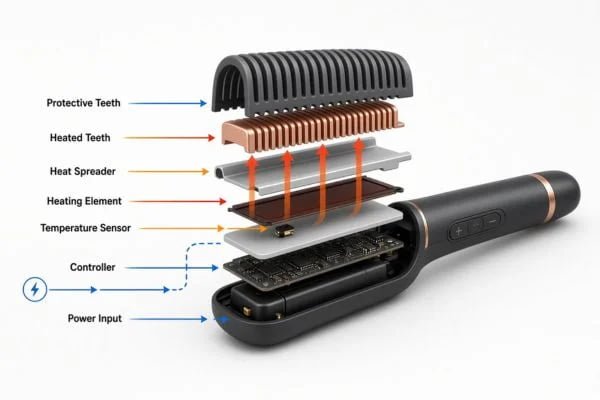
At system level, the working path is straightforward:
- A cord or battery supplies electrical power.
- A resistive heating element converts that power into heat.
- A metal carrier or heat-spreading structure distributes heat toward the working surface.
- A sensor and control circuit, where used, regulate power around the selected temperature.
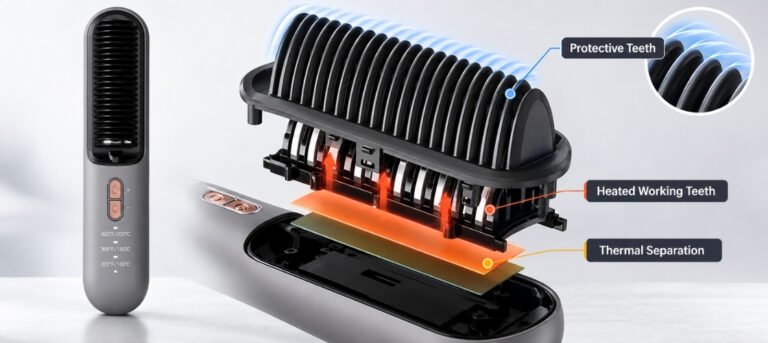
- The tooth layout guides hair through the heated area while limiting direct contact with hotter internal parts.
Each stage affects the next. A powerful heater cannot compensate for poor heat spreading, and an accurate sensor cannot correct a badly chosen sensing location. Buyers comparing hair styling tool platforms should therefore evaluate the thermal system as an assembly, not as a list of isolated features.
What Parts Make Up a Hair Straightener Brush Heating System?
Although architectures vary, most heated straightening brushes combine a power stage, heater, heat-transfer structure, temperature-control elements, guarded comb geometry, insulation, and one or more protective functions.
The main subsystems are the power source, resistive heater, heat spreader, temperature sensor, controller, working teeth, protective teeth, insulation, and safety components. Their materials, positions, tolerances, and assembly quality determine how quickly and evenly the brush heats—and whether approved performance can be reproduced in production.
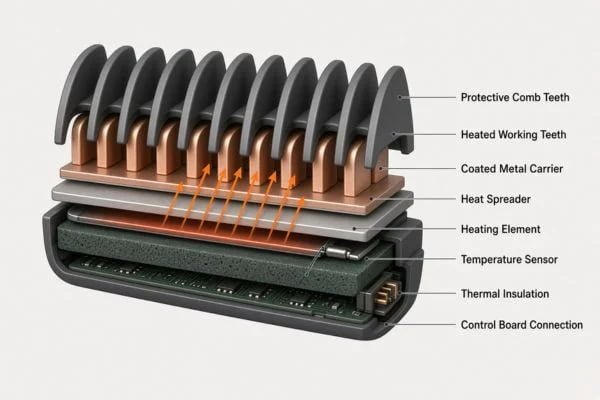
| Subsystem | Primary function | What a buyer should verify |
|---|---|---|
| Power input | Supplies voltage and current to the heating circuit | Rated input, corded or cordless architecture, market version, and behavior under normal voltage variation |
| Heating element | Converts electrical energy into heat | Heater type, supplier specification, rated voltage, power range, and approved part number |
| Heat spreader or carrier | Conducts heat toward the working area | Material, dimensions, coating, contact with the heater, and center-to-edge distribution |
| Temperature sensor | Reports temperature to the controller | Sensor type, mounting position, response time, tolerance, and thermal contact |
| Control circuit | Switches or modulates heater power | Setpoints, control method, ready indication, overshoot, steady-state behavior, and fault response |
| Heated and protective teeth | Transfer heat and manage contact | Tooth material, spacing, height, surface finish, alignment, and separation from skin-accessible areas |
| Insulation and protection | Limits unwanted heat transfer and abnormal conditions | Insulation system, thermal cutoff or fuse where applicable, auto-off logic, and accessible-surface checks |
These elements do not have one universal configuration. A corded product may have more continuous power available, while a cordless design must balance battery output, runtime, thermal mass, and warm-up behavior. The approved specification must identify the exact architecture being purchased.
How Does Temperature Control Work in a Straightener Brush?
Temperature control connects the user-selected setting to the heater’s real behavior. It determines when power is applied, reduced, or stopped as the measured temperature changes.
In a sensor-controlled system, the user selects a setpoint, the controller reads a temperature sensor near the heating structure, and power is cycled or modulated to stay within a defined range. The displayed setting, sensor reading, and actual tooth-surface temperature are related, but they are not automatically identical.
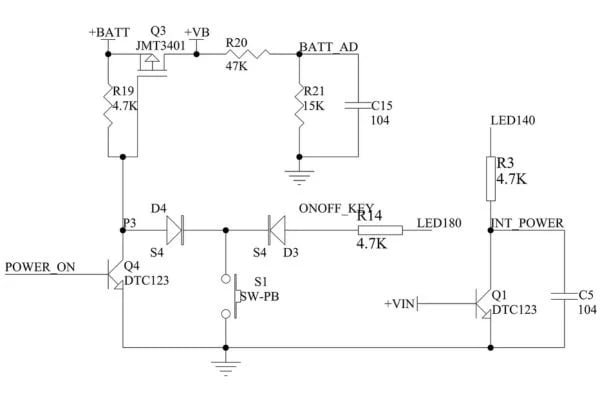
The Basic Control Sequence
- The user selects a temperature level.
- The controller energizes the heater.
- The sensor changes its electrical output as temperature rises.
- The controller compares that signal with its programmed thresholds.
- Heater power is reduced or interrupted near the target, then restored when temperature falls.
An NTC thermistor is one common sensing component. Its resistance falls as temperature rises, allowing the control circuit to infer temperature from a calibrated resistance curve. Murata’s technical overview of NTC thermistors explains this sensing principle. Other sensor types and control strategies are also possible, so buyers should confirm the actual circuit rather than assume an NTC is always present.
The following terms should remain separate in a sample report:
| Term | What it means |
|---|---|
| Selected temperature | The level requested through a button, dial, or software setting |
| Sensor temperature | The temperature inferred at the sensor’s mounting location |
| Working-surface temperature | The measured temperature at defined heated teeth or surfaces |
| Ready indication | The controller’s signal that its programmed condition has been reached |
| Steady-state variation | The temperature range observed after the system has stabilized |
A ready light proves that the programmed trigger occurred; it does not, by itself, prove uniform surface temperature. Independent protective measures also need review. Auto-off logic, thermal cutoffs, insulation, and fault behavior serve different purposes and should not be treated as interchangeable.
For market planning, buyers should identify the applicable product-safety route early. IEC 60335-2-23:2026 covers hair straighteners and other hair-care appliances and includes requirements relevant to PTC heating elements and accessible surface temperatures. The exact edition, national adoption, and additional requirements depend on the destination market and product version.
Where Does a PTC Heater Fit Into the System?
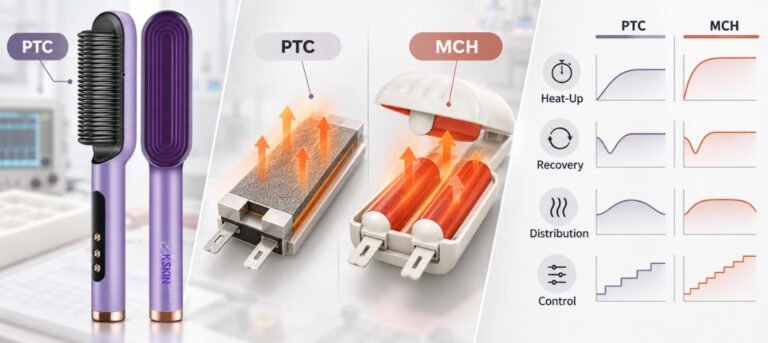
PTC is frequently used in hair-tool specifications, but the term describes the heater’s temperature-dependent resistance behavior—not the performance or safety of the finished brush by itself.
A PTC heater increases its electrical resistance sharply as it approaches its designed switching region. Under a broadly constant voltage, higher resistance reduces heating power, creating a self-regulating effect. This behavior can support thermal control, but actual brush temperature still depends on voltage, heater grade, mounting, heat loss, sensor logic, and assembly.
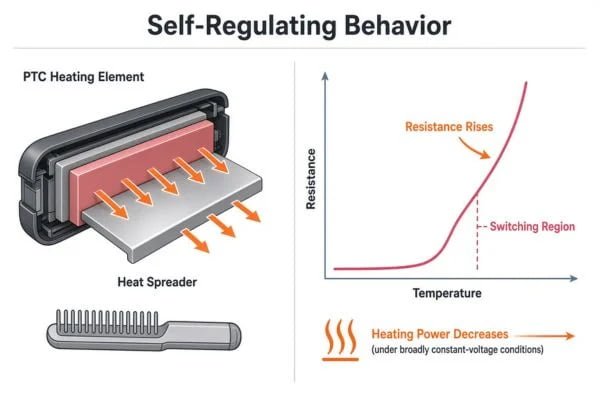
At lower temperature, a PTC element can draw more power and warm rapidly. As its resistance rises, electrical power falls according to the relationship P = V²/R under constant-voltage conditions. This is why PTC heaters are described as self-regulating; TDK identifies PTC thermistors used as heating elements as self-regulating ceramic heaters.
However, “self-regulating” does not mean “fixed at an exact brush-surface temperature.” The equilibrium changes with heat sinking, airflow, contact pressure, surrounding materials, mains or battery conditions, and component tolerance. A PTC element also does not remove the need to evaluate the complete appliance, its abnormal-operation behavior, and its applicable protection system.
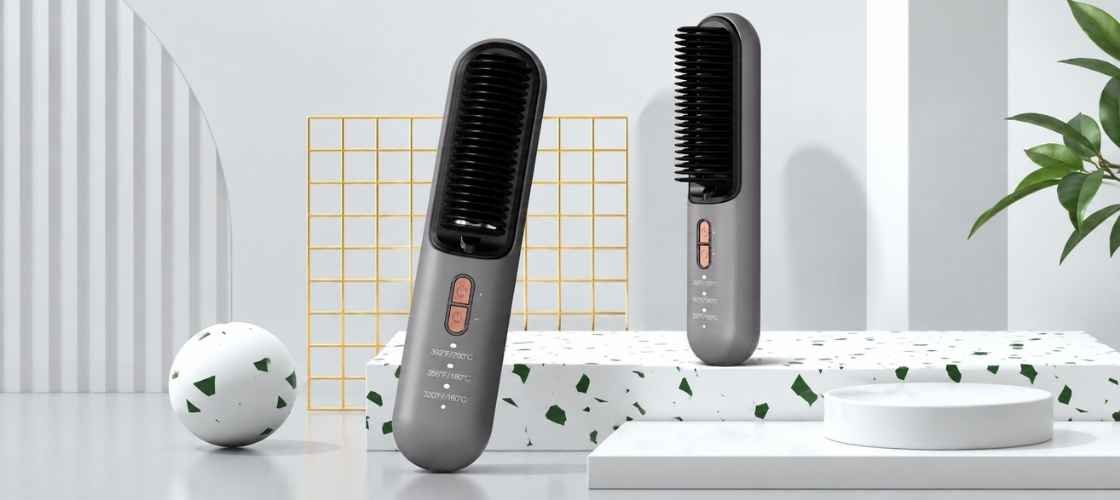
Not every straightener brush uses the same heater. For example, the KD382B cordless straightener brush reference platform uses an electric heating film with constant-temperature control. That model-specific specification should not be generalized to PTC-based, corded, or other cordless platforms.
Before approving a PTC claim, request the heater specification, approved part number, resistance or switching-temperature range, rated electrical conditions, mounting method, temperature-control logic, and test record for the exact sample version. The label “PTC ceramic heating” is not a substitute for those details.
Why Do Heat Distribution and Comb Geometry Matter?
The heater creates thermal energy, but the heat spreader and tooth structure determine where that energy goes, what hair contacts, and which surfaces remain accessible during operation.
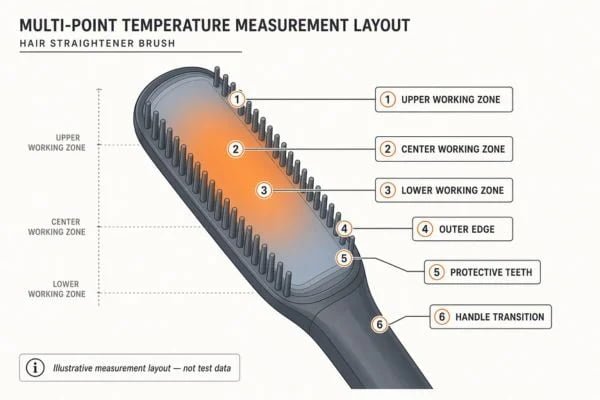
A useful straightener brush needs controlled heat across the working zone, not merely a high reading at one point. Center-to-edge variation, tooth alignment, heated-surface area, protective-tooth height, coating, and thermal isolation influence contact consistency. Buyers should measure the complete brush head and evaluate the geometry with representative hair tresses.
Thermal Performance to Record
| Measurement | What it reveals | Common evaluation error |
|---|---|---|
| Time to target range | Warm-up behavior under defined conditions | Timing only until the ready light turns on |
| Temperature at multiple working points | Distribution across the usable heating zone | Reporting only the hottest center point |
| Overshoot after warm-up | How far the surface rises beyond the intended range | Ending the test as soon as the target is reached |
| Steady-state variation | Stability while the heater cycles or modulates | Averaging data so widely that short peaks disappear |
| Recovery after a controlled load | Ability to restore temperature after heat is removed | Comparing products with different loads or contact times |
| Edge, guard, and handle temperatures | Unwanted heat transfer toward accessible areas | Measuring heated teeth while ignoring surrounding surfaces |
There is no single center-to-edge limit or stability band that suits every product. Acceptance criteria should be defined for the intended platform, setpoint, market, and test method before samples are compared.
Comb Geometry Is Part of the Thermal System
The spacing and height of the teeth determine how deeply a hair tress enters the heating zone and how close skin can approach hotter parts. Protective teeth may reduce direct access, while heated teeth or coated metal surfaces provide working contact.
Excessive spacing can reduce control of smaller sections; overly restrictive spacing can increase drag or trapping risk. These outcomes require dimensional inspection and controlled tress testing, not a visual judgment alone.
How Should B2B Buyers Test a Straightener Brush Sample?
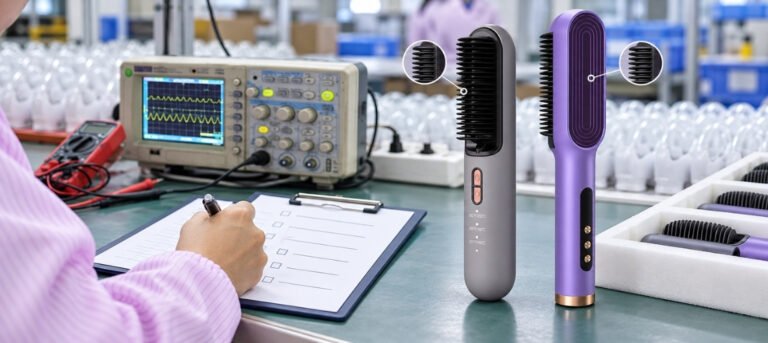
A repeatable sample test should separate interface claims from measured performance. It must identify the sample version, test conditions, instruments, locations, operating sequence, and acceptance criteria.
Begin with more than one unit, confirm that every sample matches the same specification, then log warm-up, multi-point temperature, overshoot, stability, recovery, external temperatures, controls, and protective functions. Record ambient conditions, power conditions, sensor attachment, instrument identification, and any deviations so suppliers can reproduce the result.
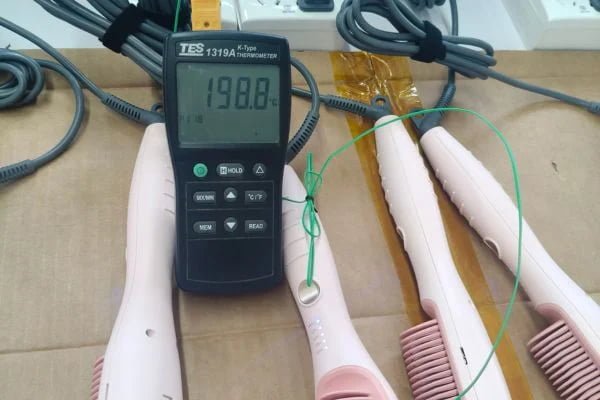
Use this sequence for an early engineering or sourcing comparison:
- Identify each unit by model, electrical version, sample revision, and serial or sample number.
- Confirm the heater, controller, firmware where relevant, comb assembly, and rated input against the submitted specification.
- Stabilize the units in the same ambient environment and begin from a comparable starting temperature.
- Use calibrated contact sensors or a validated infrared method. Document sensor type, attachment method, measurement locations, and infrared emissivity settings where applicable.
- Measure at several defined locations across the working zone, including center and edge positions. Use the same points on every unit.
- Run every temperature setting long enough to capture warm-up, overshoot, and steady-state cycling.
- Apply a repeatable thermal load or controlled tress procedure if recovery and working contact are being compared.
- Check controls, ready indication, automatic shutoff, external heat transfer, and specified fault responses separately.
- Repeat failed or borderline checks after confirming that the method and sample version have not changed.
For an initial commercial screen, testing at least three units is more informative than approving a single presentation sample. It is not a compliance sample-size rule; formal sampling and certification plans must be defined for the project and target market.
The supplier package should connect the approved product to the evidence:
| Requested record | Purpose |
|---|---|
| Approved specification and sample revision | Defines the product version being evaluated |
| Heating-system description | Identifies heater type, sensor, controller, heat spreader, and key protections |
| Multi-point heating curves | Shows warm-up, overshoot, distribution, and stability under stated conditions |
| Critical-component control | Links heater, sensor, cutoff, and other critical parts to approved sources or specifications |
| Test method and instrument record | Makes the result understandable and repeatable |
| Applicable compliance-document list | Maps reports or certificates to model, electrical version, market, and standard |
| Change-control process | Requires review when thermal components, materials, software, or assembly change |
K·SKIN’s manufacturing and quality-control framework treats heating performance and temperature control as product-specific checks. If a project changes the heater, control logic, tooth structure, or electronics, those changes should move through an agreed OEM/ODM development and validation scope rather than be accepted as a cosmetic customization.
Frequently Asked Questions
Is a PTC hair straightener brush automatically safer than other heater designs?
No. PTC behavior can provide a self-regulating effect, but finished-product safety also depends on electrical design, mounting, insulation, control logic, protective components, accessible temperatures, abnormal-operation testing, and compliance for the destination market.
Is the displayed temperature the same as the heated-tooth temperature?
Not necessarily. The display may represent a programmed setpoint, while the sensor measures at another location. Buyers should compare the displayed setting with multi-point surface measurements after warm-up and during steady operation.
Does faster warm-up always indicate a better heating system?
No. Warm-up speed is only one metric. Excessive overshoot, uneven distribution, weak recovery, high external temperatures, or unstable battery behavior can make a fast-heating sample unsuitable for its intended product position.
How many temperature points and sample units should a buyer test?
Use several fixed points across the working zone and test more than one unit. Three units can support an early comparison, but the final sample count and locations should follow project risk, product geometry, acceptance criteria, and any applicable test plan.
What should be frozen after the heating system is approved?
Freeze the approved sample revision and the relevant heater, sensor, controller or firmware, heat-spreading structure, comb assembly, insulation, protective parts, electrical version, test method, and acceptance limits. Later changes should trigger documented impact review and appropriate revalidation.
Conclusion
A hair straightener brush works through a connected thermal system: electrical input powers a heater, the structure distributes heat, sensing and control manage temperature, and comb geometry defines working contact and separation from hotter components. Buyers should approve measured system behavior for a specific product version—not a heater label, display setting, or single demonstration.
To evaluate an existing platform or define a private-label heating specification, review K·SKIN’s hair styling tools and contact the project team with your destination market, corded or cordless preference, target temperature settings, sample quantity, and required validation scope.