The term “anti-scald” appears frequently in straightener-brush specifications, but buyers need to understand which physical structures provide that protection and whether the submitted sample performs as intended.
Anti-scald design is neither a single component nor an absolute guarantee against burns. In a hair straightener brush, it relies mainly on protective comb geometry and thermal separation to reduce unintended access to hotter styling surfaces. Buyers should verify tooth geometry, edge protection, accessible-surface temperatures, assembly consistency, temperature behavior, and the exact sample version through controlled inspection and measurement.
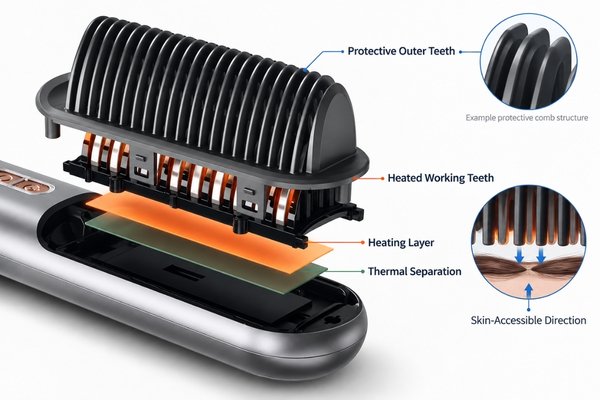
The key question is not whether the packaging says “anti-scald.” It is whether the complete brush head creates a controlled relationship among hair access, heated working surfaces, and areas that users may approach during intended use.
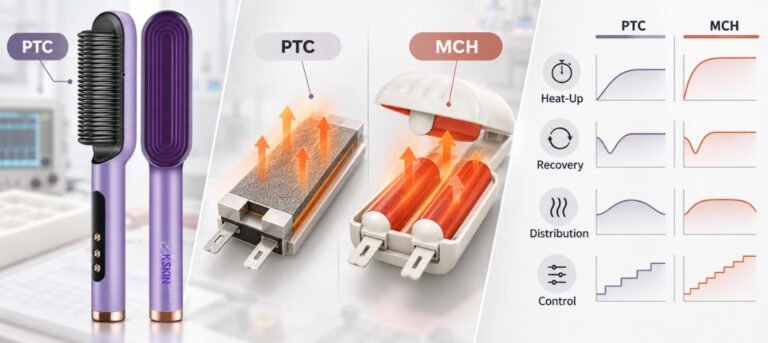
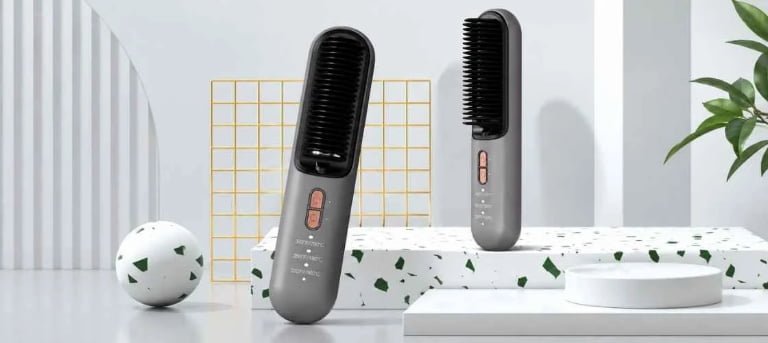
Different product platforms may achieve this in different ways. The KD382B cordless straightener brush combines an electric heating film, temperature control, and an anti-scald comb-tooth structure. The KD680 compact corded brush uses a different PTC-based heating platform with its own comb structure. Buyers should inspect the actual design instead of assuming that every “anti-scald” brush works in the same way.
What Does “Anti-Scald” Actually Mean in a Straightener Brush?
An anti-scald claim needs to be separated into physical contact protection, thermal management, and other protective functions. These layers support one another, but they do not perform the same job.
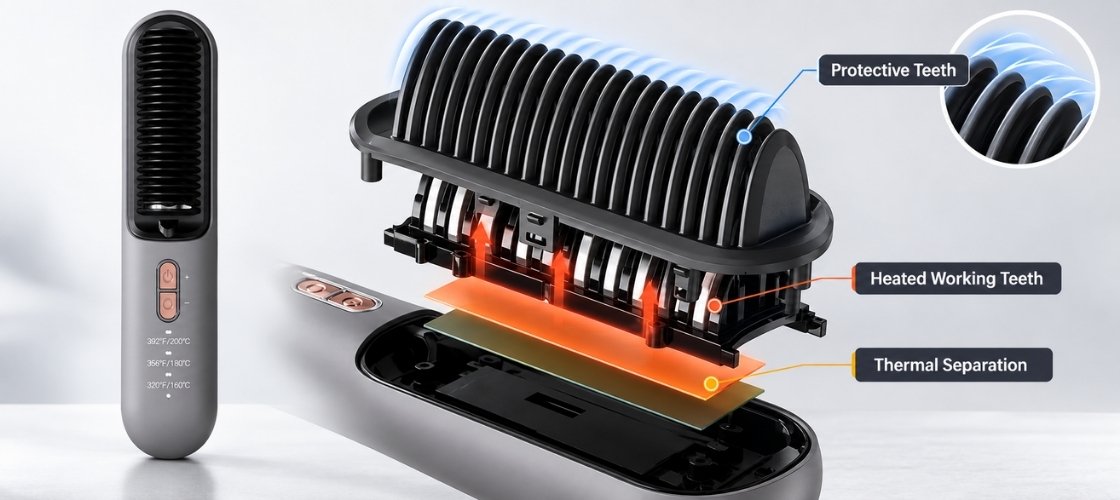
The core anti-scald function comes from physical geometry that limits unintended access to the hottest working surfaces. Protective teeth, recessed heated areas, edge guards, and thermal separation form the first barrier. Temperature control supports this structure by managing heat, while functions such as automatic shutoff address other operating risks and should not be treated as substitutes for physical contact protection.
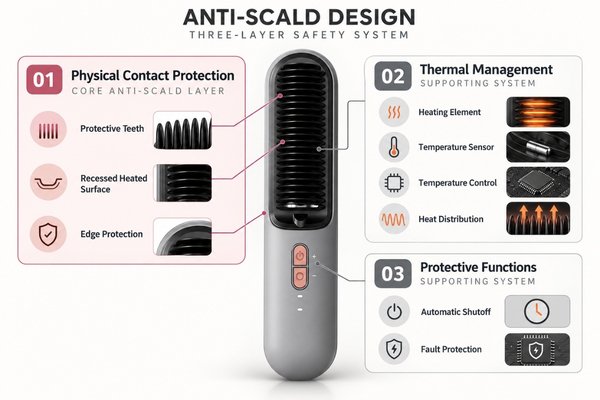
One practical way to review the design is to separate these functions:
| Feature | Primary Role | Relationship to Anti-Scald Performance |
|---|---|---|
| Protective comb teeth | Create physical separation from hotter working areas | Core |
| Recessed heated surface | Positions hotter surfaces behind the contact barrier | Core |
| Outer-edge protection | Reduces direct access from the sides of the brush head | Core |
| Thermal insulation | Limits unwanted heat transfer into surrounding structures | Supporting |
| Temperature sensor and control | Regulate heater operation around the intended temperature range | Supporting |
| Heat-spreading structure | Influences local temperature distribution | Supporting |
| Automatic shutoff | Stops operation after a defined condition or period | Separate protective function |
This distinction matters when comparing suppliers. A product can have automatic shutoff and still expose an unsuitable hot area during normal operation. Likewise, well-designed protective teeth do not compensate for unstable temperature control.
An anti-scald claim should therefore be understood as a system, but the physical relationship between accessible areas and heated styling surfaces remains the starting point.
Which Comb Geometry Details Matter Most?
Two straightener brushes can use similar heater technology and still provide very different contact protection because their comb heads differ in tooth height, spacing, working-surface position, and outer-edge structure.
Buyers should examine where the protective teeth sit in relation to the heated working teeth, how far skin-accessible contact points are separated from hotter surfaces, whether the outer edges are guarded, and whether these dimensions remain consistent after assembly. Anti-scald performance depends on the complete geometry and tolerance stack, not simply on the material name or the number of teeth visible from the outside.
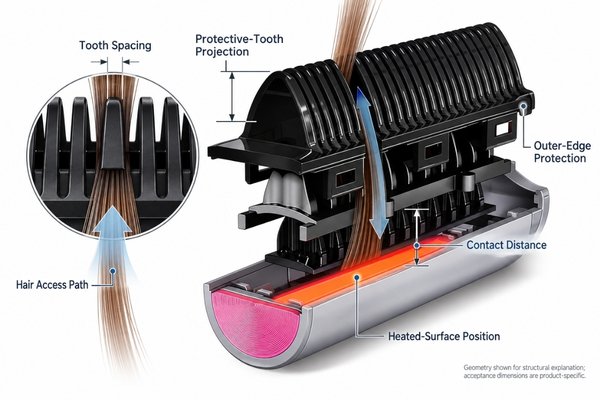
Several geometric relationships deserve particular attention.
| Geometry Detail | What Buyers Should Review |
|---|---|
| Protective-tooth projection | Whether the protective structure reaches an approaching surface before the hotter working area |
| Heated-surface position | Whether the main heated surface is sufficiently recessed within the intended comb structure |
| Tooth spacing | Whether openings unnecessarily expose internal hot areas while still allowing useful hair capture |
| Outer perimeter | Whether side edges and corners create another path toward hotter components |
| Brush-head sidewall | Whether heat transfers into surrounding areas that may be approached during handling |
| Alignment | Whether protective and working teeth remain correctly positioned after assembly |
| Dimensional tolerance | Whether production variation could reduce the designed separation |
Material selection matters, but a material name alone proves little. Nylon, silicone, coated metal, and other materials can be used in very different structures. Buyers should consider the approved material grade, heat resistance, dimensions, distance from the heater, and behavior after repeated heating rather than assuming that one material label automatically makes a design safer.
Anti-Scald Protection Must Still Allow Hair Contact
More separation is not necessarily better.
A straightener brush still needs to guide hair into the heated working zone. If the protective teeth are excessively tall or the working surface is too deeply recessed, hair contact may become weak and styling efficiency may fall. If the openings are too restrictive, drag or snagging may increase.
The engineering balance is therefore:
skin access ↔ hair access ↔ thermal contact ↔ styling performance
This is why comb geometry should be evaluated alongside controlled hair-tress testing. Buyers need to confirm that the sample both limits unintended access to hotter areas and performs the styling task for which the product is being purchased.
Products in the hair styling tools range may use different brush-head geometries because their size, power system, heating architecture, and intended styling routines differ. No single protective-tooth shape proves that every platform has a good anti-scald design.
How Can Buyers Verify Anti-Scald Performance on a Sample?
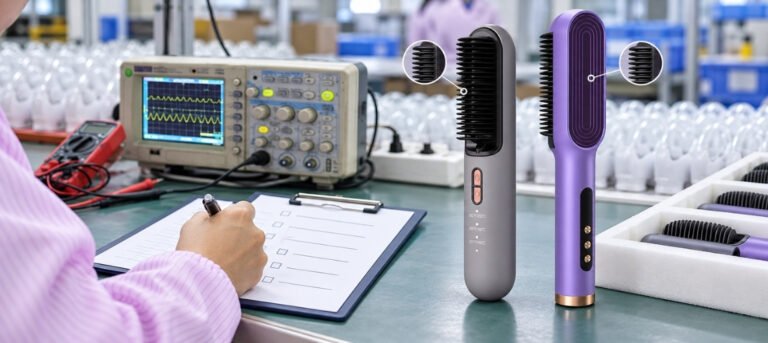
Visual inspection helps, but it cannot show how heat moves through the brush during operation. Verification should combine dimensional inspection with controlled temperature measurements on the exact submitted sample.
Practical anti-scald verification begins with identifying the sample revision, measuring the protective and working-tooth geometry, defining repeatable temperature points, operating the brush through warm-up and steady-state conditions, and comparing the heated working areas with surrounding accessible surfaces. Repeat the procedure across representative samples and settings, then inspect the comb structure again for heat-related deformation, movement, or assembly changes.
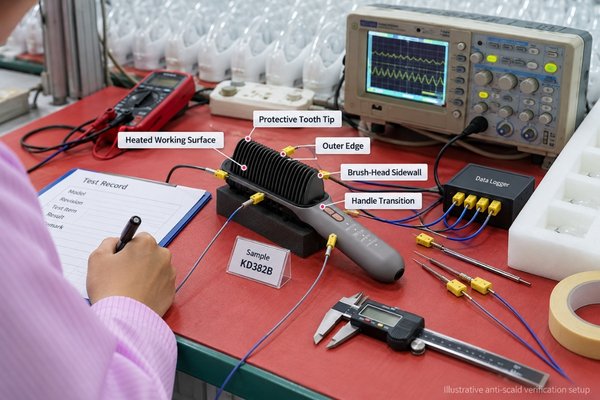
A B2B sample review can follow this sequence:
- Identify the exact model, sample number, revision, and electrical or charging configuration.
- Confirm the comb assembly and heating configuration against the submitted specification.
- Measure the protective-tooth height, working-tooth position, key spacing, and relevant brush-head dimensions.
- Define the same temperature measurement points on every test unit.
- Start each sample under comparable conditions and run the selected temperature settings long enough to observe stable operation.
- Measure both the intended heated working surfaces and surrounding areas that users may approach during normal handling.
- Repeat the test using the same sensors, attachment method, and measurement locations.
- Inspect the comb head after heating for looseness, distortion, abnormal gaps, or visible material changes.
Useful measurement points may include:
| Measurement Point | Why It Matters |
|---|---|
| Heated working tooth or surface | Establishes the temperature of the styling area |
| Protective tooth tip | Shows how the intended contact barrier behaves thermally |
| Outer brush-head edge | Helps identify side-access hot spots |
| Brush-head sidewall | Checks unwanted heat transfer outside the main working zone |
| Handle transition | Shows whether heat is conducting toward the normal grip area |
Use calibrated contact sensors where appropriate or a validated infrared method under controlled measurement conditions. Infrared images can help locate hot spots, but the method, emissivity assumptions, and viewing geometry should be documented if the results will be used for approval.
Do not apply one universal temperature limit as the pass/fail rule for every straightener brush. Applicable limits depend on the exact product, surface, material, test method, and regulatory route. IEC 60335-2-23:2026 addresses hair-care appliances, including hair straighteners, and contains requirements relevant to accessible-surface temperatures. The applicable edition, national adoption, and project requirements should be confirmed for the actual destination market.
For a broader sample-review process, buyers can also use the 12-point hair straightener brush sample test to connect anti-scald verification with heating, assembly, controls, styling behavior, and commercial-version approval.
How Do Temperature Control and Auto-Off Support Anti-Scald Design?
Physical guarding works with the thermal system, but several commonly advertised technologies are often credited with more protective value than they can provide on their own.
Temperature control, heater behavior, and automatic shutoff can support a safer product architecture, but none of them automatically makes a brush anti-scald. Sensor position affects which temperature the controller actually detects, PTC behavior does not hold every surface at one fixed temperature, and auto-off mainly addresses continued operation rather than direct contact with a hot working surface during styling.
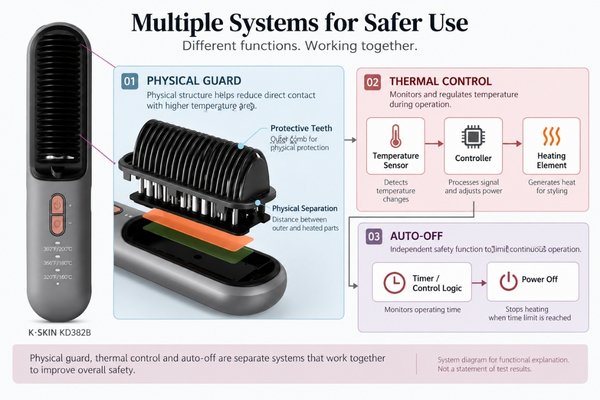
Three distinctions are particularly important.
| Claim | What It Actually Tells the Buyer |
|---|---|
| “PTC heating” | Describes heater behavior, not complete brush-head contact protection |
| “Constant-temperature control” | Describes a control objective, not necessarily the temperature at every accessible surface |
| “Automatic shutoff” | Limits continued operation under a defined condition; it does not physically separate skin from the heater |
A PTC heating element increases resistance as its temperature rises, creating a self-regulating characteristic under appropriate electrical conditions. TDK’s technical information on PTC heating elements explains this basic behavior. The finished brush temperature still depends on the heater grade, voltage, mounting, heat loss, control logic, and surrounding structure.
Sensor placement matters for the same reason. A sensor mounted near the heater does not directly measure every protective tooth or outer edge. Buyers should distinguish among the selected temperature, sensor temperature, and actual surface measurements.
The relationship among the heater, sensor, and working surface is covered in more detail in the hair straightener brush heating system guide.
What Evidence Should Buyers Review Before Approving an Anti-Scald Claim?
A supplier’s anti-scald claim becomes more useful when the buyer can trace it to a specific sample, physical structure, measurement method, and controlled production version.
Before approving an anti-scald claim, buyers should review the approved sample, comb-structure or dimensional information, temperature measurements from defined working and accessible surfaces, relevant material specifications, the test method, applicable compliance evidence where verified, and the change-control process. A logo or certificate alone does not show which comb geometry or sample revision produced the claimed performance.
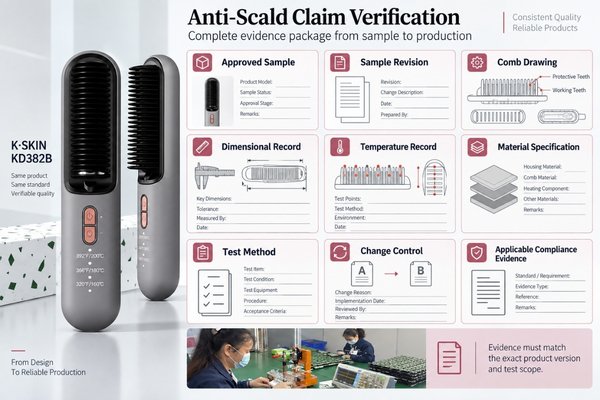
A useful evidence package may contain:
| Evidence | Question It Should Answer |
|---|---|
| Approved sample | Which physical product was accepted? |
| Sample revision | Which version was actually tested? |
| Comb drawing or dimensional record | Which protective geometry was evaluated? |
| Material specification | Which approved materials are used around the heated structure? |
| Multi-point temperature record | Which working and accessible surfaces were measured? |
| Test method | Can the measurements be reproduced? |
| Applicable safety evidence | Does the document cover the relevant model, version, and standard? |
| Change-control record | What happens if the comb, heater, material, or assembly changes? |
The last item is easy to overlook. Anti-scald performance can change without an obvious cosmetic redesign. Changes to tooth dimensions, resin grade, heater mounting, insulation, control logic, or assembly tolerance can alter the relationship between the protective structure and the heated area.
This is why the approved sample should remain tied to production controls. K·SKIN’s manufacturing and quality framework treats heating performance, temperature control, assembly condition, and product-specific checks as part of a version-controlled production review.
Certification documents should be reviewed with the same discipline. Buyers should confirm the model, version, standard, issuing or testing body, scope, and date rather than assuming that a certification logo independently proves a specific anti-scald marketing claim. Relevant company- and product-level documentation can be reviewed through the K·SKIN credentials and evidence framework.
Frequently Asked Questions
What does anti-scald mean on a hair straightener brush?
It generally describes design features intended to reduce unintended contact with hotter styling surfaces. In a straightener brush, the core protection usually comes from comb geometry, physical separation, and the surrounding thermal structure. The term should not be interpreted as a guarantee that no part of the product can become hot or that burns are impossible.
Are anti-scald comb teeth supposed to stay completely cold?
Not necessarily. Protective teeth can still warm up because they are close to the heater and may receive heat through conduction, convection, or radiation. The important question is how the complete accessible-surface behavior compares with the applicable design and safety requirements under the defined test method.
Can a PTC heater make a straightener brush automatically anti-scald?
No. PTC behavior can help regulate heating power, but anti-scald performance also depends on comb geometry, heat spreading, sensor and control behavior, insulation, operating conditions, and the temperature of accessible surfaces. PTC is one part of the thermal architecture, not proof of the finished protection system.
How should buyers measure anti-scald performance on a sample?
Begin with a dimensional inspection of the protective and working teeth. Then measure defined heated and surrounding surfaces during warm-up and steady operation. Use repeatable locations and calibrated contact sensors or a validated infrared method. Record the exact sample version, temperature setting, test conditions, and measurement procedure.
Does a safety certificate prove an anti-scald claim?
Not by itself. A certificate or report may support compliance for a defined product, version, market, and standard, but buyers still need to verify exactly what the document covers. A specific anti-scald claim should also be tied to the actual comb structure, sample revision, temperature evidence, and approved production configuration.
Conclusion
Anti-scald design in a hair straightener brush is primarily a matter of physical contact geometry and controlled heat transfer. Protective teeth, recessed working surfaces, and edge protection should reduce unintended access to hotter areas without preventing hair from reaching the styling zone. Temperature control, insulation, and automatic shutoff support the design, but none should replace verification of the complete brush head.
For a sourcing or private-label project, review the actual sample rather than relying on the claim alone. Explore K·SKIN’s hair styling tools and contact the project team to discuss the product platform, comb structure, heating configuration, and sample-verification scope required before approval.