PTC and MCH are often compared as though one is automatically safer, faster, cheaper, or more advanced. For B2B buyers, those labels alone are not enough to approve a heating system.
PTC and MCH heating systems should be compared as complete thermal architectures, not as isolated heater labels. Buyers should evaluate heat-up and recovery curves, working-surface temperature distribution, stability, control logic, power demand, structural integration, implemented system cost, reliability evidence, and production consistency. The better choice is the one that meets the product requirement under defined test conditions and can be reproduced in production.
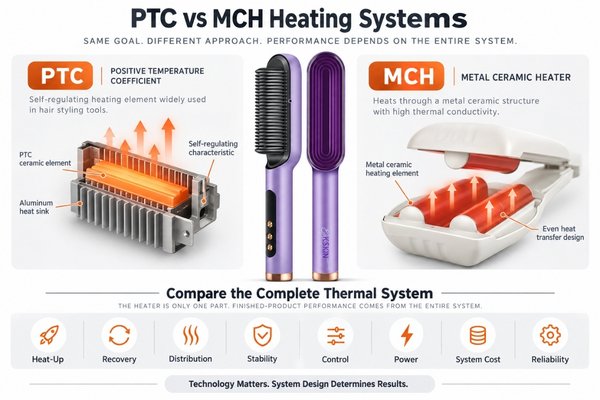
A fast warm-up demonstration may look impressive, but it does not show how the styling surface behaves after contact with hair, how evenly heat reaches the working area, or whether production units will perform like the approved sample.
The same applies to phrases such as “PTC self-regulating” or “MCH rapid heating.” Both describe useful technical characteristics, but neither proves how a finished hair styling tool will perform.
For buyers developing or sourcing private-label products, the practical question is not “Which heater is better?” It is:
Which thermal architecture fits the product, and what evidence supports the decision?
For a broader explanation of how the heater, sensor, controller, heat spreader and working surface interact, see our guide to hair straightener brush heating systems.
PTC vs MCH: What Actually Changes?
PTC ceramic heaters use a material whose electrical resistance rises sharply as it approaches its characteristic switching region, creating a self-regulating tendency under suitable electrical conditions. MCH-type ceramic heaters use a resistive heating structure integrated with a ceramic substrate and can support rapid response and high power density. In both cases, finished-product temperature still depends on the complete thermal and control system.
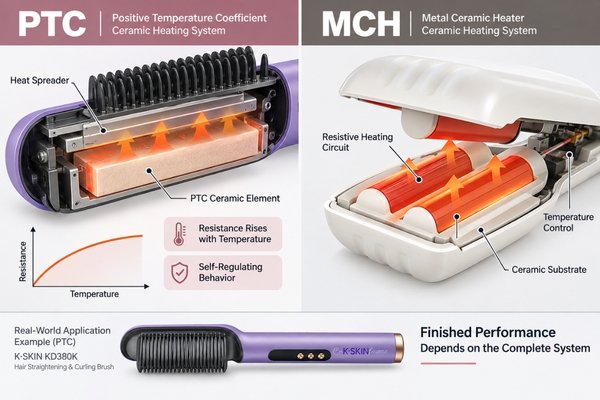
PTC stands for Positive Temperature Coefficient. As the ceramic approaches its switching region, its resistance increases. Under approximately constant-voltage conditions, the higher resistance reduces heating power and creates the self-regulating behavior associated with PTC heaters.
TDK describes PTC thermistors used as heating elements as self-regulating ceramic heaters.
This does not mean that a PTC-equipped styling tool automatically maintains an exact working-surface temperature. Heater grade, voltage, mounting, heat loss, sensor location, controller logic and the thermal structure surrounding the heater all affect the final result.
A real K·SKIN example is the KD380K ionic hair straightening and curling brush, which uses PTC ceramic heating as part of a corded, temperature-controlled styling platform.
MCH-type ceramic heaters use a different architecture. A resistive heating circuit is integrated with a ceramic substrate, creating a compact thermal structure that can provide relatively high power density and fast response when designed for those objectives. Kyocera’s alumina ceramic heater technology describes rapid heating, compact construction and high watt density, and lists hair irons among its applications.
These characteristics create engineering options. They do not establish a universal ranking.
What Should Buyers Compare Between PTC and MCH?
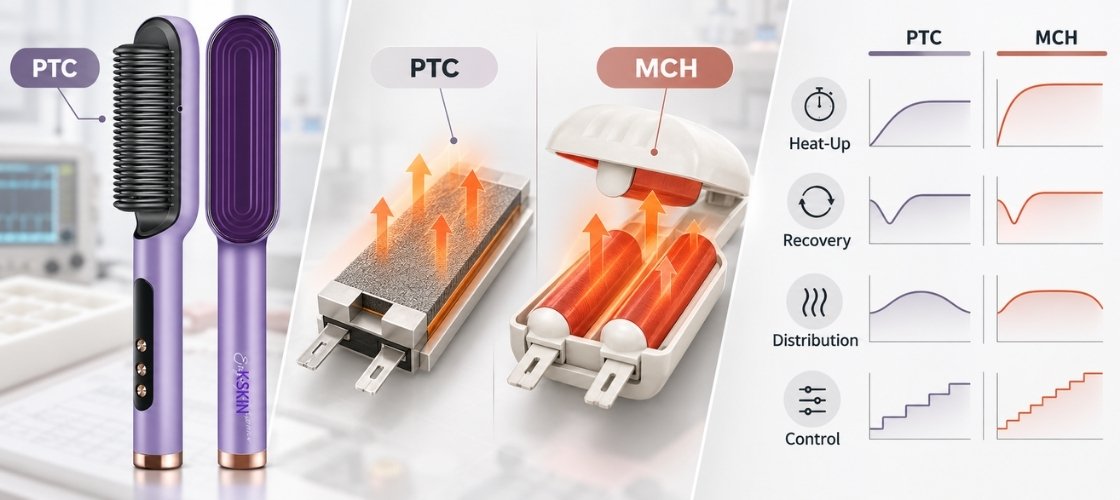
The useful comparison is not PTC versus MCH in isolation. Buyers should compare the finished products under the same operating conditions: cold-start heat-up, recovery after thermal load, temperature distribution, steady-state stability, control behavior, electrical demand, structural fit and production repeatability. A heater that performs well in one styling-tool architecture may be unsuitable for another product with different geometry or power limits.
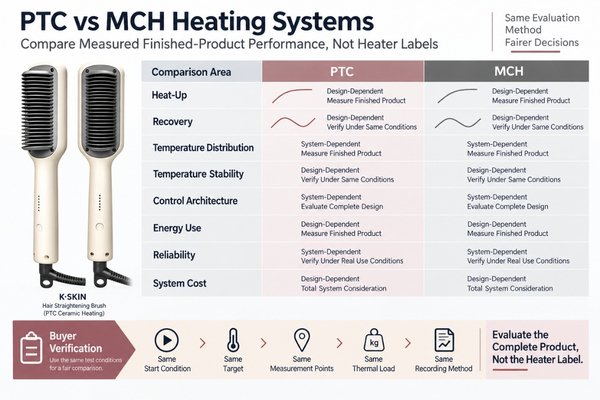
| Comparison Area | PTC | MCH-Type Ceramic Heater | What the Buyer Should Verify |
|---|---|---|---|
| Heating behavior | Temperature-dependent resistance provides self-regulating behavior | Resistive ceramic heating architecture supports active thermal design | Finished-product heating curve |
| Heat-up | Depends on heater grade, power and thermal mass | Can support rapid thermal response | Time from the same starting condition to the defined working state |
| Recovery | Depends on available power and thermal structure | Can support high power density | Recovery after the same thermal load |
| Distribution | Depends heavily on mounting and heat spreading | Depends on heater geometry, circuit and heat spreading | Multi-point working-surface temperatures |
| Stability | PTC behavior can support thermal control | Usually depends strongly on sensor and controller behavior | Overshoot, cycling and steady-state variation |
| Control | Heater characteristics plus optional active control | Active sensing and control according to the product design | Sensor position and control logic |
| Product integration | Established in many heated styling platforms | Can support compact, high-density heater designs | Actual heater package and product geometry |
| Energy use | Depends on duty cycle and system design | Depends on duty cycle and system design | Energy used during the same test cycle |
| Reliability | Requires validation under actual operating conditions | Requires validation under actual operating conditions | Thermal cycling and production evidence |
| Cost | Evaluate the complete implemented system | Evaluate the complete implemented system | Heater, electronics, assembly, testing and yield |
Heat-Up and Temperature Recovery
Warm-up time is one of the easiest specifications to market and one of the easiest to misunderstand.
A meaningful comparison starts with both products under comparable initial conditions and measures how long each takes to reach a defined working condition.
That is only the first part.
When a heated plate or comb contacts hair, heat leaves the working surface. The system must then recover.
A useful test therefore follows this sequence:
Cold Start
→ Working Temperature Region
→ Defined Thermal Load
→ Temperature Drop
→ Recovery
Two systems can have similar cold-start times but behave differently after repeated contact with hair. A system with a slightly slower initial warm-up may recover more quickly or maintain a more stable working temperature. The reverse can also occur.
For buyers, recovery behavior is often more relevant to actual use than a single “heats in X seconds” claim.
Temperature Distribution and Stability
Heater technology alone does not determine temperature uniformity.
The entire thermal path matters:
Heater
→ Mounting Interface
→ Heat Spreader
→ Heated Plate or Teeth
→ Hair Contact Zone
A poorly integrated heater can produce uneven working temperatures regardless of whether the element is PTC or MCH.
The same system-level principle applies to other heated beauty appliances. For example, facial steamer leakage can result from the interaction of the tank interface, sealing structure, water path, assembly condition, and operating conditions, rather than from a single component in isolation.
If a supplier claims that one system provides more uniform heat, request multi-point measurements from the complete product assembly.
Useful measurement locations may include the upper, center, lower and edge areas of the working zone, adjusted to match the actual product geometry.
The same principle applies to stability. Buyers should continue recording after warm-up long enough to observe:
- overshoot;
- control cycling;
- steady-state variation;
- recovery after loading.
The displayed temperature should not be treated as the measured working-surface temperature unless the test method demonstrates a reliable relationship between the two.
Control and Power Architecture
A heater does not operate independently of its control system.
The practical thermal loop usually includes:
Selected Setting
→ Controller
→ Power Regulation
→ Heater
→ Working Surface
→ Temperature Sensor
→ Feedback to Controller
PTC behavior can provide a degree of inherent self-regulation, but active sensing and protective functions may still be used, depending on the product design.
MCH-type heaters likewise need to be evaluated together with their temperature sensor, controller, switching method and protective functions.
This leads to a practical sourcing rule:
Approve the heater and temperature-control architecture together.
A product specification that states only “PTC heater” or “MCH heater” leaves too many engineering variables undefined.
Structural Integration
The space available inside a straightener, curling tool or heated brush can influence the heater decision.
Important factors include:
- heater dimensions;
- heated area;
- available wattage;
- ceramic and metal interfaces;
- heat-spreader geometry;
- sensor position;
- insulation;
- housing clearances;
- comb or plate construction.
MCH-type ceramic heaters can be attractive when rapid response and compact, high-density heating are important. That does not mean every compact styling tool should use MCH.
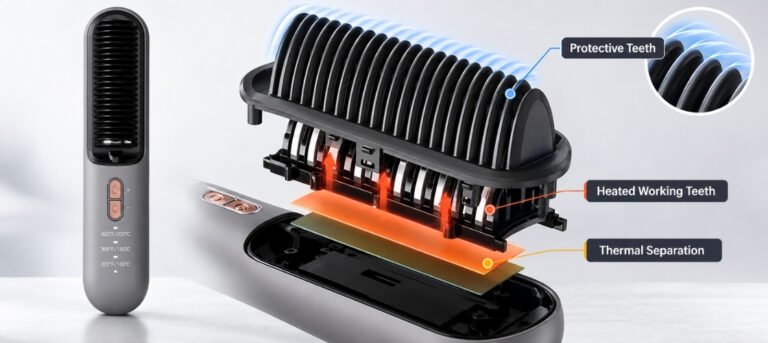
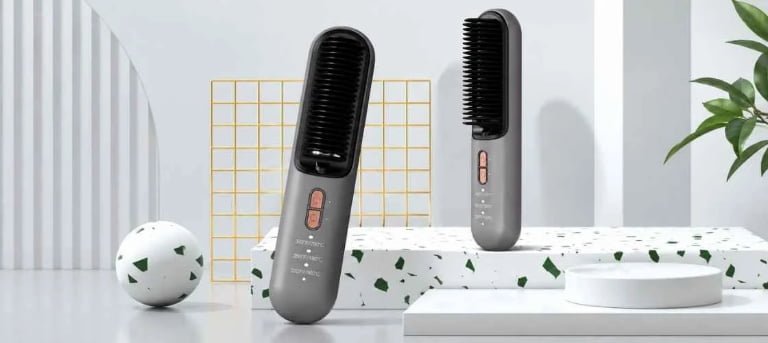
The KD382B cordless straightener brush illustrates another important point: not every project comes down to a PTC-versus-MCH decision. Its reference configuration uses an electric heating film with constant-temperature control because cordless products introduce different constraints related to battery power, product size and portability.
The product architecture should lead the heater decision, not the other way around.
What Should You Ask the Supplier Before Sampling?
Before requesting a sample, buyers should know more than the heater category. Ask for the heater specification, electrical conditions, dimensions, control method, sensor location, mounting structure and approved product revision. The supplier should also be able to explain how the heater is identified during production and how changes to the heater, sensor, controller or thermal structure will be handled after sample approval.
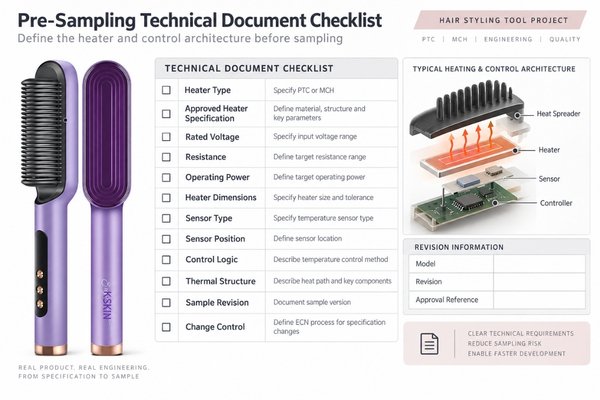
A practical pre-sampling request can include:
| Item | What to Confirm |
|---|---|
| Heater technology | PTC, MCH-type ceramic or another defined architecture |
| Heater specification | Approved part, grade or supplier specification |
| Electrical condition | Rated voltage, resistance and operating power, as applicable |
| Heater geometry | Dimensions and active heating area |
| Sensor | Type, mounting position and relationship to the working surface |
| Controller | Temperature-control method and switching logic |
| Thermal structure | Mounting, spreader and contact path |
| Protective functions | Relevant cutoff, auto-off or abnormal-condition protection |
| Sample revision | Exact product and heater version being evaluated |
| Change control | How future heater or control changes will be reviewed |
This information matters because two products sold under the same heater category can use different heater grades, control strategies and mechanical structures.
Technical sample information should also be considered alongside supplier qualification. Before investing in samples, buyers can use a beauty device manufacturer audit checklist to verify the manufacturing entity, relevant production capabilities, quality records, testing resources, version control, and corrective-action processes behind the proposed product.
The supplier should also be able to link the approved sample to subsequent production. K·SKIN’s Manufacturing & Quality approach treats the approved commercial version as a controlled reference instead of relying on an unmarked sample or a general heater description.
How Should PTC and MCH Samples Be Compared?
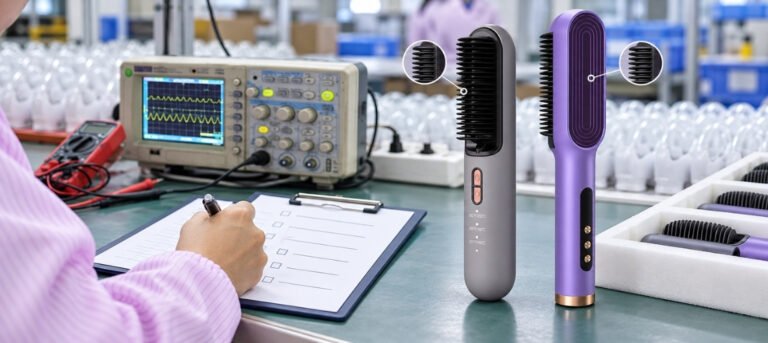
A fair PTC-versus-MCH sample comparison requires the same starting conditions, power assumptions, target operating condition, measurement locations, thermal load and recording method. Buyers should compare complete heating curves rather than a single warm-up number. The test should capture heat-up, overshoot, multi-point distribution, steady-state behavior, load-induced temperature drop, recovery and energy use over the defined evaluation cycle.
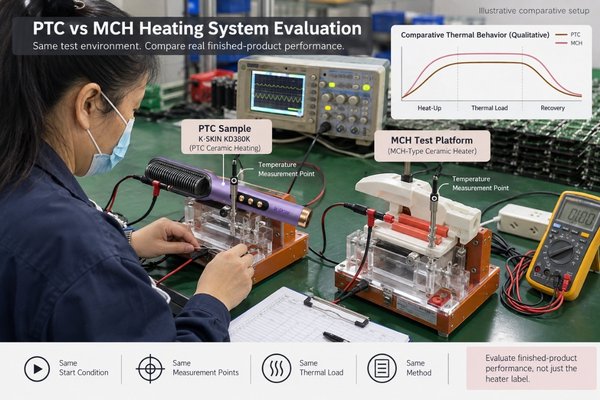
A useful comparison sequence is:
- Identify each sample and revision.
- Record the starting temperature and test environment.
- Confirm the supply voltage, battery condition or power source.
- Select the same functional temperature target where the products are technically comparable.
- Use fixed measurement positions.
- Start all data logging before power-on.
- Record the complete warm-up curve.
- Continue recording through stabilization.
- Apply the same defined thermal load.
- Record the temperature drop and recovery.
- Repeat the cycle consistently.
- Compare multiple units instead of relying on one sample.
The comparison may include:
- heat-up time;
- overshoot;
- steady-state variation;
- working-zone temperature spread;
- recovery time;
- energy consumption;
- unit-to-unit variation.
Three units can support an early engineering comparison, but this is not a universal compliance or production-sampling rule. The sample quantity should reflect the project risk, test purpose and applicable validation plan.
Thermal imaging can help visualize heat distribution, while contact sensors or thermocouples can provide point measurements when used correctly. Whichever method is selected, it should be applied consistently throughout the comparison.
Do not conclude that “MCH is 30% faster” or “PTC uses 20% less energy” unless data from the exact products and test conditions supports the claim.
How Should Buyers Compare Cost and Reliability?
For commercial decisions, buyers should compare the total implemented system cost and validated reliability, not just the purchase price of the heating element. Heater cost is only one part of the finished architecture. Sensor requirements, PCB design, power components, heat spreaders, assembly steps, inspection, manufacturing yield and revalidation can change the real cost of adopting one heating system instead of another.
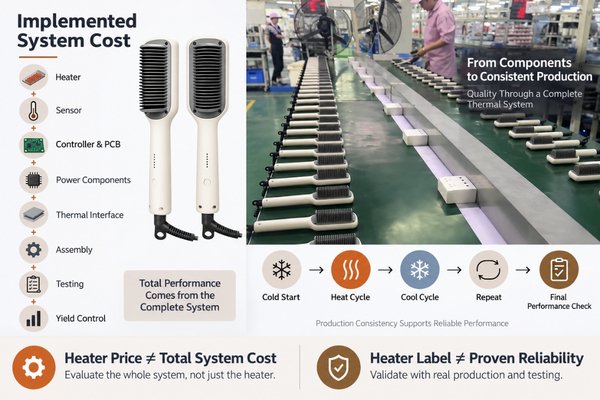
System cost can include:
Heater
- Sensor
- Controller and PCB
- Power Components
- Thermal Interface
- Heat Spreader
- Assembly
- Testing
- Yield Control
Changing a validated PTC platform to MCH simply to create a different marketing specification can therefore cost substantially more than the difference in heater price suggests.
The same caution applies to service-life claims.
PTC should not automatically be described as longer-lasting, nor should MCH automatically be described as having a shorter or longer service life.
Ceramic heater manufacturers such as Kyocera identify long operating life as a potential characteristic of their ceramic heater technology. Actual reliability in a hair styling tool still depends on the chosen heater, electrical loading, mechanical integration and operating cycle.
Relevant validation may include:
- repeated cold starts;
- heating and cooling cycles;
- high-temperature dwell;
- resistance change;
- heater connection integrity;
- ceramic cracking or structural damage;
- sensor and controller behavior;
- working-surface performance after cycling.
When comparing suppliers, ask for reliability evidence that matches the heater version and operating conditions proposed for the project.
When Does PTC or MCH Fit the Project Better?
PTC may suit projects that value a mature heating platform and useful self-regulating behavior, while MCH-type ceramic heating may deserve evaluation when rapid response, compact integration or high power density is important. Neither choice should be automatic. Product format, power source, thermal design, target performance, manufacturing readiness and revalidation cost should determine whether the existing platform is retained or redesigned.
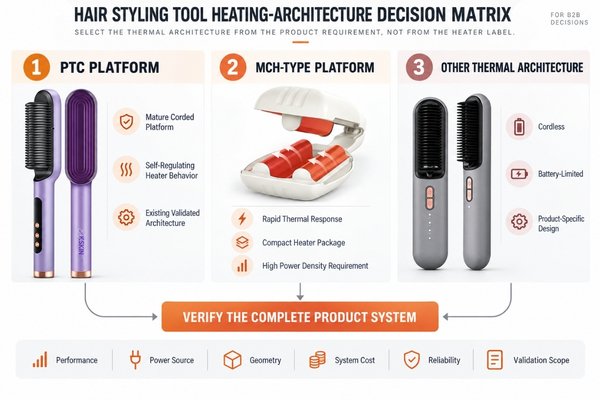
| Project Requirement | What to Evaluate First |
|---|---|
| Mature corded heated-styling platform | Whether an existing validated PTC architecture already meets the requirement |
| Self-regulating heater behavior is valuable | PTC characteristics and complete control design |
| Rapid thermal response is a priority | MCH-type ceramic heater feasibility and measured product response |
| Compact high-density heating is required | Heater package, watt density and thermal integration |
| Cordless or battery-limited product | Complete battery, power and thermal architecture rather than the PTC/MCH label |
| Lowest total product cost | Implemented system cost, not heater price alone |
| High reliability requirement | Thermal-cycle evidence for the exact version |
| Private-label project on an existing platform | Retain the validated architecture unless a redesign has a clear commercial reason |
For many private-label projects, the strongest engineering decision is not to replace the heater at all.
If an established styling platform already meets the intended temperature, usability, market and commercial requirements, changing from PTC to MCH can require new work involving:
- PCB design;
- temperature calibration;
- thermal protection;
- housing temperature;
- insulation;
- power configuration;
- production process;
- reliability validation;
- product-safety assessment.
Hair-care appliances, including hair straighteners, fall within the scope of IEC 60335-2-23:2026. Selecting a PTC or MCH heater does not replace appliance-level evaluation against the standards and market requirements applicable to the exact product version.
The commercial benefit of changing the heater should therefore justify the engineering and validation work it creates.
Frequently Asked Questions
Is MCH always faster than PTC in a hair styling tool?
No. MCH-type ceramic heaters can support rapid heating and high power density, but finished-product heat-up depends on the heater specification, rated power, thermal mass, control strategy and mechanical integration. Compare complete product curves under the same conditions rather than assuming performance from the heater category.
Does a PTC heater control the exact surface temperature automatically?
No. PTC resistance rises sharply near its switching region, creating self-regulating behavior, but the final working-surface temperature also depends on voltage, thermal load, mounting, heat spreading, sensor location and control logic. Self-regulation is not the same as precise surface-temperature control.
Which heater provides better temperature uniformity?
Neither technology guarantees uniformity by itself. Heater geometry, the mounting interface, the heat spreader, plate or comb construction and heat loss all affect surface-temperature distribution. Buyers should compare multi-point measurements from the complete product.
Is MCH more energy-efficient than PTC?
Not necessarily. Energy use depends on rated power, warm-up time, control duty cycle, target temperature, heat loss and usage pattern. Compare watt-hours or another appropriate energy measure over the same defined operating cycle rather than relying on a generic efficiency percentage.
Should a private-label buyer change an existing PTC platform to MCH?
Only when the project has a clear performance or commercial requirement that the current architecture cannot meet. Changing the heater can affect temperature control, PCB design, power components, mechanical integration, reliability testing and compliance evaluation. A validated existing platform is often the lower-risk option for private-label development.
Conclusion
PTC and MCH describe different heating technologies, but neither label determines the quality of a finished styling tool. Buyers should compare measurable thermal behavior, control architecture, structural fit, total implemented cost, reliability evidence and production consistency under defined conditions.
Start with the product requirement, then evaluate which heating architecture can meet it with repeatable evidence. Explore K·SKIN’s hair styling tools or contact our team with your product format, power configuration, target temperature requirements and sample-validation scope.