A leaking facial steamer may indicate a simple filling issue, a water-path problem, an assembly deviation, transport damage, or a defect that requires supplier correction.
Facial steamer leakage can originate from the water tank, fill opening, seals, tank interface, water-path connections, heating-area joints, steam path, nozzle, or housing. Buyers should first determine when and where the water appears, then reproduce the condition before assigning a cause. Condensation and nozzle spitting should be distinguished from repeatable structural leakage before a sample is approved or rejected.
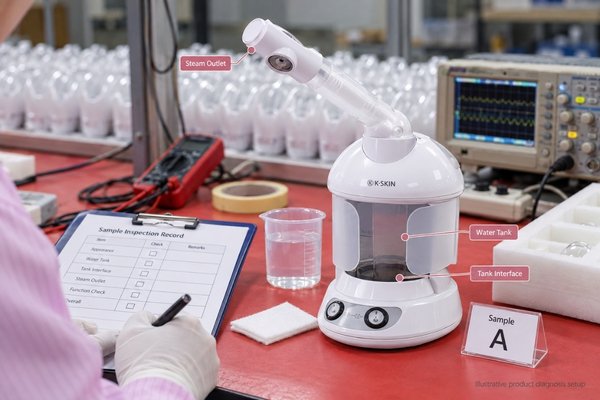
For brands, importers, and distributors evaluating facial steamer platforms, the important question is not simply whether water is visible. The diagnosis should identify the failure stage, first wet location, repeatability, affected product area, and corrective action required before approval.
A repeatable record also helps distinguish an isolated handling issue from a product or assembly problem that may recur during production.
Is It Really a Leak?
Visible moisture around a steamer can have several causes. Treating every water droplet as the same defect may send the investigation in the wrong direction.
A true leakage problem means that water repeatedly escapes from a location where the approved product is expected to remain sealed. Condensation forms when steam contacts a cooler surface, while spitting or water carryover occurs at the steam outlet. The location, timing, and repeatability of the water are therefore more informative than simply recording that the product was “wet.”
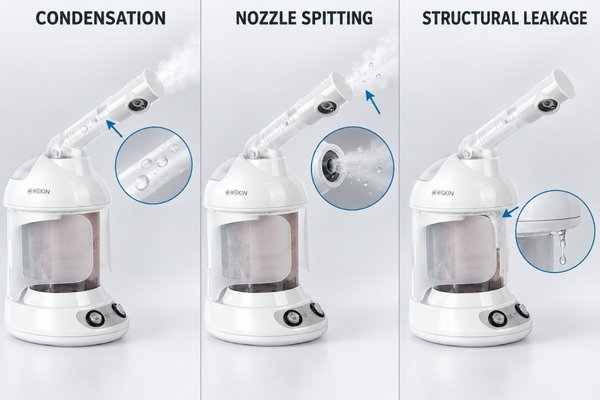
| Observation | What It May Indicate | Buyer Response |
|---|---|---|
| Droplets form near the steam outlet after operation | Condensation may be forming as the steam cools | Record the location and confirm whether it is expected under normal operation |
| Water droplets are expelled with the steam | Possible water carryover, overfilling, or a steam-path issue | Recheck the fill condition and reproduce the outlet behavior |
| Water appears around the tank interface while stationary | Possible tank, sealing, or fit problem | Repeat a static leakage check |
| Water appears beneath the housing before heating | Possible tank, interface, or housing issue | Stop and locate the first wet point before operation |
| Moisture appears only after heating begins | Possible hot-state water-path or joint problem | Record the timing and inspect the affected area |
| Water reaches an electrical opening or creates unsafe operation | Potential safety concern | Stop the test immediately |
Operating instructions for facial steam appliances often specify both the water type and the maximum fill level. For example, Conair’s facial sauna instructions specify distilled water and a maximum fill line, while HoMedics facial steamer instructions warn against overfilling and also specify distilled water for that product.
These instructions should not be generalized into one universal rule for every steamer. Buyers should use the water type and fill condition specified for the exact product version being evaluated.
When Does the Water Appear?
The stage at which water first appears can narrow the investigation faster than immediately disassembling the product. Record what happened before the first unexpected wet point developed.
Separate the diagnosis into filling, static holding, controlled orientation, heating, cooldown, and post-transport conditions. A product that leaks immediately after filling may have a different problem from one that remains dry while cold but develops moisture during heating. Recording the stage at which leakage begins helps the supplier investigate the correct part of the water path instead of guessing from the final puddle location.
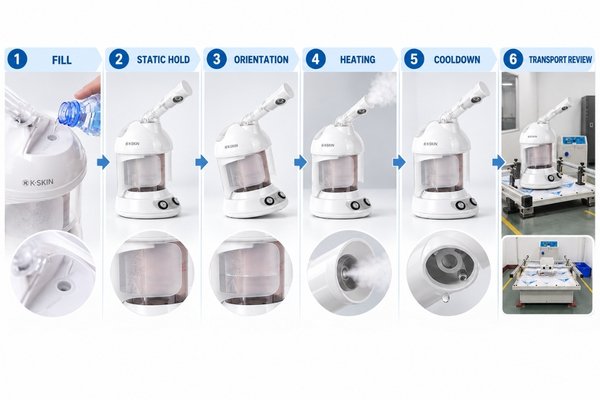
| Stage | What to Observe | Areas to Review First |
|---|---|---|
| After filling | Residual external water, fill level, tank seating, cap, or closure condition | Tank, fill opening, seal |
| Static hold | First wet location around or beneath the unit | Tank interface, seal, housing |
| Controlled orientation | Whether leakage appears only in a repeatable position | Fill opening, tank interface, assembly fit |
| Heating and steaming | Whether moisture begins only after thermal operation | Water path, heating-area connection, steam path |
| Steam outlet | Normal mist, condensation, droplets, or continuous water carryover | Steam path, nozzle |
| Cooldown | Residual moisture or water returning through the steam path | Steam path, tank interface |
| After transport | New crack, deformation, loosened fit, or shifted component | Tank, housing, connections, packaging protection |
This sequence is particularly useful when the supplier and buyer are in different locations. A report such as “the sample leaked during operation after seven minutes, first visible at the rear tank interface” is far more actionable than “water was found under the product.”
The same method helps identify transport-related problems. If the product remains dry during factory evaluation but leaks after the sample is received, the investigation should cover the product condition, tank seating, cracks, packaging restraint, and transport effects rather than immediately assuming that the end user caused the problem.
Which Parts Can Cause Facial Steamer Leakage?
Facial steamers use different tank, heating, and steam-path architectures. Diagnosis should begin with functional areas rather than with the assumption that every model contains the same valve, gasket, or internal connection.
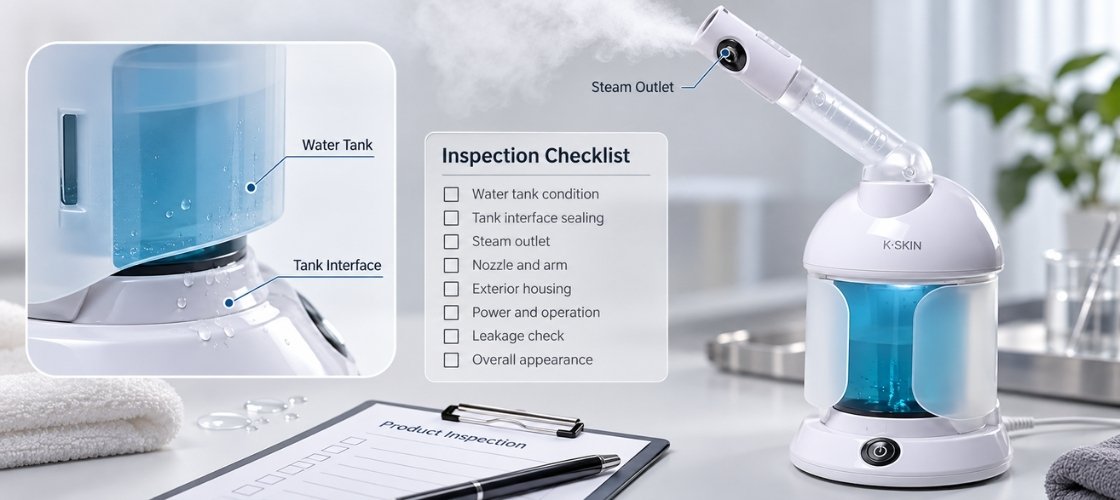
Common leakage areas include the water tank, fill opening, seals, tank-to-unit interface, internal water-path joints, heating-area connections, steam path, nozzle, and housing. The visible wet location does not always reveal the true source because water may travel along internal surfaces before exiting. The first reproducible wet point is usually more useful than the place where the water eventually collects.
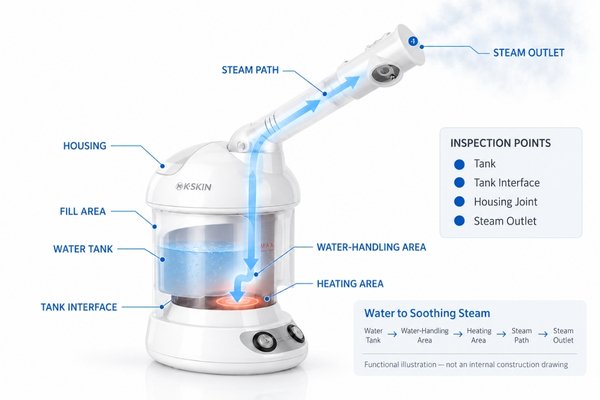
| Functional Area | Possible Problem | Typical Clue |
|---|---|---|
| Water tank | Crack, deformation, or incorrect seating | Leakage begins while the unit is filled or stationary |
| Fill opening or closure | Incomplete closure, seal issue, or overfilling | Water appears shortly after filling or an orientation change |
| Seal or gasket | Damage, contamination, compression, or assembly variation | Repeatable wetness around a defined interface |
| Tank-to-unit interface | Fit, dimensional, or assembly deviation | Leakage appears where the removable tank connects to the main unit |
| Water-path connection | Loose or damaged connection or assembly deviation | Water appears inside or beneath the housing |
| Heating-area connection | Joint or sealing issue affected by thermal operation | The product remains dry when cold but leaks after heating |
| Steam path | Condensation, blockage, or abnormal water carryover | Outlet behavior changes during steaming |
| Nozzle or steam arm | Condensation or unintended droplets | Moisture appears primarily around the outlet |
| Housing | Crack, deformation, or assembly gap | External leakage follows a visibly damaged area |
If a specific design uses valves, O-rings, tubes, or other sealing components, those parts can be examined during the supplier’s root-cause analysis. They should not be assumed to exist in every steamer architecture.
A larger-tank product such as the KD2328 facial steamer illustrates why water handling should be reviewed through several separate checks. Its sample evaluation covers tank fit and sealing, filling condition, steam behavior, and abnormal outlet droplets rather than treating all visible water as one type of failure.
How Should Buyers Reproduce a Facial Steamer Leakage Problem?
A useful leakage test must reproduce the same conditions across samples. Changing the water quantity, tank installation, product position, or operating sequence between attempts makes root-cause analysis unreliable.
Begin with a dry, identified sample and the approved water and fill condition. Test the product first without power, then through controlled orientation, normal operation, and cooldown. Record the first unexpected wet location, timing, and operating state. If the problem repeats, test another unit using the same method before deciding whether the issue is isolated or potentially related to the product version.
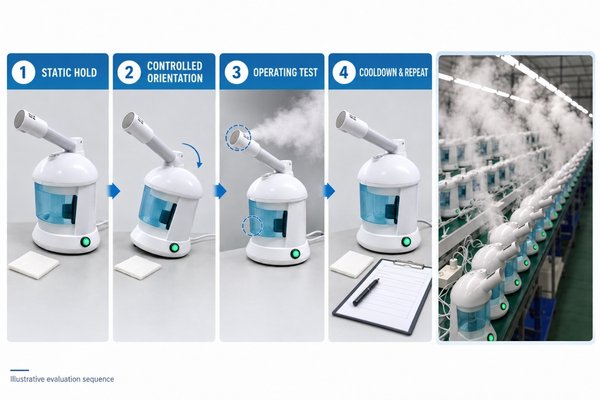
Stage 1: Fill and Static Hold
Record the model, sample revision, and water quantity or fill level before starting.
Dry the outside of the tank, the housing, and the work surface so that residue from filling cannot be mistaken for leakage. Install the tank or closure according to the approved operating method, then place the product in its normal stationary position.
Before applying power, inspect the tank, fill opening, tank interface, and bottom of the unit.
If water already appears in an unintended location, record the first wet point. Do not continue merely to see whether heating makes the problem worse.
Absorbent material can help locate moisture during an unpowered static check, but it must not obstruct vents, electrical openings, or normal assembly interfaces.
Stage 2: Controlled Orientation Check
Some leakage complaints occur only when a filled product is moved, installed, or repositioned.
Use a defined, repeatable orientation that remains within the intended handling or evaluation scope. Apply the same movement and hold condition to every sample being compared.
Do not impose a universal requirement such as a specific angle and duration unless that criterion has already been defined for the project. An inverted-product test, for example, should not be treated as a normal-use requirement unless it is specified in the product requirements or test plan.
Stage 3: Operating Test
Once the cold-state product has passed the applicable static check, operate it according to the approved instructions.
Record:
- when visible steam begins;
- where moisture first appears;
- whether the tank interface remains dry;
- whether the outlet produces normal steam or abnormal droplets;
- whether leakage begins only after the unit becomes hot;
- whether the condition remains stable, worsens, or disappears during operation.
Do not place paper, hands, or diagnostic materials near electrical openings while the appliance is energized. If water reaches an electrical area or the product behaves abnormally, stop the test.
Stage 4: Cooldown and Repeat
After switching off the unit and allowing it to cool according to the normal handling procedure, inspect the water path, tank interface, housing, and surrounding surface again.
Repeat the same procedure if the first result is unclear. Where practical, compare more than one unit from the same sample revision.
Photographs or short videos should show the sample identification, operating stage, and first visible water location. This makes the result easier for the supplier to reproduce.
How Should a Leakage Defect Be Classified?
Not every moisture observation calls for the same commercial decision. Buyers should classify the result according to its repeatability, location, operating condition, and potential consequence.
Repeatable leakage from a sealed tank or water-path interface should normally prevent approval of the current sample until the cause has been corrected and the product retested. Unexplained moisture should first be reproduced, while expected condensation should be documented separately. If water reaches electrical areas or causes abnormal operation, testing should stop rather than continue solely to complete the checklist.
| Observation | Suggested Buyer Action |
|---|---|
| Water reaches an electrical area or operation becomes unsafe | Stop testing immediately and escalate the issue for technical review |
| Repeatable leakage from a tank, seal, or water-path interface | Do not approve the current sample |
| Abnormal outlet spitting or water carryover | Confirm the filling and operating conditions, investigate, and retest |
| One isolated wet mark with an uncertain origin | Dry the unit, reset the method, and reproduce the condition |
| Moisture appears only after transport | Inspect the product condition and packaging-related factors |
| Condensation occurs at an expected steam-contact area | Record it separately and confirm that it is not structural leakage |
These are buyer-side decision principles, not universal regulatory defect classifications. Formal acceptance limits should follow the project specification, approved sample, applicable safety requirements, and agreed test plan.
What Should the Supplier Provide After a Leakage Failure?
Sending a replacement sample without explaining the failure may remove the symptom from one unit, but it does not show that the underlying problem has been understood.
After a repeatable leakage failure, buyers should request the failed sample identity, failure stage, leak location, root-cause finding, corrective action, before-and-after evidence, and retest result. If the correction changes a component, dimension, assembly process, or water-path structure, the revised sample should receive a new identifiable version, and the effect on related functions should be reviewed before approval.
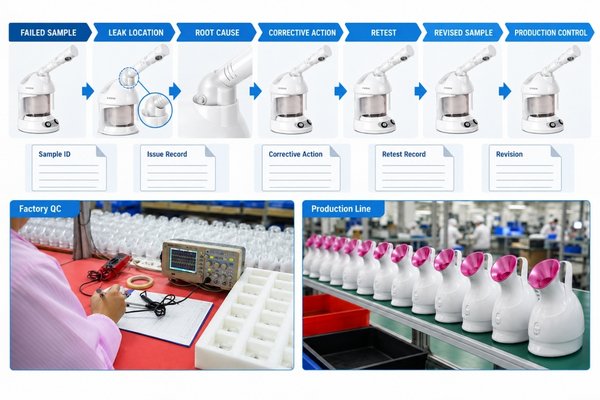
A useful supplier response can be organized around the following records:
| Supplier Record | What the Buyer Needs to Know |
|---|---|
| Failed sample ID | Exactly which model and revision failed |
| Failure stage | Filling, static, orientation, operation, cooldown, or transport |
| First leak location | Where unintended water first became visible |
| Root-cause finding | The confirmed cause rather than an unsupported assumption |
| Corrective action | Which component, dimension, assembly step, or process was changed |
| Before-and-after evidence | How the revised condition differs from the failed version |
| Retest method | Whether the corrected sample was checked under the same failure condition |
| Retest result | Whether the leakage was successfully reproduced or eliminated |
| Change impact review | Whether the correction could affect steam, heating, controls, or assembly |
| Revised sample reference | Which version is now proposed for approval |
If the leakage results from assembly variation rather than a product-design change, the supplier should still explain how production controls will prevent it from recurring.
K·SKIN’s manufacturing and quality framework treats facial steamers as water-path and steam-system products that require model-specific checks of water-system operation, leakage, heating, steam output, controls, and operating stability. The approved product version should remain tied to those checks throughout production.
Which Operating Conditions Can Mimic or Worsen Leakage?
Not every failed observation begins with a defective part. Filling, water quality, installation, product position, and residue can affect water handling and should be controlled before a manufacturing cause is assigned.
Overfilling, incomplete tank seating, external water left after filling, incorrect product position, mineral accumulation, steam-path obstruction, or the use of an unapproved liquid can produce symptoms that resemble or worsen leakage. These factors should be checked without automatically blaming the user; a repeatable failure under the approved operating method still requires a product-level investigation.
Common variables include:
- filling above the specified level;
- a tank or closure that is not fully seated;
- water remaining on the outside of the tank after filling;
- operating the product outside its intended position;
- mineral accumulation affecting heating or steam flow;
- an obstruction in the steam path or outlet;
- liquids or additives not permitted by the approved instructions;
- residual water left in the system before storage or transport.
Mineral buildup is particularly relevant because it can affect steam performance and internal flow. Manufacturers of other steam appliances also identify mineral accumulation as a possible cause of intermittent or restricted steam behavior. This does not prove that mineral buildup caused a particular facial steamer leak; it is one operating variable to eliminate during diagnosis.
For K·SKIN projects, the water type, cleaning procedure, and storage instructions should follow the approved manual for the selected model rather than a generic maintenance schedule.
Frequently Asked Questions
How can I tell condensation from an actual facial steamer leak?
Start by identifying where and when the water appears. Moisture near a steam outlet or a cooler steam-contact surface may be condensation, while repeatable water emerging from a tank interface, housing joint, or other normally sealed area points more strongly to leakage. Dry the product and repeat the same operating condition before deciding.
What parts commonly cause a facial steamer to leak?
Potential areas include the tank, fill opening, seal, tank-to-unit interface, water-path connections, heating-area joints, steam path, nozzle, and housing. The exact component depends on the product architecture, so the supplier’s inspection should confirm the internal cause before corrective action is assigned.
How should a buyer reproduce a leakage problem on a sample?
Use the same identified sample version, water type, fill condition, product position, and operating sequence each time. Begin with an unpowered static check, proceed to controlled orientation where relevant, then operate the product normally and inspect it again after cooldown. Record the first wet point and whether another unit shows the same behavior.
Can mineral buildup cause symptoms that look like leakage?
Mineral buildup can affect heating surfaces and steam paths, which may contribute to restricted flow, intermittent steam, or abnormal water carryover. It should be considered as an operating variable, but buyers should not assume that it explains repeatable leakage from a sealed interface without reproducing and locating the fault.
What should a buyer request from a supplier after a leakage failure?
Request the failed sample reference, failure condition, root-cause analysis, corrective action, before-and-after evidence, and retest result. If the change affects the product configuration or water-path structure, confirm the revised sample version before approval and review whether other product functions require revalidation.
Conclusion
A facial steamer leak should be diagnosed by its stage, location, and repeatability rather than by the final place where water collects. Separating condensation and nozzle spitting from structural leakage, controlling the test method, and tracing the first unexpected wet point give buyers a much stronger basis for sample approval and supplier corrective action.
To evaluate an existing platform, compare K·SKIN’s facial steamers or review the KD2328 large-tank facial steamer. For a sourcing or development project, contact the K·SKIN project team with the product model, failure stage, and sample-validation requirements you want reviewed.