Approving a facial steamer sample requires more than confirming visible steam. A reliable review connects product performance, water-system behavior, protection functions, construction, packaging and version records.
A facial steamer sample should be approved only after the buyer fixes the product version and test conditions, compares at least two or three equivalent units, records warm-up and full-cycle behavior, inspects the water path and protection functions, classifies deviations and retains a signed approval sample as the reference for production.
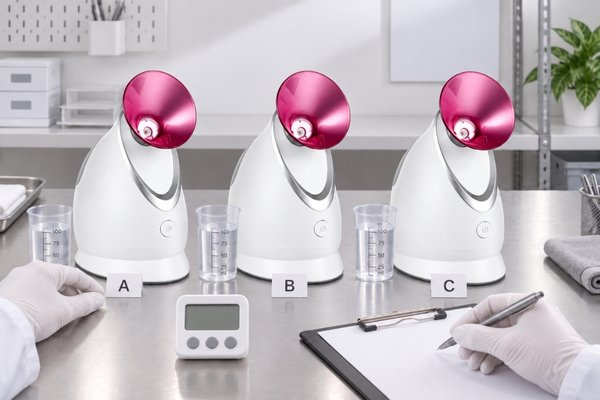
For brands, importers and distributors, sample approval is the point where a product concept becomes a controlled commercial reference. The review should cover the complete unit, not only its primary steam function.
This checklist applies to established products, private-label configurations and selected OEM/ODM samples. It supports commercial and functional evaluation but does not replace accredited safety testing or production-lot inspection.
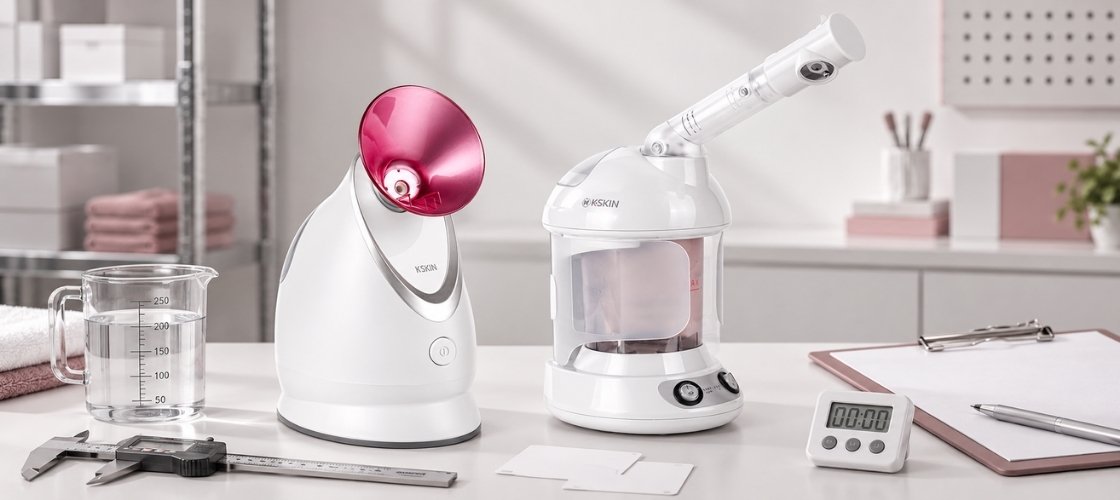
Buyers comparing different facial steamer platforms should first define the target market, sales channel and intended product configuration. A compact tabletop model and a larger-capacity platform may require different acceptance criteria even when both produce warm steam.
What Should Be Fixed Before Testing a Facial Steamer Sample?
Comparable results require comparable samples. Every unit should represent the same agreed product configuration and begin testing under documented conditions.
Before testing, record the model, revision, sample number, rated electrical version, plug, functions, water-system configuration, accessories, branding and packaging revision. Use the same approved water type, fill quantity, starting condition, power supply, operating position and observation method for every sample being compared.
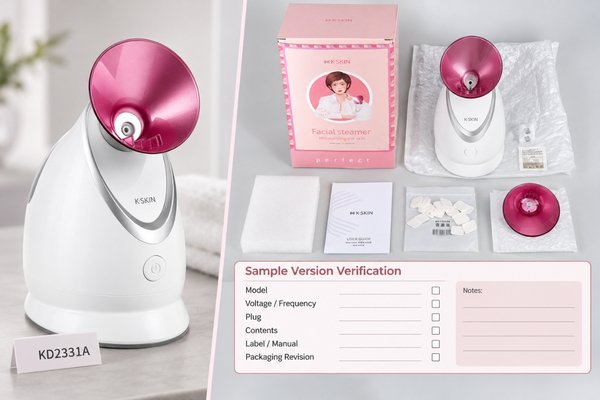
A sample that looks identical externally may still contain a different heater, control board, water tank, seal, cord or protection configuration. Packaging and rating-label changes can also create a different commercial version.
The sample identity record should contain the following fields:
| Control Field | Information to Record | Why It Matters |
|---|---|---|
| Product identity | Model, revision and sample ID | Connects every result to a traceable unit |
| Functional configuration | Heating, steam, control and accessory functions | Prevents different configurations from being compared |
| Electrical version | Rated voltage, frequency, plug and cord | Keeps testing aligned with the destination market |
| Water system | Tank, cap, seal, nozzle or steam-arm version | Defines the water path being evaluated |
| Appearance | Color, finish, logo and printing | Establishes the intended retail presentation |
| Accessories | Included parts and approved quantities | Prevents incomplete samples from being approved |
| Product information | Rating label, warnings and manual revision | Connects the unit to its market-facing documentation |
| Packaging | Inner tray, retail box and carton revision | Defines the complete commercial product |
| Test conditions | Water type, fill quantity and starting condition | Makes results comparable across units |
| Test record | Date, reviewer, equipment and method | Allows the result to be repeated and reviewed |
Two or three equivalent units provide a useful preliminary comparison because they can reveal unit-to-unit variation. They do not provide statistical proof of future production quality.
Acceptance limits should be agreed before the results are reviewed. If warm-up time, steam behavior or cosmetic tolerance has not been defined, record the item as “not defined” and resolve it before approval instead of creating a limit that conveniently matches the sample.
What Should a Facial Steamer Sample Evaluation Checklist Include?
The checklist should connect each inspection item to a repeatable method, a measurable or observable record, an acceptance basis and supporting evidence.
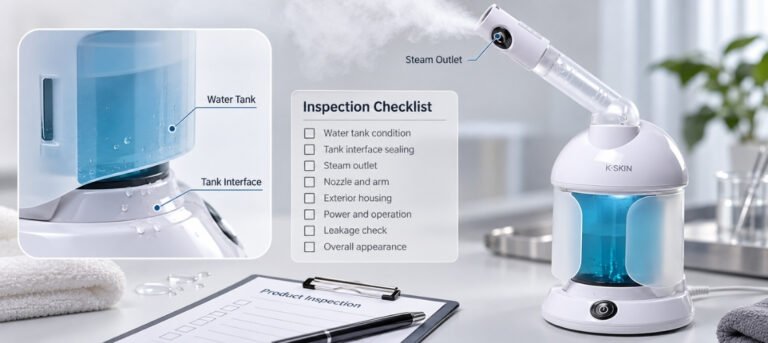
A complete facial steamer sample checklist should cover product identity, cold-start behavior, steam stability, abnormal droplets, tank fit, water-path leakage, nozzle movement, controls, protection behavior, continuous operation, assembly, appearance, accessories, labels and packaging. Each line requires a result and evidence rather than a general comment such as “works normally.”
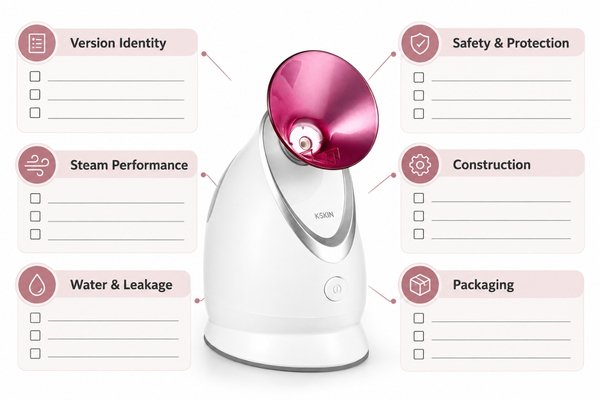
The following structure can be adapted to the selected model and project requirements:
| Check Area | Evaluation Method | What to Record | Acceptance Basis | Suggested Evidence |
|---|---|---|---|---|
| Sample identity | Compare each unit with the approved project file | Model, revision and sample ID | Confirmed specification | Product and label photographs |
| Cold start | Start each unit from the defined initial condition | Time to first steam and stable output | Project specification | Timer record or video |
| Steam stability | Observe the defined operating cycle | Interruptions, pulsing or declining output | Approved sample and requirement | Continuous video and log |
| Droplet behavior | Observe the outlet during normal operation | Spitting, large droplets or abnormal condensation | Defined product requirement | Close-up photographs or video |
| Tank installation | Remove, fill and reinstall the tank as intended | Fit, closure, alignment and handling | Approved construction | Before-and-after photographs |
| Water-path leakage | Inspect before, during and after operation | Location, timing and amount of visible moisture | No unintended external leakage | Inspection photographs |
| Nozzle or steam arm | Move through the intended adjustment range | Movement, holding position and steam direction | Approved mechanical reference | Position photographs |
| Controls and indicators | Operate every user control | Response, sequence and indicator behavior | Functional specification | Operation record |
| Protection behavior | Follow the approved protection-test method | Trigger condition and product response | Model-specific protocol | Test log |
| Continuous operation | Complete the defined operating cycle | Noise, odor, interruption and housing condition | Project requirement | Running record |
| Appearance and assembly | Inspect housing, joints, printing and stability | Gaps, scratches, looseness or misalignment | Cosmetic limit sample | Detailed photographs |
| Commercial version | Compare accessories, label, manual and packaging | Version, language, quantity and market details | Approved order file | Packaging photographs |
The working checklist should provide separate result fields for every sample. A single combined “Pass” can hide variation between units. Record Pass, Fail or Not Evaluated for each item, followed by the deviation, evidence reference, reviewer and date.
A failed result should describe what occurred. “Steam output interrupted twice after the midpoint of the cycle” is useful. “Steam unstable” is too vague to support engineering review or retesting.
How Should Buyers Test Steam Performance, Water Flow, and Leakage?
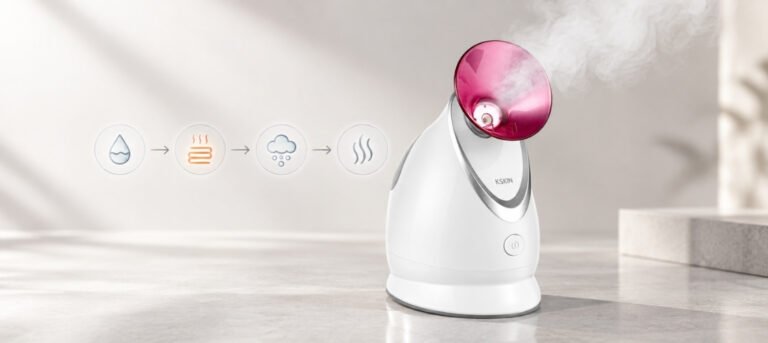
Steam performance depends on the complete path from the tank and heater to the outlet. The review should examine that path throughout a controlled operating cycle.
Test each facial steamer from a comparable cold start with the same water specification, fill level and electrical version. Record the transition from startup to stable steam, observe output throughout the defined cycle, inspect for abnormal droplets and examine the tank, seals, housing joints and surrounding surface before, during and after operation.
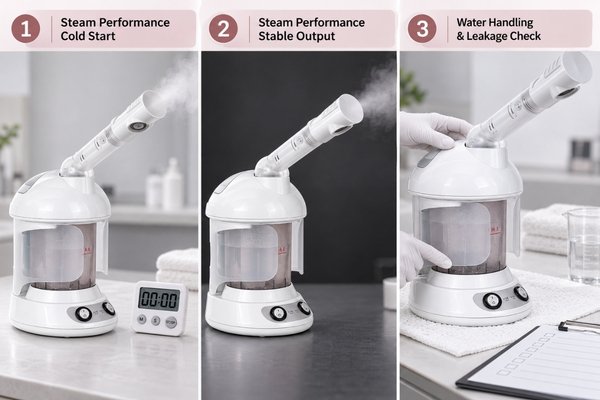
Start With a Controlled Cold-Start Test
Allow every unit to reach the same defined starting condition before testing. Fill the tank using the water type and quantity specified for that model, place the unit on a stable surface and use the approved operating position.
Record two separate events:
- Time from activation to the first visible steam.
- Time from activation to the defined stable operating condition.
First visible steam is not necessarily stable steam. Separating these observations prevents an early intermittent output from being reported as the full warm-up result.
Use the same timer method and camera position for all units. If the product is available in several rated versions, test and report each version separately.
Observe the Complete Operating Cycle
A short demonstration may miss interruptions that appear after the heater, water path and housing reach their operating condition. Run each unit for the cycle defined in the test plan and record observations at consistent checkpoints.
The record should cover:
- Steam continuity
- Visible changes in output
- Pulsing or repeated interruption
- Abnormal droplets from the outlet
- Control and indicator response
- Unexpected noise
- Unusual odor
- Moisture outside the intended water path
- Product response at the normal end of the cycle
Do not convert a single observation into a universal product specification. If operating time or steam output has not been measured under a defined method, describe the test procedure without publishing an unsupported number.
Inspect the Tank, Seals and Steam Outlet
Inspect the dry unit before filling so that pre-existing marks are not mistaken for leakage. After tank installation, check its fit, closure and alignment before switching on the product.
During normal operation, observe the tank connection, housing joints, base and steam outlet. After shutdown and cooling, remove the tank according to the instructions and inspect the surrounding areas again.
Different product structures require different checkpoints. Buyers evaluating the compact KD2331A facial steamer should follow the tank and adjustable-nozzle arrangement of that approved version. A larger platform such as the KD2328 facial steamer requires checks that match its own tank, steam arm and control configuration.
Do not deliberately tip an energized unit, block the outlet, defeat a protection device or perform other abnormal-operation tests unless the procedure has been defined and is conducted by qualified personnel.
| Observed Condition | Areas to Investigate |
|---|---|
| Delayed stable steam | Starting condition, water quantity, electrical version, heater and water delivery |
| Intermittent output | Water supply, heating control, blockage, tank installation and operating position |
| Large outlet droplets | Condensation path, outlet geometry, startup condition and water delivery |
| Moisture under the product | Tank connection, seals, internal water path and assembly |
| Output changes when the nozzle moves | Nozzle position, hose or channel routing, connection and condensation |
This table identifies investigation areas. It does not establish the cause of a failure without inspection and supporting evidence.
How Should Buyers Check Protection, Construction, and the Commercial Version?
Steam performance alone cannot approve a retail-ready product. Protection behavior, physical construction and market-facing components must match the version intended for production.
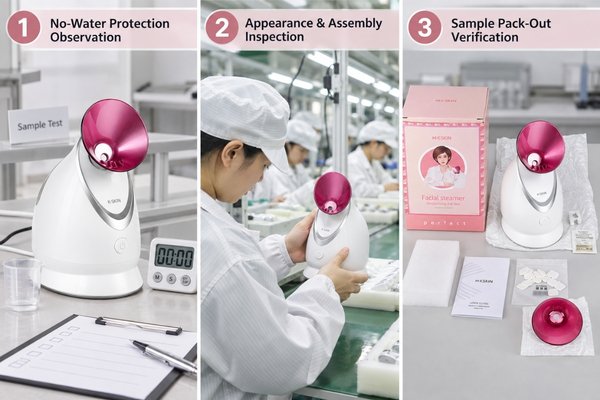
Verify every specified control and protection function using an approved procedure, then complete the defined operating cycle while observing the housing, cord, switches, indicators, noise, odor and stability. Finish by matching the unit, accessories, rating label, warnings, manual, plug and packaging to the confirmed destination-market version.
Protection Tests Require a Defined Procedure
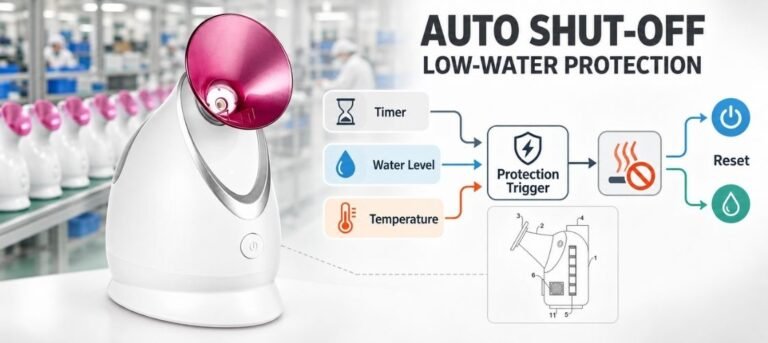
Where the model includes no-water, overtemperature or other protective behavior, the test plan should define the starting condition, trigger condition, expected response and reset behavior.
Routine buyer evaluation should not involve dismantling a live product or bypassing its controls. Formal tests covering electrical construction, abnormal operation, moisture resistance and accessible temperatures require suitable equipment and qualified personnel.
The IEC overview for IEC 60335-2-23:2026 notes that skin-care appliances, including facial saunas, were relocated to IEC 60335-2-115 in the 2026 revision. The applicable standard, national adoption, edition and rated product version should therefore be confirmed with a qualified compliance partner for the destination market.
A buyer checklist can identify which evidence must be reviewed. It cannot certify that a product complies with a standard.
Review Continuous Operation and Construction
Observe the unit through the model-defined operating cycle rather than only during startup. Record any change in sound, odor, steam behavior, control response or housing condition.
The physical review should include:
- Housing fit and visible gaps
- Tank and removable-part alignment
- Switch and indicator operation
- Nozzle or steam-arm movement
- Cord entry and strain-relief condition
- Product stability on the intended surface
- Printing and logo position
- Surface finish and color consistency
- Accessibility for normal filling, cleaning and drying
If one unit behaves differently from the others, isolate the sample and investigate the deviation. Averaging the observations can conceal an individual failure.
Approve the Complete Commercial Version
A technically functional unit can still be unsuitable for production if the plug, label, manual or packaging is incorrect.
Compare the sample against the approved commercial file and confirm:
- Product and accessory configuration
- Destination-market electrical version
- Plug and cord
- Rating label and warning information
- Manual language and revision
- Logo, color and surface finish
- Included accessories
- Retail-box artwork and inner support
- Barcode and carton marks
- Packing quantity and version
K·SKIN’s manufacturing and quality-control process is built around controlling the approved product version through assembly, product-specific checks, packaging and commercial release. Sample records should define the reference that these later controls are expected to reproduce.
How Should Failed Items Be Classified and the Approved Sample Controlled?
A useful evaluation ends with a documented decision. Unclassified comments and unrecorded changes create uncertainty when the project moves into production.
Classify every deviation by its safety, functional, cosmetic or documentation impact. Stop approval for potential safety or market-version conflicts, correct and retest major functional failures, record minor cosmetic issues against agreed limits, and approve production only after the final sample, test record, product specification and packaging version describe the same product.
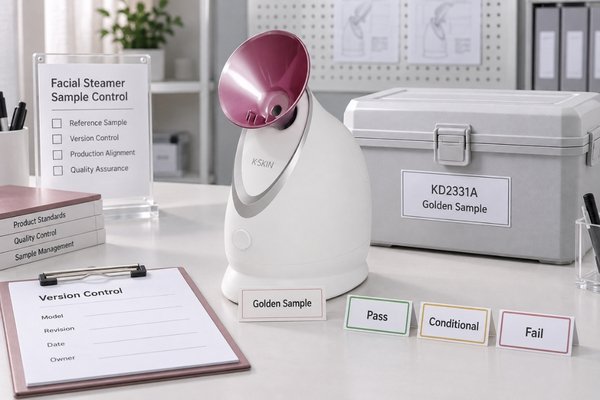
A practical classification framework is shown below. Exact definitions and acceptance rules should be agreed for the project and reflected in the inspection plan.
| Classification | Typical Meaning | Recommended Disposition |
|---|---|---|
| Critical | Potential safety issue, prohibited condition or incorrect electrical version | Stop approval and investigate |
| Major | Core function failure, repeated leakage, unstable operation or substantial specification mismatch | Correct and retest |
| Minor | Cosmetic deviation that does not affect function and may fall within an agreed limit | Record and compare with the approved limit |
| Documentation mismatch | Product, label, manual, accessory or packaging revisions do not align | Hold approval until the versions are corrected |
Avoid “approved with minor issues” unless every open item has an owner, required action, due date and defined approval condition. Otherwise, the phrase can be interpreted differently by purchasing, engineering, quality and production teams.
Retest the Areas Affected by a Change
A correction should not be approved only from a photograph or written explanation. Retest the changed item and any connected functions.
For example, changing a tank seal may require another leakage and installation review. Changing the heater or control board may require warm-up, steam-stability, protection and electrical verification. Changing the housing can affect tank fit, nozzle movement, stability, labels and packaging.
Create a Controlled Approval Record
The final approval package should identify:
- Project and customer
- Product model and revision
- Electrical and market version
- Sample identification numbers
- Test conditions and equipment
- Evaluation date and reviewers
- Results and evidence references
- Approved deviations
- Corrective actions and retest results
- Final product, label and packaging images
- Approval decision and signatures
- Location of retained reference samples
- Conditions that require reapproval
Where practical, both buyer and supplier should retain a clearly identified approved sample. The purchase order, product specification, packaging files and inspection documents should refer to the same controlled version.
Keep Sample Approval Separate From AQL Inspection
Testing two or three development or commercial samples helps define and approve the product. It does not statistically represent a future production lot.
ISO 2859-1:2026 defines AQL-indexed acceptance-sampling schemes for lot-by-lot inspection. That process applies after the product, defect definitions, inspection level and production lot have been established.
Sample approval and production inspection answer different questions:
| Process | Main Question |
|---|---|
| Sample evaluation | Is this the product version the buyer intends to approve? |
| Engineering or compliance validation | Does the defined product meet the applicable technical requirements? |
| Production-lot inspection | Does the inspected lot conform to the approved product and acceptance plan? |
A good sample does not guarantee that every production unit will match it. A passed production inspection cannot correct an unclear or incomplete approved sample.
Frequently Asked Questions About Facial Steamer Sample Approval
How many facial steamer samples should a B2B buyer evaluate?
Two or three equivalent units provide a practical starting point for comparing behavior and identifying obvious variation. More samples may be needed for higher-risk changes or wider validation. This preliminary quantity is not an AQL sample size and does not establish production-lot quality.
What water should be used during facial steamer sample testing?
Use the water type specified for the exact model and keep it consistent across all samples and repeat tests. Record the source, quantity and starting condition. Do not add oils, toner or other substances to the water tank unless the approved product instructions explicitly permit them.
Is stable visible steam enough to approve a facial steamer?
No. Stable steam is only one part of the review. Buyers should also check startup behavior, droplets, water-path leakage, tank installation, controls, protection functions, continuous operation, construction, electrical version, labels, accessories and packaging.
Can an existing test report replace physical sample evaluation?
No. A test report and a buyer sample review serve different purposes. The report must first be matched to the exact model, rated version, construction, applicable standard and market. Physical evaluation confirms the commercial sample, while accredited testing addresses defined technical or compliance requirements.
When should an approved facial steamer sample be tested again?
Retesting is required when a change can affect performance, safety, fit, user interaction or the commercial version. Typical triggers include changes to the heater, controller, water path, tank, seal, nozzle, housing, material, voltage, plug, cord, accessory, label, manual or packaging.
Conclusion
A facial steamer sample should become a controlled product reference, not a unit that received a quick visual approval. Fix the version, compare equivalent samples, use repeatable conditions, record the complete operating cycle, inspect the water path and commercial configuration, classify deviations and retain the final approved sample with its supporting records.
If you are evaluating a private-label or OEM facial steamer project, review K·SKIN’s facial steamer platforms and share your target market, preferred product format, electrical version, estimated quantity and sample priorities. The evaluation plan can then be aligned with the selected product and commercial configuration.