Facial steamer specifications often emphasize wattage, tank capacity, or “nano” terminology, but those points alone do not explain whether a sample will deliver repeatable steam throughout operation.
A facial steamer supplies water to a heated area, converts it into water vapor, and directs that vapor through a steam path and nozzle. Stable steam depends on consistent water supply, sufficient and controlled heat, steam-path design, condensation behavior, nozzle geometry, electrical conditions, and protection logic. Wattage or a “nano” claim alone cannot confirm stable output.
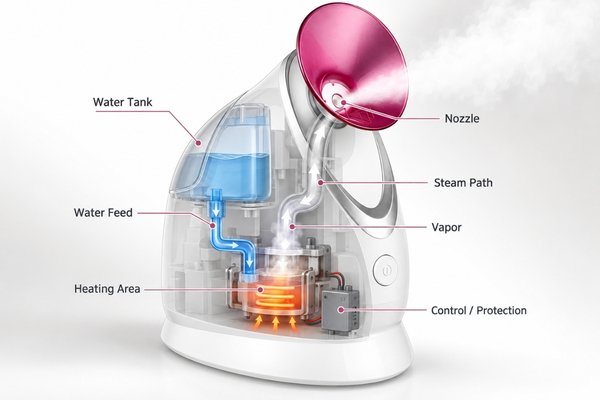
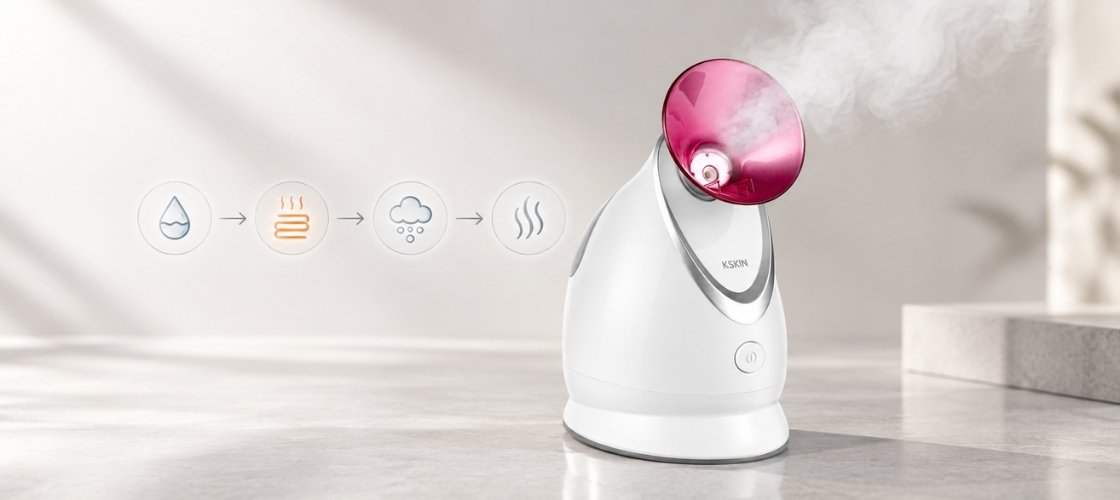
For buyers asking how a facial steamer works, the useful unit of analysis is the complete steam-generation path:
- Water is stored in a tank or reservoir.
- Water reaches the heated region through the product’s water-supply structure.
- Electrical energy is converted into heat.
- Water absorbs enough heat to generate vapor.
- Vapor moves through an internal steam path.
- The nozzle directs the outlet toward the intended use area.
- Controls and protective functions manage operation under defined conditions.
For product evaluation, stable steam should mean repeatable outlet behavior under defined water type, fill level, electrical version, starting condition, product position, and test environment. It does not imply one universal steam rate or tolerance for every facial steamer.
Buyers comparing facial steamer platforms should therefore evaluate the water, heating, flow, outlet, and control systems together.
How Does a Facial Steamer Turn Water Into Steam?
The basic phase change is simple, but the appliance must repeatedly supply water, transfer heat, move vapor, and release it without creating unstable behavior elsewhere in the system.
Water stored in the product reaches a heating area, absorbs thermal energy, and changes from liquid water into vapor. The vapor then travels through an internal passage before leaving the nozzle. The quality of this process depends not only on heater power, but also on how consistently water reaches the heated region and how the generated vapor is transferred.
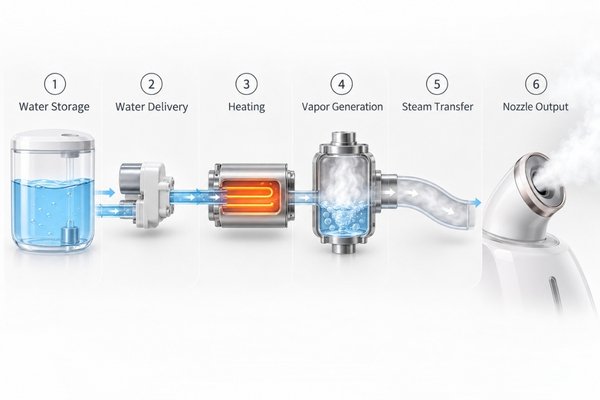
At the physical level, heat provides the energy required for liquid water to become water vapor. The U.S. Geological Survey explanation of evaporation describes this liquid-to-vapor transition and the role of added heat.
In a facial steamer, that principle becomes an engineered sequence:
| Stage | What Happens | What a Buyer Should Understand |
|---|---|---|
| Water storage | Water is held in a tank or reservoir | Tank capacity alone does not determine steam performance |
| Water delivery | Water reaches the heated area | Inconsistent supply can affect continuity |
| Heating | Electrical energy is converted into heat | Heater type and rated power are only part of the system |
| Vapor generation | Water receives enough energy to change phase | Thermal balance must continue after initial warm-up |
| Steam transfer | Vapor moves through an internal passage | Geometry and heat loss can change outlet behavior |
| Nozzle output | Vapor and visible mist leave the product | Nozzle position and geometry affect the observed output |
The important distinction is between generating vapor once and sustaining the process. A facial steamer may reach steam production quickly from a cold start yet behave differently after several minutes if water delivery, heat input, condensation, or protection behavior changes.
This is why warm-up time should not be treated as a complete measure of steam-system performance.
What Determines Stable Steam Output?
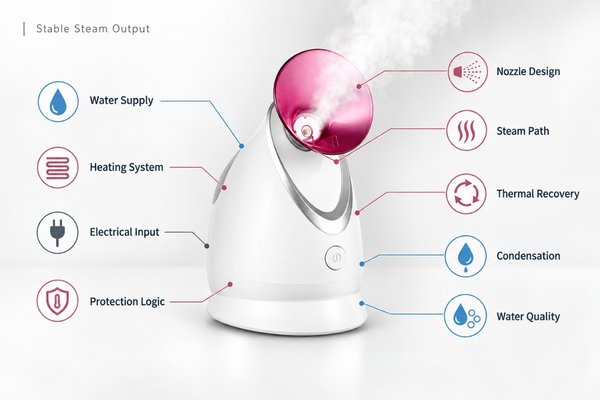
Stable steam is the result of several interacting variables. A change in only one of them may be enough to alter warm-up behavior, continuity, outlet appearance, or repeatability between samples.
The main variables are water delivery, heating capacity, electrical conditions, thermal recovery, internal steam-path resistance, nozzle geometry, condensation, water quality, and protection logic. Buyers should compare these variables under the same test conditions rather than judging steam stability from one demonstration, a wattage figure, or the density of the visible mist.
| Variable | What Can Change | What a Buyer May Observe |
|---|---|---|
| Water supply | Water reaches the heated area inconsistently | Delayed, pulsing, or interrupted output |
| Heating system | Available heat does not remain balanced with water input | Weakening or changing steam output |
| Electrical version | Voltage or power conditions differ between samples or markets | Different warm-up and operating behavior |
| Thermal recovery | Heat is removed faster than the system restores it | Output falls after initial operation |
| Steam path | Restriction, geometry, or heat loss changes | Different outlet behavior |
| Nozzle design | Outlet size, direction, or position changes | Different plume shape or direction |
| Condensation | Vapor cools before leaving the product | More visible droplets or changing mist behavior |
| Water quality | Mineral deposits accumulate over time | Possible changes in flow or heat transfer |
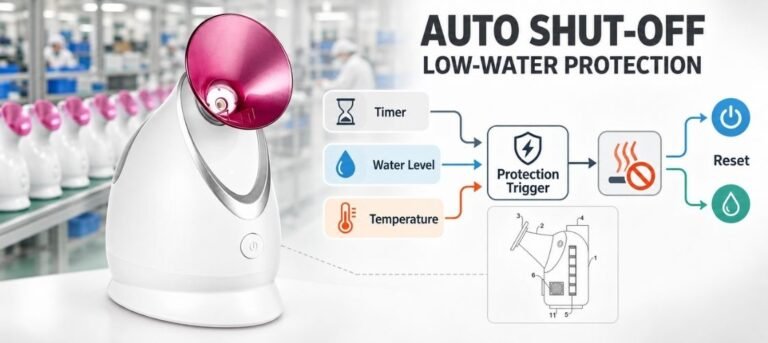
| Protection logic | A low-water or abnormal condition is detected | Heating or output may be interrupted |
Higher wattage can provide more available heating power, but it does not prove that the finished appliance will maintain better steam stability. The same principle applies to other heated beauty appliances: our hair straightener brush heating system guide explains why finished performance should not be inferred from the heater specification alone.
Water condition can also become relevant over repeated use. The U.S. Environmental Protection Agency notes that hard-water scale can impede water flow and reduce heat conductivity in water-heating equipment in its guide to water softeners and hard-water scale. The exact effect on a facial steamer depends on its design and maintenance instructions, but the underlying mechanism is a reason to confirm the approved water type and cleaning requirements.
As one product-platform example, the KD2331A facial steamer uses a 280 W PTC heating system and an adjustable nozzle. Those specifications describe the platform, but sample approval should still include actual warm-up and mist-stability observation.
Why Do Steam Path, Nozzle Design and Condensation Matter?
Steam does not move directly from a heater into open air. Before reaching the user, it may travel through chambers, passages, bends, joints, and the final nozzle.
Steam-path dimensions, internal surface temperatures, flow resistance, nozzle geometry, and product orientation can influence what appears at the outlet. As hot water vapor moves through cooler parts of the appliance and enters cooler surrounding air, some vapor can condense into liquid droplets. Steam generation and visible outlet behavior are therefore related, but they are not the same measurement.
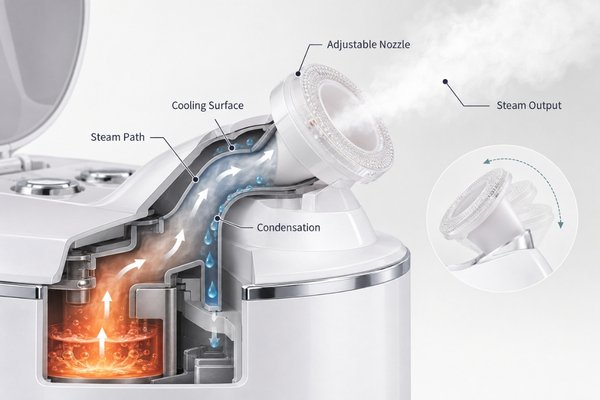
Condensation is the change from gaseous water vapor back into liquid water. The U.S. Geological Survey overview of condensation explains that cooling water vapor produces liquid droplets.
This distinction matters when visually comparing samples. The white plume seen outside a steamer is not a direct measurement of how much water vapor was generated inside the heating system. Visible mist contains condensed droplets, and its appearance can also change with room temperature, humidity, outlet geometry, and observation conditions.
During sample review, buyers should therefore separate several observations:
- Does steam begin consistently from a comparable cold start?
- Does the outlet remain continuous during the defined operating period?
- Does the nozzle maintain its intended position and direction?
- Does the visible outlet behavior change significantly after warm-up?
- Do unexpected large droplets appear at the outlet?
- Does condensate accumulate where it interferes with normal operation?
A small amount of condensation does not automatically indicate a defective product. The important question is whether outlet behavior matches the approved product design and remains repeatable under the defined test conditions.
How Should B2B Buyers Observe Steam Stability in a Sample?
A useful sample review does not require an elaborate laboratory setup at the first sourcing stage. It does require controlled conditions and a record that another person can reproduce.
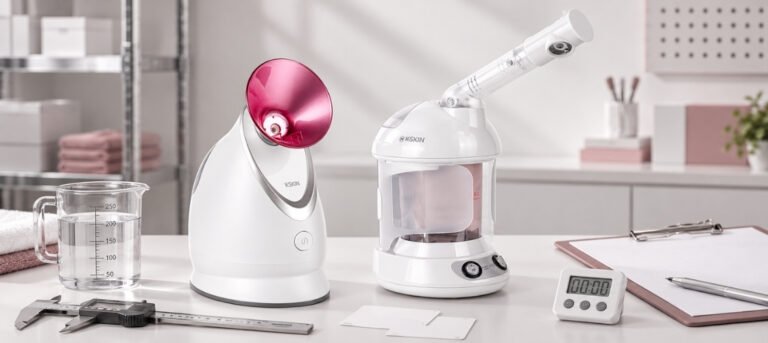
Compare samples using the same model revision, electrical version, water specification, fill condition, starting temperature, product position, and observation method. Record warm-up behavior, output continuity, obvious changes in steam intensity, unexpected interruption, liquid discharge, and protection events over a defined operating period. Repeat the observation before treating one successful demonstration as representative performance.
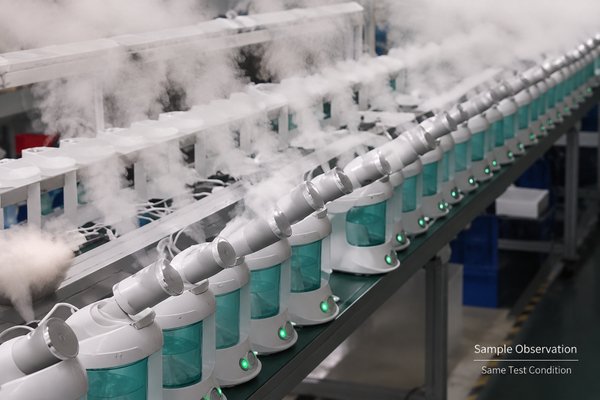
A practical early-stage comparison can follow this sequence:
- Identify each sample by model, revision, rated electrical version, and sample number.
- Use the same approved water type and a defined starting water quantity.
- Begin from comparable cold-start conditions.
- Place each unit in the operating position specified for the product.
- Record the time from startup until continuous steam output is observed.
- Continue for a defined operating window and record interruptions, obvious weakening, outlet changes, or unexpected droplets.
- Repeat the observation and compare results between units.
The test record should state the conditions rather than only report “stable” or “unstable.”
| Record | Why It Matters |
|---|---|
| Model and sample revision | Confirms that the same product version is being compared |
| Rated voltage and test supply | Prevents electrical-version differences from being mistaken for product variation |
| Water type and starting quantity | Controls an important steam-system input |
| Cold-start condition | Makes warm-up comparisons more meaningful |
| Observation period | Shows whether the result covers only startup or sustained operation |
| Outlet observations | Documents interruption, weakening, droplets, and direction changes |
| Protection events | Shows whether operation stopped because a defined protective condition was reached |
This is an engineering or sourcing observation framework, not a universal certification method. Formal sample size, instruments, steam-output measurements, tolerances, abnormal-operation tests, and compliance procedures should be defined for the specific project.
K·SKIN’s manufacturing and quality framework treats water-system operation, heating performance, steam or mist output, leakage-related checks, controls, and operating stability as product-specific evaluation areas.
What Should Buyers Confirm Before Approving a Facial Steamer Version?
A good sample is only useful if the version approved during evaluation can be clearly connected to the version ordered and produced.
Before approval, buyers should confirm the exact model and revision, electrical configuration, heating architecture, water-supply structure, steam path, nozzle, protection behavior, water and cleaning instructions, test method, acceptance criteria, and approved sample. Components or configurations that can change steam performance should be subject to documented review rather than treated as invisible production substitutions.
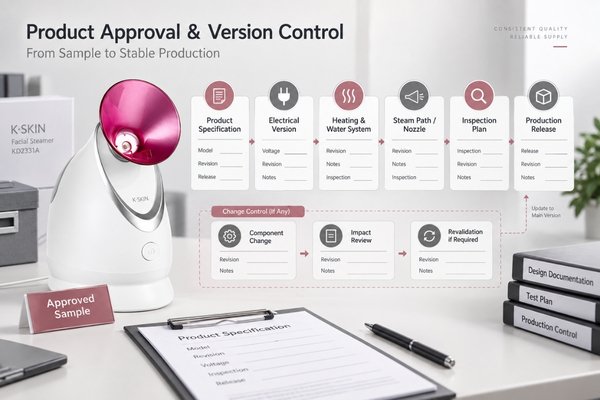
When evaluating a facial steamer manufacturer, confirm the following before commercial approval:
| Confirm With the Supplier | Why It Matters |
|---|---|
| Exact model and revision | Prevents a different version from being supplied after testing |
| Rated voltage and plug configuration | Defines the intended electrical version |
| Heating architecture | Identifies how heat is generated and controlled |
| Water-tank and feed structure | Defines how water reaches the heated area |
| Steam-path and nozzle configuration | Connects internal vapor transfer to outlet behavior |
| Recommended water type | Supports repeatable use and maintenance |
| Warm-up and steam-stability test method | Makes performance records interpretable |
| Low-water or abnormal-condition behavior | Defines when heating or output may stop |
| Cleaning and descaling instructions | Helps control water-path and heating-system changes over time |
| Approved sample and specification | Establishes the reference product |
| Change-control procedure | Requires review when relevant components or structures change |
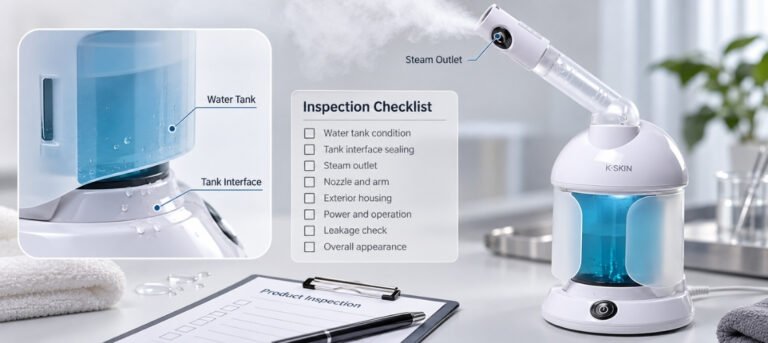
The approved version should also connect to production inspection. Water-tank installation, water-path behavior, mist function, nozzle operation, protection functions, electrical configuration, labels, and packaging should be checked against the agreed product and order specification where applicable.
The goal is not to freeze every cosmetic detail unnecessarily. The goal is to identify which changes can affect the steam-generation system and require technical review before they reach production.
Frequently Asked Questions
Does higher wattage always mean more stable steam?
No. Wattage describes rated electrical power, not complete steam-system performance. Water delivery, heater design, thermal recovery, electrical conditions, steam-path geometry, condensation, controls, and assembly can all affect output. Compare finished samples under the same conditions.
Is “nano-ionic” technology what makes facial steamer output stable?
No. “Nano-ionic” is a product-feature term and should not be used as proof of steam stability. Stable output must be evaluated from the actual water, heating, steam-path, nozzle, electrical, and control behavior of the approved product.
Why does product position matter during steam testing?
Product orientation can affect water delivery or condensate movement in designs that depend on gravity or a particular tank position. Samples should be tested in the operating position specified by the manufacturer and kept consistent during comparisons.
Should buyers observe a complete operating cycle?
A longer observation is more informative than checking only the first visible steam after startup. The test window should be long enough to identify changes in output, interruptions, protection events, or condensation behavior. The exact duration should follow the product and project test plan.
What should be frozen after steam performance is approved?
Freeze the approved model revision and relevant electrical configuration, heater, water-supply components, steam path, nozzle, protection logic, operating instructions, test method, acceptance criteria, and approved sample. Later changes that can affect steam performance should receive documented impact review.
Conclusion
A facial steamer produces steam through a connected water-and-thermal system: water must reach the heated area consistently, sufficient heat must be maintained, vapor must travel through the steam path, and the nozzle must deliver the intended outlet behavior. Stable steam is therefore a system result, not a single wattage, heater, tank, or “nano” specification.
For a sourcing project, compare the complete operating behavior of the approved sample and connect that result to a clearly defined production version. Review K·SKIN Global’s facial steamer platforms to compare warm-mist, larger-tank, multifunction, and different steam-delivery product directions for your market.