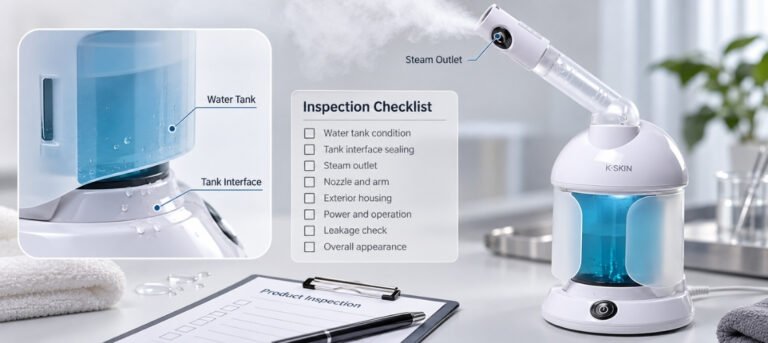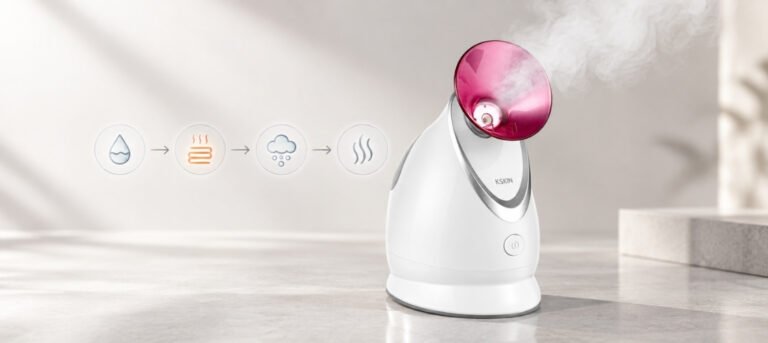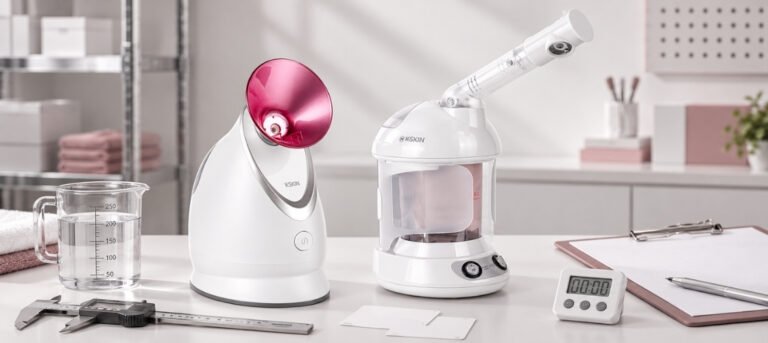
A facial steamer may stop heating when the water runs low, but the mechanism is not always the same. For buyers, the trigger and reset behavior matter as much as the shut-off itself.
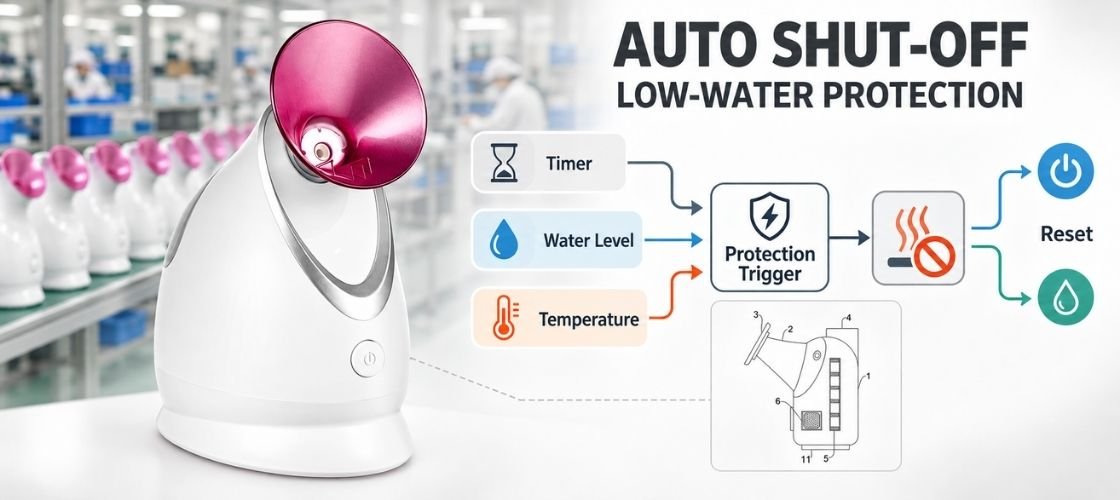
Facial steamer auto shut-off and low-water protection may be triggered by a timer, direct water-level detection, a temperature rise during dry heating, or a combination of controls. Some protective devices reset automatically after cooling, while others require a restart or remain open after activation. Buyers should verify the actual trigger, heater state, reset behavior, repeatability, and approved specification for the exact product version.
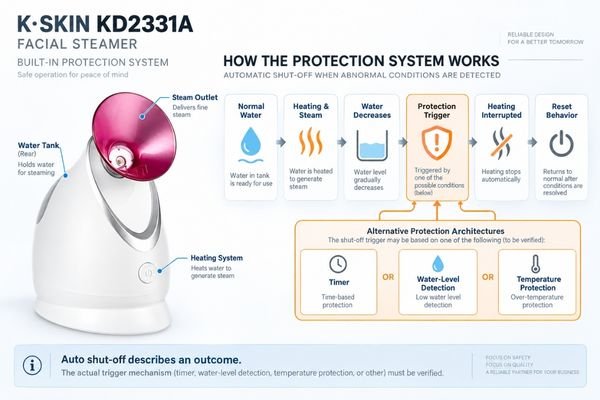
Two steamers may both be described as having “auto shut-off” even though they use different sensing methods, protective components, and reset logic.
For B2B evaluation, finding the feature on a specification sheet is not enough. Buyers need to know what condition activates it, what actually switches off, and what happens afterward.
Are Auto Shut-Off, Low-Water Protection, and Dry-Heating Protection the Same?
These terms are related, but they do not describe the same function.
Auto shut-off describes an outcome: the heater or appliance stops operating after a defined trigger.
Low-water protection describes a response to insufficient water. Depending on the design, the product may detect the water condition directly or respond indirectly to a thermal change caused by insufficient water.
Dry-heating or dry-boil protection is more specific. It addresses a condition in which the heater continues producing heat while too little water remains to absorb and transfer that heat.
| Term | What It Describes | What Buyers Still Need to Confirm |
|---|---|---|
| Auto shut-off | The appliance or heater stops after a trigger | What caused the shut-off and whether operation can resume automatically |
| Low-water protection | A response when the available water becomes insufficient | Whether water is detected directly or the protection is temperature-based |
| Dry-heating protection | Protection against heating with insufficient water | Trigger condition, reset type, and repeatability |
| Timer shut-off | Operation stops after a defined period | Timer duration and restart behavior |
| Thermal protection | Temperature causes a protective device to interrupt heating | Component type, operating condition, and reset behavior |
The same visible result can come from different internal mechanisms.
If steam stops after the tank empties, that alone does not prove that the steamer contains a water-level sensor. Nor does it prove that electrical power to the heater will remain disconnected.
What Can Trigger a Facial Steamer to Shut Off?
A facial steamer can use several control and protection approaches. The exact architecture must be confirmed for the specific model and electrical version.
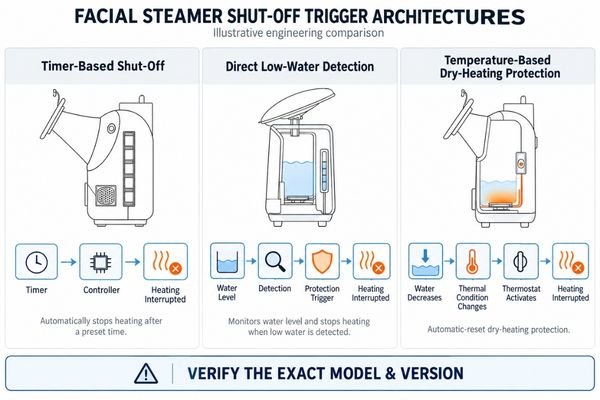
Timer-Based Shut-Off
A timer-based system stops operation after a programmed period.
The timer does not necessarily detect how much water remains. Its purpose may simply be to limit the operating cycle.
Buyers should confirm:
- the defined operating duration;
- whether the heater or the complete appliance switches off;
- whether immediate restart is possible;
- whether the timer operates independently of low-water or thermal protection.
A timer can be useful, but it should not be presented as evidence of direct low-water detection unless the product actually uses that logic.
Direct Low-Water Detection
Some designs monitor the water level or the presence of water directly.
When the detected condition reaches a defined threshold, the control system may stop heating, change an indicator, sound an alert, or move the appliance into another programmed state.
Direct water-level monitoring is one possible protection architecture. It is not a universal feature of facial steamers.
K·SKIN also lists a facial-steamer water-level-monitoring utility-model record on its Credentials page. That evidence represents a specific area of facial-steamer engineering and should not be interpreted as meaning that every K·SKIN model uses the same water-level monitoring structure.
Temperature-Based Dry-Heating Protection
Another common approach responds to temperature rather than measuring the amount of water directly.
During normal operation, water absorbs heat from the heating system and converts part of that energy into steam. When too little water remains, the thermal condition can change and the temperature around the heater or boiler can rise.
A thermostat or another protective component can then interrupt heating when its operating condition is reached.
The sequence may be:
Normal Water Level
→ Heating
→ Steam Generation
→ Water Decreases
→ Thermal Condition Changes
→ Protection Activates
→ Heating Is Interrupted
This differs fundamentally from detecting the water level directly.
The KD2331A facial steamer is one K·SKIN platform where dry-heating protection is included in sample evaluation. The exact acceptance criteria should follow the approved specification for the commercial version being tested.
What Happens When the Water Runs Low?
A low-water evaluation should follow the entire sequence rather than focusing only on the moment when visible steam disappears.
A useful observation sequence is:
Normal Water Level
→ Stable Steam
→ Water Decreases
→ Steam Behavior Changes
→ Protection Trigger
→ Heating State Changes
→ Cooling or Reset
→ Restart or Remain Off
The distinction between “steam stopped” and “heater power was interrupted” matters.
A buyer should determine:
- whether steam output decreases gradually or stops abruptly;
- whether the heater remains energized after visible steam stops;
- whether an indicator changes;
- whether an audible warning is provided;
- whether the complete appliance switches off;
- whether only the heating circuit is interrupted;
- whether the product can resume heating without user action.
This is especially important when the design uses an automatic-reset thermostat.
Why Does Reset Behavior Matter?
A protection check is incomplete unless it covers both activation and recovery.
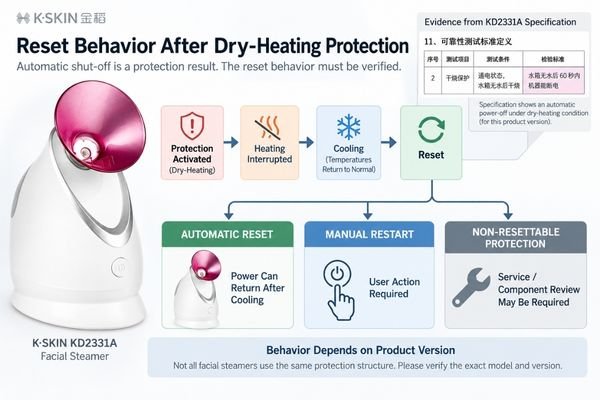
Automatic Reset
An automatic-reset thermostat can change its electrical state when a defined temperature condition is reached, then reset after the system cools.
A typical sequence can therefore be:
Protection Activated
→ Heating Interrupted
→ Appliance Cools
→ Thermostat Resets
→ Heating Can Resume
A steamer that appears to have shut down after the water is depleted may therefore not remain permanently disconnected.
For buyers, this behavior must match the approved product specification and user instructions.
Manual Restart
Other designs may require deliberate user action before operation resumes.
Depending on the product, that action could include:
- refilling the tank;
- pressing the power control;
- disconnecting and reconnecting the power;
- waiting for a defined cooling period.
The required sequence should be clear and repeatable.
Non-Resettable Protection
Some appliance designs may also include secondary protective components that are not intended to reset automatically.
These devices serve a different purpose from normal operating controls or automatic thermostats. They should not be treated as equivalent simply because each can interrupt electrical power.
For sourcing decisions, asking whether the facial steamer shuts off is only half the question.
Buyers must also ask:
What happens after it shuts off?
How Should Buyers Test Facial Steamer Low-Water Protection?
A useful low-water test should reproduce the defined operating condition and record the complete protection sequence.
The purpose is not to impose one universal shutdown time on every facial steamer. It is to determine whether the sample behaves according to the approved specification for that product.
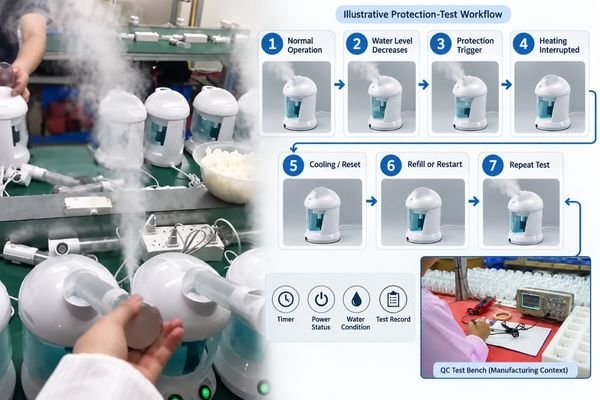
A practical test sequence can include:
- Identify the sample model, electrical version, and revision.
- Confirm the specified water type and filling method.
- Fill the tank to the defined starting condition.
- Operate the steamer under its rated electrical conditions.
- Record normal heat-up and steam behavior.
- Allow the water level to decrease according to the test method.
- Observe when the steam output begins to change.
- Record when the protection function activates.
- Verify whether heating power is interrupted.
- Record any indicators, alarms, or other status changes.
- Observe the cooling and reset behavior.
- Refill or restart the appliance according to its instructions.
- Confirm that normal steaming resumes correctly.
- Repeat the sequence according to the agreed validation plan.
One successful activation is not enough to establish repeatability.
Repeated protection cycles can reveal changes in:
- activation behavior;
- reset behavior;
- restart sequence;
- steam recovery;
- abnormal noise or odor;
- housing condition;
- unexpected re-energization.
K·SKIN’s Manufacturing & Quality process treats product-specific testing and approved-version control as part of the path from sample evaluation to production. It does not assume that one protection check applies to every configuration.
What Should Buyers Record During the Test?
A useful protection record should document the test conditions and observed behavior rather than simply state “Pass.”
| Record Item | What to Capture |
|---|---|
| Sample identification | Model, revision, and electrical configuration |
| Starting condition | Water quantity or defined fill condition |
| Electrical condition | Voltage, frequency, and other relevant supply conditions |
| Normal operation | Heat-up and steam behavior before depletion |
| Protection trigger | Water state or thermal condition when activation occurs |
| Trigger time | Time recorded according to the approved test method |
| Heater state | Whether heating is actually interrupted |
| User indication | Light, display, buzzer, or other status |
| Reset behavior | Automatic reset, manual restart, or non-resettable protection |
| Recovery | Whether normal steaming resumes correctly |
| Repeated result | Whether later cycles behave consistently |
Trigger time can be a valid acceptance criterion for a specific product version, but it should not be presented as a universal facial-steamer requirement.
The same applies to trigger temperature, reset temperature, and recovery time. These values depend on the product architecture, component selection, electrical version, and approved validation plan.
What Does Low-Water Protection Not Prove?
Low-water protection addresses a defined operating condition. It does not prove that the appliance is protected against every possible abnormal condition.
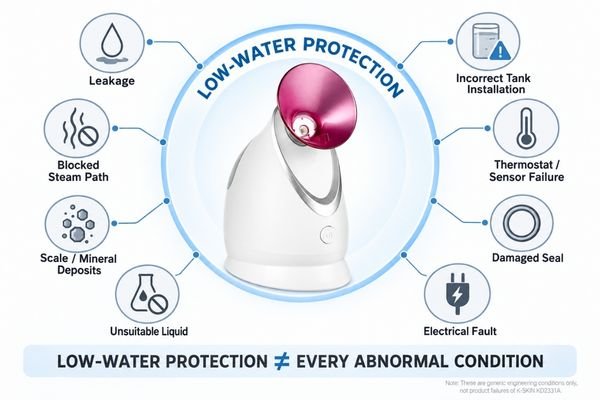
Separate evaluation may still be needed for:
- blocked or restricted steam paths;
- incorrectly installed water tanks;
- leakage;
- mineral deposits or scale;
- thermostat or sensor failure;
- damaged seals;
- wiring faults;
- abnormal electrical conditions;
- unsuitable liquids added to the water system.
A steamer can pass a low-water protection test and still require additional checks of its water path, sealing, steam output, electrical construction, and behavior under abnormal conditions.
Auto shut-off should not be presented as equivalent to product certification.
The applicable safety framework depends on the exact appliance, electrical configuration, market, and standard edition. IEC 60335-2-23:2026 identifies skin-care appliances as outside its current hair-care scope and directs them to IEC 60335-2-115. The IEC pre-release information for IEC 60335-2-115:2026 specifically includes facial saunas within its scope.
Buyers should confirm the applicable edition and national adoption in the destination market rather than treating the presence of one protection feature as proof of compliance.
What Should the Manual and Approved Specification Confirm?
The protection hardware, operating instructions, and approved product specification should all describe the same behavior.
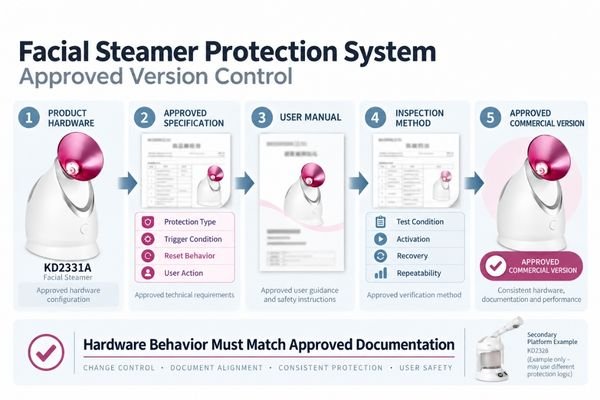
The approved specification should define relevant items such as:
- protection type;
- trigger condition;
- reset behavior;
- required user action;
- inspection method;
- acceptance criteria.
The user manual should describe that behavior accurately from the user’s perspective.
For example, if heating can resume automatically after the appliance cools, the instructions should not imply that the product has been permanently disconnected from power after the first protection event.
Warnings, labels, and operating instructions should also match the electrical and protection configuration actually being supplied.
Facial steamer approval should therefore not be based solely on appearance, steam volume, or tank capacity.
The KD2331A and KD2328 are different facial-steamer platforms. Their water systems, heating components, and protection arrangements should be evaluated independently rather than assuming that the protection behavior of one model also applies to the other.
Buyers comparing different platforms can also review K·SKIN’s complete facial steamer range before defining the required sample-validation scope.
Frequently Asked Questions
Does a facial steamer detect low water directly?
Not always. Some designs may use direct water-level or water-presence detection, while others respond to the temperature change that occurs when insufficient water remains around the heating system. The actual trigger method should be confirmed for the exact model.
Is auto shut-off the same as dry-boil protection?
No. Auto shut-off describes the result of a control or protection event. Dry-boil or dry-heating protection specifically addresses heating under insufficient-water conditions. Auto shut-off can also be triggered by a timer or another programmed condition.
Can a facial steamer turn back on after low-water protection activates?
Yes, depending on the design. An automatic-reset thermostat can restore electrical continuity after the heating system cools. Other designs may require a manual restart or use a non-resettable protective component. Buyers should verify this behavior on the actual sample and in the approved documentation.
How should buyers test facial steamer low-water protection?
Test the exact product version under defined operating conditions. Record normal steaming, the transition to a low-water condition, protection activation, heater state, indicators, reset behavior, and recovery. Repeat the sequence according to the agreed validation plan rather than relying on a single shut-off event.
Does auto shut-off mean a facial steamer is safety certified?
No. Auto shut-off is one control or protection function within the appliance. Product compliance depends on the applicable standards, exact electrical version, destination market, and supporting test documentation.
Conclusion
Facial steamer auto shut-off does not rely on one universal mechanism. A product may stop heating because of a timer, direct water-level detection, rising temperature, or another defined control condition. The resulting shut-off may be temporary, require a manual restart, or be non-resettable.
For B2B approval, verify the trigger condition, actual heater state, reset behavior, repeatability, and alignment between the hardware, specification, and instructions for the exact product version. Explore K·SKIN’s facial steamers or contact the project team to discuss sample evaluation, electrical configuration, and protection requirements for your project.