
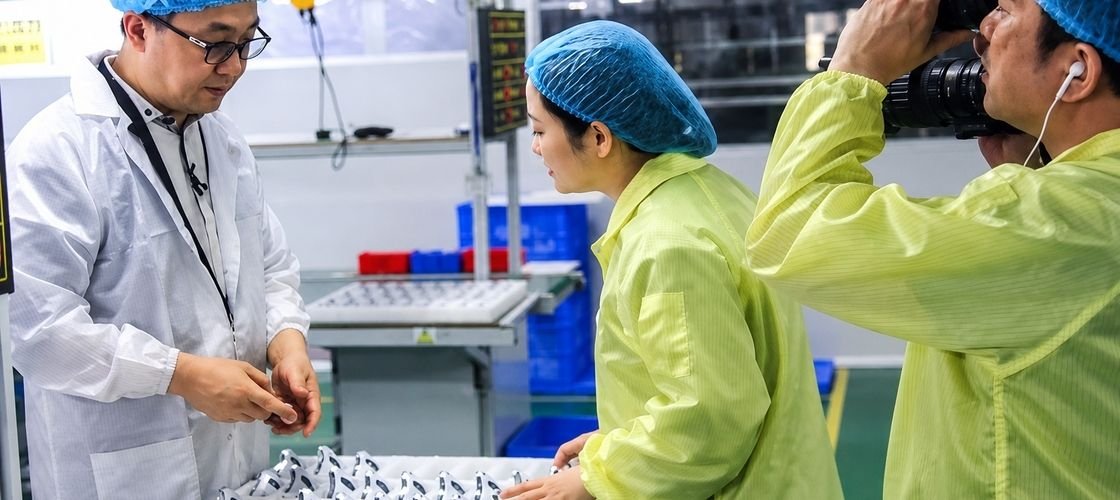
A good sample does not automatically prove that the supplier behind it can control production, documentation, product revisions, quality records, or future changes.
Before ordering samples, buyers should verify who will manufacture the product, where the relevant production takes place, whether the factory has suitable product and process capabilities, how it controls quality records and revisions, which testing resources it actually uses, how certificates and reports are scoped, and how problems are corrected. Sampling should verify a product; it should not compensate for an unverified manufacturer.
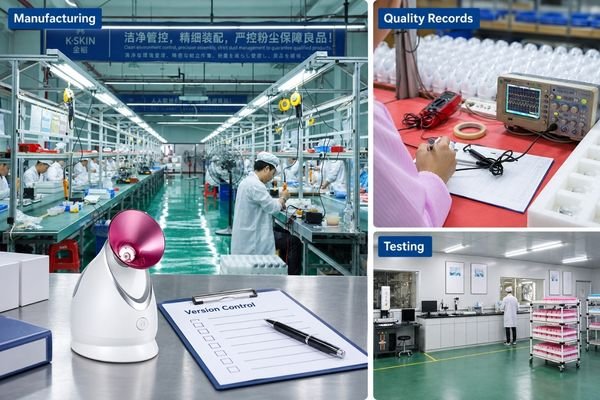
A pre-sampling audit does not need to replicate a full certification audit. Its purpose is narrower: to determine whether there is enough verified evidence to justify spending time and money on product samples.
The buying process is easier to control when three decisions remain separate:
| Stage | Main Question |
|---|---|
| Supplier qualification | Is this manufacturer credible and capable enough to enter sampling? |
| Sample evaluation | Does this exact product version meet the agreed requirements? |
| Production approval | Can the approved version be reproduced and controlled in production? |
A sample can help answer the second question. It cannot answer the first or third on its own.
What Should a Manufacturer Audit Prove Before Sampling?
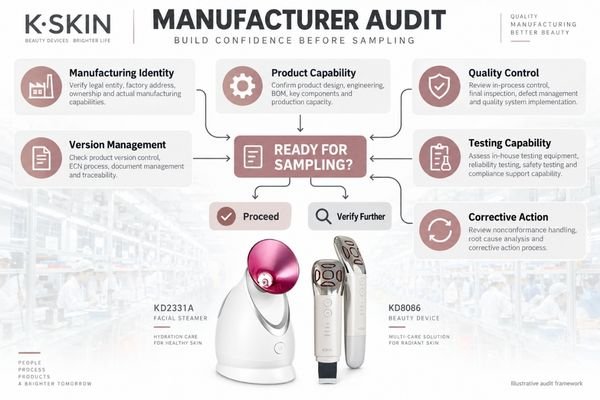
A pre-sampling manufacturer audit should establish that the supplier is a verifiable manufacturing partner with relevant product capabilities, controlled quality processes, traceable records, defined version management, appropriate testing resources, and a practical method for handling problems. The audit should focus on evidence connected to the buyer’s project rather than factory size, showroom presentation, or a collection of certificates viewed without context.
A large production floor may be useful, but floor area alone does not prove that the factory can control your project. The same applies to equipment lists, marketing presentations, and certificates.
Buyers should establish six basic points before moving forward:
- The manufacturing entity and production location can be identified.
- The factory has experience with the technical systems relevant to the proposed product.
- Production and inspection processes are visible and reasonably controlled.
- Completed records demonstrate that quality procedures are actually being used.
- Product revisions and commercial configurations can be distinguished and controlled.
- Problems can be identified, contained, corrected, and followed through.
This is why reviewing a supplier’s manufacturing and quality framework is more useful than simply asking whether the factory has a QC department.
The depth of the audit should reflect the project risk. A standard beauty appliance built on an established platform may not require the same level of investigation as a heavily customized device involving new electronics, heating architecture, battery systems, tooling, or firmware.
What Can Buyers Verify Before an On-Site Audit?
A useful remote pre-audit can verify business and manufacturing identity, relevant product platforms, real production evidence, current quality-system documents, project contacts, product-specific documentation capabilities, and whether the supplier answers technical questions consistently. It will not replace every on-site audit, but it can eliminate weak candidates before buyers invest in travel, samples, or development work.
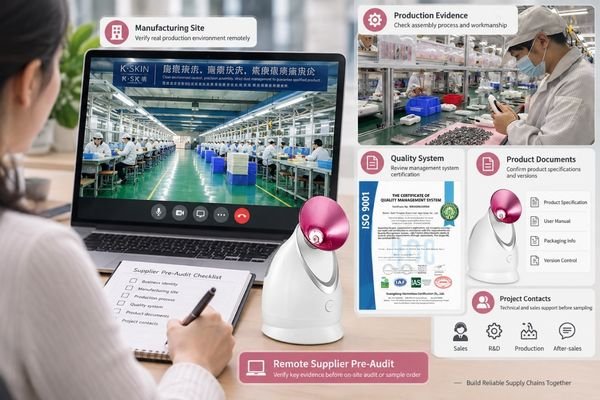
Start with information that can be checked without entering the factory.
| Pre-Audit Area | What the Buyer Should Establish |
|---|---|
| Business identity | Who communicates, contracts, and invoices |
| Manufacturing location | Where the relevant assembly, testing, and packaging occur |
| Product relevance | Whether the supplier actually works with similar technical systems |
| Production evidence | Whether current production, assembly, testing, and warehouse activities can be shown |
| Quality-system evidence | Whether current management-system documents have an identifiable holder and scope |
| Product documentation | Whether records can be linked to specific models or configurations |
| Project ownership | Who is responsible for engineering, quality, and commercial decisions |
Video calls are useful when they are used for verification rather than presentation. Where practical, ask the supplier to move through relevant areas in real time, including assembly, testing, inspection, packaging, and controlled storage. A prepared corporate video can provide context, but it should not be the only evidence.
Documents require the same discipline. Check a certificate image for its holder, scope, date, and status. Connect a product report to the model or configuration it actually covers.
The K·SKIN Credentials framework follows the same principle: evidence should be read according to its document type, holder, product or scope, market or jurisdiction, and current status. One document should not automatically be treated as proof for another model, configuration, market, or period.
A remote review also shows how the supplier responds to questions. If straightforward requests about the manufacturing location, product revision, or document scope repeatedly produce contradictory answers, additional sampling is unlikely to solve the underlying problem.
What Should You Check in the Factory?
The factory audit should concentrate on seven areas: the actual manufacturing site and production flow, relevant product and engineering capabilities, quality records and traceability, test equipment and methods, version and change control, compliance-document scope, and corrective-action capabilities. Each area should be assessed in relation to the product being sourced rather than as an abstract factory feature.
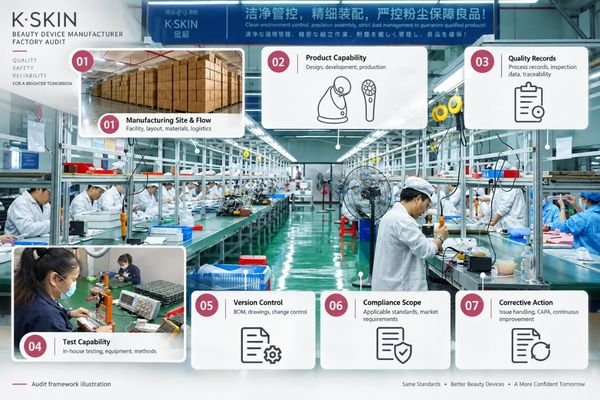
1. Manufacturing Site and Production Flow
Confirm where the relevant product will actually be assembled, tested, inspected, packed, and released.
The objective is not to count workstations. Follow the proposed product through a realistic production path and determine whether the factory can explain what happens at each important stage.
Look for practical separation between:
- incoming materials or components;
- assembly and processing;
- in-process inspection;
- functional or performance testing;
- final inspection;
- packaging;
- finished-product storage.
Partially subcontracted production does not automatically disqualify a supplier. The important question is whether the subcontracted process is identified and controlled rather than presented as an in-house capability.
2. Product and Engineering Capability
A factory should be evaluated against the technologies relevant to the buyer’s project.
A hair straightener brush may require capabilities related to heating systems, temperature control, comb structures, batteries, or mains-powered electrical systems. A facial steamer requires a different combination of water-path control, heating, steam generation, tank interfaces, and leakage prevention.
For example, a common problem such as facial steamer leakage may involve the tank interface, sealing structure, water path, assembly condition, or operating conditions. Our guide on what causes a facial steamer to leak illustrates why product-specific engineering knowledge matters during supplier qualification.
Home beauty devices may introduce another combination of electronics, treatment heads, charging systems, and functional outputs.
Do not inspect an unrelated production line and assume that it proves the factory’s capabilities for the product you intend to source.
For projects involving modifications or a new commercial configuration, also review how engineering responsibilities are managed through the supplier’s OEM and ODM development process.
3. Quality Records and Traceability
Ask to see completed, non-confidential records rather than only blank forms.
A blank inspection sheet shows that a template exists. A completed, controlled record shows how the process was actually used.
Where confidentiality permits, follow one recent record trail through several stages:
Incoming Item
→ Production or Assembly
→ In-Process Check
→ Functional Test
→ Final Inspection
→ Release
The purpose is not to obtain another customer’s confidential information. Customer names, order numbers, prices, and protected design information should be removed.
What matters is whether the records show:
- what was checked;
- when it was checked;
- which product or batch it related to;
- which requirement was used;
- what happened when a result was unacceptable.
4. Equipment and Test Capability
Do not assess testing capability by counting instruments.
Check whether the available equipment is relevant to the product and whether the factory can explain:
- which characteristic the instrument measures;
- which products or processes use it;
- how the test method is defined;
- how the equipment status is identified;
- which records are produced.
An expensive instrument does not prove that a test process is mature if the operator cannot explain how it is used for the relevant product.
The same applies to factory laboratories. A supplier does not need to perform every regulatory test in-house, but it should know which checks are performed internally, which are sent to qualified external laboratories, and how the results relate to the project.
5. Version and Change Control
Version control deserves particular attention before sampling because the sample may later become the commercial reference.
Ask how the supplier identifies changes to:
- heaters;
- batteries;
- PCBs;
- motors or pumps where applicable;
- water-path components;
- firmware;
- housing materials;
- labels;
- accessories;
- manuals;
- packaging.
The audit is not intended to complete an exhaustive change-control assessment at this stage. It is intended to verify that a controlled change process exists.
The key question is simple:
If a relevant component or configuration changes after sample approval, how will the buyer know?
A supplier that cannot distinguish the sampled version from the subsequent production version creates unnecessary approval risk, even if the original sample performs well.
6. Compliance and Document Scope
Do not reduce the compliance audit to “Do you have CE, FDA, or ISO?”
These documents and designations do not all serve the same purpose.
For each relevant document, determine:
- who the holder is;
- which product, model, or quality-system scope it covers;
- which standard or requirement it relates to;
- which market or jurisdiction is relevant;
- whether the document is current.
An ISO 9001 certificate can provide useful evidence of a quality management system, but it does not by itself prove that every beauty device model or market configuration meets its product-specific requirements. The official ISO 9001 overview describes the standard as a quality management system framework rather than a product certification scheme.
Product-specific reports and regulatory evidence should therefore be reviewed separately and matched to the project.
7. Problem Solving and Corrective Action
Every factory encounters defects or abnormal results. The audit should examine what happens next.
A useful process should show how the supplier:
- identifies an abnormal condition;
- separates or contains affected material;
- records the issue;
- investigates the cause;
- defines corrective action;
- verifies the result;
- prevents uncontrolled release.
The objective is not to demand a perfect factory with no defects. A stronger indicator is whether problems are visible, controlled, and followed through.
What Evidence Is Stronger Than a Supplier Claim?
Supplier statements become more credible when they are supported by completed records, live process evidence, and independently verifiable documents with matching scope. Buyers should audit the evidence trail rather than simply collect marketing materials. A claim such as “we have strict quality control” has limited value until the factory can show how that control operates on a relevant product.
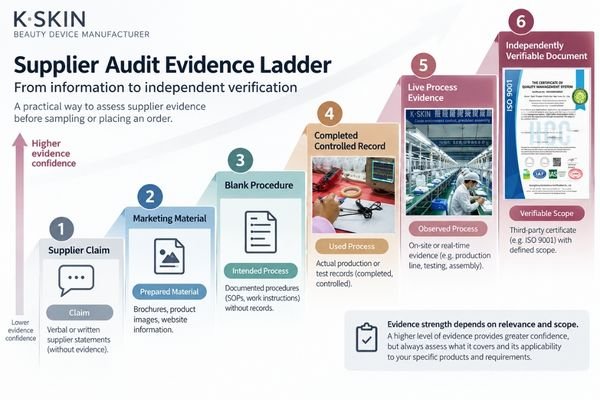
A practical evidence hierarchy looks like this:
| Evidence Level | Example | Typical Value During Audit |
|---|---|---|
| Supplier claim | “We have strict QC.” | Low without supporting evidence |
| Marketing material | Website, brochure, prepared presentation | Useful background, limited verification |
| Blank procedure or form | SOP or inspection template | Shows the intended process, not actual execution |
| Completed controlled record | Redacted inspection, test, or production record | Stronger evidence that the process is used |
| Live process evidence | Relevant production or testing demonstrated | Strong operational evidence |
| Independently verifiable document | Current certificate or report with a matching holder and scope | Strong within the stated scope |
This does not mean that every audit requires every document in the table. The evidence reviewed should reflect the project’s risk and purpose.
ISO 19011, the international guidance for auditing management systems, includes evidence-based and risk-based approaches among its auditing principles. These principles are also useful outside formal management-system audits: conclusions are more reliable when they rely on verifiable evidence and focus on meaningful risks.
One particularly useful technique is record sampling.
Instead of asking:
“Can you show me your inspection form?”
Ask to review a recent, non-confidential record and trace how the product moved through the process.
This often reveals more about actual controls than a prepared audit presentation.
Which Findings Should Stop Sampling?
Not every audit gap should immediately disqualify a supplier. Missing formatting or incomplete documentation can sometimes be corrected before sampling. More serious findings involve identity, integrity, relevant manufacturing capabilities, uncontrolled product changes, unverifiable evidence, or an inability to explain how important product and quality decisions are controlled.
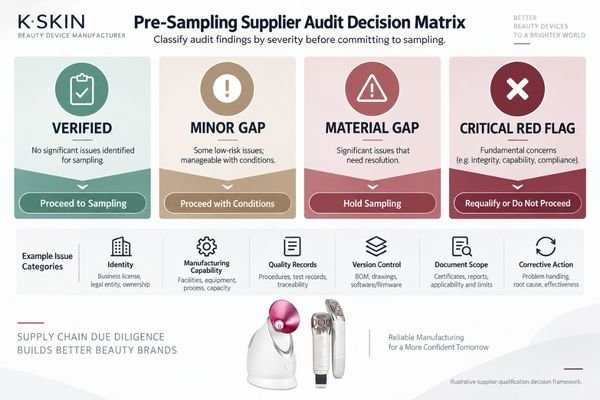
Separate ordinary gaps from red flags.
| Finding | Typical Decision |
|---|---|
| Evidence verified | Proceed |
| Minor documentation gap | Proceed with conditions |
| Material capability or evidence gap | Hold sampling until resolved |
| Critical integrity or control issue | Do not proceed without requalification |
Examples that warrant further investigation include:
- the claimed manufacturing entity or production location cannot be explained;
- the factory shown to the buyer is not the site performing the relevant work;
- certificates or reports are presented without a clear holder or scope;
- only blank forms are available, and no controlled records can be demonstrated;
- the factory cannot identify the revision of the product being sampled;
- unrelated equipment or production lines are presented as evidence of project capability;
- components or specifications can change without a defined review;
- important measuring equipment has no identifiable control status;
- abnormal products are not clearly isolated or handled;
- one certificate is claimed to cover every product and market;
- repeated requests for basic evidence are met with sales claims rather than answers.
A single documentation issue is not automatically evidence of a poor manufacturer. The pattern matters.
The most serious warning is usually not that a document is missing. It is that the supplier cannot consistently explain who controls the product, where it is made, which version is current, which evidence applies, or what happens when something changes.
What Should Be Confirmed Before the Sample Is Ordered?
Once the supplier passes the qualification gate, the sampling request should define the exact model or platform, intended market, electrical or charging version, required functions, commercial configuration, evaluation purpose, and expected supporting documents. A sample is most useful when both the buyer and supplier know exactly which version is being built and what the sample is intended to prove.
Before issuing a sample order, first make sure the sample type matches the intended development route. If the distinction is not yet clear, review the differences between Private Label, OEM, and ODM beauty device projects before defining the sample configuration.
Before issuing a sample order, confirm:
| Sampling Item | What to Define |
|---|---|
| Product identity | Exact model or development platform |
| Intended market | Destination market or project region |
| Power configuration | Voltage/frequency or charging version |
| Functional configuration | Required functions and operating modes |
| Appearance | Color, finish, and agreed physical configuration |
| Branding | Standard, neutral, or private-label sample |
| Accessories | Required items included with the sample |
| Packaging | Standard sample packaging or project-specific requirement |
| Evaluation scope | What the buyer intends to verify |
| Supporting documents | Specifications, drawings, or records expected with the sample |
| Revision reference | How the sample version will be identified |
The audit should lead to one of four practical decisions:
| Decision | Meaning |
|---|---|
| Proceed to Sampling | Core capabilities and evidence are sufficiently verified |
| Proceed with Conditions | Minor gaps remain but can be closed during sample preparation |
| Hold | Material evidence or capability questions remain unresolved |
| Requalify or Reject | Critical integrity, manufacturing, or control risks remain |
Once sampling begins, the project moves from supplier qualification to product evaluation. The sample should then be tested against defined requirements rather than used as a substitute for manufacturer due diligence.
Frequently Asked Questions
What Should Buyers Verify Before Ordering Beauty Device Samples?
Buyers should verify the manufacturing identity and location, relevant product capabilities, production and testing processes, completed quality records, version-control method, compliance-document scope, and corrective-action process. The objective is to determine whether the supplier is ready to enter sampling, not to complete every possible factory-audit activity.
Can a Remote Supplier Audit Replace an On-Site Factory Audit?
A remote review may sometimes be sufficient for initial qualification, especially when the project uses an established product platform and the risk is relatively low. Higher-risk projects, substantial customization, conflicting evidence, or unclear manufacturing arrangements may justify an on-site or independent third-party audit.
Does ISO 9001 Certification Prove That a Beauty Device Manufacturer Is Qualified?
No. ISO 9001 can provide useful evidence that a quality management system has been established within a defined scope. It does not automatically prove product-specific engineering capabilities, regulatory compliance, sample quality, or suitability for a particular buyer’s project.
Should Every Beauty Device Supplier Use the Same Audit Checklist?
No. The core qualification principles can remain consistent, but the technical audit points should follow the product. Heating appliances, facial steamers, cordless devices, and electronic beauty devices have different components, processes, and failure risks. The audit should be adapted accordingly.
Which Audit Findings Should Stop a Buyer from Moving to Sampling?
Sampling should normally be placed on hold when questions about the actual manufacturer, relevant production capabilities, product-version control, critical quality records, or document scope remain unresolved. Evidence of misrepresentation, uncontrolled product changes, or consistently unverifiable claims is more serious than a minor documentation gap.
Conclusion
A beauty device manufacturer audit before sampling should not become a factory-tour exercise. Its purpose is to determine whether the supplier can support the next stage with verifiable manufacturing capabilities, controlled records, relevant technical knowledge, version management, and a credible method for handling problems.
Once these fundamentals have been sufficiently verified, sampling becomes far more useful because the buyer is evaluating a defined product from a qualified manufacturing source. To review K·SKIN’s manufacturing approach, visit Manufacturing & Quality, or contact our team with the product platform, intended market, and supplier-evaluation requirements for your project.