
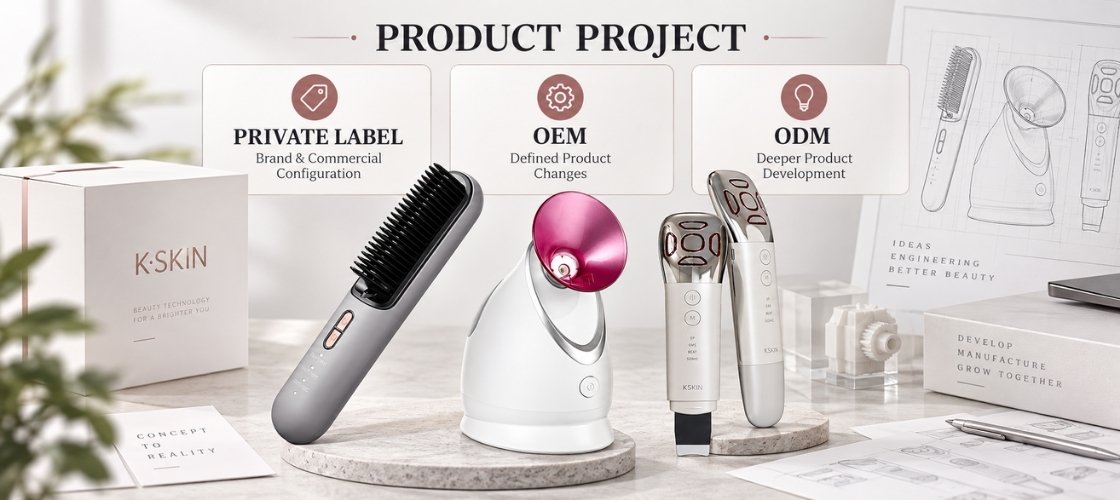
Choosing among Private Label, OEM, and ODM affects far more than branding. It changes who defines the product, what can be modified, how much engineering is needed, and what must be validated before production.
Private Label usually suits projects built around an established product platform. OEM fits projects in which the buyer provides clearer product requirements or requests controlled changes, while ODM is better suited to projects requiring deeper manufacturer-led development. Because terminology varies among suppliers, the safest approach is to compare the actual scope, responsibilities, engineering work, validation, investment, and commercial risk—not the label alone.
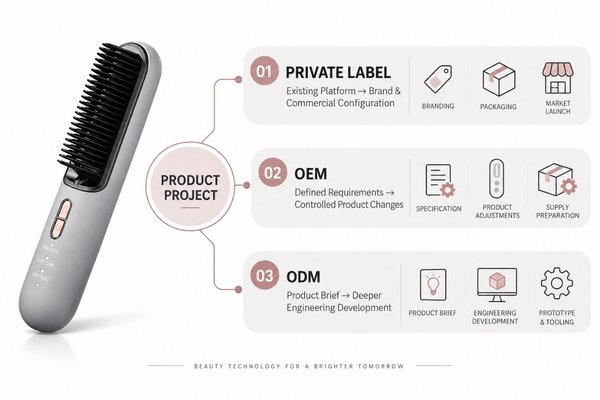
The three terms are often used as though they represent fixed industry categories. In practice, one supplier may describe a modified existing platform as OEM, while another may call a similar project ODM. Some manufacturers also use OEM/ODM as a combined term.
For buyers, the more useful question is not “Which acronym sounds more advanced?” It is:
How much of the existing product already fits, what exactly needs to change, and who will be responsible for defining and validating those changes?
This project-based approach is especially important for beauty devices because changing a housing color is very different from changing a heating system, water path, electronic control, battery architecture, or technical output.
What Do Private Label, OEM and ODM Mean in a Beauty Device Project?
The practical distinction begins with the product available at the start of the project. One route adapts an established platform, while the others may require more buyer input, engineering work, or new product development.
Private Label generally begins with an existing product whose core technical system remains substantially unchanged. OEM usually involves clearer buyer-defined requirements, specifications, or controlled product changes. ODM places more product-development responsibility with the manufacturer. These are working definitions, not universal legal meanings, so the project contract and technical scope should always define the actual responsibilities.
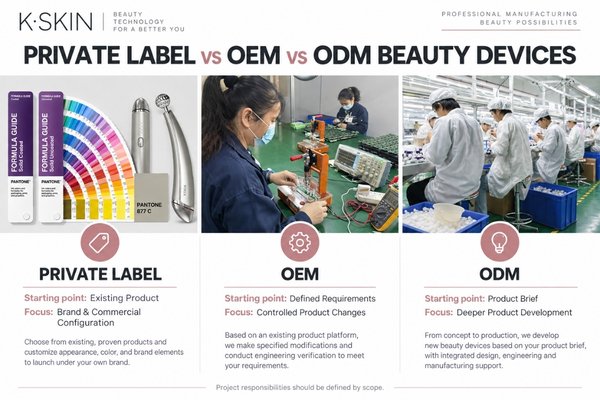
A practical comparison looks like this:
| Project Factor | Private Label | OEM | ODM |
|---|---|---|---|
| Starting point | Established product platform | Existing platform or buyer-defined product requirements | Product concept or development brief |
| Core technical system | Usually remains substantially unchanged | May be modified within an agreed scope | May require deeper development |
| Buyer input | Brand and commercial requirements | Stronger technical or design input | Market, product, and performance objectives |
| Manufacturer role | Adapt the commercial version | Manufacture and support agreed modifications | Take greater design and engineering responsibility |
| New tooling | Usually not required if the structure remains unchanged | Possible | More likely where a new structure is developed |
| Prototype work | Base or branded sample | Modified sample or prototype | Engineering prototypes and iterations |
| Validation scope | Commercial-version confirmation | Change-driven validation | Broader development validation |
| Development uncertainty | Relatively low | Moderate and scope-dependent | Usually higher |
| Best fit | Faster market entry using a proven platform | Defined differentiation without unnecessary full development | A more distinctive product requiring substantial engineering |
Private Label: Build the Commercial Version Around an Existing Product
Private Label is not necessarily limited to printing a logo.
Depending on the product, a Private Label project may include:
- logo and brand identity;
- approved product colors or surface finishes;
- packaging and inserts;
- rating labels and user manuals;
- plug, voltage, or charging configuration where supported;
- approved accessories or bundles.
The key boundary is that these changes do not normally require redesigning the core product system.
If a buyer already accepts an existing product’s functions, user experience, and technical platform, forcing the project into deeper development may add little value. The K·SKIN Private Label process is built around this type of commercial adaptation.
OEM: Start With Clearer Buyer Requirements
OEM becomes more relevant when the buyer has defined technical requirements that go beyond commercial presentation.
These may include selected changes to:
- product structure;
- control interface;
- electrical configuration;
- accessories;
- dimensions;
- components;
- specified functions.
The buyer may already have drawings, technical specifications, benchmark products, or a defined product architecture. The manufacturer’s role is then to evaluate manufacturability, turn those requirements into a controlled production solution, and verify the agreed changes.
ODM: Develop More of the Product With the Manufacturer
ODM is more appropriate when the buyer understands the market opportunity and desired product direction but needs greater manufacturer involvement to turn that idea into a production-ready product.
The development scope may include:
- industrial design;
- structural engineering;
- electronics;
- control logic;
- heating or airflow systems;
- water or steam systems;
- tooling;
- prototype development;
- engineering verification.
ODM is not automatically “better” than OEM. It simply assigns more of the product-development work to the manufacturer.
Which Route Fits Your Beauty Device Project?
The right route depends first on the gap between the product already available and the product actually required. Greater customization is worthwhile only when the difference creates enough commercial value to justify the additional work.
Choose Private Label when an existing product already meets the core functional requirements and the main differentiation is commercial. Move toward OEM when specific parts of the product must change and the buyer can define those requirements. Consider ODM when the project requires substantial development of new structures, electronics, tooling, or technical systems. If the requirements remain unclear, define the product brief before choosing a route.
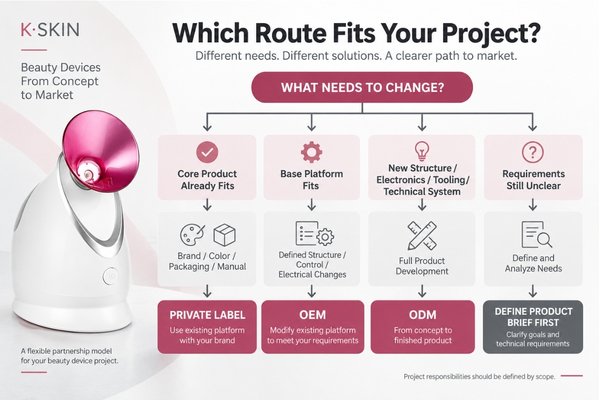
Use the following decision matrix as a starting point:
| Your Project Situation | Likely Starting Route |
|---|---|
| An existing product already fits the required functions | Private Label |
| You mainly need a logo, color, packaging, manual, and supported market configuration | Private Label |
| You want a differentiated branded version without changing the core technical system | Private Label |
| The base platform is suitable, but selected structural, control, or electrical elements need modification | OEM or controlled development |
| You already have detailed drawings or technical specifications | OEM |
| You have a benchmark product and clearly defined functional changes | OEM |
| You need a substantially different housing or internal structure | ODM or deeper OEM/ODM development |
| New tooling is required to create the intended product | ODM or deeper development |
| The heating, airflow, water, steam, electronics, or control system must be redesigned | ODM |
| You have a market concept but need the manufacturer to help define the technical product | ODM |
| You do not yet know which functions or product architecture are required | Define the product requirements first |
One common sourcing mistake is assuming that the route with the greatest customization will automatically produce the strongest product.
That is not necessarily true.
If an established platform already meets the intended user’s needs, deeper development adds engineering decisions, tooling exposure, validation work, and schedule risk without necessarily improving the commercial proposition.
The opposite mistake also occurs. A buyer may try to force a fundamentally different product into a Private Label project because that route appears faster. If the requested differentiation changes the technical system, the project should be treated as product development rather than cosmetic customization.
The K·SKIN OEM/ODM development framework separates existing product fit, controlled product changes, and deeper development for this reason.
What Can You Change Under Each Route?
Customization depth should be defined item by item. A project may look visually simple while requiring major technical changes internally, while a visually distinctive product may still use an established technical platform.
Private Label mainly changes the commercial version built around an established product. OEM can extend to controlled structural, electrical, or functional modifications based on defined buyer requirements. ODM can involve broader industrial design, electronics, tooling, and technical-system development. The route should be determined by the most demanding change in the project—not the simplest customization visible from the outside.
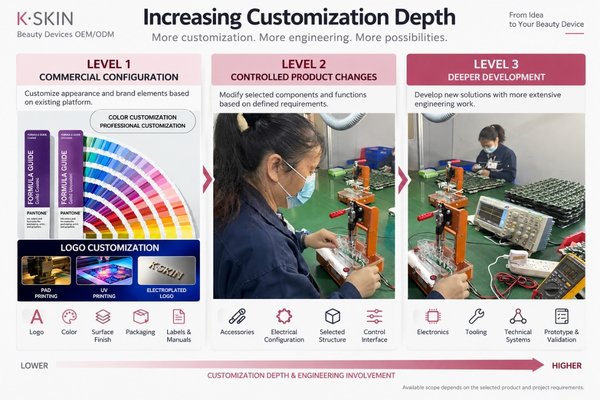
One useful way to define the scope is to separate commercial configuration from product engineering.
| Project Element | Private Label | OEM | ODM |
|---|---|---|---|
| Logo and branding | Common | Common | Common |
| Product color and finish | Often available by model | Available within the project scope | Can form part of a new design |
| Packaging | Common | Common | Developed with the final product |
| Labels and manuals | Common | Common | Developed with the final commercial version |
| Market electrical configuration | Where supported by the existing platform | Can be modified where feasible | Designed into the project |
| Accessories | Existing approved options | Modified or new options possible | Can be developed |
| Product dimensions | Usually unchanged | May be changed | Can be newly developed |
| Housing structure | Usually unchanged | Controlled modification possible | New structure possible |
| Control interface | Existing logic normally retained | Can be modified | Can be developed |
| Electronics | Normally unchanged | Changed according to the agreed specification | Broader development possible |
| Heating / airflow / water system | Existing system | Selected changes may be possible | Deeper system development |
| Tooling | Existing | May require modification or new tooling | Often project-specific |
| Prototype iterations | Limited | Change-driven | Usually broader |
This distinction matters because a single requested change can affect several other areas.
Changing a housing dimension may require new tooling and an assembly review. Changing the battery configuration may affect charging, runtime, electronics, labeling, and transport documentation. Changing a heater may influence temperature behavior, power demand, protective functions, and validation.
The technical consequences of each change should therefore be understood before it is classified as “simple customization.”
Design Control and Intellectual Property Should Be Defined Separately
OEM or ODM terminology does not automatically determine ownership of intellectual property.
A project may involve several different rights:
- the manufacturer’s existing platform and technical know-how;
- buyer-provided drawings or industrial designs;
- new tooling;
- jointly developed structural solutions;
- project-specific electronics or firmware where applicable;
- trademarks, packaging artwork, and other brand assets;
- patentable inventions or registered designs.
These rights should be defined in the applicable agreements rather than assumed from the project label. Buyers should also have the legal right to use any trademarks or brand assets supplied for production.
The World Intellectual Property Organization’s patent resources provide useful background on patent protection, but ownership, licensing, confidentiality, tooling use, and exclusivity remain project-specific contractual matters.
How Do Cost, MOQ, Lead Time and Validation Change by Route?
There is no credible universal price, MOQ, or development schedule for Private Label, OEM, and ODM beauty devices. The product type and requested changes matter more than the acronym attached to the project.
Private Label usually has the most predictable commercial conditions because it uses an established platform. OEM adds cost and time when engineering changes, prototypes, tooling, or additional verification are introduced. ODM can require the greatest upfront development effort because more of the product must be defined, built, and validated. Actual MOQ, pricing, and lead time still depend on the exact model and project scope.
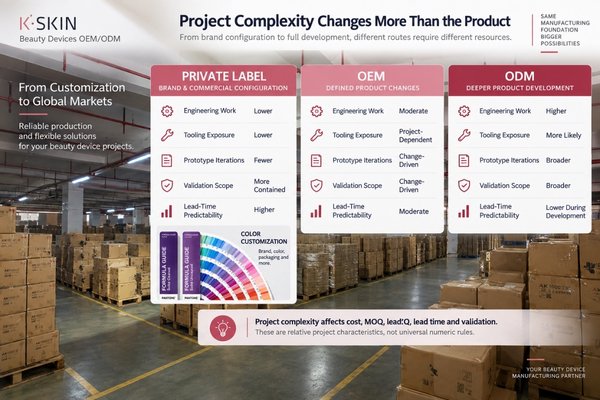
Instead of relying on generic market figures, buyers should identify which requirements drive the cost.
Private Label Cost Drivers
Typical variables include:
- selected product model;
- logo method;
- custom color or finish;
- packaging;
- labels and manuals;
- accessories;
- electrical or charging configuration;
- order quantity.
When the base product remains unchanged, the exposure to additional engineering and tooling can remain relatively contained.
OEM Cost Drivers
OEM projects may add:
- engineering review;
- component changes;
- structural modification;
- electronic changes;
- modified samples;
- tooling modification or new tooling;
- additional testing and validation.
A change that appears inexpensive at the component level may still create substantial engineering work if it affects other systems.
ODM Cost Drivers
Deeper ODM projects can add:
- product-definition work;
- industrial design;
- structural engineering;
- electronics and control development;
- new prototypes;
- several engineering iterations;
- new tooling;
- broader verification;
- production-readiness work.
This is why comparing only finished-unit quotations can be misleading. Two projects may produce similar-looking beauty devices while involving completely different development histories and levels of risk.
MOQ behaves in a similar way. A Private Label project may be influenced by the base product’s normal production quantity, while custom colors, packaging materials, electronic components, or tooling may introduce their own minimum quantities.
K·SKIN therefore does not apply one fixed Private Label MOQ to every product. Commercial conditions are influenced by the model, branding method, packaging, electrical configuration, order quantity, and target-market requirements.
Lead time should also be considered as a sequence rather than a single number:
Requirement Definition → Sample or Prototype → Review → Revision if Needed → Validation → Commercial Version Approval → Production
The more product systems that change, the more opportunities there are for iteration.
How Do Development, Validation and Compliance Responsibilities Change?
Deeper customization does more than increase development work. It also changes what must be rechecked before the final product can be approved for production and its intended market.
An established Private Label platform usually requires confirmation of the branded commercial version. OEM changes require validation of the affected parts and any connected systems. ODM may require broader prototype and design verification before the product is frozen. Existing test reports or certificates should never be assumed to cover a modified version automatically; their applicability must be checked against the exact product and market.
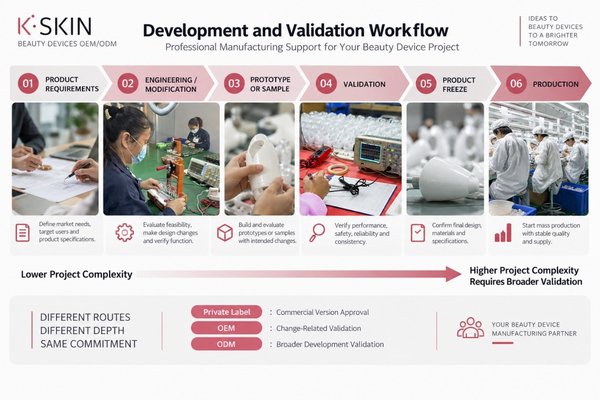
The development paths can be simplified as follows:
Private Label
Existing Product Platform
→ Base Sample
→ Branding and Commercial Configuration
→ Branded Material Review
→ Commercial Version Approval
→ Production
OEM
Buyer Requirements
→ Feasibility Review
→ Controlled Product Changes
→ Modified Sample or Prototype
→ Change-Related Validation
→ Product Freeze
→ Production
ODM
Product Brief
→ Product Definition
→ Industrial Design and Engineering
→ Prototype
→ Iteration
→ Broader Validation
→ Tooling and Production Readiness
→ Product Freeze
→ Production
The deeper the project, the more important version control becomes.
The approved product should identify the agreed structure, electronics, components, accessories, functions, labels, packaging, and other critical characteristics. Any later change should be reviewed for its effect on previously accepted performance or documentation.
Formal regulatory requirements remain specific to the product and market. For example, a heated hair-care appliance may fall within the scope of IEC 60335-2-23, while other beauty-device technologies may be subject to different requirements.
Quality-management certification is also not a substitute for product-specific verification. ISO 9001 provides a framework for quality management systems, but the finished commercial product still requires the applicable technical, quality, and market review for its actual configuration.
Buyers should therefore confirm:
- which documents apply to the base product;
- whether the proposed changes affect their scope;
- what additional testing or documentation is required;
- who is responsible for arranging each activity;
- what evidence must be completed before production release.
The K·SKIN manufacturing and quality framework follows a product-specific approach because a straightening brush, facial steamer, and multifunction beauty device do not require identical verification.
What Should You Define Before Requesting a Quote?
A manufacturer can assess a project more accurately when the buyer explains the commercial objective and required product differences instead of providing only a target price or the words “OEM needed.”
Before requesting a quotation, define the product category, target customer and market position, sales channel, required functions, genuinely necessary changes, approximate quantity, branding and packaging scope, target launch timing, market requirements, and any drawings or technical inputs already available. These details allow the manufacturer to determine whether Private Label, OEM, or ODM is the most practical starting route.
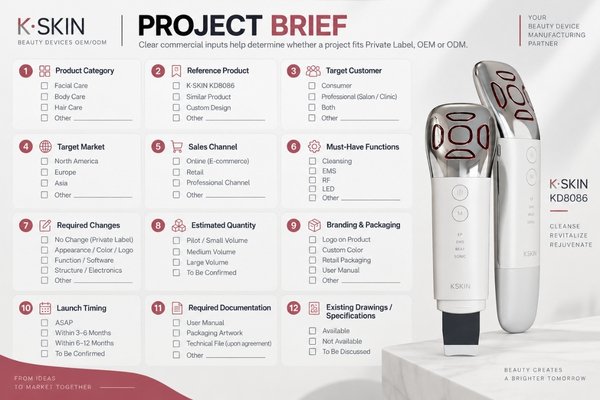
A useful initial project brief can remain short:
- What type of beauty device or hair-care product are you evaluating?
- Is there an existing product or reference model you already like?
- Who is the intended customer, and what is the target market position?
- Where do you plan to sell the product?
- Which functions are mandatory?
- What must differ from an existing platform?
- Do you already have drawings, specifications, or industrial-design files?
- What branding, color, packaging, or accessory requirements do you have?
- What approximate order quantity or forecast are you evaluating?
- What launch timing are you working toward?
- Are there any known market-specific documentation or configuration requirements?
A complete engineering specification is not required for the first discussion.
If an existing product already meets most of these requirements, the project may begin with Private Label. If the requested differentiation affects the structure, electronics, tooling, or core technical systems, the project can move into an OEM/ODM feasibility review.
The purpose of the first discussion should be to choose the appropriate development depth—not to force the project into a predetermined category.
Frequently Asked Questions
What is the difference between Private Label, OEM and ODM beauty devices?
Private Label normally starts with an established product platform and adapts the commercial version to a brand. OEM generally involves clearer buyer-defined product requirements or controlled modifications. ODM usually gives the manufacturer greater responsibility for design and engineering development. Exact definitions still vary among suppliers, so the project scope and responsibilities should be confirmed in writing.
Is Private Label the same as ODM?
No. Private Label normally keeps the core product substantially unchanged while adapting the branding, packaging, and supported commercial configuration. ODM usually involves deeper product-development work. Some suppliers use these terms differently, so buyers should compare what will actually change rather than relying on the label alone.
Which route usually has the lowest development risk and shortest lead time?
When a suitable existing product platform is available, Private Label normally involves less development uncertainty because the core product does not need to be created again. OEM and ODM can take longer when structural, electronic, tooling, or technical-system changes require additional prototypes and validation.
Who owns the product design, tooling and IP in an OEM or ODM project?
There is no universal ownership rule based solely on the terms OEM or ODM. Existing manufacturer IP, buyer designs, new tooling, project-specific developments, trademarks, and other rights should be identified in the relevant agreements. Ownership, usage rights, confidentiality, and exclusivity should be defined explicitly for each project.
Can existing certificates or test reports still be used after product customization?
Not automatically. The applicability of existing evidence depends on what changed, which product version was tested, the scope of the relevant documents, and the destination market. Structural, electrical, functional, or component changes may require technical review or additional validation before earlier evidence can be relied upon.
Conclusion
Private Label, OEM, and ODM are different ways to organize a product project, not a ranking from basic to advanced. The most efficient route is the one that creates the required market differentiation without adding unnecessary engineering, tooling, validation, or commercial risk.
If you already have a product direction, review K·SKIN’s beauty device and hair styling product platforms and contact the B2B project team with your product category, target market, estimated quantity, and required changes. The project can then be matched to an existing platform, a Private Label scope, or deeper OEM/ODM development.