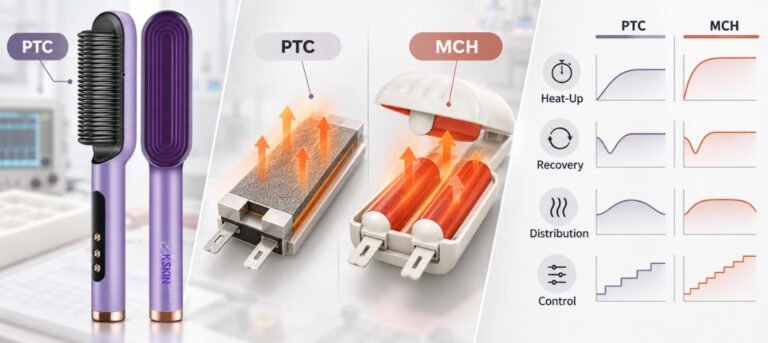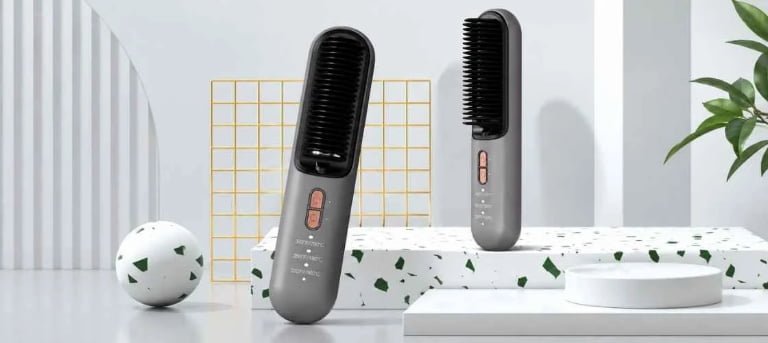
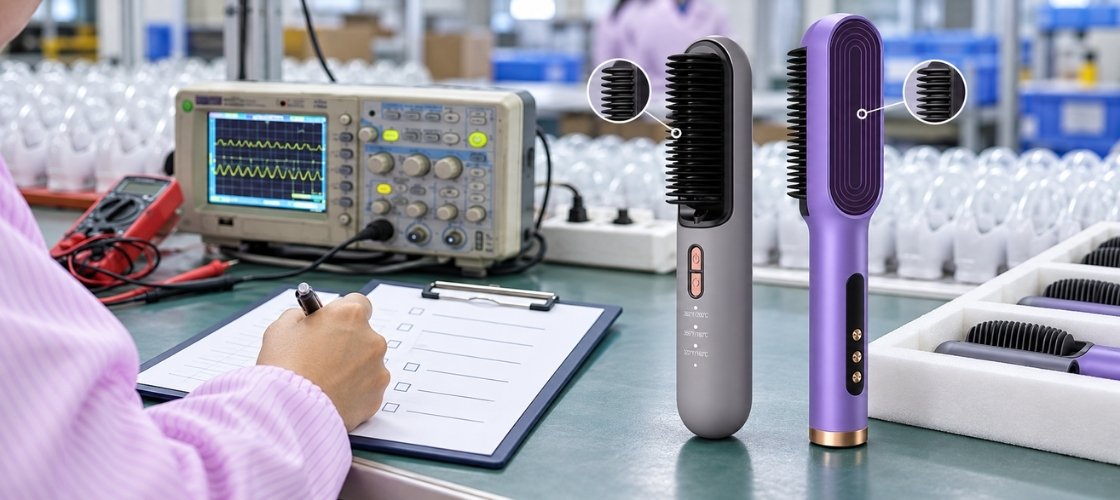
A polished sample can still hide problems with heating, controls, assembly, power configuration, styling behavior, or the commercial version that eventually reaches production.
A hair straightener brush sample should be approved only after the exact version has been identified and checked for workmanship, controls, heat-up response, temperature accuracy, heat distribution, stability, comb structure, styling behavior, protective functions, power-system performance, and final commercial configuration. The 12 checks below provide a practical B2B approval framework, not a universal certification standard.
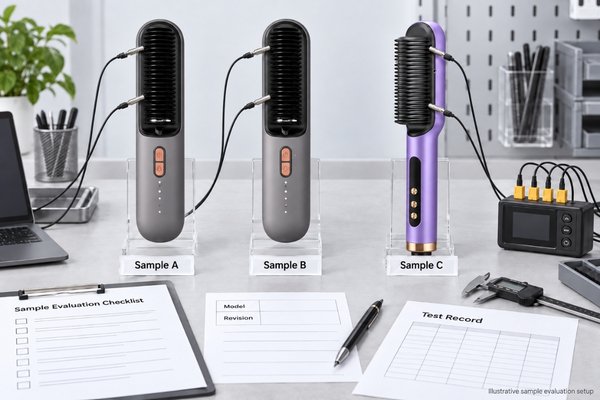
Sample approval should answer one simple question: Is this the exact product version the buyer is prepared to accept as the reference for the next commercial stage?
Answering that question takes more than switching on the brush and confirming that it heats up. Buyers comparing hair styling tool platforms need to connect the physical sample to its specification, electrical or charging configuration, operating behavior, styling result, packaging, and any other agreed commercial requirements.
Formal product-safety, EMC, market-access, and certification testing remains a separate process. The sample test determines whether the submitted product is suitable for approval and whether any unresolved issues must be corrected before production.
What Should Be Fixed Before You Start the Sample Test?
A repeatable test begins before the first temperature reading. The sample version, test method, measurement conditions, instruments, operating sequence, and acceptance basis should already be clear.
Before testing, identify the exact model and revision, confirm the approved specification and power configuration, define the temperature settings and measurement points, prepare representative hair tresses where styling will be evaluated, and record the test conditions. Agree on the acceptance criteria before reviewing the results so that the decision is based on evidence, not expectations formed after testing.
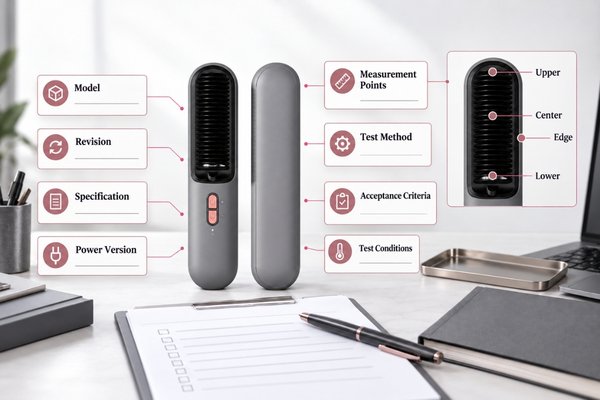
Use a short pre-test record to keep every unit and result traceable.
| Item to Fix Before Testing | What Should Be Confirmed | Why It Matters |
|---|---|---|
| Sample identity | Model, sample number, and revision | Prevents results from being assigned to the wrong version |
| Product specification | Current approved parameter and configuration reference | Establishes the comparison basis |
| Power configuration | Corded voltage/frequency or cordless charging configuration | Different platforms require different checks |
| Temperature settings | Every level or mode to be evaluated | Prevents selective testing of only one favorable setting |
| Measurement locations | Fixed working-zone and external-surface points | Makes comparisons repeatable |
| Instruments | Sensor type, attachment method, and equipment identification | Helps explain differences between test records |
| Test environment | Comparable starting and ambient conditions | Reduces uncontrolled variation |
| Hair tresses | Defined and repeatable tress types where styling is evaluated | Makes product-to-product comparisons more useful |
| Acceptance basis | Specification, project requirement, or agreed test plan | Prevents criteria from changing after results are known |
Testing more than one unit is preferable when practical. Three units can be useful for an early commercial comparison because they may reveal obvious unit-to-unit variation, but this is not a formal compliance or production-sampling rule.
The test plan should also reflect the actual product architecture. A cordless platform such as the KD382B requires charging and runtime evaluation. A corded platform such as the KD380K requires closer review of its rated electrical version, cord, plug, and continuous operating condition.
What Are the 12 Checks Before Product Approval?
The checklist should cover the complete commercial sample, not just one headline feature. Heating is critical, but it does not replace checks of assembly, handling, the power system, styling, controls, and packaging.
The 12 core checks cover sample identity, workmanship, controls, heat-up response, temperature accuracy, temperature distribution, temperature stability, comb-tooth structure, styling and glide, specified protective functions, power-system performance, and commercial-version alignment. Each result should state what was tested, how it was checked, which requirement applies, and whether corrective action or retesting is needed.
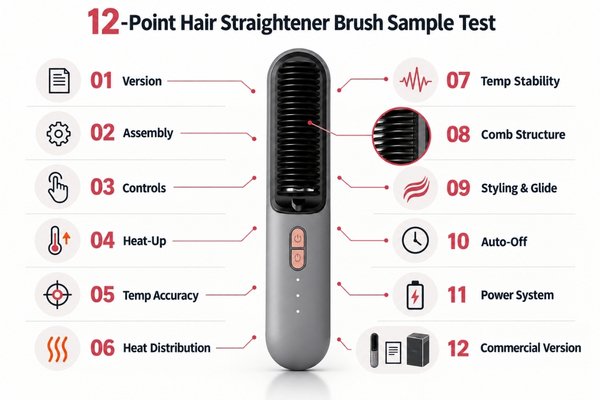
| # | Sample Check | What to Verify | Useful Record |
|---|---|---|---|
| 1 | Sample identity and version | Model, revision, and electrical or charging configuration | Sample ID and specification |
| 2 | Appearance, assembly, and dimensions | Housing, finish, gaps, alignment, dimensions, and visible workmanship | Photos and dimensional check |
| 3 | Controls and indicators | Buttons, heat levels, displays, indicators, and operating sequence | Functional record |
| 4 | Heat-up response | Behavior from a comparable cold start to the defined operating condition | Timed heating record |
| 5 | Temperature accuracy | Actual working-zone temperature against the approved requirement | Contact or validated infrared measurements |
| 6 | Temperature distribution | Temperature at several defined points across the working area | Multi-point record |
| 7 | Temperature stability | Overshoot, cycling, and variation after stabilization | Time-temperature record |
| 8 | Comb-tooth and protective structure | Alignment, spacing, looseness, deformation, and separation from hotter parts | Close-up inspection |
| 9 | Styling, glide, and snagging | Hair capture, movement through the brush, and intended styling result | Controlled hair-tress comparison |
| 10 | Specified functions and automatic shutoff | Ready indication, auto-off, and other functions included in the approved version | Functional test record |
| 11 | Power-system performance | Corded electrical configuration or cordless charging, battery, and runtime behavior | Platform-specific record |
| 12 | Commercial-version alignment | Color, branding, labels, manual, accessories, and packaging | Final approval checklist |
Thermal Performance: Checks 4–7
Heat-up response should be measured from comparable starting conditions rather than judged by how quickly an indicator changes state. A ready indicator shows that the controller has reached its programmed trigger condition. It does not prove that the entire working surface has reached an acceptable temperature.
Temperature accuracy should therefore be checked at defined working locations. The selected setting, internal sensor reading, and actual heated-tooth or working-surface temperature are related, but they are not necessarily identical.
Temperature distribution requires several repeatable measurement points. Depending on the brush geometry, these may include upper, center, lower, and edge positions. Use calibrated contact sensors or a validated infrared method, and keep the sensor attachment, locations, and measurement procedure consistent across samples.
Continue recording after the initial warm-up. This reveals overshoot and steady-state cycling instead of reducing the evaluation to a single convenient temperature reading.
Do not apply a generic rule such as “every point must be within a fixed number of degrees” to every straightener brush. The acceptable range should reflect the approved product, temperature setting, test method, and project requirements.
Product Interaction and Usability: Checks 2, 3, 8, 9 and 10
Appearance inspection should cover more than scratches. Check the housing fit, assembly gaps, button installation, comb-tooth alignment, surface finish, unexpected movement, and any obvious dimensional differences from the approved reference.
Test every user control. Confirm that temperature or mode changes follow the intended sequence and that the displays or indicators are easy to understand during normal use.
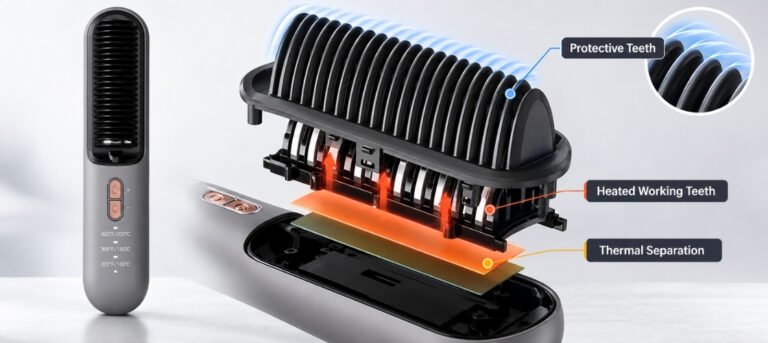
Comb geometry is part of the styling system. Loose, misaligned, or deformed teeth can affect hair guidance even when the heating performance is acceptable. The protective-tooth structure should also remain consistent with the approved version.
Use representative hair tresses and a consistent routine for the styling evaluation. Record hair capture, glide, snagging, straightening or shaping behavior, and practical differences between settings. Do not turn a sourcing comparison into unsupported claims about percentage hair-damage reduction or guaranteed performance for every hair type.
Check specified protective and feedback functions separately. If the approved version includes automatic shutoff, a ready indication, a low-battery warning, or another control function, verify that the sample performs that function as defined.
Power System and Commercial Version: Checks 1, 11 and 12
The core checklist applies across product platforms, but the power-system checks should change with the product.
| Corded Sample | Cordless Sample |
|---|---|
| Confirm rated electrical version | Confirm approved charging input |
| Inspect cord and plug configuration | Check charging operation and indicators |
| Review cord connection and visible condition | Record runtime under defined conditions |
| Operate under the agreed electrical conditions | Review low-battery behavior where applicable |
| Match rating label to the approved version | Match battery and charging configuration to the approved version |
After functional testing, return to the commercial product. A technically acceptable brush can still be the wrong SKU if its color, logo, rating label, accessories, manual, or packaging does not match the version the buyer expects to purchase.
For a private-label project, these items should be tied to the agreed commercial-version approval process before production.
How Should Buyers Set Pass/Fail Criteria?
A useful approval record must distinguish an acceptable result from a correctable deviation, a genuine failure, or a test that cannot be trusted because the method was unclear.
Pass/fail criteria should come from the approved product specification, agreed project requirements, applicable verified requirements where relevant, and a defined test method. Buyers should not take a temperature tolerance, runtime figure, dimensional limit, or other acceptance value from an unrelated product and treat it as an industry-wide standard for every hair straightener brush.
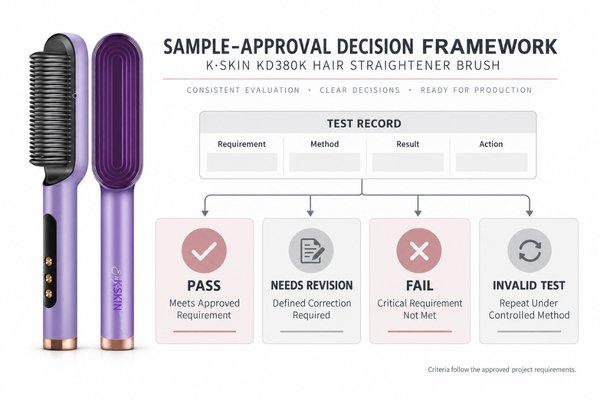
A simple decision structure keeps the sample-review process controlled.
| Result | Meaning | Typical Next Step |
|---|---|---|
| Pass | The checked requirement is satisfied | Record the result and continue |
| Needs Revision | The product direction remains acceptable, but a defined item requires correction | Correct the issue and retest the affected items |
| Fail | A critical approved requirement is not met | Do not approve the current sample version |
| Invalid Test | The method, sample identity, or conditions are not sufficiently controlled | Repeat the test correctly before deciding |
Write the acceptance requirement beside each result. “Temperature OK” is weak evidence. A stronger record identifies the selected setting, measurement points, test method, measured behavior, and the agreed range used for the decision.
The same principle applies to runtime, dimensions, controls, and styling. A result is meaningful only when the buyer knows which requirement it is being compared with.
Sample approval is also not a substitute for formal safety or market-access evaluation. IEC 60335-2-23:2026 covers hair straighteners and other hair-care appliances within its scope and includes appliance-safety requirements relevant to these products. The exact applicable standards, editions, national requirements, and supporting documents must be established for the specific product version and destination market.
Passing an internal or buyer-defined sample checklist therefore means that the submitted commercial sample has met the agreed approval scope. It does not, by itself, mean that the product has completed every regulatory or certification requirement for sale.
What Should Happen After a Sample Fails—or Passes?
A sample test has little value unless the results are tied to revision control. Failed items require corrective action and retesting, while a passed sample needs a clearly identifiable approved reference.
When a sample fails, record the exact deviation, confirm that the test method was valid, define the required correction, and retest the affected function after the change. When the sample passes, freeze the model, revision, configuration, relevant test records, and commercial details as the approved reference so that later production is not based on memory or an unmarked sample.
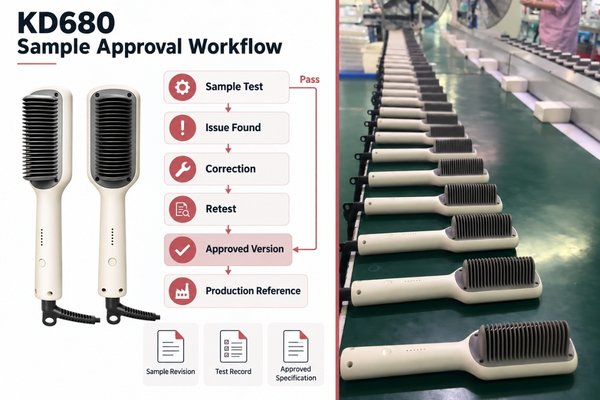
For a failed or borderline result:
- Record the sample identity and the exact failed requirement.
- Confirm that the test method, instrument, and operating condition were valid.
- Identify whether the issue comes from the component, assembly, control logic, commercial configuration, or test setup.
- Define the correction before a replacement or revised sample is submitted.
- Retest the affected item using the same controlled method.
- Check whether the change could affect another approved characteristic.
A heater change, for example, can affect heat-up response, temperature distribution, control behavior, and power demand. A comb change may affect both hair handling and the relationship between the user and the heated surfaces. Retesting only the visible symptom can therefore miss a secondary effect.
For a passed sample, the approval record should be simple but specific.
| Approval Record | What to Capture |
|---|---|
| Product identity | Model and approved revision |
| Power version | Corded electrical configuration or cordless charging configuration |
| Functional reference | Approved modes, controls, and specified functions |
| Test evidence | Relevant measurement and evaluation records |
| Appearance reference | Product photos, finish, and approved physical details |
| Commercial configuration | Branding, labels, manual, accessories, and packaging |
| Open issues | Any agreed items that still require closure |
| Approval status | Date, revision, and responsible project reference |
K·SKIN’s manufacturing and quality-control framework follows the same basic principle: production should remain tied to the approved product version, relevant product-specific checks, and final commercial configuration.
Frequently Asked Questions
What are the 12 checks in a hair straightener brush sample test?
The baseline checks are sample identity, appearance and assembly, controls, heat-up response, temperature accuracy, temperature distribution, temperature stability, comb-tooth structure, styling and glide, specified protective functions, power-system performance, and commercial-version alignment. A particular technology or project may require additional checks.
How many hair straightener brush samples should a buyer test?
Testing more than one unit is preferable for an early comparison because a single presentation sample cannot reveal unit-to-unit variation. Three units can provide a practical early engineering or sourcing screen, but this should not be treated as a universal compliance or production-sampling requirement. The final sample quantity should reflect the project risk and agreed test plan.
How should temperature distribution be measured?
Use several fixed points across the working zone and keep the locations identical between units. Contact temperature sensors can be used where suitable. A validated infrared method can help visualize the distribution when emissivity and other measurement conditions are controlled. Record the method so that the supplier can reproduce the result.
Should corded and cordless straightening brushes use the same checklist?
The core approval logic can remain the same, but the power-system checks should differ. Corded products require confirmation of the approved electrical version and cord and plug configuration. Cordless products require checks of charging, battery, runtime, and low-battery behavior where those functions are part of the approved design.
Does passing the sample test mean the product is certified for sale?
No. Sample approval confirms that the submitted version satisfies the defined commercial and technical evaluation scope. Product-safety testing, EMC, labeling, documentation, and other regulatory requirements depend on the exact product and destination market and should be verified through the applicable compliance process.
Conclusion
A useful hair straightener brush sample test connects the physical product to measurable performance and an identifiable commercial version. Buyers should review more than maximum temperature or styling appearance. Version identity, workmanship, control response, thermal behavior, comb structure, real hair interaction, power-system operation, and final packaging all influence whether a sample is ready for approval.
To compare an existing platform or prepare a structured sample review, explore K·SKIN’s hair styling tools and contact the project team with the product format, intended commercial configuration, and evaluation requirements you want confirmed before approval.