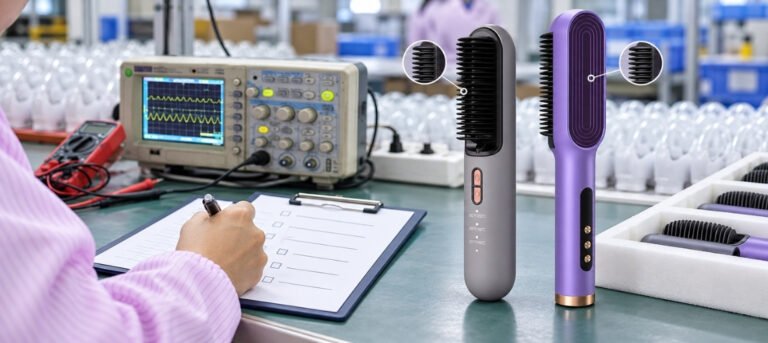
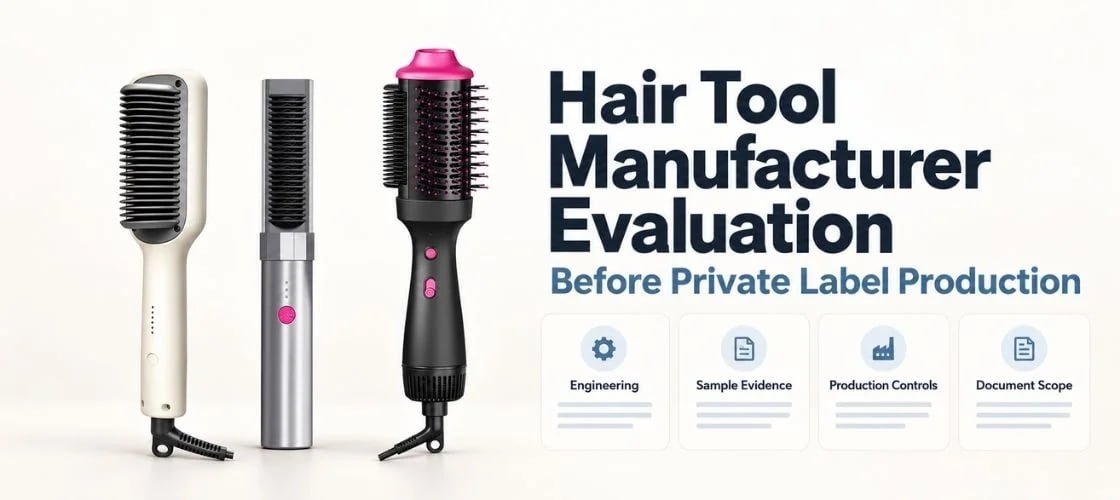
A supplier may offer the right-looking hair tool yet lack the engineering support your branded version needs. Before committing to production, establish whether its product platform, sample evidence and manufacturing controls fit your specific project.
Evaluate a hair styling tool manufacturer by matching its relevant product platforms to your requirements, then checking engineering responsibility, critical components, sample results, production controls, document scope and commercial commitments. Compare evidence for the exact version you intend to buy. Catalogue breadth and a competitive quotation can support a shortlist, but neither establishes that the supplier can reproduce your approved private-label product.
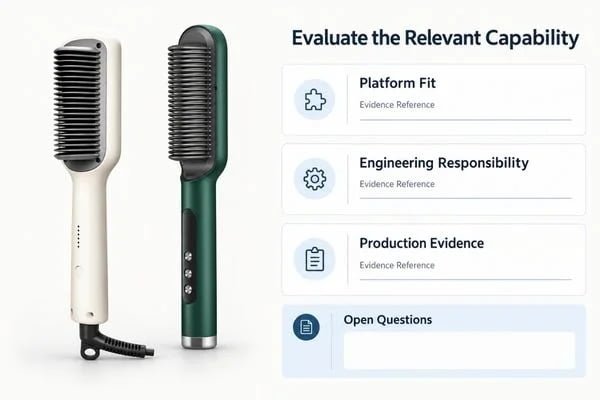
Establish who will supply, engineer and manufacture the product
Begin with the parties responsible for the order. A brand owner, importer or purchasing manager needs to know who accepts commercial commitments, who approves technical decisions and where the proposed product will be assembled and checked.
A trading company can coordinate a suitable manufacturing arrangement. An integrated manufacturer may perform more activities directly. Either arrangement needs identifiable responsibilities, including any outsourced work.
| Supplier arrangement | What to establish | Evidence to request |
|---|---|---|
| Manufacturer supplying an established platform | Who controls its specification, assembly and release | Named operator and site, product revision and relevant production records |
| Commercial supplier coordinating a separate factory | How technical commitments reach the factory and how issues return to the buyer | Documented responsibilities, manufacturing relationship and engineering contact |
| Supplier proposing product development | Who owns each design task and approves the production solution | Agreed development scope, review stages and deliverables |
Record the contracting entity separately from the factory operator and evidence holder. Shared branding or similar company names do not establish ownership, manufacturing authority or certification rights.
Match the supplier to the hair platforms your range actually needs
Evaluate relevant capability across the intended assortment. A supplier experienced with a corded straightening brush still needs to demonstrate the additional controls required for rechargeable, hot-air, steam or specialized hair-care products.

The following eight K·SKIN platforms provide a practical starting matrix. Their product directions are reflected in the Hair Styling Tools range. The review questions are buyer evaluation prompts, not claims that a particular test has been passed.
| Model | Product direction | Questions that distinguish the supplier's capability |
|---|---|---|
| KD680 | Compact corded straightening brush | How are heating, tooth assembly and the market electrical version controlled? |
| KD380K | Corded ionic straightening and curling brush | How are temperature control and the specified ionic function checked separately? |
| KD382B | Cordless ionic straightening and curling brush | How are heating, charging, battery condition and operating duration evaluated together? |
| K6 | Cordless mini bang styling brush | How are the compact heated surface, charging interface and controls verified? |
| KD311 | Hot-air straightening brush | How are airflow, heated brushing and their operating combinations evaluated? |
| KD880 | Steam straightening brush | How are the water path, steam control and heated brush assessed together? |
| KD881 | Ultrasonic hair-care device | How is the specified ultrasonic output verified under defined operating conditions? |
| KD3802 | LED microcurrent scalp massage comb | How are optical, electrical and massage functions checked without implying unproved effects? |
Use only the rows relevant to your launch. A focused supplier may suit a single-platform project; a broader range needs evidence for each included technical system. Eight catalogue entries are not eight demonstrated manufacturing competencies.
Test engineering knowledge with specific component questions
Ask the engineering team to explain how the selected product works and which parts control its important characteristics. Useful answers connect a component to an observable requirement, a test method and a controlled revision.
Ask about the complete heating or output system
For a heated brush, discuss the heater, temperature sensing, control logic, comb geometry and accessible surfaces together. Ask where temperature is measured and what condition triggers a ready indication. A displayed setting and a measured tooth temperature are different observations.
The K6 specification dated August 21, 2025 identifies heating film and an NTC-related component. The KD311 specification dated December 4, 2024 describes PTC-heated teeth alongside a fan-and-heater airflow function. These source-version examples show why one generic heating questionnaire is insufficient; they do not establish the current approved configuration for every order.
For KD311, ask which controls select airflow and heated brushing, and which combinations the evaluation covers. For KD880, ask what happens at filling, steam initiation, stopping and cooling. For cordless products, request the approved charging configuration and the method used to assess operation as battery charge changes.
Separate branding changes from engineering changes
Define logo, color, finish, label, manual and packaging requirements item by item. Then ask which changes affect materials, assembly, electrical configuration or validation.
Moving a control, changing tooth geometry or replacing a battery may require technical work beyond commercial decoration.
K·SKIN's OEM/ODM development framework distinguishes existing-platform adaptation from deeper product changes. For your project, request a written scope stating what can remain unchanged, what needs review and which deliverables support the decision.
Make the sample evaluation demonstrate the proposed version
Order samples with a defined purpose. The sample request should identify the model, electrical or charging configuration, build revision, proposed branding changes and the questions the evaluation must answer.
Agree the method before comparing results
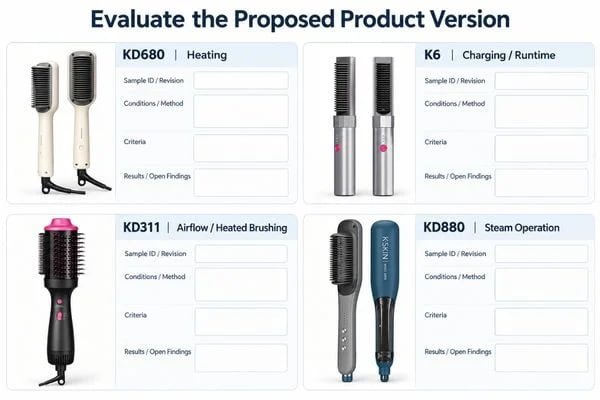
Have the responsible technical reviewer define sample quantity, conditions, instruments, measurement locations, duration and acceptance criteria. Record actual values and observations, rather than accepting a summary that says only “tested OK.”
For a heating comparison, record starting temperature, selected setting, measurement position and the definition of heat-up completion. For a cordless operating-duration check, record initial charge, operating mode, use pattern and the chosen stopping condition. Do not derive runtime from battery capacity alone.
Airflow and steam evaluations need their own conditions. Identify the operating combination for a hot-air brush, and water type, fill level, orientation and steam setting for a steam brush. Use the applicable instructions; do not introduce unapproved operating conditions simply to obtain a more impressive result.
Electrical-safety or abnormal-condition evaluation should be assigned to competent personnel using appropriate methods. A buyer demonstration cannot replace required laboratory work.
Check how the supplier responds to a finding
The sample review should also test the working relationship. Submit a precise observation with the sample identity, conditions and supporting record. Ask the supplier to explain the suspected cause, proposed correction and verification needed.
For example, if a ready indicator activates before a buyer's agreed measurement criterion is met, compare the definitions first. Then determine whether the issue concerns the measurement method, indicator logic or thermal behavior. A promise to “improve quality” does not answer those questions.
Record whether the next submission contains the agreed correction and whether connected functions remain acceptable. One attractive sample is less informative than a traceable revision that resolves a documented issue.
Follow a relevant production and quality record through the factory
Factory evaluation should follow the selected hair tool through component preparation, assembly, inspection and release. Request a live walkthrough or a controlled record review that relates to the proposed technical system.
General factory photographs provide context. They cannot independently prove that KD311, KD880 or your branded version is manufactured at the pictured workstation.
Connect critical parts to in-process checks
For heated brushes, ask how the heater, sensor, wiring and comb assembly are identified and checked. For cordless versions, follow battery and charging-system control. For hot-air and steam products, include the relevant fan assembly or water-path connections.
Ask the reviewer to show the requirement used, the inspection point, instrument status and record produced. Identify which checks occur before the product is closed and which occur on the finished unit.
K·SKIN's Manufacturing & Quality page outlines a version-based production discussion. Request the actual model-specific method and records for your project rather than treating that framework as proof of an individual batch's result.
Review one corrective-action trail
Where confidentiality permits, request a redacted example of a relevant production issue. Follow the original finding, affected units, containment, cause investigation, correction and subsequent verification. Keep customer identities and protected commercial details out of the review copy.
Distinguish sorting or reworking an affected lot from preventing recurrence. Ask what changed in the component, assembly instruction or inspection method, and what later record demonstrates that the action worked.
For a proposed outsourced process, identify its operator and the supplier's control method. Outsourcing itself is not a rejection criterion; undisclosed responsibilities or untraceable results require clarification.
Review documents against the intended private-label configuration
Document review should establish what applies to the product being ordered. Match the specification, sample identification, label, manual and supporting reports to the same model, configuration and destination market.
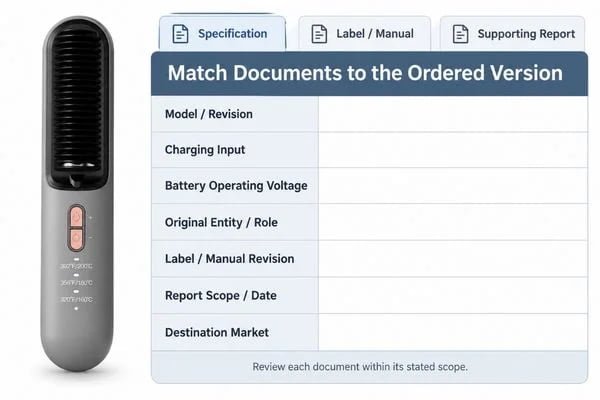
Keep each document's purpose clear. ISO describes ISO 9001 as a quality management system standard. A management-system certificate needs review of its holder, site, activity scope and status; it is not product certification for every hair tool in a catalogue.
A product report needs a separate check of the tested model, relevant configuration, method, date and covered requirements. When a summary document refers to a full report, request the supporting report through an authorized review route.
If an applicant or manufacturer differs from the commercial supplier, preserve the original name and establish the relevant relationship. Access to a report does not establish certificate ownership or permission to reproduce it publicly.
A rating label for one mains version cannot define another version. Likewise, a rechargeable brush's charging input, battery operating voltage and heater behavior should not be merged into one “voltage” field.
For a related example of matching electrical configurations to labels and supporting documents, see our facial steamer voltage and plug checklist; the hair tool's own configuration and applicable requirements still need a separate review.
For ionic, ultrasonic, LED or microcurrent functions, distinguish verified technical output from claims about the user's hair or scalp. Approve packaging and listing language against the available evidence; an observed function does not prove hair growth, permanent repair or a particular treatment outcome.
Compare commercial terms after defining the product and responsibilities
A quotation becomes comparable when it describes the same approved product and delivery scope. Ask each shortlisted supplier to separate the product price from branding, packaging, engineering, testing and other project-specific charges.
Identify what drives MOQ and timing
Request the MOQ basis for the exact color, decoration, packaging and accessory configuration. Ask whether the limit comes from finished-product assembly, a purchased component, printed materials or another requirement. Do not assume that a stock version and a customized version share the same minimum.
Break timing into sample preparation, buyer decisions, material availability, production and relevant release work. Record what starts each stage and which inputs remain outstanding. A delivery promise made before the configuration is defined needs qualification.
Confirm commercial availability for the intended destination and sales channel. Existing platform availability does not automatically mean that every configuration or territory is open to a new private-label project.
Agree how production problems will be handled
Define defect reporting, evidence required, response ownership and proposed remedies in the project terms. Ask how a suspected batch issue will be traced and how replacement units will be checked against the approved revision.
Also confirm notification before component or process changes, access to relevant inspection records, and approval responsibility for revised artwork. Discuss tooling, brand assets and exclusivity where relevant; private-label terminology alone does not settle those rights.
Use a scorecard without letting the total hide a critical gap
Use the same evidence-based scorecard across candidates, then retain the underlying findings. The suggested weights below are a buyer planning tool, not an industry standard or a completed assessment of K·SKIN or another supplier.

| Review area | Suggested weight | Evidence that supports the assessment |
|---|---|---|
| Relevant platform fit | 15% | Selected model and technical system matched to the project |
| Engineering and component control | 20% | Named technical owner, controlled component definition and change review |
| Sample evaluation and correction | 20% | Identified samples, reproducible results and verified issue closure |
| Manufacturing and QC execution | 20% | Relevant process review and completed inspection or corrective-action records |
| Product documents and market version | 15% | Aligned specification, label, manual and applicable evidence scope |
| Commercial responsibilities | 10% | Defined quotation scope, timing assumptions and issue-handling terms |
For each area, a buyer can use a 0–3 scale: 0 for no usable evidence or a material contradiction; 1 for a statement or template only; 2 for relevant evidence with specific gaps; and 3 for evidence reviewed against the agreed scope. Calculate each contribution as its weight multiplied by the score divided by three.
Set decision criteria before reviewing candidates and adjust weights to the project. A cordless launch may require greater attention to charging and battery control; a steam platform may need a deeper water-system review.
Keep critical findings outside the numerical total. An unexplained production site, evidence misrepresentation, unresolved safety issue or uncontrolled critical substitution can justify a hold regardless of the score. Ordinary documentation gaps may instead receive a defined owner and closure date.
Do not score an unreviewed area as satisfactory. Record “not assessed” separately, and do not compare an incomplete total directly with a fully reviewed candidate's result.
Record the qualification decision before authorizing production
Supplier selection should produce a clear decision record, not just a preferred quotation. Confirm which model and version the decision covers, what was reviewed and what remains to be completed before the next commitment.
Use this checklist as a working record. Add an evidence reference, reviewer, outcome and open action beside each item:
- Record the contracting party, factory operator, site and responsible engineering and quality contacts.
- Match the selected hair platform to the intended product range and buyer requirements.
- Confirm the supported branding changes and any work requiring engineering review.
- Identify the critical component references and route for approving substitutions.
- Record sample identities, methods, acceptance criteria, results and outstanding findings.
- Review relevant assembly and QC controls, including a completed record where available.
- Check the correction and verification trail for significant sample or production issues.
- Align specifications, labels, manuals and evidence with the intended market version.
- Confirm quotation scope, MOQ basis, timing dependencies and commercial availability.
- Record change-notification, defect-handling and production-release responsibilities.
Choose a specific outcome: qualified for the defined scope, qualified subject to identified conditions, or on hold pending stated evidence. Give every condition a decision owner and a required closure point.
Qualification does not itself approve a production sample or release an order.
Frequently Asked Questions
Must a manufacturer offer every type of hair styling tool?
No. Evaluate the technical systems required by your assortment. A single-platform project can suit a focused supplier. A broader range requires relevant engineering, sample and production evidence for each included platform; catalogue size alone is a poor substitute.
Can a supplier keep its BOM confidential during evaluation?
Agree a controlled review route that provides enough information to verify critical components, revision control and substitution responsibilities. A full unrestricted BOM copy may be unnecessary. If confidentiality prevents a meaningful technical check, keep that part of the assessment unresolved.
Should buyers select the lowest-priced sample supplier?
Compare the same configuration and scope first. Identify whether the price includes the required branding, packaging, documentation and evaluation work. Then consider verified capability and issue handling alongside cost. A sample quotation does not define the complete production commitment.
How can a small buyer assess manufacturing consistency before ordering?
Request relevant completed records and trace one controlled product revision through assembly, inspection and correction. Agree the inspection and release approach for the proposed order. Limited purchasing volume does not make a showroom sample sufficient evidence of repeatable production.
Does a new logo require the whole evaluation to be repeated?
Review the actual change and its effects. A bounded artwork change may need decoration and label checks, while a different coating, material or application process may require additional assessment. Retain earlier results only where their configuration and scope remain applicable.
Conclusion
A useful manufacturer evaluation connects the selected hair platform to engineering decisions, sample evidence and production controls. Compare what each supplier can demonstrate for your version, retain unresolved findings and make qualification conditional where the evidence is incomplete.
Start a K·SKIN discussion with the relevant Hair Styling Tools platform, then share your market, branding scope and evaluation requirements. Confirm the technical responsibilities, documents and commercial conditions before committing your brand to production.
For your next product review, explore hair straightener brush project options.