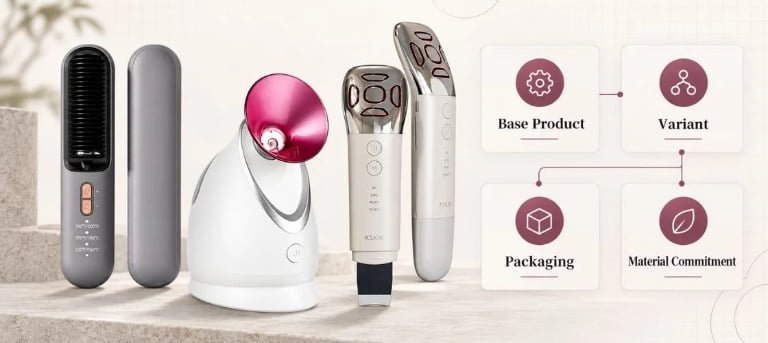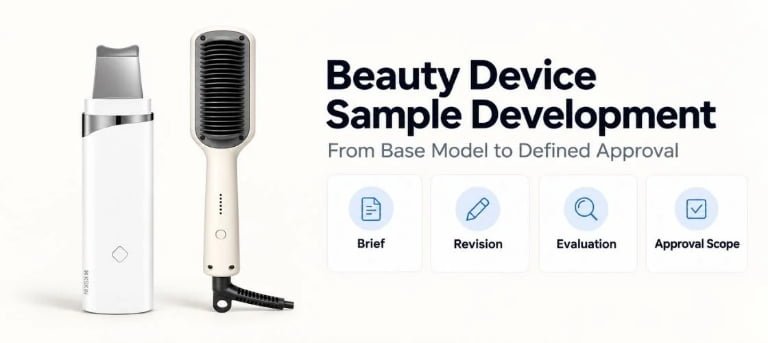
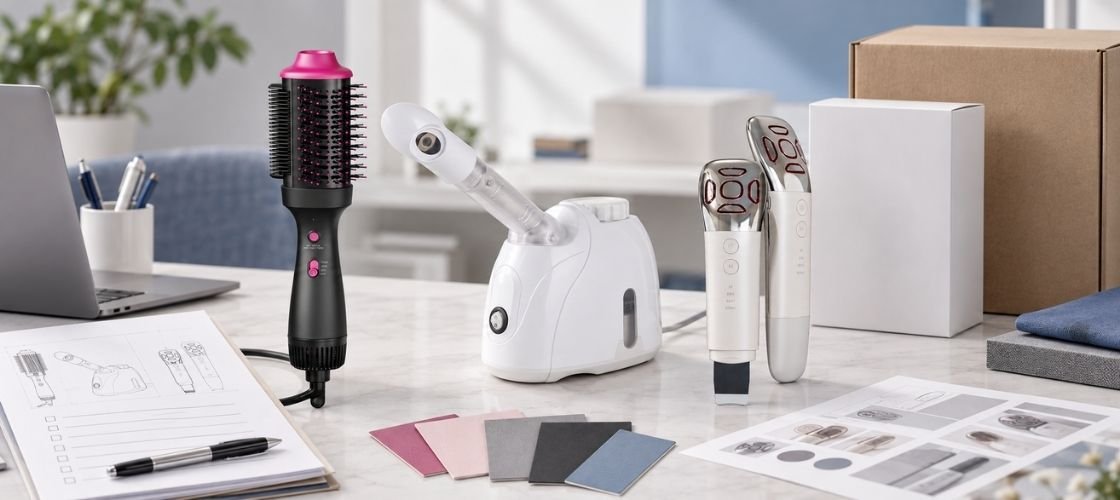
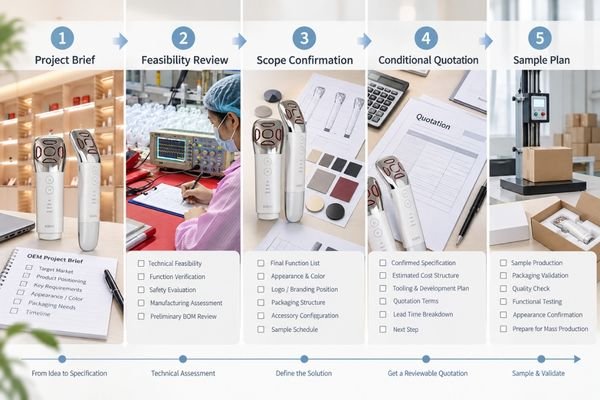
A clear OEM project brief helps a beauty device manufacturer assess feasibility, define the development route and prepare a quotation based on fewer assumptions.
A useful beauty device OEM project brief should identify the target market and channel, selected product platform or concept, required product changes, commercial quantities, packaging, electrical version, compliance responsibilities, sample expectations, launch milestones and decision owners. It does not need to be a finished engineering specification, but it should distinguish confirmed requirements from preferences and unresolved questions.
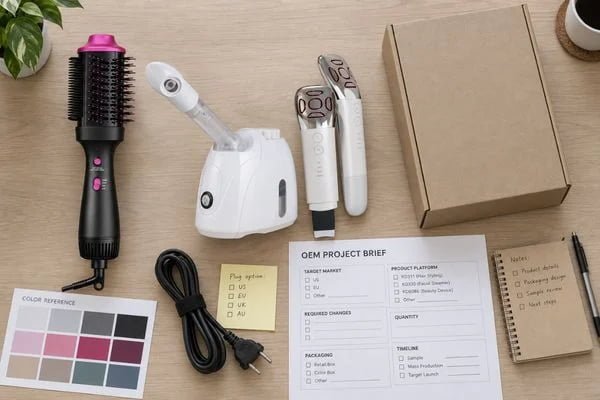
Why Does an Incomplete OEM Brief Produce an Unreliable Quote?
The phrase “custom beauty device” can describe very different projects. One buyer may need a logo and branded packaging for an existing product. Another may expect a new housing, control interface, battery system or treatment head.
These projects cannot be quoted on the same basis.
When the scope is unclear, suppliers must make assumptions about the product version, materials, tooling, packaging, testing and order quantity. Two quotations may therefore appear to cover the same product while excluding different costs and responsibilities.
| Missing Information | Likely Quotation Problem |
|---|---|
| No target market | Electrical version, labels and document scope remain unclear |
| No base product or concept | The supplier cannot judge platform fit or development depth |
| No prioritized change list | Private Label and OEM requirements become mixed |
| No estimated quantity | MOQ, component sourcing and unit-price basis cannot be evaluated |
| No packaging definition | Packaging, accessories and logistics costs may be excluded |
| No intended use or claims | Product and compliance requirements may be misunderstood |
| No target timeline | Sample, tooling, artwork and testing dependencies remain unknown |
| No trade term or destination | Freight, delivery and commercial comparisons may be misleading |
The brief is not intended to eliminate every open question. It should give the supplier enough information to identify those questions before issuing a quotation.
Match the Quotation to the Maturity of the Project
A first inquiry does not always support a firm production quotation. The supplier’s response should reflect how clearly the product has been defined.
| Project Stage | Information Available | Reasonable Supplier Response |
|---|---|---|
| Early concept | Product direction, market, main difference and estimated scale | Development-route recommendation, initial feasibility comments and open questions |
| Scope definition | Base model, prioritized changes, market version, packaging and quantity | Conditional quotation, development-cost range, MOQ basis and sample proposal |
| Approved specification | Controlled product version, packaging, validation scope and commercial terms | More stable pricing and a production-planning basis |
Terminology varies among suppliers, but the distinction matters. An early estimate should not be treated as a fixed production price while the structure, functions, packaging or testing requirements are still changing.

Start by Defining the Product Development Route
The buyer does not need to know the final technical solution before contacting a manufacturer. The brief should, however, explain what needs to change and why the change matters commercially.
Existing Product or Private Label
An existing platform may be appropriate when the product already fits the intended consumer routine and the main requirements involve:
- logo application;
- approved colors or finishes;
- branded packaging;
- labels and manuals;
- electrical or market configuration;
- approved accessories or product bundles.
These requirements are generally closer to a Private Label project than to deeper OEM development.
Controlled Modification
An existing platform may still be suitable when selected elements require engineering review, such as:
- a revised control interface;
- a different accessory;
- selected structural changes;
- a changed electrical configuration;
- adjusted operating logic;
- a market-specific commercial version.
The manufacturer should determine whether these changes can be controlled within the existing platform or whether they affect tooling, electronics, validation or production processes.
Deeper OEM or ODM Development
A deeper OEM/ODM development project may be necessary when the requested difference affects:
- product structure or dedicated tooling;
- electronics or firmware;
- heating, airflow, steam or water systems;
- battery or charging architecture;
- treatment heads or technical outputs;
- new combinations of core functions.
If the appropriate route is uncertain, the brief should describe the required outcome rather than assign an inaccurate label to the project.
Define the Commercial Goal Before Listing Product Features
A feature list without commercial context can lead to unnecessary development. The supplier needs to understand how the proposed product will be positioned.
The brief should explain:
- the intended consumer;
- the primary use scenario;
- the planned sales channel;
- the target countries;
- the expected market position;
- the intended retail or procurement price level;
- the commercial difference the product should create;
- the requirements essential to that difference.
A buyer selling through an online marketplace may prioritize compact packaging, clear instructions and parcel-shipping protection. A retail project may need different display packaging, barcode placement, language coverage and approval steps. Salon, distributor and promotional channels may have different expectations for accessories and durability.
Competitor links and reference images can help communicate the intended direction, but “make the same product” is not an adequate project requirement. A reference product does not define its internal structure, materials, intellectual-property position, electrical configuration or applicable documentation.
Identify the Base Product or Product Concept
The brief should show the project’s current starting point.
Possible starting points include:
- A model selected from the manufacturer’s existing beauty device and hair styling tool range.
- An existing model that requires controlled changes.
- A reference sample or competitor product.
- An industrial design, drawing or technical concept.
- An early product idea that requires platform selection.
In each case, divide the requirements into clear priorities:
| Priority | Meaning |
|---|---|
| Must have | The project cannot proceed without this requirement |
| Preferred | Important, but an alternative may be considered |
| Optional | Useful if practical within the cost and schedule |
| Out of scope | Specifically excluded from the project |
This prevents optional ideas from being quoted as mandatory engineering work. It also helps the supplier recommend a practical existing platform when full development is unnecessary.
Describe the Required Changes by Product System
Customization should be divided by system instead of presented as one undifferentiated request.
| Change Area | Information to Provide | Possible Project Impact |
|---|---|---|
| Branding | Brand name, logo, placement and marking requirements | Artwork and application review |
| Color and finish | Color reference, finish and acceptable variation | Sampling, material and process review |
| Product structure | Dimensions, housing, treatment head or assembly changes | Engineering, tooling and validation |
| Electrical system | Voltage, frequency, plug, adapter, battery or charging input | Market version, sourcing and testing |
| Functions and controls | Modes, levels, interface and control logic | Electronics, firmware and functional validation |
| Accessories | Cables, adapters, pouches, heads or compatible consumables | Compatibility, packaging and MOQ |
| Packaging | Box, insert, protection, labels, barcode and carton markings | Artwork, sampling and logistics |
| Documentation | Manual languages, warnings, reports and customer requirements | Review responsibility, cost and schedule |
Engineering priorities also vary by product.
For hair styling tools, the relevant systems may include heating, airflow, temperature control, comb structure and electrical configuration. Facial steamers may require a review of the water tank, heating system, steam path, nozzle and cleaning design. Other home beauty devices may depend on treatment-head structure, output controls, batteries, charging and compatible accessories.
The brief should not assume that a change that is simple for one product will be equally simple for another.

Specify the Target Market, Channel and Commercial Version
A country name alone may not define the complete commercial version. Buyers should provide:
- primary and secondary sales markets;
- online, retail, salon, distributor or promotional channels;
- marketplace or retailer requirements, if known;
- required voltage and frequency;
- plug, power cord or adapter type;
- charging cable and battery requirements;
- label and manual languages;
- brand owner, importer or responsible-party information;
- intended product claims;
- required accessories;
- expected packaging configuration.
Availability should also be confirmed for the specific combination of model, country and channel. A product shown in a supplier’s catalogue should not automatically be assumed to be available for every market, platform or distribution arrangement.
A single physical platform may require multiple commercial versions when plugs, voltage, adapters, languages, labels, responsible-party details or packaging differ. The brief should therefore identify whether the project involves one SKU or a multi-market product family.

Provide Quantity and Commercial Assumptions
“Please quote your MOQ” is not enough to define the commercial basis.
The buyer should provide:
- required sample quantity;
- estimated initial order quantity;
- expected annual quantity range;
- quantity by color, plug or SKU;
- whether mixed-SKU production is requested;
- target price or market price level, if available;
- quotation currency;
- delivery destination;
- requested trade term;
- whether development and tooling costs should be separated from unit pricing.
A target price is useful only when its basis is clear. Buyers should specify whether it represents an expected purchase price, landed cost or retail position and whether it includes packaging, accessories, testing and one-time development costs.
If an exact target price is confidential or still under review, a price tier or intended market position can still help the supplier avoid proposing an unsuitable platform.
There is no universal MOQ for every beauty device project. The workable quantity may depend on the product model, material, logo method, color, packaging, electrical version, component conditions and number of SKUs.
Define Packaging and Logistics Requirements Early
Packaging is part of the commercial product, not a final decoration added after development.
The project brief should address:
- retail box or alternative packaging format;
- insert and protective structure;
- product and accessory arrangement;
- manuals, cards and other printed materials;
- barcode and marketplace labels;
- master-carton markings;
- single-product or bundled configuration;
- retail-display or parcel-delivery requirements;
- customer-specific packaging tests;
- battery transport configuration where applicable.
Custom boxes, trays, labels and manuals may have separate quantity and artwork requirements. Late packaging changes can also affect product fit, shipping protection, carton dimensions and launch timing.
For rechargeable products, the buyer should identify whether batteries are installed in the equipment and how the goods are expected to ship. The current IATA lithium battery guidance explains why battery configuration and shipment conditions must be considered separately from general product pricing.
Clarify Compliance Responsibilities and Required Evidence
A request such as “CE, FCC and FDA required” does not provide enough information to determine the correct project scope.
The buyer should first identify:
- destination markets;
- intended use;
- product claims;
- sales channel;
- known retailer or importer requirements;
- documents required by the buyer’s organization;
- whether reports must be held by a particular party.
The supplier should then identify which documents are available for the proposed product version, which requirements still need review and whether new testing may be necessary.
| Question | Buyer Input | Supplier Response |
|---|---|---|
| Where will the product be sold? | Countries and channels | Review available product versions |
| How will it be marketed? | Intended use and claims | Identify possible claim and document gaps |
| What records are requested? | Customer, importer or retailer requirements | Confirm available and missing documents |
| Is new testing expected? | Market and project expectations | Propose scope, samples, cost and timing |
| Who needs to hold the records? | Commercial or contractual requirement | Confirm applicant, holder and document access |
| Who approves the final version? | Named buyer representative | Submit the controlled version for approval |
The buyer should not be expected to determine every applicable technical standard alone. Applicable requirements depend on the exact product, intended use, market and commercial version. For example, the European Commission’s CE marking guidance explains that CE marking applies only when the relevant EU rules require it.
An ISO management-system certificate should not be presented as product certification. Registration, listing, testing and certification also have different meanings. Supporting reports must be checked against the correct manufacturer, model, configuration, market, report holder and date.
Product changes may affect previously available evidence. A report for an earlier battery, adapter, heating system or product configuration should not automatically be assumed to cover the modified version.
Set the Sample, Approval and Launch Milestones
“Urgent” is not a project schedule.
A useful timeline identifies:
- the preferred date for receiving a base sample;
- the date for confirming the product direction;
- expected engineering or branded sample stages;
- artwork and packaging submission dates;
- buyer review periods;
- external testing or retailer review;
- commercial-version approval;
- target production timing;
- target launch date.
The target launch date and factory delivery date are not the same milestone. Shipping, importing, retailer onboarding and local distribution may require additional time.
The brief should also name:
- the person responsible for commercial decisions;
- the person responsible for technical review;
- the person approving artwork and packaging;
- the contact responsible for consolidating feedback.
Conflicting comments from several departments can delay a project even when the product itself is technically straightforward.
What Files Should Buyers Attach?
Useful attachments may include:
- company and brand information;
- selected model or product link;
- reference-product photographs;
- functional requirements;
- prioritized change list;
- vector logo files;
- color or finish references;
- preliminary packaging direction;
- market and language list;
- quantity and SKU plan;
- known retailer requirements;
- drawings or industrial-design files, if available;
- intended timeline.
A complete engineering drawing is not required for every initial inquiry. Early information can support route selection and feasibility review, but quotation accuracy remains limited until the product and commercial scope are defined.
Sensitive technical files should be shared through an agreed process. If a project includes unpublished designs, proprietary structures or confidential commercial information, the parties can determine whether an NDA is appropriate before detailed disclosure.
What Should the Supplier Return with the Quote?
A useful quotation should provide more than a unit price. Buyers should request:
- the recommended development route;
- the supplier’s understanding of the product scope;
- the exact base model or proposed configuration;
- open technical and commercial questions;
- quotation assumptions;
- excluded work or costs;
- MOQ and quantity breaks;
- one-time development, tooling or sample fees;
- packaging and accessory assumptions;
- proposed sample or prototype stages;
- expected validation and document scope;
- estimated project milestones;
- information still required from the buyer;
- quotation validity;
- conditions that would require re-evaluation or re-quotation.
A low quotation may not be comparable with a higher one if it excludes packaging, tooling, testing, accessories or market-specific work. Compare scope before price.
The supplier’s subsequent validation and production controls should also connect the quotation to an identifiable product version. More information about that transition is available in our manufacturing and quality control overview.
Beauty Device OEM Project Brief Template
The following template can be copied into an inquiry document or internal project form.
| Brief Field | Buyer Information |
|---|---|
| Company and brand | |
| Project contact | |
| Commercial decision owner | |
| Technical review contact | |
| Product category | |
| Selected base model or concept | |
| Commercial objective | |
| Target consumer | |
| Primary market | |
| Secondary markets | |
| Sales channels | |
| Must-have requirements | |
| Preferred requirements | |
| Optional requirements | |
| Out-of-scope items | |
| Branding and appearance | |
| Structural changes | |
| Functions and controls | |
| Electrical version | |
| Battery or charging requirements | |
| Accessories | |
| Packaging format | |
| Labels and manual languages | |
| Intended product claims | |
| Required documents or retailer requirements | |
| Sample quantity | |
| Initial order quantity | |
| Annual quantity range | |
| Number of SKUs | |
| Quantity by SKU | |
| Target price basis | |
| Quotation currency | |
| Delivery destination | |
| Requested trade term | |
| Target sample date | |
| Target launch date | |
| Attached reference files | |
| Open questions |
Common RFQ Problems That Delay Evaluation
Several recurring problems make an OEM request difficult to evaluate:
- sending only a product photograph and requesting the best price;
- omitting the target market;
- providing no estimated quantity;
- mixing simple branding with new product development;
- requesting multiple colors, plugs or countries without defining the SKU structure;
- using medical or performance claims that have not been reviewed;
- requesting a fixed quotation before the structure and packaging are defined;
- adding functions after receiving the quotation while expecting the price to remain unchanged;
- submitting conflicting requirements from different departments;
- setting a launch date without allowing time for sampling, testing, artwork and packaging.
These issues do not necessarily make a project unworkable. They need to be identified before the quotation is treated as a production commitment.
Frequently Asked Questions
Do Buyers Need a Complete Engineering Specification Before Requesting a Quote?
No. An early project brief can support route selection and feasibility review. However, a quotation based on an early concept will contain more assumptions than one based on a controlled specification.
Should Buyers Include a Target Price?
A target price or price tier can help the supplier select an appropriate platform. It should identify the expected quantity, packaging scope, trade basis and whether one-time costs are included.
Can a Manufacturer Quote from a Competitor Link or Product Photo?
A reference link or photograph may support an initial discussion, but it does not define the internal construction, functions, materials, electrical version, documentation or packaging. Additional requirements are needed for a comparable quotation.
What If the Final Sales Markets Have Not Been Decided?
The buyer should identify at least one primary market and any likely secondary markets. Without this information, the electrical configuration, languages, labels, documentation and SKU plan cannot be evaluated accurately.
Should Buyers List Every Required Certification?
Buyers should provide their target markets, channels, intended claims and known customer requirements. The applicable requirements and testing scope should then be reviewed against the exact product and commercial version.
Is an NDA Required Before Sending the Initial Brief?
Not necessarily. Basic product, market and quantity information can normally support an initial discussion. An NDA may be appropriate before sharing unpublished designs, proprietary engineering files or sensitive commercial information.
Conclusion
A beauty device OEM project brief should make the project understandable before attempting to make it complete. The first version should define the commercial goal, target market, product starting point, required differences, quantity, packaging, timeline and known approval requirements.
The quotation should then show how the supplier has interpreted those inputs. It should identify the proposed route, configuration, assumptions, exclusions, costs, MOQ basis and next steps. This makes quotations easier to compare and gives both parties a clearer basis for sample development and later production approval.