
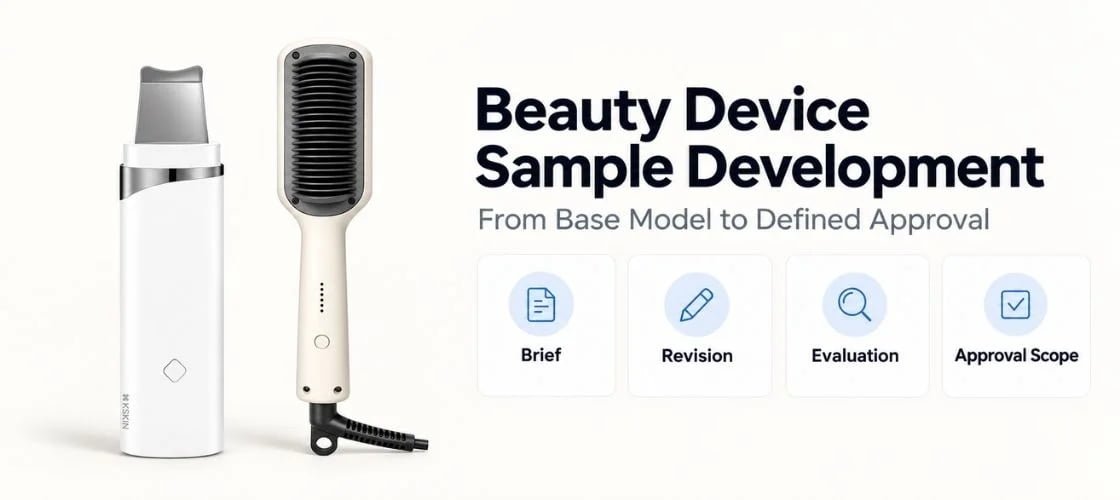
A revised sample arrives, and the finish is closer to what your brand wanted. But has the control issue been fixed? Does it match the market version you requested? A good sampling process keeps those answers within reach.
The beauty device sample development process takes an agreed brief through base-model review, defined changes, engineering evaluation, packaging and document review, and final sample approval. Each round should resolve a specific question while keeping unfinished work visible. Stages may overlap or repeat. The important part is that everyone knows which version they reviewed, what has been accepted and what still needs to happen before the next commitment.
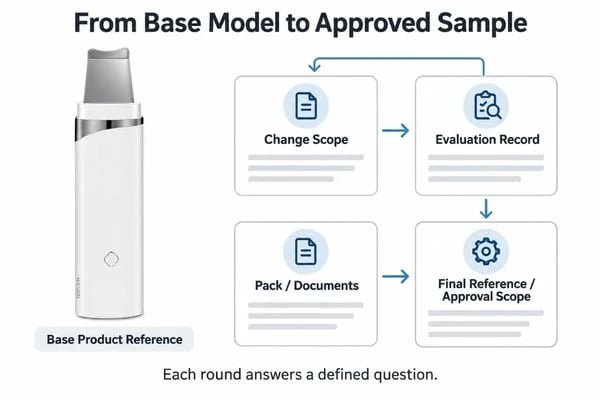
Start With a Brief That Gives the Sample a Purpose
Before requesting the first sample, decide what your team needs to learn from it. You might be assessing whether an existing platform fits a customer routine, or whether a particular control layout or water-handling arrangement can be improved. The sample review should follow that question.
Separate Essential Requirements From Preferences
A useful brief identifies the intended use, target market, sales channel, proposed claims, expected quantity and commercial position. It also makes your priorities clear. Which requirements would rule the product out, and which details are still open to discussion?
A preferred housing color can remain undecided while your team assesses handling. An essential function or the intended electrical version needs a more definite place in the conversation. If a launch date is important, discuss it alongside the development and evaluation work required to reach it.
You don't need a complete engineering specification before starting. A clear account of what is known, what remains open and who will decide is more useful than a brief that leaves the supplier to fill in the gaps.
Choose the Development Route Before Adding Changes
When the underlying product already fits and the work concerns branding, supported finishes, packaging or an available commercial configuration, a private-label project may be the appropriate route.
Changes to structure, electronics, heating, charging or control logic need an engineering scope review. An existing platform may still be the right starting point, but the responsibilities, deliverables, feasibility and any tooling investment need to be understood before work expands.
That early distinction helps the buyer and supplier agree what the sample quotation actually includes.
Use Sample Stages as Decision Points
Suppliers use terms such as “prototype,” “engineering sample” and “pre-production sample” differently. Ask what the particular unit represents and which decision it is ready to support. The name on the box will not answer that on its own.
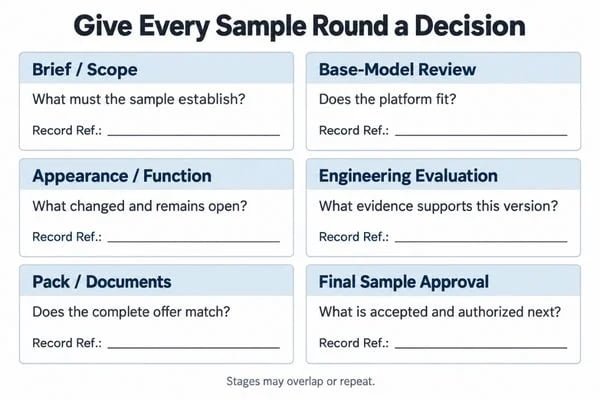
The following framework can help structure the discussion. Projects may combine stages or return to an earlier one when findings require it.
| Stage | Main input | Useful output | Decision to make |
|---|---|---|---|
| Brief and scope | Intended use, market, priorities and proposed changes | Agreed requirements, open questions and responsibilities | What should the sampling work establish? |
| Base-model review | Identified product version and its documents | Product-fit findings and a prioritized change list | Is this the right platform to continue with? |
| Appearance or functional iteration | Approved change scope and review criteria | Revised references with differences identified | Which requirements are satisfied, and what still needs work? |
| Engineering evaluation | Defined configuration and assessment plan | Relevant results, deviations and follow-up evidence | Does the evidence support the evaluated configuration? |
| Packaging and document review | Product definition, accessory list and artwork | A matching pack, labels and instructions | Does the complete offer describe and protect the product being ordered? |
| Final sample approval | Reconciled references and review records | A specific approval record and controlled reference | What has been accepted, and what may happen next? |
A straightforward branding project may combine several reviews. A project involving functional changes may need repeated engineering work before the final packaging can be settled. Progress comes from resolving the questions behind the samples, rather than simply completing another round.
The number of rounds, sample quantities and timing depend on the scope, parts, tooling, evaluation needs and findings. Neither “OEM” nor “private label” defines a guaranteed development period.
Learn What the Base Sample Can Actually Tell You
A base sample gives your team a chance to judge the underlying product before investing further. Handling, controls, construction and the operating experience can all inform that decision. The unit may still differ from the proposed order in color, accessories, electrical configuration or packaging.
For a facial steamer project, the first review might focus on filling access, nozzle positioning and the after-use routine. These are useful questions to settle before the team puts more work into branding the platform.
For a more detailed comparison, our guide to facial steamer tank size and nozzle design examines filling, permitted nozzle movement, operating and storage space, and after-use water handling. These points help turn a preference for a larger tank or longer nozzle into specific questions for the base-sample review.
Make Any Differences Visible From the Start
Ask for a short description of how the supplied sample differs from the intended commercial version. A unit sent for handling review is not necessarily the electrical version being proposed for your market. Temporary or non-production parts may also limit what a demonstration sample can establish.
With those differences clear, you can accept the platform direction while leaving particular technical or commercial decisions open.
Good feedback then describes the task. As an illustrative example, compare “the tank is awkward” with “the evaluator couldn't reinstall the filled tank without moving the appliance from the proposed display position.” The second gives the supplier a setup and an observation to investigate. It is far easier to discuss what should change.
A photo or short video can help, provided it identifies the sample and shows the relevant conditions. The next submission should explain the action taken and how the team will judge whether it resolves the issue.
Develop Appearance and Function Without Confusing Their Approvals
A finished-looking housing can make a sample feel ready before its technical work is complete. Engineering can also be ahead of appearance, with a temporary finish still in place. Separate approvals let both areas move forward without creating a misleading picture of the whole product.
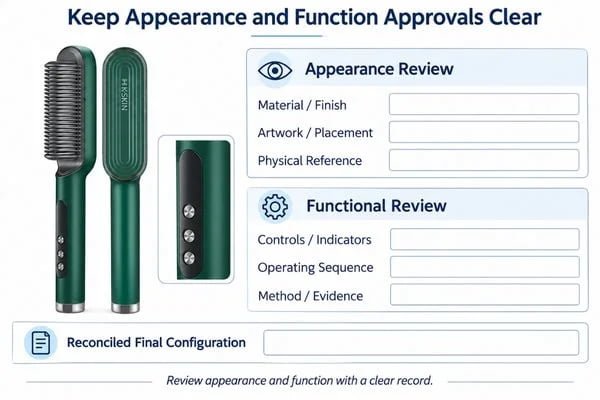
Review Color and Logo on a Defined Reference
A screen rendering is useful for discussing direction. Where final color, texture or gloss matters to the purchase, an appropriate physical reference and agreed viewing conditions provide a firmer basis for the decision. The material and surface process should be identifiable too.
Logo review brings together the artwork, placement, size, orientation and application method. Accepting the visual result may leave durability or other relevant checks outstanding. Recording that limit allows the design decision to stand without implying that every requirement has been accepted.
Give Functional Changes Their Own Acceptance Criteria
“Improve the experience” is a reasonable starting point, but the development team needs an outcome it can evaluate. A revised button sequence, heating arrangement, charging configuration or nozzle assembly should have defined requirements and an agreed assessment.
The review also needs to follow the change into related parts of the product. A new operating sequence may affect indicators and instructions; a structural revision may affect assembly or packaging.
In a hair straightener brush project, for example, changing button markings is a different task from changing how the controls operate. The functional review should consider the indicators, instructions and intended styling routine together. A visually attractive sample cannot settle those questions by itself.
Make Every Revision Easy to Identify
Once several samples are on the meeting table, it becomes surprisingly easy to refer to “the latest one” and mean different units. A visible identity saves everyone from relying on memory.
Connect the project, base model, revision and individual sample. Supplier and buyer naming systems can differ, provided their mapping is clear. Specifications, drawings, artwork, review records and any relevant software version should identify the configuration they describe.
Keep One Issue List Through the Iterations
An issue list should carry forward with the project rather than disappear when the next shipment arrives. For each item, keep:
- The affected sample and requirement.
- The observation and relevant photos or measurement records.
- The agreed action and responsible person.
- The revision containing the change.
- The evidence needed for closure and the resulting decision.
“Revised” does not always mean “closed.” The change may be implemented while buyer review or a technical assessment is still pending. Keeping that distinction visible makes the next conversation much more productive.
The final combination needs attention as well. One unit may show the accepted finish and another the accepted function. The version intended for approval must bring those references together, with the affected requirements assessed on that defined configuration.
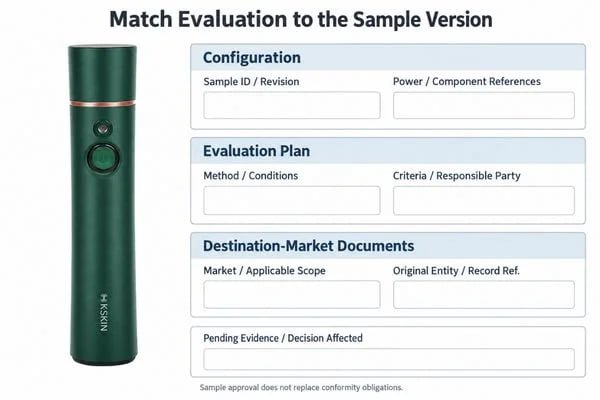
Evaluate the Engineering Version Against the Intended Market
At this point, the team needs evidence that supports the proposed product. A demonstration can answer useful questions about operation, but safety, durability, performance and market requirements may need separate assessments.
Agree What Will Be Assessed and How
A workable assessment plan identifies the requirements, sample count, methods, conditions, acceptance criteria, responsible parties and records to be supplied. Electrical and safety work belongs with appropriately qualified personnel and facilities.
For performance measurements, the record needs enough detail to interpret the result: product and software versions where relevant, settings, environment, instruments, units and endpoint. A test requirement in a specification remains a target until there is evidence of the assessment and its outcome.
Results also have limits. A component report does not automatically establish finished-device performance, and one sample's result does not establish the performance of every future unit.
Keep Market Documentation Connected to the Product
For products subject to EU CE-marking requirements, the EU's official guidance explains that the manufacturer must identify applicable requirements, follow the relevant conformity assessment route, assemble technical documentation and prepare the EU declaration of conformity. A buyer's sample approval does not replace those obligations.
This is why the destination market belongs in the brief. Document responsibilities and assessment timing need to be agreed, and any existing report needs a scope review against the proposed model and configuration. The original applicant, manufacturer or holder must remain accurately identified.
Where evidence is pending, explain what remains open and which decision depends on it. Approval to continue development can be useful, but it should not be described as complete technical clearance or authorization to sell.
Review the Pack and Instructions Around the Same Product
Artwork development can run alongside the engineering work. Before final approval, though, the complete pack needs to contain and describe the version the customer will receive.
Fit, protection, unpacking and accessories deserve the same attention as print appearance. A changed nozzle, cable or cap may affect the insert even when the outer artwork stays the same. The packaging reference should make those details clear.
Then walk through the instructions with the actual controls. Do the diagrams and operating sequence agree? Are the applicable filling, cleaning, charging, cooling and storage requirements accurate? A manual borrowed from a similar platform can look finished while describing the wrong behavior.
Labels, product naming, warnings, languages, barcodes and carton markings also need to align with the commercial version and destination-market requirements. Any publicly shared approval example should exclude sensitive customer information, pricing and supplier contacts.
The agreed manufacturing and quality requirements help connect this work with the next stage. Where transport or reliability assessments are required, their records should identify the product and packaging configuration actually evaluated.
Make Final Approval Specific Enough to Use
“Looks good” may be enough to settle a visual discussion. It leaves more room for misunderstanding when purchasing or production reads it as approval of the complete product. A useful sign-off explains exactly what the next team can rely on.
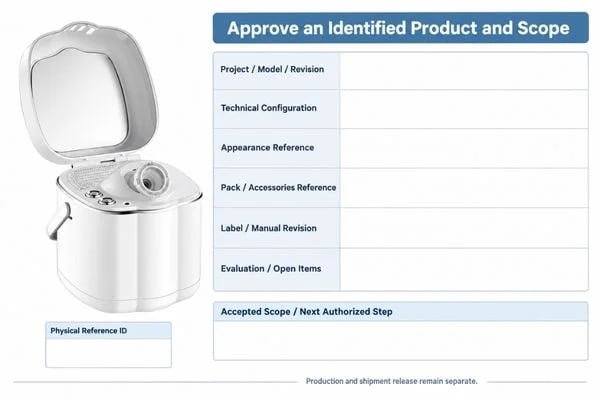
The following fields can be reused in a project approval checklist:
| Approval item | Information to record |
|---|---|
| Product identity | Project, model, sample revision and physical reference IDs |
| Technical configuration | Electrical version, agreed functions, relevant components and software where applicable |
| Appearance | Material, color or finish reference, logo artwork and marking method |
| Commercial pack | Accessories, packaging, labels and manual revisions |
| Evaluation | Records reviewed, their scope and any relevant limitations |
| Outstanding items | Unresolved issues, responsible parties and the decisions they restrict |
| Approval decision | Accepted scope, excluded scope, approver, date and next authorized step |
A final review should allow your team to:
- Match the physical sample to the listed specification and revision.
- Reconcile appearance, function and packaging references into one defined configuration.
- Close the issues required for the approval being requested, using reviewable evidence.
- Confirm that the supplied instructions, labels and accessories describe that configuration.
- Agree who retains reference samples and how records will remain accessible.
- State the next authorized step and the process for reviewing later changes.
An approved sample may become a controlled physical reference, often called a golden sample. It works alongside the written specification and inspection requirements, which capture details a physical unit cannot show on its own: hidden components, tolerances and test conditions, among others.
That is the end point of this development review. Production readiness, any necessary pilot work and shipment release remain separate decisions; sample approval should make their starting point clearer, rather than quietly authorize them all.
Frequently Asked Questions
Practical arrangements around sample rounds are worth agreeing early, particularly when several teams share the decisions.
How Many Sample Rounds Should a Beauty Device Project Need?
There is no fixed number. A branding project on an existing platform and a project involving new structure or controls have different needs. Agree the purpose and deliverables of the planned rounds, then revisit the plan when findings change the scope. The number of submissions says little without knowing what each one resolved.
Can We Approve a Sample From Photos and Video?
They can support a defined decision, but they cannot reproduce every aspect of handling, finish or technical performance. Identify which questions they can answer and which need a physical reference, measurement or qualified assessment. The approval record should reflect those limits.
Who Should Keep the Approved Physical Sample?
Agree this between buyer and supplier, including references needed by inspection or manufacturing teams. Where several units are retained, identify them and establish how they represent the same configuration. Labels, storage arrangements and linked records make the reference useful.
Can Appearance and Engineering Teams Approve at Different Times?
Yes. A color decision can proceed separately from a functional review when the scope and references are clear. Before complete product approval, those decisions need to be reconciled into the configuration that will actually be supplied.
What Should the Sample Quotation Include?
It should explain which base or revised samples, changes, assessments and deliverables are included, and how additional work will be handled. Clarify applicable sample, engineering, tooling, packaging, testing and shipping charges. A sample fee should not be assumed to cover the whole development program.
Conclusion
A useful sample round leaves your team with a clearer product decision. The brief establishes what matters, revisions show what changed, and evaluation provides evidence for the version being considered. Final approval brings the physical reference, technical configuration and commercial pack together so both sides understand what has been accepted.
For a K·SKIN project, an OEM/ODM development discussion can start with the base product or concept, target market and difference your brand wants to create. You can share your project requirements while the route is still open, then agree the scope and purpose of the first sample before committing to further work.