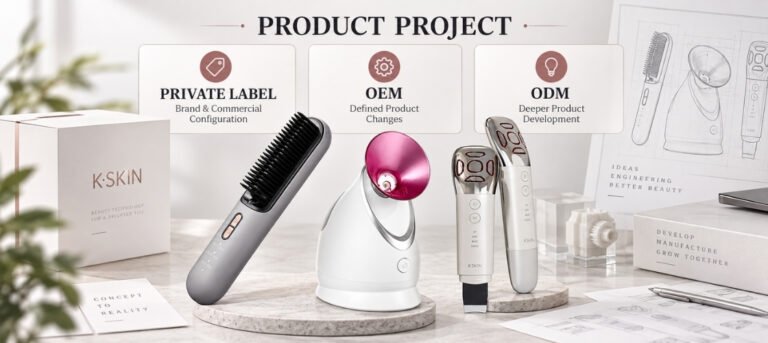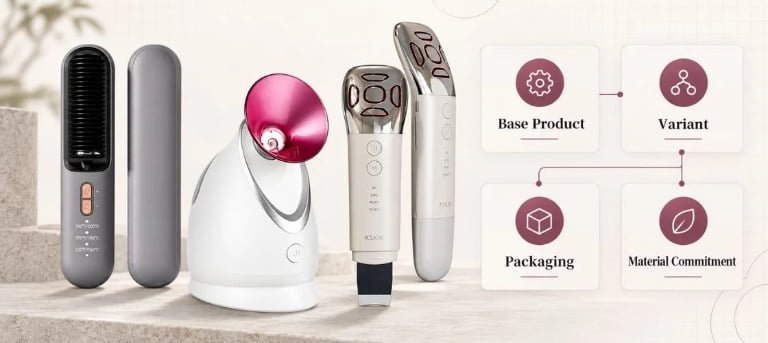

Buyers often assume that customization requires a new mold. In practice, many branding and commercial changes can be made to an existing beauty-device platform, while technical or structural changes may require engineering review or new tooling.
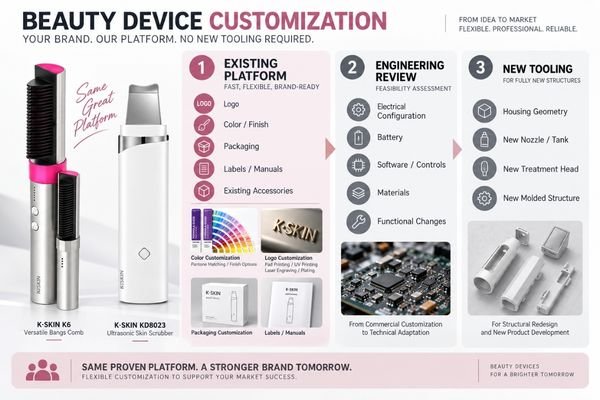
Most established beauty-device platforms can be customized without new product tooling through approved logo application, selected colors or finishes, packaging, labels, manuals, barcodes, and existing accessory bundles. Electrical, software, material, or control changes may also avoid a new mold but still require engineering or compliance review. Changes to molded geometry or the core product structure usually move into tooling or OEM/ODM evaluation.
What Does “Without New Tooling” Mean in Beauty Device Sourcing?
In this context, “without new tooling” means retaining the core molded structure of an existing product platform rather than creating a new housing mold or other dedicated structural tooling.
It does not mean that every change is free from setup work.
A private-label project may still require:
- printing screens or plates;
- marking or assembly fixtures;
- packaging dies;
- artwork preparation;
- color matching;
- sample approval;
- engineering confirmation;
- additional validation.
This distinction matters because product tooling and production setup are not the same thing.
For example, changing the artwork on an existing retail box is very different from developing a new product housing. Both are forms of customization, but they involve different technical work, cost drivers, and approval steps.
A useful starting point is to divide customization into three levels:
| Customization Level | Typical Scope | Likely Route |
|---|---|---|
| Existing-platform commercial changes | Logo, approved color, packaging, labels, manuals, existing bundles | Private Label |
| Technical changes without obvious new geometry | Electrical version, battery, controls, software parameters, materials | Engineering Review |
| Changes to molded structure or product architecture | Housing, nozzle, tank, head geometry, button or port layout | New Tooling / OEM/ODM |
The exact boundary still needs to be confirmed for the selected model.
What Can Usually Be Customized on an Existing Product Platform?
Projects carry the least development risk when they retain the core product system and customize the commercial version around it.
Logo and Brand Marking
Logo application is one of the most common private-label changes.
Depending on the product surface and manufacturing process, a supplier may offer printing, engraving, or another supported marking method.
Buyers should confirm:
- logo position;
- maximum practical size;
- marking method;
- surface material;
- artwork format;
- color;
- durability expectations.
A logo change usually does not require a new product mold, but it may still involve printing setup, samples, or dedicated production preparation.
Color and Surface Finish
A custom product color can often be produced with the existing housing geometry.
However, not every color or finish is automatically available.
Feasibility may depend on:
- plastic or housing material;
- molding or coating process;
- available color references;
- surface treatment;
- production quantity;
- consistency requirements;
- interaction with printed markings.
The same mold may therefore support several commercial colors, while a particular finish may still require a separate process evaluation.
Packaging, Labels, and Manuals
Packaging and printed materials are usually among the most flexible private-label elements.
Common changes include:
- branded retail-box artwork;
- inserts and information cards;
- rating and warning labels;
- barcode labels;
- carton markings;
- manual language;
- brand information;
- market-specific instructions.
The important distinction is between changing the artwork and changing the packaging structure.
Applying new graphics to an established box format may be relatively straightforward. A different box size, molded tray, structural insert, or special presentation format may require new packaging dies or other packaging-specific tooling.
That is still different from opening a new product mold.
Existing Accessories and Commercial Bundles
Buyers may also be able to create a different commercial package using accessories already supported by the product platform.
Examples include:
- charging accessories;
- storage items;
- approved treatment heads;
- compatible consumables;
- existing product accessories;
- selected bundle combinations.
This is normally easier than developing an entirely new molded accessory.
If the requested accessory changes the device’s electrical, mechanical, liquid-contact, or functional interface, it should move into engineering review.

The K·SKIN Private Label framework follows this existing-platform approach: branding and commercial configurations are reviewed around a selected product, while deeper structural or technical changes are handled as product-development work.
Which Changes May Avoid a New Mold but Still Need Engineering Review?
One of the most important sourcing distinctions is that “no new mold” does not mean “no engineering.”
Some changes leave the housing geometry untouched but can still affect product performance, safety, documentation, or market configuration.
| Requested Change | New Product Mold Usually Required? | What Still Needs Review |
|---|---|---|
| Plug type | Often no | Destination market and electrical configuration |
| Voltage or frequency version | May not | Electrical design, rating, testing, documentation |
| Adapter or charging cable | Often no | Compatibility and market requirements |
| Battery configuration | May not | Electrical, charging, safety and validation impact |
| Software or control parameter | Often no | Control logic and functional validation |
| Material or coating | May not | Mechanical, thermal, chemical or process impact |
| Existing accessory bundle | Often no | Compatibility, packaging and commercial version |
| New functional configuration | Depends | Engineering, validation and compliance review |
A project should therefore not be classified solely by whether the mold changes.
A software adjustment can leave the plastic housing unchanged while altering how the product operates. A different battery may fit inside the same housing but still affect charging, operating time, thermal behavior, or documentation.
For EU-market projects, the European Commission’s Blue Guide on the implementation of EU product rules explains that significant physical or software modifications can affect product conformity and should be assessed according to the nature and impact of the change.
The principle also applies beyond a single market: changes should be reviewed against the exact product, intended destination, and applicable requirements rather than assumed to remain covered simply because the housing looks unchanged.

What Changes Usually Move Into New Tooling?
Changes to molded geometry or the product’s physical architecture are more likely to require tooling work.
Examples include:
| Requested Change | Why Tooling May Be Required |
|---|---|
| New housing shape | Existing mold geometry no longer produces the required part |
| Different product dimensions | Structural parts and interfaces may need redesign |
| New button or port position | Housing and internal support geometry may change |
| New facial-steamer nozzle | Molded output structure may change |
| New water tank or water path | Housing, sealing and internal interfaces may change |
| New comb-tooth geometry | Functional molded structure changes |
| New treatment-head shape | Mechanical or functional interface changes |
| New molded accessory | A dedicated molded component may be required |
| Major internal layout change | Housing supports or internal structures may need redesign |
Not every structural request automatically requires a completely new mold. In some projects, an existing tool can be modified or a separate component developed.
That decision requires a tooling and engineering review.
Projects involving meaningful changes to the structure, electronics, controls, technical systems, or tooling should move into an OEM/ODM development discussion instead of being treated as simple private-label requests.
How Do Customization Boundaries Differ by Product Platform?
No single factory-wide customization list applies equally to every beauty device.
Products use different materials, structures, electrical systems, accessories, and manufacturing processes. The same requested change can therefore have a different technical impact from one platform to another.
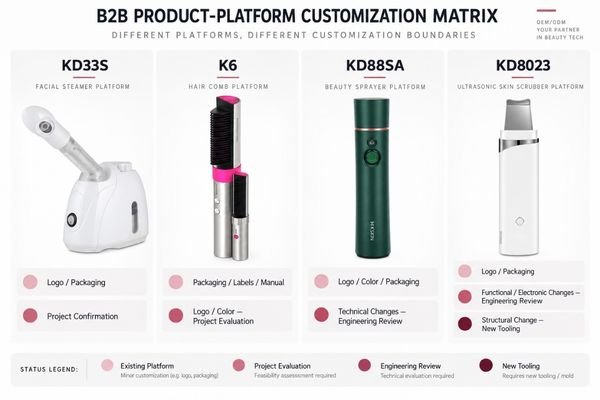
K·SKIN’s current product documentation provides several useful examples.
| Product Platform | Existing-Platform or Private-Label Direction | Additional Review Boundary |
|---|---|---|
| KD33S | Logo and packaging graphics; packaging, labels, manual language, and accessories can be reviewed | Color, surface finish, plug type, voltage, and frequency require project confirmation |
| K6 | Packaging graphics, sleeve and inner-tray artwork, labels, manual language, barcode and carton markings | Logo, color/finish, and selected bundle configuration require project evaluation |
| KD88SA | Color, logo, packaging, labels, barcode, and manual localization can be evaluated | Structure, liquid path, battery, electronics, accessories, or functional changes require engineering review |
| KD8023 | Logo, branded packaging, manual localization, labels, and barcode markings are established customization directions | Other colors/finishes require review; functional or electronic changes require engineering review; structural modification may require new tooling |
These examples are not universal promises for every order.
They demonstrate a broader rule:
The customization boundary belongs to the product platform, not simply to the factory.
A compact cordless styling tool, facial steamer, liquid-mist device, and ultrasonic skin scrubber each has a different technical system. Their private-label options should be confirmed separately.
Buyers evaluating styling platforms can review the K·SKIN Hair Styling Tools range, while those working with steam-based platforms can review the Facial Steamers range.
What Does “No New Tooling” Not Mean?
“No new tooling” should not be used as shorthand for a project with no additional work.
Keeping the existing product mold does not automatically mean:
| It Does Not Automatically Mean | Why |
|---|---|
| No setup cost | Printing, marking, color, packaging or production setup may still apply |
| No MOQ impact | Custom colors, packaging and components may have their own minimum quantities |
| No sample approval | The branded commercial version still needs review |
| No validation | Technical changes may require affected functions to be rechecked |
| No compliance review | Electrical, material or control changes may affect market requirements |
| No packaging tooling | A new box or tray structure can require packaging-specific dies |
| No lead-time impact | Artwork, samples, components and approval steps still take time |
A useful quotation should therefore begin with the actual project scope, not simply with the question, “Can you do this without a mold fee?”
How Should a No-Tooling Private Label Version Be Approved?
Even an existing platform needs a clearly defined commercial version before production.
A practical approval route is:
Base Product
→ Customization Scope
→ Artwork / Color / Packaging Review
→ Sample or Reference Review
→ Market Configuration
→ Commercial Version Approval
→ Production
The buyer should be able to identify exactly what changed from the base product and what remained unchanged.
At minimum, the final approval should align:
- product model and version;
- logo and marking position;
- product color or finish;
- packaging artwork and structure;
- labels;
- manual;
- accessory set;
- barcode and carton markings;
- electrical or charging configuration where applicable.
The approved sample or written reference should then become part of the production baseline.
This reduces a common sourcing problem: the buyer approves the product itself while the packaging, labels, color, accessories, or electrical configuration continue to change through separate email or messaging threads.
What Information Should Buyers Provide for a Customization Review?
A supplier does not need a complete engineering package to begin reviewing a private-label request.
The most useful information to provide initially is:
| Buyer Input | Why It Matters |
|---|---|
| Base model or product category | Defines the existing platform |
| Target market | Helps identify configuration and documentation needs |
| Estimated quantity | Affects feasible processes and commercial conditions |
| Logo requirement | Determines marking method and placement review |
| Color or finish | Determines process and availability review |
| Packaging request | Separates artwork changes from structural packaging changes |
| Manual and language | Defines the commercial documentation version |
| Accessories | Confirms bundle compatibility |
| Electrical requirement | Identifies whether engineering or market review is needed |
The objective is to identify the most difficult requested change early.
If every requested item remains within the established commercial configuration, the project can usually stay closer to Private Label.
If one requirement changes the product’s technical system or molded structure, it may determine the development route for the entire project.
Private Label, Engineering Review, or New Tooling?
A three-level decision is usually more useful than debating OEM terminology.
| Requested Scope | Likely Starting Route |
|---|---|
| Logo, approved color, packaging, labels, manuals, existing accessories | Private Label |
| Electrical, software, material, control, or functional change | Engineering Review |
| Molded geometry or core structural change | Tooling / OEM/ODM Review |
Terminology may vary between suppliers, but the project should always define the actual work involved.
For buyers, the practical question is not whether the quotation says “Private Label” or “OEM.”
It is:
What exactly changes, what stays unchanged, and what must be revalidated?
Buyer Takeaway: Start With the Existing Platform
The lowest-risk customization route is usually to retain the product system that already works and change only what is needed to create the intended commercial version.
Start by answering four questions:
- What must change for the brand or market?
- What can remain on the existing platform?
- What requires engineering review even without a new mold?
- What changes the molded structure and requires tooling evaluation?
This approach avoids both extremes: paying for unnecessary development when an existing platform is sufficient, or trying to force a genuine engineering project into a simple private-label scope.
If an established beauty-device platform already provides the required function, Private Label offers a more controlled starting point for branding, packaging, and commercial configuration before deeper product changes are considered.
Frequently Asked Questions
Does a custom product color require a new mold?
Usually not, provided the product geometry remains unchanged. However, the requested color or finish still needs to be reviewed against the material, molding or coating process, available production options, quantity, and color-consistency requirements.
Can a logo be added without new product tooling?
Often, yes. Logo application normally changes the branded surface rather than the product geometry. The supplier still needs to confirm the marking method, position, size, surface compatibility, setup requirements, and final sample.
Can voltage or plug type be changed without new tooling?
Potentially, but this should not be treated as a simple branding change. Changes to the plug, voltage, frequency, power cord, adapter, or charging system can affect the electrical commercial version and may require engineering, documentation, testing, or market-specific review.
Can software or control settings be changed without new tooling?
Yes, for some products, because software changes do not necessarily alter molded parts. However, a control or software change can still affect product behavior and validation requirements, so it should be treated as an engineering change rather than ordinary packaging or branding customization.
Can custom packaging require tooling even when the device does not?
Yes. A buyer may keep the device completely unchanged while requesting a new box structure, molded tray, insert, or another packaging format that requires packaging-specific dies or tooling. That does not mean the product itself needs a new mold.
Conclusion
Beauty device customization without new tooling mainly involves using an established product platform efficiently. Logo application, selected colors or finishes, packaging, labels, manuals, and supported accessory bundles can often be reviewed without changing the core molded product structure.
The boundary still needs to be confirmed model by model. Electrical, software, material, or functional changes may require engineering and validation even when no new mold is needed, while changes to molded geometry usually move into tooling evaluation. The right starting question is not “How much can we customize?” but “Which changes support the commercial goal without adding unnecessary development?”