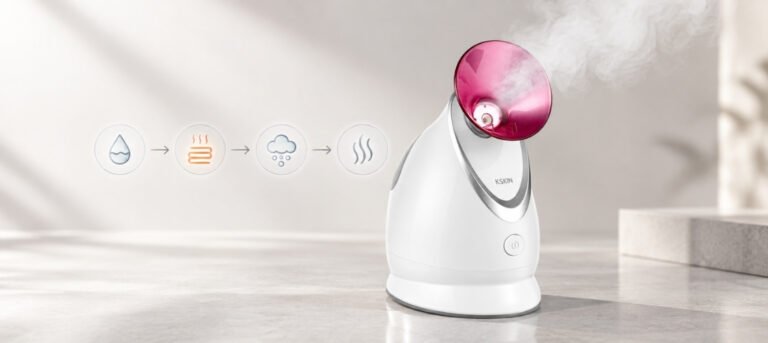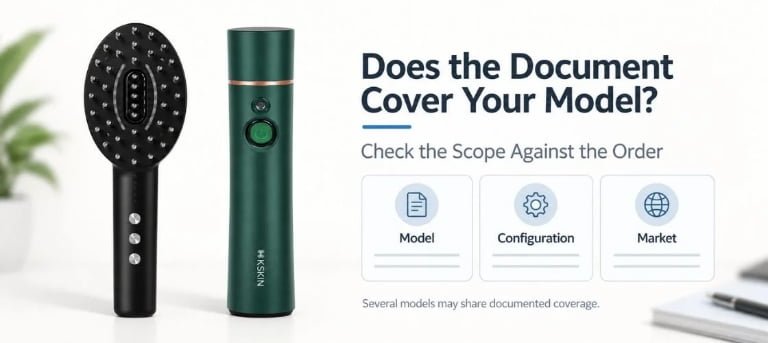
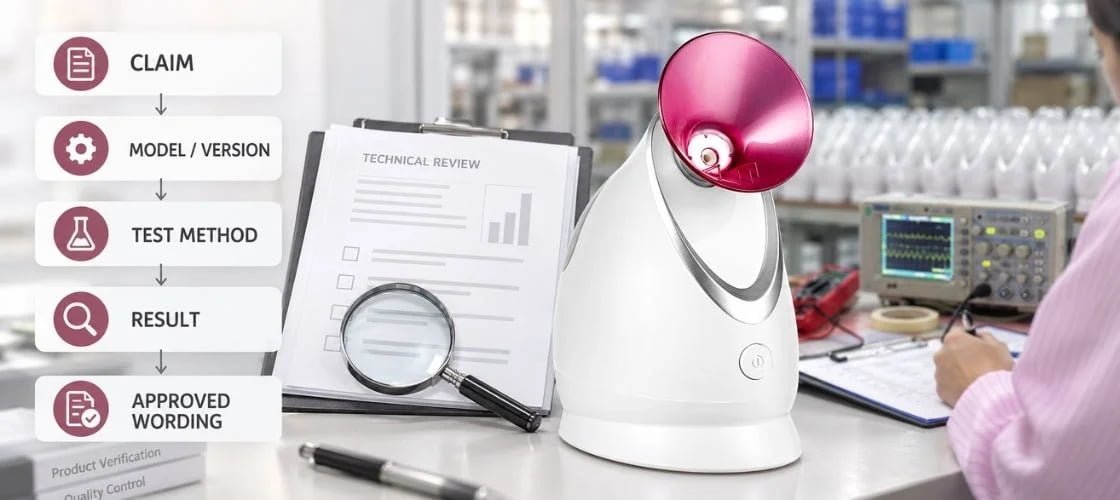
“Nano-ionic” is widely used in facial steamer marketing, but the term alone does not prove particle size, ion output, skin penetration, hydration performance, or other consumer benefits. Product buyers need to separate the wording from the evidence behind it.
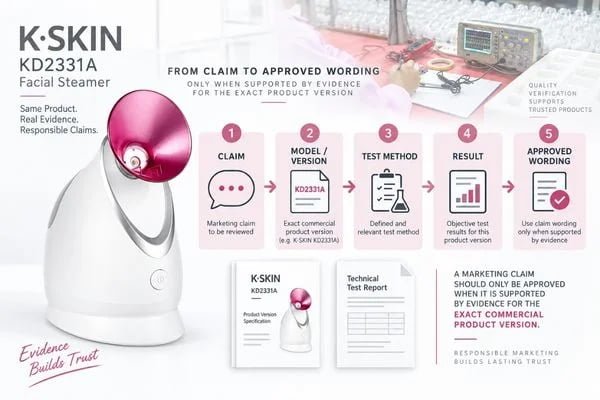
A nano-ionic facial steamer claim should be approved only when the statement is matched to evidence for the exact model and product version. Buyers should confirm what was measured, how it was measured, which sample was tested, who performed the test, when the test was completed, and whether the final marketing copy remains within the scope of the result.
What Does a “Nano-Ionic” Claim Actually Mean?
The first issue is that “nano-ionic” can mean several different things.
It may be the name of a product platform, refer to fine mist, imply a particle-size characteristic, or be associated with ion generation. In some marketing materials, the term is extended into claims about hydration, penetration, cleansing, or other skin benefits.
Those statements are not equivalent.
For a product buyer, the right place to start is not:
“Does this supplier sell a nano-ionic facial steamer?”
Ask instead:
“What exact statement do we intend to publish, and what evidence supports that statement for this exact model?”
A claim is much easier to review when its wording is broken down into a measurable or verifiable proposition.
| Proposed Claim | What the Claim Is Actually Saying | Evidence Question |
|---|---|---|
| Nano-ionic facial steamer | Product or technology positioning | Is this terminology approved for the exact product version? |
| Nano mist | Mist has a defined small-particle characteristic | Was particle size actually measured? |
| Smaller steam particles | Output is smaller than a reference | What was the comparator and test method? |
| Negative-ion output | The product produces measurable negative ions | Was ion output measured on this model? |
| Stable warm mist | Steam output remains stable during defined operation | Was output stability evaluated under controlled conditions? |
| Improves hydration | Produces a measurable consumer or skin outcome | Is there suitable efficacy evidence? |
| Penetrates deeper | Produces a biological or physical penetration outcome | Was penetration directly tested? |
| Opens pores | Produces a physiological effect | What evidence supports the statement? |
Evidence for one row does not automatically support another.
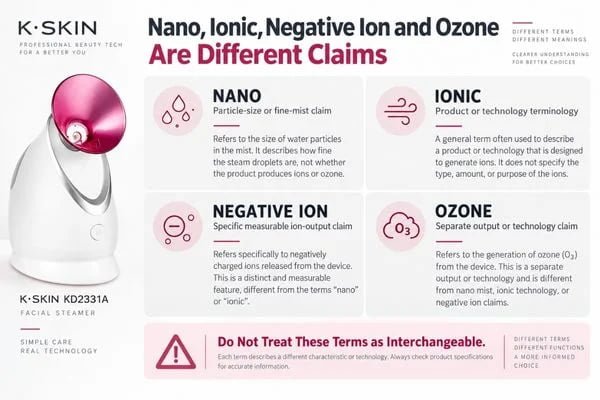
Are Nano, Ionic, Negative Ion, and Ozone the Same Claim?
No.
These terms are sometimes grouped together in supplier brochures or older product materials, but each one should be reviewed separately.
“Nano” may describe a claimed particle-size characteristic.
“Ionic” may refer to product naming, an ionization concept, or another model-specific technical feature.
“Negative ion” is a more specific output claim that should normally be tied to an appropriate measurement method and unit.
“Ozone” is a separate output claim and should not be inferred from the words “nano” or “ionic.”
A product described as nano-ionic should therefore not automatically be marketed as:
- a negative-ion generator;
- an ozone facial steamer;
- a sterilizing device;
- a skin-treatment device.
This distinction matters when current specifications, historical sales materials, and different product versions use different terminology.
For example, the current K·SKIN KD2331A Classic Nano-Ionic Facial Steamer is positioned as a nano-ionic warm-mist platform. That product naming does not, by itself, justify adding negative-ion sterilization, ozone, treatment, or other unrelated claims.
What Evidence Should Support Different Facial Steamer Claims?
Different claims require different types of evidence.
A product name, measured physical output, comparative statement, consumer benefit, and treatment claim each operate at a different evidence level.
| Claim Type | Example | Typical Evidence Needed |
|---|---|---|
| Product identity | Nano-ionic facial steamer | Approved specification and current model documentation |
| Physical output | Fine mist or defined particle-size range | Model-specific output measurement with documented method |
| Ion output | Negative-ion generation | Appropriate ion measurement for the tested product |
| Comparative claim | Smaller particles than conventional steam | Same-method comparison against a clearly defined reference |
| Performance claim | Stable steam output | Repeatable product-level test under controlled conditions |
| Consumer benefit | Improved hydration | Suitable efficacy evidence supporting that specific outcome |
| Biological claim | Deeper penetration | Direct evidence supporting penetration, not particle size alone |
| Treatment claim | Treats acne or another skin condition | Regulatory and clinical evidence appropriate to the claim |
A document can be valid and still be irrelevant to the claim under review.
For example, an ISO 9001 certificate can support a supplier’s quality-management-system credentials, but it does not prove steam particle size, ion concentration, or hydration performance.
Buyers should therefore match the document’s scope to the product and claim instead of asking only whether a supplier “has certificates.” The same principle is used in the K·SKIN Credentials framework, where documents are reviewed by holder, model or scope, market, date, and status.
How Strong Is the Evidence?
Evidence should be judged by its relevance, traceability, and scope, not by appearance alone.
A polished brochure may provide weaker evidence than a simple internal test record if the record clearly identifies the model, sample, method, date, and result.
The following hierarchy provides a practical way to assess evidence:
| Evidence Level | Example | How Buyers Should Use It |
|---|---|---|
| Supplier statement | “This product is nano-ionic.” | Treat as an unverified claim |
| Marketing material | Product page or promotional graphic | Useful for context, not measurement proof |
| Internal training material | Sales or technical training slides | Use for internal terminology and background only |
| Generic technical article | General explanation of mist or ionization | Use for background, not model verification |
| Component document | Heater or ionization-component specification | Confirm that it applies to the finished product |
| Internal model-specific test | Exact model, method, date, and result recorded | May support a limited technical statement |
| Third-party model-specific report | Independent report tied to the tested sample | Stronger support when method and scope are appropriate |
| Current version-matched evidence | Evidence tied to the commercial version being supplied | Strong basis for claim approval |
Internal training material requires particular caution.
It can show how a supplier has historically described a technology, but it does not automatically provide scientific substantiation for a finished-product claim.
The strongest evidence is not necessarily the document with the most official-looking cover. It is the evidence that answers the specific question being asked about the exact commercial product.
What Should Buyers Check in a Nano-Ionic Test Report?
A test report deserves the same scrutiny as the claim it is intended to support.
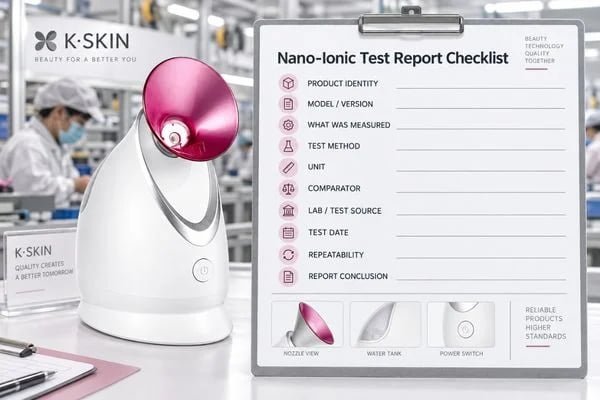
Product Identity
First, confirm which product was tested.
The report should contain enough information to connect the evidence to the product being purchased.
Useful identifiers may include:
- model number;
- sample description;
- product version or revision;
- sample code;
- product photograph;
- relevant electrical or output configuration.
A report for one facial steamer should not automatically be applied to another model simply because the housings look similar.
What Was Actually Measured?
Determine what the test was designed to measure.
The test object may be:
- droplet or particle size;
- aerosol distribution;
- ion concentration;
- steam temperature;
- mist output;
- another physical or electrical characteristic.
This is a basic but important distinction.
A particle-size measurement is not evidence of ion output. An ion measurement is not evidence of particle size. A steam-temperature test is not evidence of hydration performance.
Test Method and Conditions
A numerical result can be difficult to interpret without a clearly documented method.
Relevant details may include:
- instrument type;
- sampling location;
- distance from the steam outlet;
- water or test-medium condition;
- ambient conditions;
- operating period;
- measurement interval;
- data-processing method.
Buyers do not need to invent a universal test setup. What matters is that the method is suitable for the claim and documented well enough for the result to be understood.
Units and Results
Units often reveal what a report has actually measured.
Depending on the test, results may be expressed in:
- nm;
- μm;
- particles per unit volume;
- ions per unit volume;
- temperature;
- time;
- output rate.
The unit must match the claim.
A particle-size result should not be converted into an ion claim, and an ion reading should not be rewritten as proof of a specific steam-particle size.
Comparator
Comparative wording requires a defined reference.
If the proposed marketing claim says:
“smaller than conventional steam”
or:
“10× smaller particles”
the buyer should ask:
- compared with which product or steam source?
- was the same measurement method used?
- were the test conditions comparable?
- was the comparator identified in the report?
Without a defined comparator, a numerical comparison may sound precise while offering little useful evidence.
Laboratory, Date, and Repeatability
Check who performed the test and when it was completed.
Also determine whether the result came from:
- one reading or repeated measurements;
- one product or several samples;
- an internal test or a third-party laboratory.
A single measurement can show that a test took place. It does not automatically demonstrate production consistency.
Scope of the Conclusion
Read the report’s conclusion literally.
If a report concludes that particle size was measured under stated conditions, do not rewrite that result as:
“the product penetrates deeper into the skin.”
The marketing statement should not extend beyond the evidence.
Does Steam Particle Size Evidence Prove Skin Benefits?
No.
Steam particle size and consumer skin benefits are separate questions.
The evidence chain should be divided into three stages:
Device Output → Measured Physical Property → Consumer or Skin Outcome
For example:
Facial Steamer → Measured Mist Particle Size → Claimed Hydration Benefit
Evidence supporting the middle step does not automatically prove the final step.
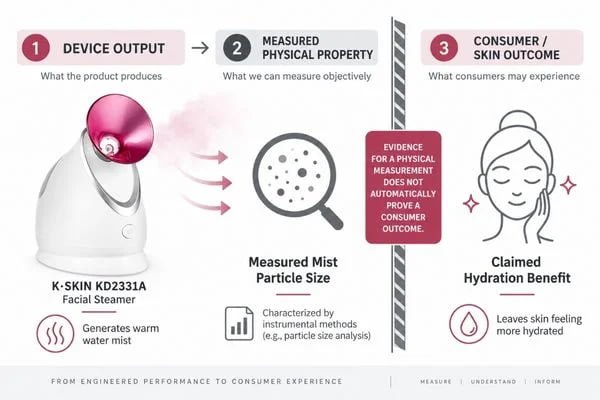
A particle-size test may support a narrowly written particle-size statement if the model identity, method, and result are appropriate.
By itself, it does not prove:
- deeper skin penetration;
- greater skincare-product absorption;
- pore opening;
- acne treatment;
- detoxification;
- improved circulation;
- superior hydration.
The same rule applies to ion measurements.
Detecting ion output does not automatically prove sterilization, treatment, or a skin-health benefit.
For U.S. advertising, the Federal Trade Commission Policy Statement Regarding Advertising Substantiation explains that objective advertising claims should have a reasonable basis before they are disseminated.
The U.S. Food and Drug Administration information on cosmetics labeling claims also distinguishes ordinary cosmetic claims from claims involving disease treatment or effects on the structure or function of the body.
Requirements vary by market, so brands and importers should review the proposed wording for the destination market instead of copying claims unchanged across regions.
How Should Evidence Be Matched to Marketing Copy?
The practical purpose of an evidence review is to determine what can be written on a product page, package, manual, marketplace listing, or distributor document.
| Evidence Actually Shows | Wording That May Be Supportable | Wording That Should Not Be Assumed |
|---|---|---|
| Fine mist observed or measured under defined conditions | Fine-mist output under the stated conditions | Deeper skin penetration |
| Particle-size range measured for the tested sample | Reported particle-size range for the tested model | Superior hydration |
| Ion output detected under stated conditions | Ion output detected under the stated method | Sterilizes skin |
| Stable warm mist recorded | Stable warm-mist output during the defined test | Opens pores |
| PTC heating confirmed | PTC-heated warm-mist platform | Therapeutic steam |
| Current specification uses nano-ionic product positioning | Nano-ionic facial steamer | Negative-ion sterilization or ozone treatment |
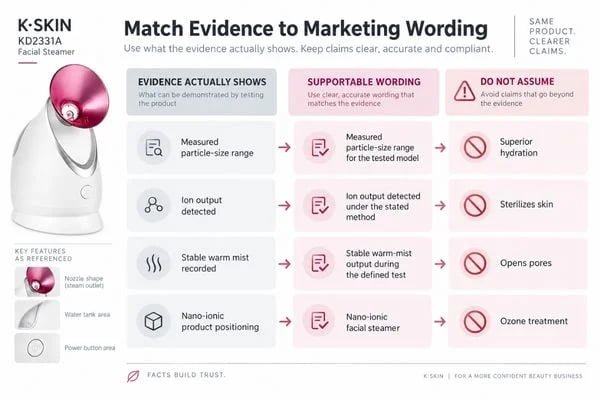
This comparison helps prevent a common product-development problem: a narrow technical result gradually becomes a much stronger consumer-benefit statement as the copy moves from the factory to a brochure, marketplace listing, or brand website.
The wording should remain within the boundaries of the evidence.
A Practical Nano-Ionic Claim Approval Workflow
A structured claim-review process makes decisions easier to repeat across websites, packaging, manuals, advertising, and distributor materials.
Step 1: Write the Exact Claim
Do not review a vague phrase such as:
“nano ionic technology”
Write the exact sentence that will appear in market-facing materials.
For example:
“Produces nano-ionic warm mist.”
and:
“Produces particles smaller than conventional steam.”
are two different claims and require different evidence.
Step 2: Classify the Claim
Determine whether the statement is:
- product identity;
- physical output;
- comparative performance;
- consumer benefit;
- biological effect;
- treatment claim.
The category affects the type of evidence required.
Step 3: Match the Exact Model and Version
Confirm that the evidence applies to:
- the same model;
- the same product version;
- the same relevant nozzle or water-path configuration;
- the same relevant component system;
- the same commercial specification.
Evidence from KD2331A should not automatically be used for KD2332, KD2328, or another facial steamer platform.
Step 4: Review the Test Method
Confirm that the method measures the proposed claim.
A particle-size claim needs particle-size evidence.
An ion-output claim needs ion-output evidence.
A hydration claim needs evidence of a hydration outcome.
Step 5: Review the Result and Its Limits
Identify exactly what the report concluded and what it did not conclude.
Do not interpret the result beyond the scope of the test.
Step 6: Approve the Allowed Marketing Wording
Record the wording that has been approved for use.
Depending on the project, approved wording may be needed for:
- product pages;
- packaging;
- user manuals;
- brochures;
- marketplace listings;
- advertising;
- distributor materials.
Step 7: Record the Product Version
The claim should remain connected to the commercial product version that will actually be supplied.
This makes claim management part of manufacturing and quality control, rather than treating it solely as a marketing exercise.
Step 8: Revalidate After Relevant Changes
A previously approved claim may need another review if a technical change affects the tested output.
Examples include changes to:
- nozzle geometry;
- water path;
- heating architecture;
- ionization components;
- output structure;
- electrical configuration;
- control logic.
A cosmetic color change may not affect a mist claim. A change to the steam outlet or output system may.
What Should You Say When the Evidence Is Incomplete?
Incomplete evidence does not always mean that every product statement has to disappear.
Often, the right response is to narrow the wording.
If the approved product specification confirms a warm-mist facial steamer but no current model-specific particle-size report is available, the buyer can use the verified product identity and technical functions without adding a numerical particle-size claim.
A practical wording hierarchy is:
- use the verified product identity;
- use confirmed technical functions;
- use quantified claims only when the exact measurement is supported;
- add consumer benefits only when suitable evidence supports those benefits.
A stronger statement such as:
“Ultra-fine nano particles penetrate 10× deeper into the skin.”
should not be used simply because similar wording appears in competitor listings, historical brochures, or supplier presentations.
This issue is especially important in private-label projects, where the same source copy may later appear on packaging, marketplace listings, brand websites, distributor catalogs, and retailer pages.
KD2331A Example: Product Naming vs Claim Scope
The KD2331A shows why product naming and claim substantiation need to be treated separately.
K·SKIN’s current approved reference identifies the product as the KD2331A Classic Nano-Ionic Facial Steamer.
Its current product definition includes:
- nano-ionic warm mist;
- PTC heating;
- 280 W rated power;
- 90 ml water tank;
- adjustable nozzle;
- aroma-pad compartment;
- home-use positioning.
These parameters define the current commercial reference.
They do not automatically support additional statements about:
- negative-ion concentration;
- ozone output;
- sterilization;
- a specific particle-size value;
- deeper skin penetration;
- acne treatment;
- quantified hydration improvement.
If a buyer wants to add any of those statements, it should be reviewed as a separate claim supported by separate evidence.
This is the difference between describing the approved product and extending its marketing story beyond the available evidence.
Buyer Decision Matrix
A claim review will usually lead to one of four decisions.
| Evidence Situation | Recommended Decision |
|---|---|
| Exact model, suitable method, clear result, current product version | Approve wording within the evidence scope |
| Relevant evidence exists but the wording is broader than the result | Restrict or rewrite the claim |
| Evidence belongs to another model or outdated version | Hold the claim pending technical review |
| No relevant evidence supports the proposed statement | Do not approve the claim |
The purpose is not to make every product description so conservative that it becomes unhelpful.
The purpose is to make every statement traceable.
Buyer Takeaway: Approve the Claim, Not Just the Product
A facial steamer can pass sample evaluation and still carry unsupported marketing language.
Product approval and claim approval should therefore be treated as separate decisions.
Before approving a nano-ionic facial steamer claim, confirm:
- the exact wording;
- the exact model and product version;
- what was measured;
- the test method;
- the measurement unit;
- the comparator, if any;
- the laboratory or test source;
- the test date;
- sample quantity or repeatability where relevant;
- the actual report conclusion;
- where the claim will be published;
- whether later product changes affect the evidence.
Buyers evaluating available platforms can review the K·SKIN Facial Steamers range and request relevant model-specific documentation through the Credentials and project-review process.
The most defensible claim is not the most impressive sentence. It is the one that accurately describes what the available evidence supports for the version being sold.
Frequently Asked Questions
Is “nano-ionic” the same as “negative ion”?
No. “Nano-ionic” may be used as product or technology positioning, while a negative-ion claim refers to a more specific output characteristic. A negative-ion statement should not be inferred from the product name alone and should be supported by appropriate model-specific evidence.
Does smaller steam particle size prove deeper skin penetration?
No. Particle size is a physical-output characteristic. Deeper penetration is a separate outcome claim and requires evidence that directly supports it. A particle-size test should not be converted into a penetration claim without additional supporting evidence.
Can a report from one facial steamer model support another model?
Not automatically. Buyers should determine whether the tested model, product version, nozzle, water path, heating system, output structure, and other relevant technical characteristics match the product being marketed.
Is a supplier brochure enough evidence for a nano-ionic claim?
A brochure can show what a supplier has marketed, but it is not equivalent to a model-specific test record or third-party report. Objective claims should be supported by evidence appropriate to the wording being used.
What should a buyer do if model-specific evidence is unavailable?
Limit the wording to product functions and specifications that can be verified for the approved version. Do not add quantified particle-size, ion-output, penetration, hydration, sterilization, or treatment claims until appropriate evidence is available.
Conclusion
“Nano-ionic” should not be treated as a shortcut from product naming to consumer benefit. The proposed claim should first be defined and then matched to evidence that identifies the product, version, method, result, and scope.
For brands, importers, distributors, and private-label buyers, a documented claim-approval process helps prevent contradictory product pages, unsupported packaging statements, and evidence mismatches later in the project. The goal is simple: approve only the wording that the current product evidence can support.