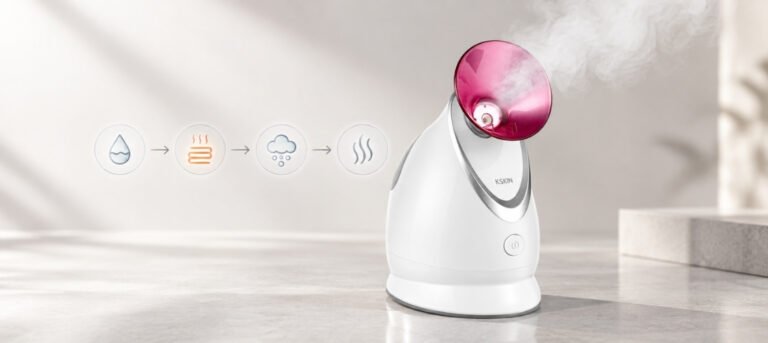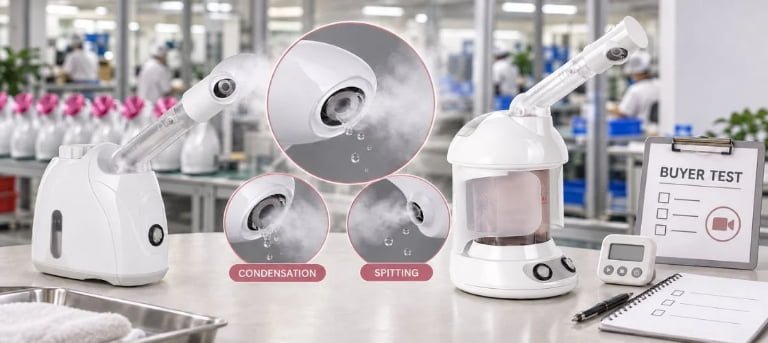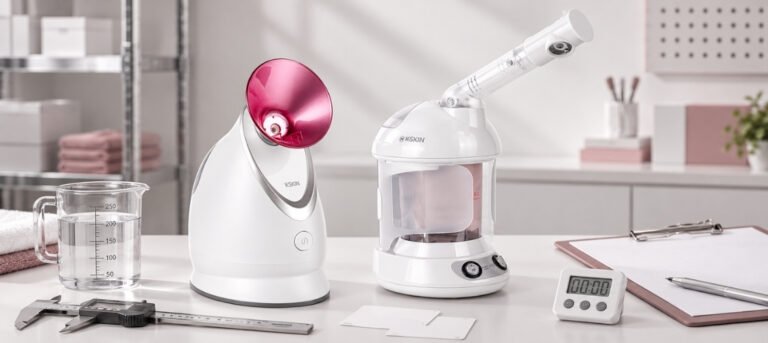
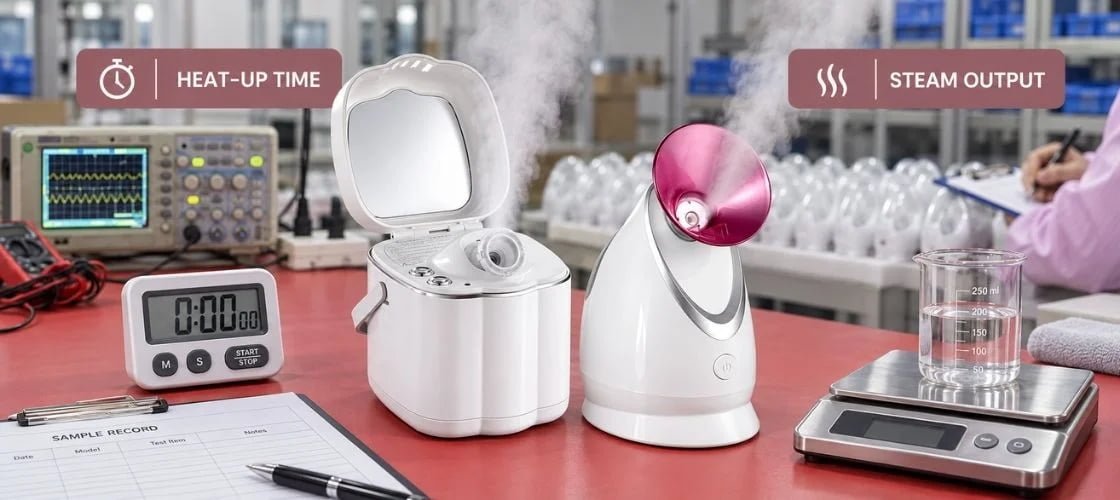
Heat-up time and steam output can help buyers compare facial steamer samples, but only when every unit is tested under the same starting conditions. A sample that appears to heat up faster is not automatically the better-controlled product.
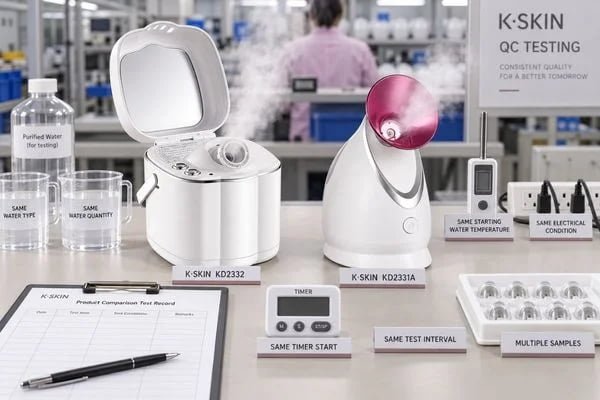
A valid facial steamer comparison should control the initial water quantity and temperature, water type, electrical supply, ambient conditions, device starting state, nozzle position, timing point, measurement interval, and sample quantity. Record first visible steam, sustained steam, stable output, interruptions, water loss, and residual water separately. Compare the method before comparing the number.
What Do “Heat-Up Time” and “Steam Output” Actually Mean?
A basic problem in facial steamer comparisons is that suppliers may use the same term for different measurements.
“Heat-up time,” for example, can refer to several points in the startup sequence.
| Metric | Practical Definition | Why the Difference Matters |
|---|---|---|
| First visible vapor | Time from power-on until vapor is first visible | A brief first plume may not represent normal operation |
| Sustained steam | Time from power-on until steam continues without immediately disappearing | More useful for comparing startup behavior |
| Stable output | Time from power-on until the product reaches a predefined stable test phase | Useful when output measurement follows startup |
| Full-tank runtime | Operating duration from a defined fill condition | Measures runtime, not startup speed |
| Comparative water-loss rate | Water mass lost during a fixed operating interval | Useful as a practical comparison indicator when abnormal water loss is excluded |
These metrics should not be used interchangeably.
One supplier may define the first visible vapor as “heat-up time,” while another records the point at which continuous steam begins. The two figures may look comparable on a product sheet even though they measure different events.
Define the endpoint before testing begins.
That definition should remain unchanged for every sample in the comparison.
Why Must Test Conditions Be Controlled?
Facial steamer measurements depend on the product’s starting conditions.
Water temperature, water quantity, electrical supply, and even whether the product has recently been used can affect the result. If these variables differ between samples, the comparison measures the test conditions as much as it measures the products.
A useful control sheet can include:
| Test Variable | Controlled or Recorded Condition |
|---|---|
| Sample identity | Model, revision and unit number |
| Sample quantity | Same planned quantity per model |
| Starting state | Cold start or another clearly defined condition |
| Water type | Same source and type |
| Initial water quantity | Same defined quantity for direct output comparison |
| Initial water temperature | Same defined range |
| Electrical supply | Approved condition for the version being tested |
| Ambient temperature | Recorded |
| Relative humidity | Recorded where relevant |
| Nozzle position | Same defined position where designs allow |
| Timer start | Same event, such as power-on |
| Heat-up endpoint | Defined before the test |
| Stable-output interval | Same duration |
| Weighing method | Same scale and procedure |
| Video position | Same view where video evidence is used |
For a sourcing comparison, testing at least three units per model provides more useful information than relying on one particularly good sample.
This is not a universal statistical rule for facial steamers. It simply gives the buyer a clearer view of unit-to-unit variation.
For measurement work requiring formal traceability, the NIST Policy on Metrological Traceability also emphasizes the need for a documented measurement chain rather than the presence of a measuring instrument alone.
A Buyer Comparison and Pass/Fail Framework
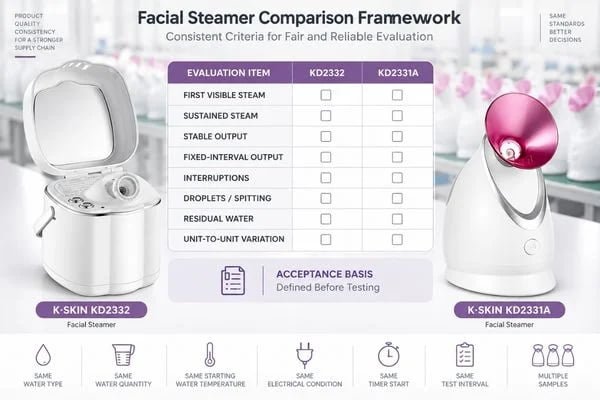
The comparison table should be prepared before testing, not created after the results are known.
There is no universal rule requiring every facial steamer to reach stable steam within a specific number of seconds or produce a fixed water-loss rate.
Acceptance criteria should come from the approved project requirement, product specification, or agreed reference sample.
| Evaluation Item | Record | Acceptance Basis |
|---|---|---|
| First visible steam | Time from defined start | Project requirement or reference only if applicable |
| Sustained steam | Time from defined start | Approved comparison criterion |
| Stable output start | Time from defined start | Approved comparison criterion |
| Steam-output comparison | Fixed-interval measurement | Agreed test range or approved reference |
| Output interruption | Frequency and duration | Project-defined tolerance |
| Spitting or droplets | Occurrence, timing and location | Approved quality requirement |
| Residual water | Defined post-test measurement | Project requirement |
| Unit-to-unit variation | Range across samples | Approved validation tolerance |
| Abnormal noise or odor | Observation | Product-specific requirement |
A Pass or Fail result is meaningful only when the criterion was defined before the result was evaluated.
How to Set Up a Repeatable Facial Steamer Comparison Test
A simple test becomes far more useful when its sequence is documented.
1. Identify Every Sample
Record:
- model;
- product revision;
- sample number;
- electrical configuration;
- relevant project or specification reference.
Do not combine different electrical or engineering versions under one result without documenting the difference.
2. Start From the Same Product Condition
If one sample has just completed a steaming cycle while another has been stored at room temperature, their startup results should not be compared directly.
Define a cold-start or conditioning procedure and apply it consistently.
3. Prepare the Water
Use the same water type for direct comparisons.
The starting water temperature should also be controlled. Water that begins substantially warmer may require less energy before steam appears.
For direct heat-up and fixed-interval output comparisons, use the same defined starting quantity unless the test specifically evaluates full-tank performance.
4. Record the Electrical and Ambient Conditions
Voltage and frequency should match the approved version under test.
Record the relevant ambient conditions as well. The objective is not to create a perfect laboratory for every sourcing test, but to make the comparison reproducible.
5. Set the Product Configuration
If the facial steamer has an adjustable nozzle, define its position for the test.
Also confirm that optional functions capable of affecting operation are either kept consistent or excluded from the comparison.
6. Start Timing From the Same Event
Power-on is usually a practical common starting point.
If another event is used, document it clearly and apply the same definition to every sample.
How Should Facial Steamer Heat-Up Time Be Measured?
Do not record only one ambiguous “steam start” figure.
A more useful startup record follows this sequence:
Power On → First Visible Vapor → Sustained Steam → Stable Output Phase
Each point answers a different question.
First Visible Vapor
Record the first clearly observable vapor emerging from the intended steam outlet.
Do not assume that this point represents usable or stable output.
Sustained Steam
Record the point at which steam continues instead of appearing briefly and then disappearing.
This separates early vapor formation from normal operating behavior.
Stable Output Phase
If the test includes a fixed steam-output measurement, define when that measurement begins.
The stable-output endpoint should be established before testing. It may be based on a project-specific observation rule or approved validation method rather than a universal figure.
Video can be useful because it provides a time-linked record of startup behavior. Use the same camera position and lighting where possible; visible steam can look very different against a dark background than against a bright one.
A statement such as “10-second steam” has limited comparison value when the timing endpoint and starting conditions are unknown.
This is particularly relevant to model-level approval. Historical timing references for a product should not be treated as current commercial specifications until they have been confirmed against the approved version.
How Should Steam Output Be Compared?
Visual steam density is useful for observation, but it is weak as the only quantitative comparison.
Lighting, background color, camera exposure, and nozzle angle can make one steam plume appear much stronger than another.
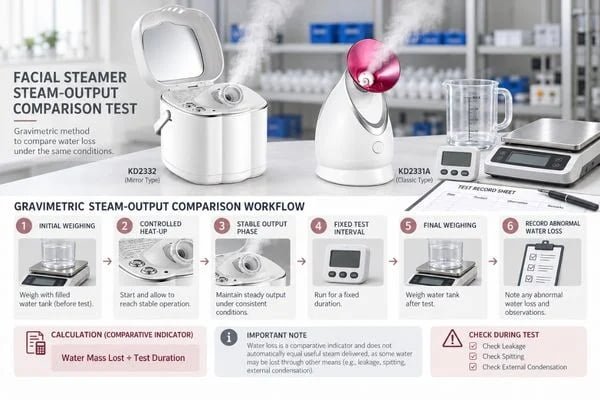
For a practical sample comparison, buyers can combine visual observation with a controlled weighing method.
A Practical Gravimetric Comparison
One approach is to weigh the product system at defined points and calculate the water mass lost during a fixed operating interval.
A simple comparative calculation is:
Comparative Water-Loss Rate = Water Mass Lost During Test ÷ Test Duration
For example, the procedure could be:
- prepare each sample with the same defined water quantity and starting conditions;
- record the relevant initial mass using the chosen method;
- complete the defined heat-up sequence;
- begin the output interval at the same defined operating point;
- operate each product for the same period;
- record the final mass;
- calculate the water mass lost over the interval;
- record any abnormal water loss separately.
The result should be described carefully.
Water mass loss is a practical comparative indicator. It is not automatically identical to the amount of useful steam delivered through the nozzle.
If the product:
- leaks;
- spits liquid water;
- traps unusual amounts of condensate externally;
- drains water into an unintended area;
then some of the measured mass loss may not represent normal steam output.
That is why weighing and observation should be used together.
Engineering Comparison and Full-Tank Runtime Are Different Tests
A direct steam-output comparison and a full-tank use test answer different questions.
For an engineering comparison of startup and output, the objective is to reduce uncontrolled differences. Using the same defined starting water quantity can therefore make sense.
A full-tank test asks a different question:
How does each product perform when operated from its approved normal fill condition?
In that case, each model can be tested with its own approved tank configuration.
This distinction matters when comparing products with different tank capacities.
For example, the current KD2331A Classic Nano-Ionic Facial Steamer uses a 90 ml water tank, while the KD2332 Multifunction Nano-Ionic Facial Steamer uses a 100 ml tank.
A longer full-tank runtime would not, by itself, prove stronger steam output.
Tank capacity, output rate, and runtime should remain separate metrics.
How Should Steam Consistency Be Recorded?
A sample may start quickly and still perform poorly throughout the rest of the cycle.
Steam consistency should therefore be evaluated after startup.
Record observations such as:
- continuous output;
- periodic interruption;
- pulsing;
- gradual output reduction;
- sudden output reduction;
- abnormal noise;
- abnormal odor;
- water droplets;
- leakage;
- residual water after the defined interval.
A continuous test video can provide useful evidence because it preserves the timing relationship between startup, stable operation, and any interruption.
Do not record only the most favorable 10 seconds of a longer operating cycle.
For product approval, sustained behavior is generally more useful than a short demonstration clip.
How Should Multiple Samples Be Compared?
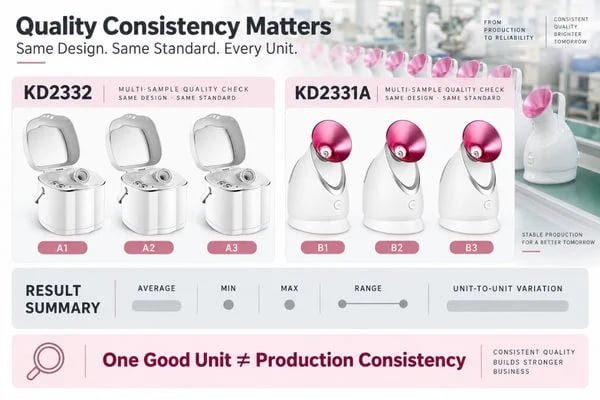
One sample can demonstrate that a single unit worked under one set of test conditions.
It does not establish production consistency.
A buyer comparing three or more samples per model can record:
- individual results;
- average;
- minimum;
- maximum;
- range;
- abnormal observations;
- repeated-run behavior where relevant.
Consider two hypothetical groups:
| Sample Group | Unit 1 | Unit 2 | Unit 3 | Buyer Observation |
|---|---|---|---|---|
| Group A | Similar result | Similar result | Similar result | Low unit-to-unit variation |
| Group B | Fast result | Slow result | Mid-range result | Wider variation requiring review |
The point is not that Group A automatically passes or Group B automatically fails.
The point is that an average can conceal variation.
For brands and importers, repeatability can be as important as the result from the fastest individual sample.
KD2332 vs KD2331A: How to Design a Fair Comparison
The KD2332 and KD2331A show why specification sheets cannot replace an actual comparative test.
Both current platforms use PTC heating and have a rated power of 280 W.
However, they are not the same product.
The KD2332 uses a 100 ml water tank and has its own product structure and control layout. The KD2331A uses a 90 ml water tank with a different housing and steam-system arrangement.
A buyer should therefore not assume:
Same Rated Power = Same Heat-Up Time = Same Steam Output
A fair comparison would test multiple units of each model using one documented method.
A useful comparison record could look like this:
| Item | KD2332 Samples | KD2331A Samples |
|---|---|---|
| Sample count | Same planned quantity | Same planned quantity |
| Heating method | PTC | PTC |
| Rated power | 280 W | 280 W |
| Starting water quantity for direct comparison | Same defined quantity | Same defined quantity |
| Starting water temperature | Same defined range | Same defined range |
| Electrical condition | Defined and recorded | Defined and recorded |
| First visible steam | Record per unit | Record per unit |
| Sustained steam | Record per unit | Record per unit |
| Stable output | Record per unit | Record per unit |
| Fixed-interval water loss | Record per unit | Record per unit |
| Interruptions / droplets | Record observations | Record observations |
| Residual water | Record | Record |
| Full-tank runtime | Separate test | Separate test |
The purpose is not to declare a universal winner.
It is to determine which product’s behavior better matches the project’s commercial requirements.
This approach is consistent with K·SKIN’s Manufacturing & Quality process, where sample evaluation and approved-version control are connected to production rather than treated as one-time demonstrations.
How Should Buyers Interpret Abnormal Results?
An unusual result should prompt an investigation, not an immediate diagnosis.
| Observation | What to Investigate |
|---|---|
| One unit starts much slower than others | Sample variation, assembly or component condition |
| All units start slower than expected | Test conditions, acceptance basis or product design |
| Output begins strongly and then declines | Water feed, thermal behavior or operating cycle |
| Steam becomes intermittent | Water path, heating behavior or control sequence |
| Liquid droplets appear | Record separately and evaluate condensation or spitting |
| Large difference between units | Sample or production consistency |
| High mass loss with weak useful steam | Check leakage, droplets and measurement method |
| Unusual residual water | Water handling, internal retention or test repeatability |
| Results change between repeated runs | Starting condition and repeatability |
Do not conclude that a heater, water system, or control component is defective based on one symptom alone.
The next step is to collect evidence: reproduce the condition, compare other samples, and inspect the relevant system.
Water spitting and nozzle condensation also require their own diagnostic process instead of being treated simply as “strong steam.”
How Should Results Be Used for Product Approval?
Testing is useful only when it leads to a clear decision.
A simple decision matrix can be used:
| Result | Buyer Decision |
|---|---|
| All key metrics meet the approved project criteria and samples are consistent | Approve |
| Core performance is acceptable but a defined issue requires confirmation | Approve with conditions |
| Results are inconsistent or the method was not controlled | Retest |
| A repeated abnormal condition conflicts with the approved requirement | Hold for investigation |
Do not create acceptance thresholds after seeing which sample performs best.
Doing so turns the test into a ranking exercise rather than a validation process.
The acceptance basis should be defined from:
- project requirements;
- approved specification;
- validated reference sample;
- agreed supplier-buyer criteria;
- applicable product requirements.
Safety and performance should also remain separate. Standards such as IEC 60335-2-23 for appliances for skin or hair care address appliance safety requirements; they should not be treated as proof that one facial steamer has a faster startup or stronger steam output than another.
Buyer Takeaway: Compare the Method Before Comparing the Number
A facial steamer heat-up time is useful only when the start point and endpoint are defined.
A steam-output figure is useful only when the water conditions, electrical supply, measurement interval, and method are known.
A sample comparison is useful only when multiple units are tested under conditions that make the results comparable.
Before approving a facial steamer, record:
- exact model and version;
- sample quantity;
- initial water quantity;
- initial water temperature;
- water type;
- starting product condition;
- electrical supply;
- ambient conditions;
- timer start;
- first visible steam;
- sustained steam;
- stable-output point;
- fixed-interval water loss;
- steam interruptions;
- droplets or leakage;
- residual water;
- unit-to-unit variation.
Buyers evaluating different platforms can review the K·SKIN Facial Steamers range and apply the same comparison method to the models relevant to their projects.
A short heat-up time or impressive-looking steam plume may attract attention. For product approval, repeatable evidence collected under controlled conditions is more useful.
Frequently Asked Questions
What counts as facial steamer heat-up time?
There is no useful basis for comparison until the endpoint has been defined. Buyers can record first visible vapor, sustained steam, and the start of a stable-output phase separately. If suppliers use different endpoints, their advertised heat-up times should not be compared directly.
Can two facial steamers be compared using advertised heat-up times?
Not reliably, unless the timing definitions and test conditions are equivalent. Initial water temperature, water quantity, electrical supply, product starting condition, and the definition of “steam start” can all affect the reported figure.
How can steam output be compared without specialized laboratory equipment?
For sourcing comparisons, buyers can combine standardized visual observation with a controlled timer-and-weighing method. Water mass loss over a fixed interval can provide a practical comparative indicator, provided that leakage, droplets, and other abnormal water loss are recorded separately.
How many facial steamer samples should a buyer test?
Testing multiple units is more informative than relying on a single sample. For a practical sourcing comparison, testing at least three units per model can help reveal unit-to-unit variation. The final validation quantity should still reflect the project’s risk level and approval plan.
Does higher steam output always mean a better facial steamer?
No. The preferred output depends on the product design and commercial requirements. Buyers should consider startup behavior, output stability, water handling, runtime, user experience, and consistency together rather than choosing the model with the highest isolated output measurement.
Conclusion
Facial steamer heat-up time and steam output can be useful approval metrics, but only when the measurement method is controlled. Define the timing points, water conditions, electrical supply, output interval, and sample quantity before comparing the results.
For brands, importers, and private-label buyers, the goal is not to find the most impressive single figure. It is to identify a product version that performs consistently under a repeatable test and continues to match the approved standard when production begins.