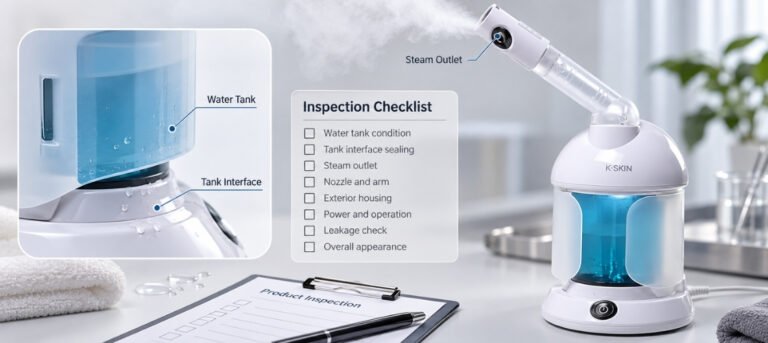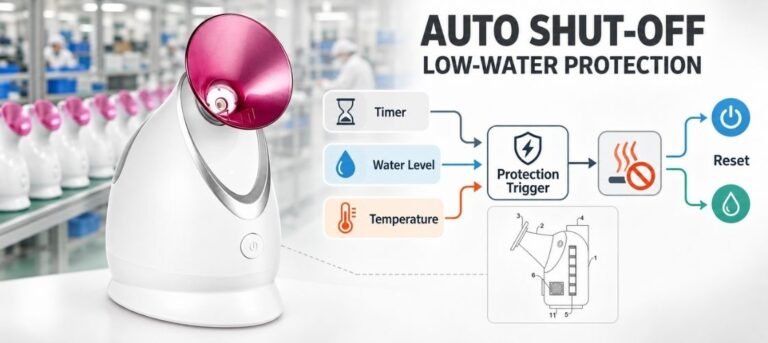

Water droplets around a facial steamer outlet do not necessarily mean that the product is leaking or defective. Buyers should first determine whether the moisture is condensation, nozzle spitting, or water escaping from another part of the product.
A facial steamer may spit water droplets because of startup condensation, temporary water carryover, an unstable water feed, mineral buildup, a restricted steam path, nozzle geometry, assembly variation, or changes in operating position. Buyers should record exactly when and where the droplets appear, the water type, fill level, nozzle position, and operating conditions, and whether the behavior continues after stable steam output has been established.
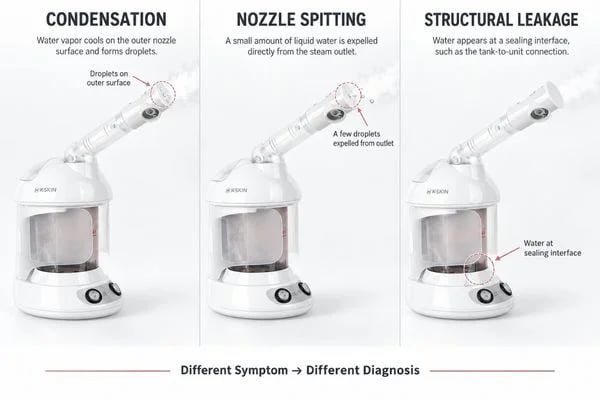
For brands, importers, and distributors evaluating facial steamer platforms, simply noting that water is visible is not enough. The test should identify the type of moisture, when it appears, whether the behavior is repeatable, and whether it matches the approved sample and operating instructions.
Is It Condensation, Spitting, or Leakage?
These three conditions should be distinguished before assigning a root cause.
Condensation occurs when steam contacts a cooler surface and turns back into liquid water. Nozzle spitting, or water carryover, occurs when liquid droplets are expelled from the steam outlet along with the steam. Structural leakage occurs when water escapes from an area that should remain sealed during approved operation.
| Observation | Likely Classification | First Buyer Action |
|---|---|---|
| Small droplets form on the outer nozzle surface | Condensation | Record when they appear and whether they remain external |
| Liquid droplets are expelled with the steam | Nozzle spitting / water carryover | Reproduce the behavior under controlled conditions |
| Moisture appears only during initial warm-up | Startup-related behavior | Continue testing until stable steam is established |
| Droplets continue after stable steam output | Potential abnormal carryover | Investigate the water feed, heating, steam path, and sample consistency |
| Water appears around the tank or housing interface | Structural leakage | Switch to leakage diagnosis |
| Water approaches an electrical opening | Potential safety concern | Stop testing and escalate the issue |
A few droplets near the steam outlet should therefore not automatically be classified as a product failure.
Their location and timing provide more useful information than simply stating that “the steamer is wet.”
Why Can a Facial Steamer Spit Water Droplets?
Several different mechanisms can produce similar visible symptoms.
Buyers should treat each possible cause as a separate investigation path instead of assuming an explanation based on appearance alone.
| Cause Category | What May Be Happening | What the Buyer Should Check |
|---|---|---|
| Cold-start condensation | Steam reaches cooler surfaces before the steam path reaches a stable operating condition | When droplets begin and whether they disappear after warm-up |
| Temporary water carryover | Liquid water reaches the steam outlet during transient operation | Fill level, startup condition, and operating sequence |
| Water-feed fluctuation | The water supply to the heating area or steam path is unstable | Whether steam surges, weakens, or becomes intermittent |
| Heating instability | Water is not being converted to steam consistently | Steam behavior before and during droplet events |
| Mineral buildup | Scale changes the heating or steam-flow behavior | Water type, maintenance history, and cleaning condition |
| Steam-path obstruction | Restricted flow changes pressure or condensate movement | Outlet condition and repeatability |
| Nozzle or arm geometry | Condensate collects in part of the steam path | Outlet position and approved adjustment angles |
| Orientation change | Water or condensate shifts within the system | Base position and nozzle position |
| Assembly variation | One unit behaves differently from approved references | Comparison across multiple samples |

More than one factor can contribute to the same symptom. For example, a cooler steam path may create condensation during startup, while an incorrect fill condition may increase the amount of liquid reaching the outlet.
The test conditions should therefore be controlled before the product is disassembled or a particular component is blamed.
Why Do Nozzle Geometry and Product Position Matter?
Facial steamers do not all use the same steam-path design.
The KD33S Long-Tube Aromatherapy Facial Steamer uses a long adjustable nozzle. When evaluating this type of platform, buyers should define the approved nozzle position and observe where condensation forms during both cold start and stable operation.
The KD2328 Large-Tank Nano-Ionic Facial Steamer uses a larger water tank and a 360-degree adjustable steam arm. Its sample test should therefore keep the water quantity, base orientation, steam-arm position, and operating duration consistent.
These design differences affect which variables need to be controlled.
They do not prove that one design is more likely to spit water than another.
A longer or adjustable steam path can affect where condensate forms and how it moves, but the product's actual behavior still needs to be observed under defined operating conditions.
What Variables Should Buyers Control Before Testing?
A spitting test is difficult to interpret if the starting conditions vary between runs.
Before testing, record the following:
| Variable | What to Record |
|---|---|
| Model and revision | Exact sample identity |
| Sample number | Individual unit reference |
| Water type | Water specified for the approved product |
| Fill level | Defined quantity or approved fill mark |
| Starting water temperature | Recorded starting condition |
| Electrical supply | Voltage and frequency used during the test |
| Ambient temperature | General test environment |
| Nozzle / steam-arm position | Defined approved position |
| Product orientation | Normal approved operating position |
| Cleaning condition | New, cleaned, previously used, or scaled |
| Residual water | Whether the system was drained before testing |
| Test start point | Defined power-on or operating event |
| Video record | Continuous video where possible |
Operating instructions from established facial-steamer brands also show why the exact water and fill conditions matter. The True Glow by Conair Facial Sauna instructions specify distilled water and instruct users not to fill the reservoir above the maximum line.
The HoMedics facial steamer instructions similarly specify distilled water and state that the water chamber should not be filled beyond the maximum level.
These instructions should not be treated as universal specifications for every facial steamer. Buyers should always use the water type, fill condition, and operating method approved for the exact model being evaluated.
Buyer Test 1: Cold-Start Spitting Test
Cold start is the first condition to isolate because a cool steam path may behave differently from a fully warmed system.
Use a dry, identified sample.
- Confirm the sample model and revision.
- Drain any residual water if required by the test method.
- Fill the product with the approved water under the defined fill condition.
- Dry the outside of the tank, nozzle, and housing.
- Set the nozzle or steam arm to the defined reference position.
- Place the product on the approved operating surface.
- Start continuous video before switching on the product.
- Record the time when steam first becomes visible.
- Record the time and location of the first liquid droplet.
- Observe whether the droplet forms on a surface or is expelled from the outlet.
- Continue the test until the steam output reaches a stable operating condition.
- Record whether the droplets stop, continue, or become more frequent.
The appearance of a single droplet is not the main issue.
What matters is whether the behavior is limited to startup or continues after stable steam output has been established.
Buyer Test 2: Continuous-Operation Test
Once stable steam output has been reached, continue operating the product under the same defined conditions.
Record:
- whether droplets continue;
- where they originate;
- whether liquid is expelled directly from the outlet;
- whether the steam becomes intermittent;
- whether the output surges;
- whether the droplet frequency changes over time;
- whether the behavior repeats during a second run.
A practical observation record may look like this:
| Observation Item | Record |
|---|---|
| Stable steam established | Time |
| First droplet after stable steam | Time / none |
| Droplet location | Nozzle surface / outlet / other |
| Droplet behavior | Surface formation / expelled with steam |
| Steam interruptions | Yes / no |
| Output surging | Yes / no |
| Defined observation interval | Recorded |
| Repeat run result | Same / different |
For comparison purposes, a buyer may choose to count droplets during a defined observation period. However, the article or commercial specification should not introduce a universal number of acceptable droplets without supporting evidence.
Acceptance criteria should come from the approved product requirement, validated reference sample, operating instructions, and agreed buyer-supplier standard.
Buyer Test 3: Nozzle-Position and Orientation Test
For a product with an adjustable nozzle or steam arm, its position can affect how condensate moves.
Testing should remain within the intended or approved operating positions.
A controlled test can include:
- reference nozzle position;
- another approved operating angle;
- return to the original reference position.
Keep the following conditions unchanged between positions:
- water quantity;
- water type;
- base orientation;
- electrical supply;
- operating duration;
- starting condition.
Observe whether droplets appear only in one position and whether the behavior can be reproduced.
If an abnormal condition repeatedly occurs at an approved nozzle position while the reference position remains stable, the supplier should review the steam path, condensate management, mechanical position, and assembly consistency.
Do not intentionally operate the product outside its approved orientation simply to produce a failure.
Buyer Test 4: Restart After Cooldown
The product's thermal condition can help distinguish startup condensation from persistent water carryover.
A useful sequence is:
Cold Start → Stable Operation → Stop → Cooldown → Restart
Compare:
- the initial cold start;
- a warm restart after a short interruption;
- a restart after the product has cooled substantially.
If temporary droplets appear consistently during cold start but disappear during stable operation, the result should be interpreted differently from continuous liquid spitting throughout the session.
If droplets persist after the entire steam path is already warm, the investigation should focus on the water feed, steam-path behavior, operating conditions, or product variation.

How Should Buyers Interpret the Test Result?
The result should be compared with the product's approved behavior instead of being judged from appearance alone.
| Test Result | Buyer Interpretation |
|---|---|
| Small temporary condensation during startup and behavior matches approved reference | May be normal operating behavior |
| Droplets disappear once stable steam is established | Record and compare with approved sample |
| Liquid continues to be expelled after stable operation | Investigate further |
| One unit behaves differently from other samples | Possible sample or assembly variation |
| Multiple samples reproduce the same unexpected behavior | Design, specification, or process review may be needed |
| Problem appears only at one approved nozzle position | Review steam-path and condensate behavior |
| Water originates from tank or housing interface | Treat as structural leakage rather than nozzle spitting |
| Water reaches an electrical area | Stop the test and escalate |
One abnormal observation should prompt an investigation, not an immediate diagnosis.
Repeat the test under the same conditions and compare the result with another sample before deciding whether the issue is isolated or related to the approved product version.
When Does Spitting Become a Product-Approval Issue?
Water droplets become a product-approval issue when the behavior is repeatable, conflicts with the agreed commercial version, or creates unacceptable consequences for the user, product quality, or safety.
The decision should consider:
- the approved sample;
- the product specification;
- the operating manual;
- agreed buyer-supplier acceptance criteria;
- repeatability across samples;
- whether the condition occurs during intended use;
- whether the issue changes the customer experience;
- whether the condition can affect safe operation.
For household and similar skin- or hair-care appliances, standards such as IEC 60335-2-23 address product safety requirements. Safety compliance, however, should not be used as proof that a particular level of nozzle condensation or water spitting is commercially acceptable.
Performance acceptance still requires a defined, product-specific basis.
Why Does Spitting Matter for Packaging and After-Sales?
Water handling remains important after the functional test has been completed.
If a factory performs wet testing before shipment, the process should specify how the product is drained and dried before packaging.
Residual water can cause confusion if a buyer or end customer later opens the product and finds unexpected moisture.
Packaging evaluation should therefore consider:
- whether the test water is fully drained;
- whether the product has an adequate drying step;
- whether residual water can move during transport;
- whether the nozzle or arm is properly restrained inside the package;
- whether transport can change the seating of the tank or other components;
- whether the received product still matches the approved sample.
After-sales diagnosis is also more effective when a complaint includes information that can be used to reproduce the issue.
Instead of recording only:
“The facial steamer sprays water.”
A useful complaint record should include:
- model and version;
- video of the event;
- time from startup;
- water type;
- fill level;
- nozzle or arm position;
- whether the product was cold or already warm;
- whether the issue occurs during every use;
- where the droplets first appear;
- whether the product has been cleaned or stored with residual water.
This information allows the supplier to reproduce the condition much more quickly.
What Corrective Evidence Should a Supplier Provide?
If testing confirms repeatable abnormal spitting, buyers should request evidence that identifies both the cause and the correction.
A useful corrective-action package may include:
- affected sample identification;
- exact failure condition;
- reproduction video;
- root-cause investigation;
- affected component or process, where confirmed;
- corrective action;
- before-and-after comparison;
- retest under the same controlled method;
- comparison with another unit or production sample;
- revised product version identification if a design or process change was made.
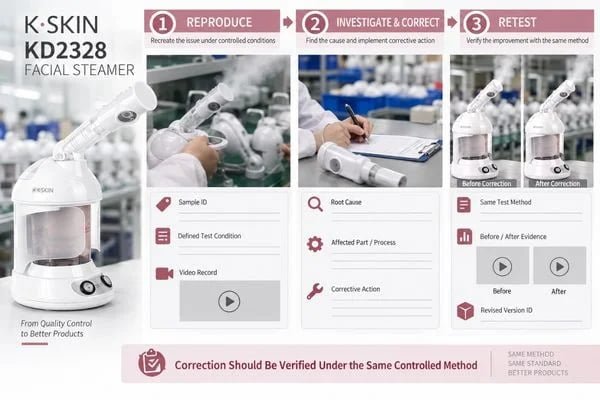
If the correction changes the water path, heating system, nozzle structure, assembly process, or another approved product characteristic, the revised version should be evaluated before production approval.
This follows the same version-control principle used in K·SKIN's Manufacturing & Quality process: the tested sample, corrective evidence, and production version should remain aligned.
Buyer Takeaway: Record the Droplet Before Diagnosing the Cause
A facial steamer that spits water should not be approved or rejected on the basis of a brief visual observation alone.
Record:
Where → When → Water Condition → Operating State → Nozzle Position → Repeatability
Then determine whether the moisture is surface condensation, temporary startup behavior, repeatable nozzle spitting, or water escaping from another part of the product.
A controlled record is more useful than a dramatic description of the symptom.
When comparing different facial steamer models, buyers should not expect a product to show no visible moisture under any possible condition. They should understand its approved operating behavior, identify repeatable abnormalities, and make sure that any correction is validated on the version that will enter production.
Frequently Asked Questions
Is water around a facial steamer nozzle always a defect?
No. Water near the nozzle may be condensation formed when steam contacts a cooler surface. Before classifying the condition, buyers should determine whether the water forms on the nozzle, is expelled directly with the steam, or originates from another product interface.
What is the difference between condensation and nozzle spitting?
Condensation forms on a surface when steam cools and becomes liquid water. Nozzle spitting occurs when liquid droplets are carried through or expelled from the steam outlet. The two conditions may look similar in a short video, but they require different diagnostic approaches.
Why does a facial steamer spit water only when starting?
During cold start, the steam path and nozzle may still be cooler than they are during stable operation, allowing more condensation to form. Temporary startup droplets should be recorded and compared with the product's behavior after it reaches stable steam output.
Can mineral buildup cause a facial steamer to spit water?
Mineral buildup can change heating and steam-flow behavior and may contribute to restricted flow, intermittent steam, or abnormal water carryover. It should be treated as one diagnostic variable rather than assumed to be the cause before the condition has been reproduced.
How should a buyer test a facial steamer that spits droplets?
Use an identified sample, approved water, a controlled fill level, a defined nozzle position, the normal product orientation, and recorded electrical and environmental conditions. Test cold start, stable continuous operation, approved nozzle positions, and restart after cooldown while recording when and where droplets appear.
Conclusion
Facial steamer water droplets should be diagnosed by their type, timing, position, and repeatability. Startup condensation, nozzle spitting, and structural leakage are different conditions and should not be grouped under a single defect label.
For product approval, control the test conditions, compare the result with the approved reference, and require reproducible evidence before assigning a root cause or accepting a corrective action. This gives brands, importers, and distributors a clearer basis for sample approval, production control, and after-sales diagnosis.