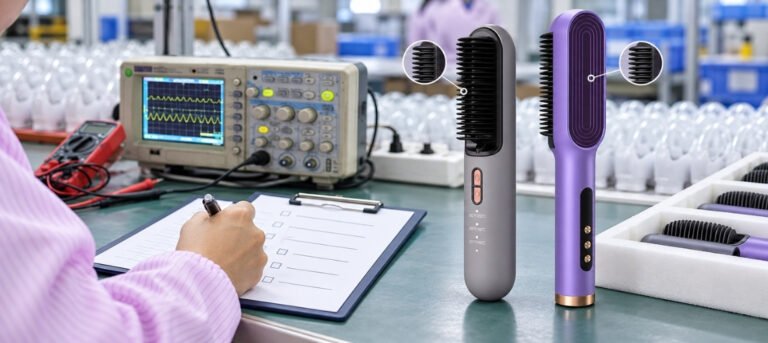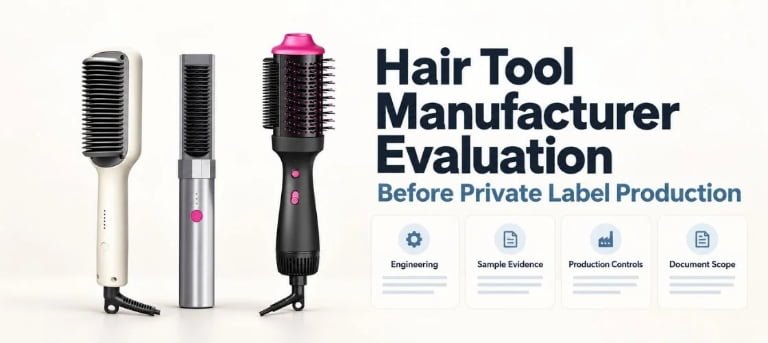
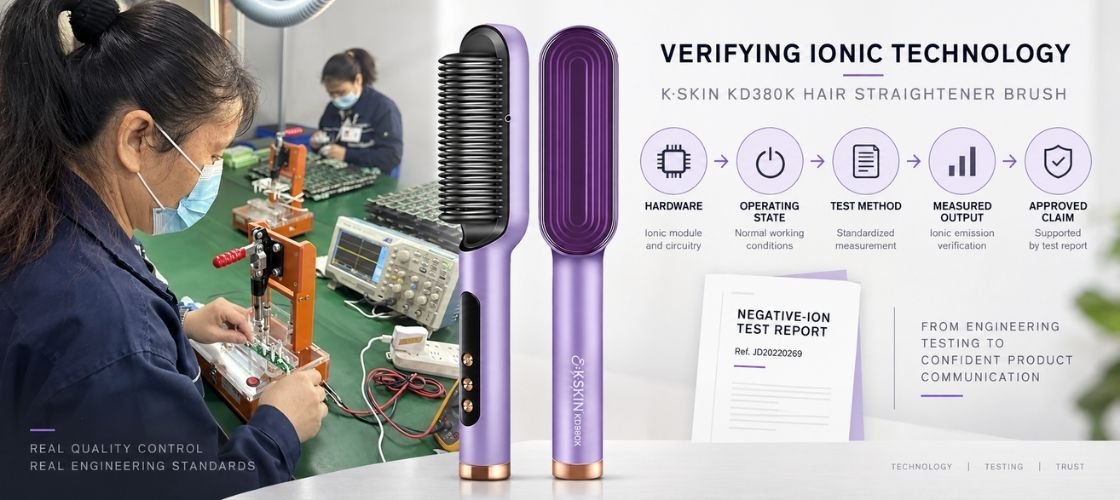
“Ionic” is widely used in hair-tool marketing, but buyers should not treat the term as a complete technical specification. The key questions are what hardware is present, when the function operates, how the output is measured, and what the available evidence actually supports.
In a hair straightener brush, ionic technology should correspond to an actual ion-generating function, not just a marketing label. Buyers should verify the relevant hardware, intended emission path, operating state, measurement method, model and version, and any supporting test records. Claims about static, frizz, moisture retention, or hair condition require separate evidence beyond confirmation of ion output.
What Does “Ionic” Mean in a Hair Straightener Brush?
For product buyers, “ionic” should describe a defined technical function within the product.
Suppliers may use several related terms:
- ionic hair straightener brush;
- negative-ion hair brush;
- negative-ion function;
- ionic generator;
- high ion concentration;
- anti-static ionic technology.
These terms do not all make the same claim.
| Marketing Term | Buyer Interpretation | What Still Needs Verification |
|---|---|---|
| Ionic hair straightener brush | Product or technology positioning | What actual ionic function is built into the product? |
| Negative-ion function | Specific output feature | Is measurable negative-ion output present? |
| Ionic generator | Hardware statement | What component or circuit provides the function? |
| High ion concentration | Quantified output claim | What was measured, under what conditions and in what unit? |
| Anti-static ionic technology | Performance claim | Was static reduction actually tested? |
| Frizz-reducing ionic technology | Styling-result claim | Was the result tested against a suitable comparison? |
A brush can include an ionic function without proving every marketing statement commonly associated with ionic hair tools for that particular model.
This distinction matters when buyers move from product selection to packaging, marketplace listings, private-label artwork, and final commercial approval.
How Does the Ionic Function Fit Into the Product Architecture?
The ionic function is separate from the main heating system in a hair straightener brush.
A typical functional architecture can be represented as:
Electrical Power / Control → Ion-Generating Function → Emission Path → Local Ion Output Near the Styling Area
The exact implementation varies by product design.
A heated brush may also include:
- a PTC heating system;
- temperature sensing and control;
- an LED or other user interface;
- comb teeth and protective structures;
- a power or battery system;
- an independent ionic subsystem.
These functions should be treated separately.
PTC heating does not, by itself, prove that a product has an ionic function. An LED indicator does not prove that ion output is active. Likewise, an “ionic” label on the packaging does not establish how the feature is implemented.
Buyers should therefore ask the supplier to identify the ionic function within the approved product architecture and explain how it is intended to operate.
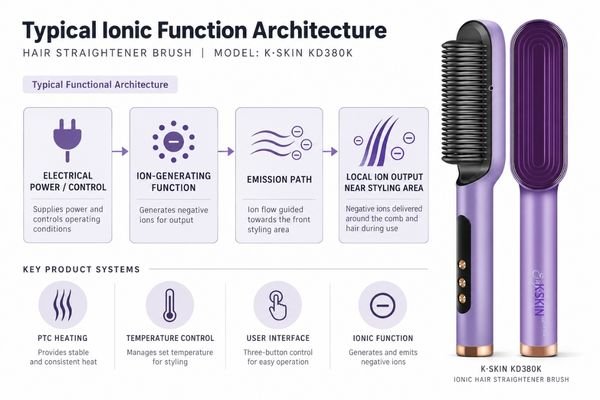
The diagram should remain a functional explanation unless the supplier provides an actual engineering drawing, component photograph, or teardown record for the model under evaluation.
What Should Buyers Verify on the Actual Sample?
The sample should be evaluated as a physical product, not just checked against a feature list.
The first step is to establish that the ionic function under discussion belongs to the exact sample and commercial version being reviewed.
| Item | What to Verify | Why It Matters |
|---|---|---|
| Model and version | Exact sample identity and specification | Prevents evidence from another version being applied incorrectly |
| Ionic function | Relevant component or system is present | Confirms that the feature is physically implemented |
| Emission area | Intended output location on the device | Helps define a repeatable measurement setup |
| Control logic | When and how the ionic function becomes active | Determines when output should be tested |
| Electrical configuration | Voltage, power system and intended market version | Different configurations may not be identical |
| Startup behavior | When measurable output begins after activation | Helps distinguish startup from stable operation |
| Repeatability | Repeated readings from the same sample | Reduces reliance on one convenient reading |
| Unit-to-unit consistency | Comparison across multiple samples where appropriate | One unit does not demonstrate production consistency |
| Production match | Approved sample versus planned mass-production version | Keeps evidence aligned with the commercial product |
One point needs particular attention: do not assume how the ionic function is controlled.
Depending on the product, it may operate continuously while the device is on, be tied to another function, activate automatically, or follow a different control sequence. The actual operating logic should be confirmed from the sample and technical documentation.
How Should Negative-Ion Output Be Tested?
The term “negative-ion output” becomes meaningful only when the test conditions are defined.
A number in a report is difficult to interpret or compare with another supplier’s result if the measurement method is missing.
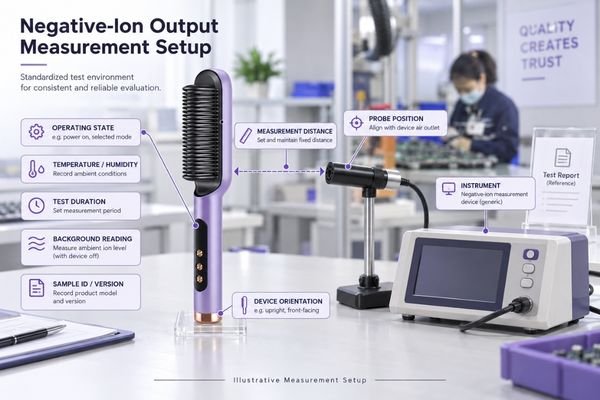
Important variables include:
| Test Variable | Why It Matters |
|---|---|
| Measurement instrument | Defines what is being detected and reported |
| Probe position | Ion concentration can vary around the product |
| Measurement distance | A different distance can produce a different result |
| Device orientation | Position should remain consistent between tests |
| Operating state | The ionic function must be active under defined conditions |
| Temperature and humidity | Environmental conditions can affect measurements |
| Test duration | Startup and continued operation may not produce identical readings |
| Measurement interval | A sequence of readings is more informative than one selected value |
| Sample quantity | More than one unit may be needed for product comparison |
| Measurement unit | Required to interpret or compare the result |
| Background reading | Helps establish the test environment before device operation |
| Model, version and date | Makes the result traceable to the tested product |
Buyers do not need to invent a universal measurement distance or test setup.
The right approach is to use a defined method appropriate to the measurement, record the conditions, and keep those conditions consistent when comparing samples or product versions.
This is particularly important when a supplier quotes a high ion-concentration figure. Without the measurement distance, instrument, environmental conditions, and unit, two impressive-looking figures may not be directly comparable.
What Evidence Should Support an Ionic Claim?
The evidence should become more specific as the claim becomes more precise.
A useful progression is:
Product Description → Hardware Evidence → Functional Verification → Model-Specific Output Record → Version-Matched Test Evidence → Approved Commercial Wording
A marketing image may show that a supplier positions a product as ionic, but it does not demonstrate measurable output.
A photograph of a component can help confirm the product’s construction, but it does not establish a specific output concentration.
A test result can support the quantity actually measured, but only within the conditions and scope of that test.
The current K·SKIN KD380K Ionic Hair Straightening & Curling Brush includes a negative-ion function in its current product positioning. Its supporting documentation also includes negative-ion report reference JD20220269.
That report reference should not be converted into a numerical marketing statement without reviewing the corresponding report for the exact model and version, including the test method, unit, conditions, and conclusion.
The same document-control principle applies across the broader K·SKIN Credentials framework: a document’s relevance depends on the product, scope, version, market, and intended claim.
Electrical and product-safety documentation should also be kept separate from feature-performance evidence. Standards such as IEC 60335-2-23 for appliances for skin or hair care address a different evidence question from a negative-ion output test.
Does Measurable Ion Output Prove Less Static, Less Frizz, or Healthier Hair?
No, not automatically.
The evidence chain should be divided into three stages:
Ion-Generating Hardware → Measurable Ion Output → Styling or Hair Outcome
Evidence for the first two stages does not automatically prove the third.
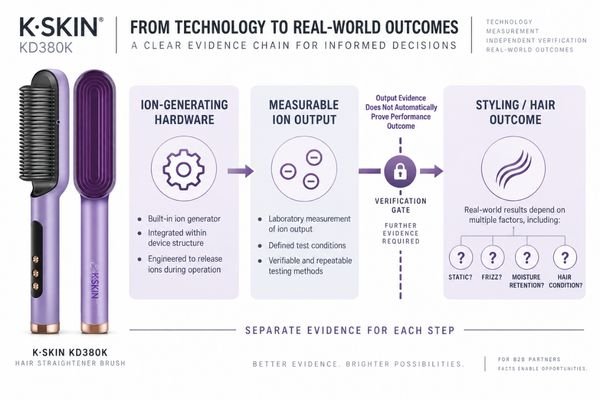
For example, detecting negative-ion output does not, by itself, prove that the finished product:
- eliminates static;
- eliminates frizz;
- prevents hair damage;
- repairs the cuticle;
- locks moisture into the hair;
- improves hair health;
- produces a superior styling result.
Actual styling outcomes may also be affected by:
- heating temperature;
- temperature stability;
- comb geometry;
- hair type;
- hair condition;
- ambient humidity;
- styling speed;
- number of passes;
- user technique.
This does not mean that an ionic feature has no product value. It means that the technical feature and claimed consumer outcome should be supported separately.
For U.S. marketing, the Federal Trade Commission Policy Statement Regarding Advertising Substantiation explains that objective advertising claims should have a reasonable basis before they are disseminated. The amount and type of support required depend on the nature of the claim.
For global B2B projects, buyers should apply the same evidence discipline while also reviewing the requirements of the intended destination market.
KD380K Example: What Is Confirmed, and What Still Needs Evidence?
The KD380K shows how an ionic feature should be separated from broader marketing claims.
Its current commercial reference includes:
- corded operation;
- 220 V / 50 Hz configuration;
- 45 W rated power;
- PTC heating;
- nine selectable temperature levels;
- 120–200°C temperature range;
- LED temperature display;
- negative-ion function;
- anti-scald comb-tooth structure;
- approximately 310 × 46 × 45 mm dimensions;
- approximately 388 g net weight.
These are product-level characteristics of the current approved reference.
The evidence status of the different ionic statements should still be considered separately:
| Statement | Buyer Treatment |
|---|---|
| KD380K includes a negative-ion function | Current product feature |
| KD380K has supporting negative-ion report reference JD20220269 | Supporting document reference available |
| Exact ion concentration | Verify from the applicable report before publishing |
| Exact ion-generator construction | Confirm with actual structure or engineering evidence |
| Exact emission-point arrangement | Confirm with actual model evidence |
| Ionic function eliminates static | Requires suitable performance evidence |
| Ionic function reduces frizz | Requires controlled outcome evidence |
| Ionic function protects hair or locks in moisture | Requires separate reliable evidence |
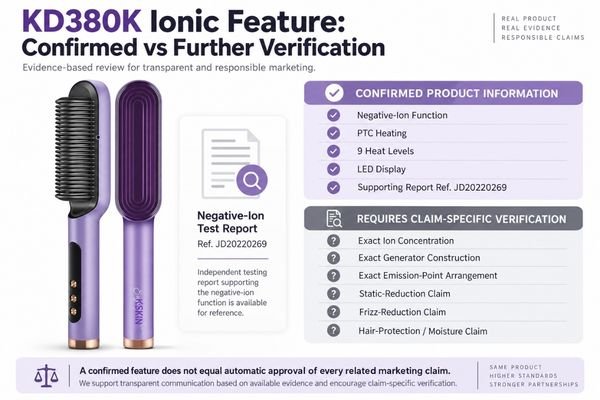
This distinction allows buyers to use confirmed product information without extending the commercial wording beyond the available evidence.
What Should Buyers Ask the Supplier Before Approving an Ionic Feature?
A short supplier questionnaire can reveal whether “ionic” refers to a defined product feature or is mainly being used as a marketing term.
Ask:
- What component or system provides the ionic function?
- Where is the intended ion-emission area?
- Under what operating condition is the function active?
- What exactly was measured during output testing?
- Which instrument, distance, environmental conditions and measurement unit were used?
- Which model and product version was tested?
- Does the tested version match the sample and planned production version?
- Has any relevant component, control logic, electrical configuration or emission structure changed since the test?
- Was the result based on one reading, repeated readings or multiple samples?
- What exact ionic wording is approved for the product page, packaging, manual and marketplace listing?
These questions should be answered before the feature becomes part of the final commercial specification.
What If Model-Level Ion Evidence Is Incomplete?
Incomplete evidence does not justify inventing a stronger claim.
The wording can be narrowed to reflect what has actually been confirmed.
If the product architecture and approved specification confirm a negative-ion function but no suitable quantitative output record is available, avoid publishing a specific ion-concentration figure.
If measurable ion output is documented but no controlled styling-outcome test is available, do not turn the output result into absolute claims about static, frizz, moisture retention, or hair protection.
If the report belongs to another model or an outdated version, hold the claim until its applicability has been confirmed.
A practical hierarchy is:
- confirm the product and version;
- confirm the ionic function;
- verify measurable output where required;
- use quantitative statements only when supported by the corresponding test record;
- use consumer-performance claims only when the outcome itself has suitable evidence.
This approach also reduces problems during manufacturing and quality control, because the approved wording remains connected to the version actually being produced.
Buyer Takeaway: Verify the Output, Then Approve the Wording
“Ionic” should not be approved simply because it appears in a supplier specification or competitor listing.
For a B2B buyer, a more useful verification chain is:
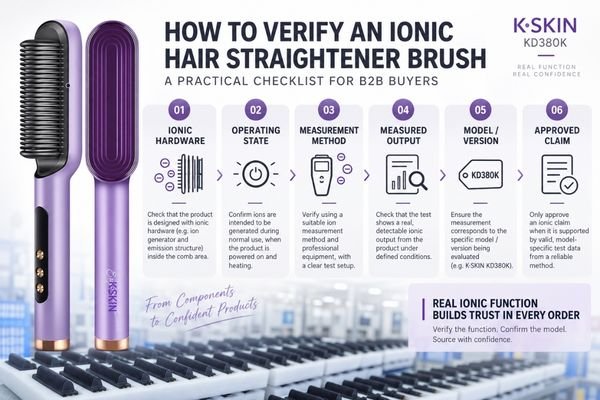
Hardware → Operating State → Measurement Method → Measured Output → Model / Version → Approved Wording
Before approving the product, confirm what the ionic function physically is, when it operates, how the output was measured, and whether the evidence applies to the same version that will enter production.
Buyers evaluating current styling platforms can review the K·SKIN Hair Styling Tools range and compare ionic and non-ionic configurations according to product format, electrical system, sample requirements, and commercial positioning.
The goal is not to remove useful product claims. It is to make each claim traceable to the product and evidence that actually support it.
Frequently Asked Questions
What does ionic mean in a hair straightener brush?
In a product-verification context, “ionic” should refer to an actual ion-generating function within the hair tool. Buyers should confirm the relevant product architecture, intended output area, and operating conditions instead of relying solely on the term used on the packaging or product listing.
Is “ionic” the same as a specific negative-ion concentration?
No. “Ionic” can describe the presence or positioning of an ion-generating function. A specific ion concentration is a quantitative claim that requires a defined measurement method, unit, test conditions, and evidence tied to the exact model and version.
How should negative-ion output be tested?
The test should identify the measurement instrument, probe location, distance, device operating state, environmental conditions, duration, unit, and sample identity. The same setup should be used when comparing products or conducting repeated tests.
Does negative-ion output prove less static or less frizz?
Not by itself. Ion output is a technical measurement, while static reduction or frizz reduction is a performance outcome. The performance claim should be supported by a test designed to evaluate that specific outcome.
Can a negative-ion report from one hair tool support another model?
Not automatically. Buyers should confirm whether the report covers the same model, version, ionic hardware, electrical configuration, and relevant product structure. Products that look similar may still use different components or operating logic.
Conclusion
Ionic technology in a hair straightener brush should be treated as a verifiable product function, not as a shortcut to a list of consumer benefits. Buyers should confirm the hardware, operating state, measurement conditions, test record, and exact model before approving quantitative ionic claims.
The same discipline should continue through packaging, marketplace listings, and mass production. Keeping the technical feature, measured output, and consumer-performance claims separate makes product approval clearer and reduces the risk of commercial wording extending beyond the evidence available for the version being sold.