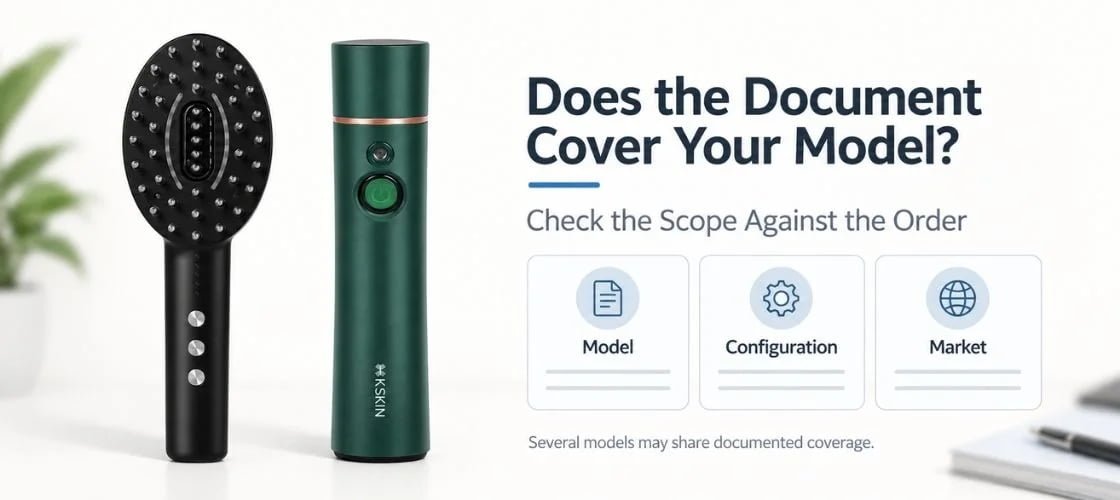
The supplier has sent a certificate. The product looks right, and the model name seems familiar. Is that enough to move the order forward? Only if the document actually covers the version you plan to buy.
One certificate can cover several beauty device models, provided its scope and supporting documents include them. What it cannot do is automatically cover everything a supplier sells. Before relying on it, connect the named entity, model, configuration, standards, market and current document status to your order. Where that connection is missing, ask for the specific evidence needed to establish it.
Start With What the Document Actually Proves
“We have the certificates” sounds reassuring. It also leaves a lot unanswered. Open the folder, and you may find a laboratory report, a management system certificate, a declaration and a registration record—all described simply as certificates.
Those files may be useful, but they serve different purposes. Sorting out which is which saves time later, especially when purchasing and compliance colleagues are looking for different answers from the same document.
| Document | What to examine | What it does not establish on its own |
|---|---|---|
| Product certificate or attestation | Scheme, holder, product description, model list and conditions | Coverage beyond the issuing scheme and stated scope |
| Test report | Sample identity, configuration, methods, results and limitations | Results for equipment or conditions outside the report |
| Declaration of conformity | Responsible entity, product identification, applicable requirements and signature | That an independent laboratory has performed every relevant assessment |
| Quality management system certificate | Certified organization, sites, activities and current status | Product certification for every finished device |
| Registration or listing record | Authority, entry type, named entity and applicable product information | Approval beyond what that regulatory entry actually means |
Take ISO 9001. ISO’s explanation concerns a quality management system and an organizational audit. That is useful context for supplier evaluation, but it answers a different question from whether a particular facial steamer configuration has been assessed against applicable product requirements.
The same distinction matters when reviewing credentials. The useful question is what each document supports—not how many files are available.
Check the Named Entity Without Rewriting Its Role
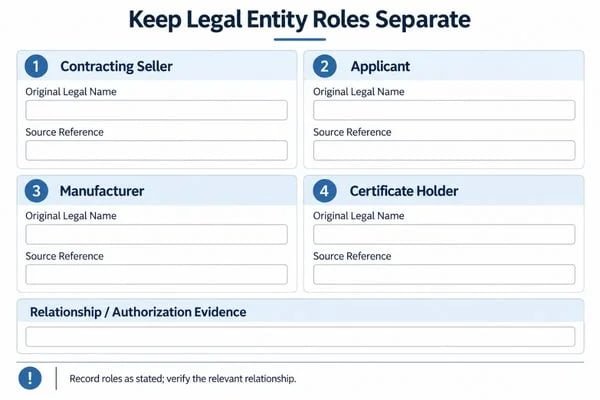
The seller on your quotation may not be the applicant, manufacturer or certificate holder named in the file. That deserves a closer look. It does not, by itself, mean the document is unusable.
Follow the Relationship Relevant to Your Order
Keep the legal names and roles exactly as they appear. A laboratory is not the applicant; a trading company is not automatically the manufacturer. Storing their documents in one folder doesn't change those relationships.
If the seller is a separate entity, ask how it is authorized to supply the documented product and how the order connects to the stated manufacturing arrangement. The answer may need a formal authorization, contractual documentation or another verifiable record, depending on the issue. A conversation can point you toward that evidence. It cannot replace it.
There is no need to reconstruct the supplier's entire corporate history to answer a specific order question. You do, however, need enough evidence to explain why the document is relevant to the transaction.
Changing the company name on an old report would defeat that purpose. Any change of holder or manufacturer needs to follow the applicable document or certification process. Your review record should explain the relationship as it exists, rather than make the names look consistent.
Read the Model List and Its Supporting Pages
Sometimes the answer is straightforward: the model is listed, and the supporting pages describe the version being offered. Other times, the cover names a family, refers to an annex or points to a separate report. That's where the next part of the review begins.
A Listed Family Still Needs a Clear Boundary
The first page may not tell the whole story. A model table or annex can explain which variants are included and what distinguishes them. Conditions and referenced reports matter too, particularly where the document says they must be read together.
Instead of asking for “another certificate,” try a more precise request: “Please show where our order model is covered and which pages describe its configuration.” This gives the supplier something concrete to answer. It also avoids assuming that every difference in a commercial name requires a new certificate.
Here is an illustrative example, not a description of any K·SKIN model or existing certificate:
| Order item | Evidence available | Question still to answer |
|---|---|---|
| Model A, specified configuration | Model A appears in the document and supporting report | Does the order match that version and intended market? |
| Model B, listed family variant | Model B appears in an annex | Which differences are included, and do they match the offered unit? |
| Model A with a different electrical configuration | Only the original configuration is described | Is further assessment or a document revision needed? |
| Commercial name C, said to be Model A | Only the supplier's statement links the names | Where is the traceable mapping, and does the scheme require any further action? |
Resolve Commercial Names and Factory Codes
A brand-facing name may differ from the factory code used in a report. That can be explainable; the explanation still needs a traceable record.
Look for a connection between the commercial name, underlying model, specification revision and label information. If the relevant document needs an amendment or additional identification, a note in the buyer's spreadsheet won't take its place.
Photographs have limited value here. Two devices can share the same enclosure while containing different parts or configurations relevant to the assessment. Looking alike is a reason to investigate the connection, not evidence that it has been established.
Match the Configuration Behind the Model Name
Even an exact model-name match can leave a question open: is this the same version? The difference may be inside the housing, in the power arrangement or among the accessories supplied with the device.

For a heated styling tool, relevant details may include the rated input, heating arrangement, controls and protective components. A rechargeable device may bring the battery, charging arrangement and accessories into the review. These are variables to examine, not a rule that every change has the same regulatory consequence.
Ask What Changed and Who Assessed It
If the specification or label shows a difference, “same model” is not quite the answer you need. Ask the supplier to describe what changed between the documented sample and the proposed order.
Then establish what that change means for the existing evidence. It might fall within an assessed variant. It might need technical review, further testing or updated documentation. The responsible technical or conformity assessment process, where applicable, should determine that—not an assumption made to keep the order moving.
This matters in OEM/ODM development, where customization can range from a surface finish to a change in an electrical or protective component. Those changes shouldn't automatically receive the same treatment. Nor should every customization be described as requiring a completely new certificate before anyone has reviewed the applicable route.
The practical aim is simple: the approved sample, configuration record and document set should describe the product you intend to order. Any difference needs an explanation before the evidence is used to support that decision.
For a product-level example, the fine-mist facial sprayer sample checklist shows how model revision, nozzle and reservoir configuration, charging arrangement, approved liquid and sample records can be tied to one identifiable product version before approval. That same traceability principle helps determine whether supporting documents actually relate to the configuration being purchased.
Separate the Standard From the Destination Market
A genuine document can still leave the market question unanswered. It may address one aspect of the product or an assessment route that does not establish everything needed for your destination.
Electrical, electromagnetic, materials, labeling and other requirements need to be considered as applicable. Which ones matter depends on the product, intended use, claims and market. One file should not be expected to answer questions outside its scope.
Read CE Documents as Part of a Conformity Route
The EU's official CE marking guidance explains the manufacturer's responsibilities: identify applicable requirements, follow the relevant assessment procedure, prepare technical documentation and draw up the EU declaration of conformity. There is no central EU body that grants permission to use the CE mark. Whether a notified body is involved depends on the applicable procedure.
So a file headed “CE Certificate” needs more than a glance at the title. What role does it play in that process, and what else is needed for the order product? The EU guidance also warns about voluntary certificates that may not be valid evidence for CE marking.
Keep Registration Separate From Product Approval
In the FDA medical-device context, registration and listing do not denote approval, clearance or authorization. FDA also states that it does not issue device establishment registration certificates.
That distinction does not tell you whether a particular beauty device falls within that regulatory system. Classification and the applicable route still need to be established. A registration record cannot settle those questions or become an approval claim for everything in a supplier's catalog.
Read Dates in Context
A recent date can be reassuring, but it helps to know what happened on that date. Was the product tested, the document revised or a certificate renewed? Those are different events.

A test date tells you when the documented evaluation took place. It doesn't tell you whether later production remained unchanged. An expiry date, where one appears, belongs to the conditions of that document or scheme; it is not a universal expiry rule for every report in the folder.
An older report may still be relevant to a documented configuration. To judge that, review product changes, applicable requirements and scheme conditions rather than dismissing it on age alone. A newer standard edition also needs context: its publication does not, by itself, explain the applicable transition arrangements.
For a management system certificate, current status and scope need checking, including any relevant expiry or suspension information. An expired certificate can remain a historical record. It should not be presented as evidence of current certification.
The date is one part of the decision. A newly issued document for the wrong configuration does not solve the order's evidence problem any more than an older report whose continuing relevance has never been reviewed.
Build a Review Around the Proposed Order
Start with the order specification, then bring in the documents. Starting with a certificate folder makes it too easy to accept whatever is available and miss what the project actually needs.
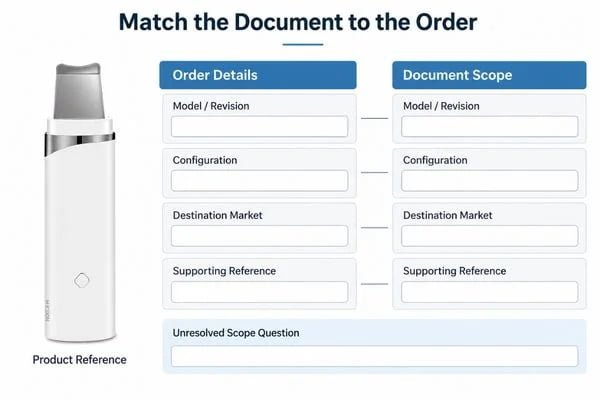
Identify the model, revision, electrical configuration, accessories, intended market and labeling arrangement. A short document map can then show which file answers each evidence question. It should be clear enough that purchasing, quality and compliance colleagues can follow the conclusion without repeating the whole exercise.
Use a Repeatable Review Sequence
- Save the received document set with its revision information, including referenced annexes and relevant report pages.
- Match the legal roles and product identifiers to the order record, keeping the original names intact.
- Compare the documented configuration with the offered specification, label and approved sample information.
- Review the standards, assessment scope, destination-market relevance and any conditions or exclusions.
- Verify authenticity and status through the issuer or relevant official source where available. Record remaining gaps and the responsible reviewer's decision.
An issuer lookup can help establish that a document exists. It cannot, on its own, confirm that the document covers your configuration or market. Equally, a polished PDF is not proof of authenticity. Both questions need attention.
Requests can stay proportionate. You may not need unrestricted public access to every confidential technical file, but you do need enough information to complete the necessary verification. Where sensitive material is involved, a controlled review arrangement may be appropriate.
The document map should also connect with manufacturing and quality records. Document review addresses the evidence for the defined product. Keeping future units consistent with that configuration requires production checks and configuration control as well.
Turn Unanswered Questions Into Specific Buyer Actions
“Please send more certificates” can easily lead to another folder. A more useful request names the gap: “Does the listed configuration include the charging arrangement proposed for our order? Please show the supporting assessment.”
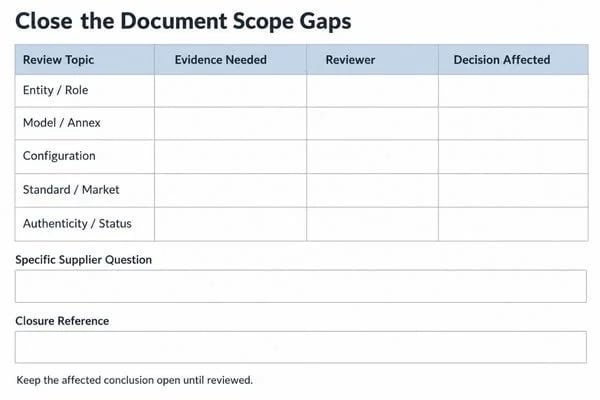
Before relying on the document set, work through these points:
- Identify the exact order model, revision, accessories and market.
- Record the applicant, manufacturer and holder as named; verify relevant relationships where they differ from the seller.
- Locate the model or family entry, including referenced annexes and conditions.
- Compare the assessed configuration with the proposed order and identify differences that may affect the assessment.
- Confirm what each document supports and which requirements need separate evidence.
- Check dates and current status through the applicable scheme or verification route.
- Record each unresolved question, the evidence needed and who can close it before the affected decision is made.
| Review finding | Practical next step |
|---|---|
| Scope is traceable to the order, with the necessary evidence reviewed | Record the conclusion for that configuration and market |
| A commercial model mapping or supporting annex is missing | Request the specific record and leave the affected conclusion open |
| An order change falls outside the documented configuration | Obtain the appropriate technical assessment and resulting evidence |
| Authenticity, status or a critical scope issue remains unresolved | Hold the decision that depends on it and refer it to the responsible reviewer |
The checklist helps organize a purchase review; it does not replace the applicable conformity procedure. Its value is in showing what is known, what is still missing and which decision depends on the answer.
Frequently Asked Questions
Document reviews also raise practical questions about components, branding and how the files can be used.
Can a Battery Report Cover the Complete Rechargeable Device?
It supports the battery, test scope and conditions described in that report. The connection to the finished device still needs to be established. It should not be treated as complete evidence for the device, charging arrangement or every destination-market requirement.
Does Adding Our Brand Logo Leave the Documents Unchanged?
Possibly, but that needs checking. Branding can affect product identification, labeling or the responsible legal roles even when the device is technically unchanged. Establish the arrangement first, then confirm what the applicable route requires.
Can We Publish a Supplier's Certificate on Our Website?
Permission to review a document internally is not automatic permission to publish it. Check reproduction conditions, permission to use the file and privacy concerns. Any public wording must preserve the named holder and scope without implying that your company holds rights it has not established.
What If the Issuer's Online Search Returns No Result?
It leaves verification open; it doesn't automatically prove the file is false. Recheck the search details and contact the issuer through an independently verified channel. Relying only on contact information in the questioned file would leave the same uncertainty unresolved.
Can a Supplier Promise to Provide the Documents After the Order?
A promise is not evidence of current coverage. Preliminary commercial discussion can continue separately, but the team needs to agree which documents must be reviewed, by whom and before which commitment. A missing core document stays an open condition until the necessary verification is complete.
Conclusion
One certificate can cover several models. The important part is being able to show how its scope connects to the product being purchased: the named entity, model, configuration, standards, market and document status. A similar appearance or shared supplier cannot establish that connection by itself.
For a K·SKIN project, begin the document discussion with the proposed model, specification and destination market. That gives both sides a clear question to work on: whether the available evidence supports the planned order, and what still needs to be confirmed before relying on it.