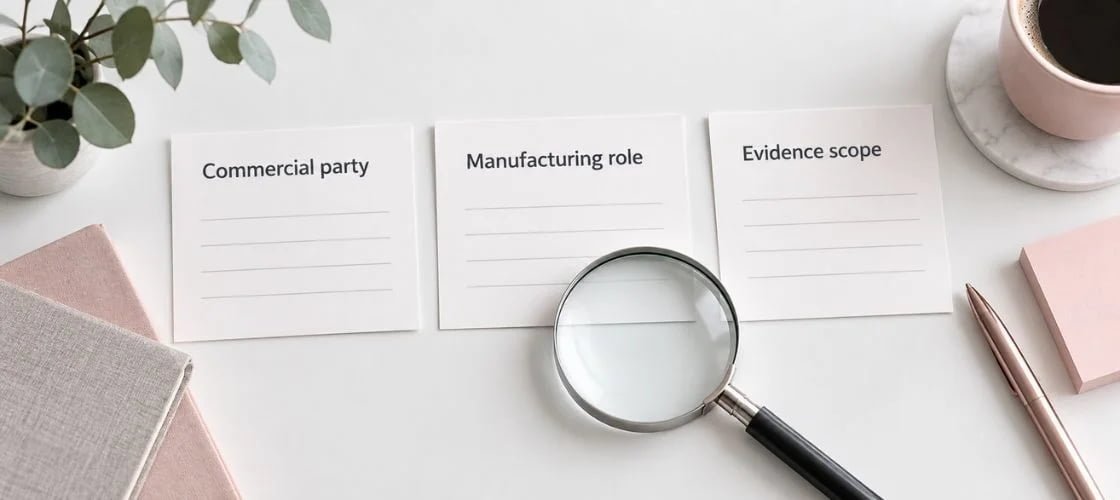
A quotation, certificate and factory presentation may show different company names. Before committing to a beauty device project, buyers need to establish who signs, who receives payment and who controls the proposed manufacturing site.
To verify a beauty device supplier, compare the registered business, contracting party, payment recipient, factory operator, certificate holder and product-label details against traceable documents. Record each party’s role, address and relevant scope. Where names differ, request evidence connecting the parties to the project. Treat unexplained differences as open verification items rather than assuming either common ownership or wrongdoing.
This is a procurement review method, not a legal opinion or a finding about any particular supplier. Legal responsibilities and required documents depend on the product, transaction and destination market.
Which Supplier Identities Should Buyers Separate?
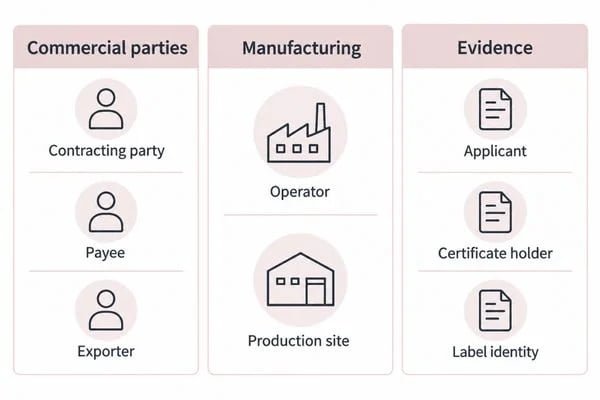
Brand, Contracting Party, Payee and Exporter
Start by replacing the single word “supplier” with named roles. The brand shown on a website is a useful commercial reference, but it does not identify every organization involved in an order.
Ask who will issue the quotation, sign the agreement, invoice the buyer, receive payment and handle the export transaction. Record the answers separately, even when the supplier says that one company performs every role.
| Role | What to record | Evidence to request |
|---|---|---|
| Brand or trading name | Public name and the organization presenting it | Company information and clarification of the name used |
| Contracting party | Exact name on the proposed agreement | Current registration record and proposed contract |
| Invoicing party | Name issuing the commercial invoice | Invoice details and explanation of any difference |
| Payment recipient | Named beneficiary, reviewed privately | Authorized payment instructions and support for any separate recipient |
| Exporter | Party proposed for the shipment documents | Written description of the export arrangement and relevant documents when available |
These requests create a comparison record; they do not imply that every role must legally belong to the same company. For a separate party, establish what authorizes its role and connects it to your transaction.
Manufacturing Operator, Production Site and Document Holder
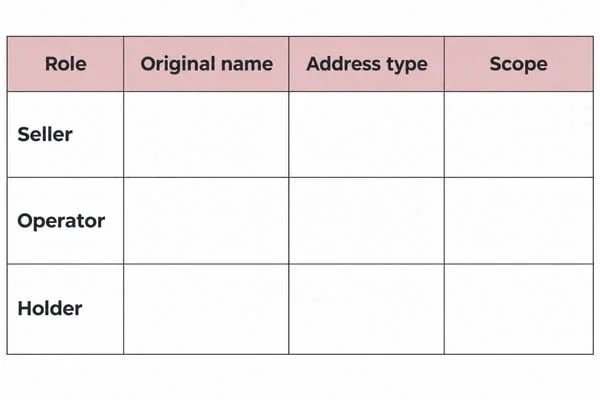
Next, separate the organization operating production from the physical site. Record where the proposed product will be assembled, tested and packed, and who controls each activity. Do not infer property ownership from an operator’s name.
Keep the applicant on a test report, certificate holder and organization identified on the product label in separate fields. A laboratory identified as the report issuer is not automatically the manufacturer or applicant.
Here, “factory operator” describes an operational role. It should not be substituted for a market’s legal definition of manufacturer, importer or other responsible party.
What Documents Connect Each Role to the Project?
Registration and Commercial Documents
Request the current registration document or official registry record for the proposed contracting entity. Preserve the name in its registered language alongside any English translation supplied for business use.
Where an official registry is available, compare the submitted document with the relevant record and note the date of review. If access is unavailable, record the check as incomplete. A supplier-provided scan and an independently checked record are different levels of verification.
Then compare the entity with the quotation, proposed agreement and invoice information. Before an order exists, some transaction documents may not yet be available. Record the proposed arrangement and identify which documents must be checked before the relevant commitment.
Keep payment verification private. An unexplained beneficiary change should go to the buyer’s authorized finance reviewer. As an internal control, confirm changed instructions through an already established contact route before acting on them.
Manufacturing, Label and Evidence Records
For the proposed manufacturing location, request records that connect the operator, site and project. Depending on the arrangement, useful inputs may include a manufacturing agreement, authorization document, site-specific quality record or documented factory review.
Ask for the approved label artwork and supporting product identification when available. Compare the named organization, model and version with the relevant documentation. A catalogue photograph or neutral manual should not be treated as a substitute for the label intended for the commercial product.
For certificates and reports, distinguish their purposes before assessing their relevance. ISO identifies ISO 9001 as a quality management system standard. A management-system certificate should therefore be reviewed for its organizational and activity scope, rather than used as product-specific approval.
Record the holder, issuer, covered site or product, standard, date and status. K·SKIN’s Credentials page provides a starting point for reviewing evidence categories; the original records remain the source for holder and scope details.
How Should Buyers Compare Names, Addresses and Scope?
Registered Names, Translations and Trading Names
Copy names exactly into the review record before comparing them. Do not edit a historical certificate to make its holder match the current quotation.
If English names differ, ask whether the difference reflects translation, a trading name, a documented name change or a separate entity. Request support for the explanation rather than accepting similar spelling as a match.
For a claimed name change, ask for records connecting the earlier and current registered names, including the relevant dates. Separately check whether the certificate or report needs clarification from its issuer. Establishing a corporate name change does not, by itself, settle the status of every document.
Registered, Operating and Certified Addresses
Label each address by its role: registered office, sales office, production site, warehouse or certified location. Comparing addresses without those labels can create both false concerns and false reassurance.
If a website shows one location and a certificate another, ask what happens at each site. Request evidence supporting the stated relationship. Do not assume relocation, common ownership or coverage of an additional site.
For beauty device factory verification, ask the supplier to identify the proposed production location during a site review or live walkthrough. Connect what is shown to the operator and relevant project records. A photograph can illustrate an environment, but it cannot independently establish ownership or prove that your model is produced there.
Broader questions about production flow, quality records and testing capability belong in a manufacturer audit before sampling. The identity review should establish which organization and location that audit concerns.
Product Model, Version and Document Scope
A matching company name is only one part of the check. Compare the exact model, relevant suffix, product configuration and document revision as well. Do not assume that a report for an earlier configuration covers a revised commercial product.
For accredited certification, ISO’s verification guidance points to certification-status checks through an appropriate database or the relevant certification or accreditation body. ISO itself does not issue certificates.
The IAF CertSearch verification guide distinguishes statuses including active, suspended, withdrawn and expired. Record the status actually verified and the date of the check. Do not infer current status solely from a future expiry date printed on a scan.
If a search returns no usable result, retain the item as unresolved and seek clarification through the appropriate issuer or official route. Do not turn an incomplete search into a finding that the document is false.
What If the Seller and Factory Are Different Companies?
Request Evidence of the Stated Relationship
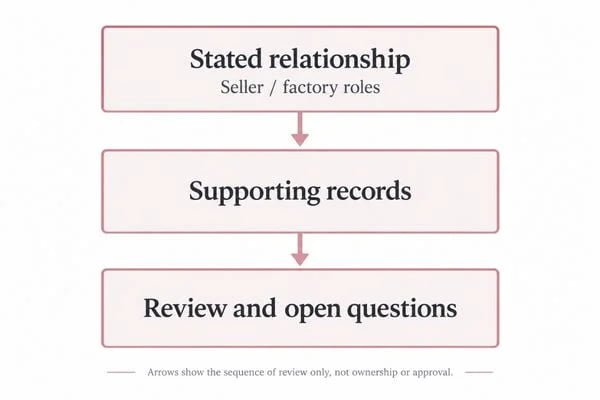
When the seller and factory differ, examine the arrangement before drawing a conclusion about the supplier.
Ask for evidence supporting the specific relationship claimed. An authorization letter, manufacturing agreement or other relevant record should be reviewed for the named parties, covered activities, applicable products, dates and authority of the people issuing it.
Keep the question precise. Permission to sell products is not the same question as ownership of a factory. Permission to access a report does not necessarily answer whether it may be reproduced publicly. The evidence needed should follow the proposed claim.
Do not expand a description such as “authorized international business” into subsidiary status, exclusive representation or certificate ownership without documents supporting that particular conclusion.
Identify Who Controls Production and Documentation
Ask the seller to identify the responsible organization for production instructions, inspection, changes and release of the commercial product. Also establish who supplies the applicable reports, labels and other controlled documents.
For an outsourced activity, record what is performed elsewhere, by whom, and how the supplier proposes to control it. A statement that production is “within our group” still needs the parties and responsibilities to be identified.
As a hypothetical review example, suppose a seller names a separate factory operator and provides a quality-system certificate for that operator. The buyer still needs to connect the stated site and manufacturing activity to the proposed project. The certificate alone does not establish the seller’s authority to make commitments on the operator’s behalf.
The review outcome should identify supported relationships and remaining questions. It should not award a general “verified manufacturer” label based on one document.
Which Identity Gaps Need Resolution Before Commitment?
Prioritize gaps that affect who accepts the order, where production occurs, who receives payment or which evidence applies. The following are suggested review actions, not findings of illegality.
| Finding | Evidence still needed | Suggested buyer action |
|---|---|---|
| Different names with an explanation but no supporting record | Evidence connecting the named parties and their roles | Keep the relationship unverified until reviewed |
| Proposed production site differs from the documented site | Site-specific explanation and applicable records | Refer the difference to the manufacturing or quality reviewer |
| Certificate holder differs from the party claiming certification | Holder, scope and support for the precise claim | Avoid recording the seller as certified without verification |
| Payment recipient changes without an established explanation | Authorized instructions and support for the recipient’s role | Pause the payment decision for finance review |
| Filename, cover or revision history conflicts | Controlled current document or issuer clarification | Do not select a version simply because its filename appears newer |
For each issue, record the evidence received, review performed and conclusion reached. An email saying “confirmed” is incomplete unless it identifies what was checked.
Escalate unresolved legal interpretation to the appropriate adviser. Supplier due diligence should distinguish a missing document, an explained difference and contradictory evidence rather than treating them as equivalent.
What Should the Buyer Record and Confirm Next?
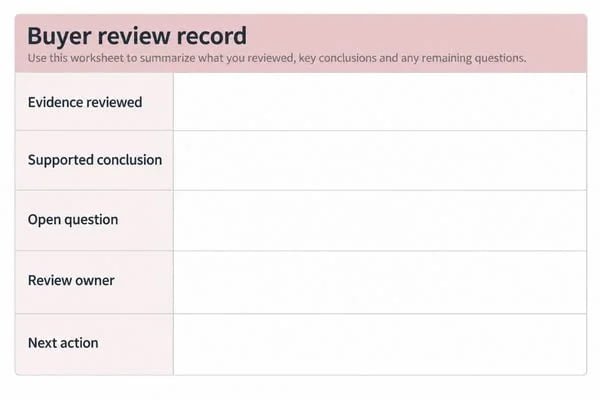
Use one review record for the proposed transaction. Repeat the following fields for each relevant role or relationship. This is a blank working template, not a completed supplier assessment.
| Field | Information for the buyer to enter |
|---|---|
| Role or relationship | Contracting party, factory operator, certificate holder or another defined role |
| Original name | Exact wording, registered-language name and separately identified translation |
| Address and type | Location plus its stated purpose |
| Source and date | Original file or official record, document date and review date |
| Project scope | Relevant model, version, site, activity or transaction |
| Supported conclusion | What the reviewed evidence establishes |
| Evidence limitation | What remains unproved or outside the document’s scope |
| Open question | Specific missing record, inconsistency or clarification |
| Review owner and next action | Responsible person, required action and decision point |
Before signing or making the relevant financial commitment:
- Request the current registration information for the proposed contracting entity.
- Compare the names on the quotation, agreement and available invoice information.
- Confirm the proposed payment recipient through the buyer’s authorized private process.
- Record the factory operator and location for assembly, testing and packing.
- Request supporting records for any separate seller, exporter or manufacturing organization.
- Match the approved label and product identification to the proposed commercial version.
- Check the relevant evidence holder, issuer, site, scope and current status where applicable.
- Assign every unresolved difference to a reviewer and record what is needed to close it.
- Retain the reviewed versions and revisit affected checks when a party, site or project configuration changes.
Record whether a statement came from the supplier, an original document, an official check or your own observation. This lets later reviewers distinguish the evidential weight of each input.
Frequently Asked Questions
Can a Trading Company Be an Acceptable Beauty Device Supplier?
Assess the disclosed role, supporting relationships and responsibilities against the project. Trading status alone is not a complete qualification decision. The buyer still needs an identifiable contracting party, manufacturing arrangement and route for obtaining applicable product documentation.
What If the English Company Name Differs Across Documents?
Keep each original spelling and compare the underlying registered-language identity and supporting records. Ask whether the difference is a translation, trading name, formal change or separate entity. Do not resolve it by choosing whichever English version appears most often.
Does a Shared Address Prove That Companies Belong to the Same Group?
Do not use a shared address as sufficient evidence of ownership or group membership. If that relationship matters to the transaction, request records supporting it. The same approach applies to shared branding, staff introductions or a common website.
Can a Supplier Use a Certificate Naming Another Company?
The answer requires review of the certificate scheme, named holder, scope and proposed use. Ask what the supplier is claiming and what supports that claim. Access to a copy does not establish that the supplier holds the certification or has permission to reproduce it in marketing.
How Can Buyers Verify Identity Without Exposing Confidential Documents?
Agree on a controlled review process and request authorized redacted copies where appropriate. Keep enough information to verify the relevant parties and scope while protecting unnecessary personal, banking and customer details. If redaction prevents a meaningful check, agree on a private review route instead of treating the evidence as complete.
Conclusion
A useful supplier identity review connects the commercial parties, manufacturing operator, production location and evidence records to the proposed project. It preserves differences until they are explained, distinguishes supplier statements from verified records and assigns unresolved questions to the right reviewer.
For a K·SKIN project, use the Manufacturing & Quality page to frame the production discussion, then contact the team with the product category, intended market and identity documents you need to review. Confirm the relevant parties and evidence before relying on them for a commercial decision.