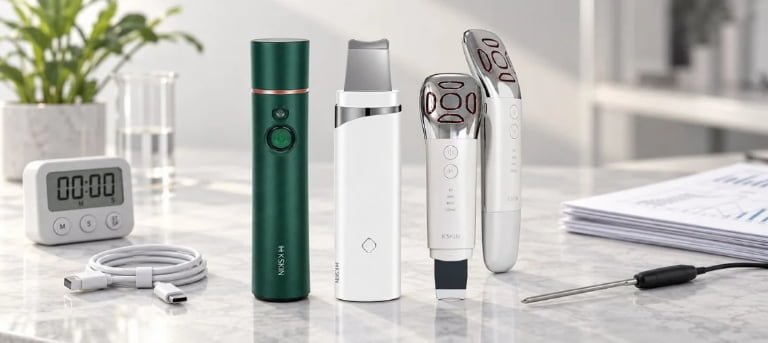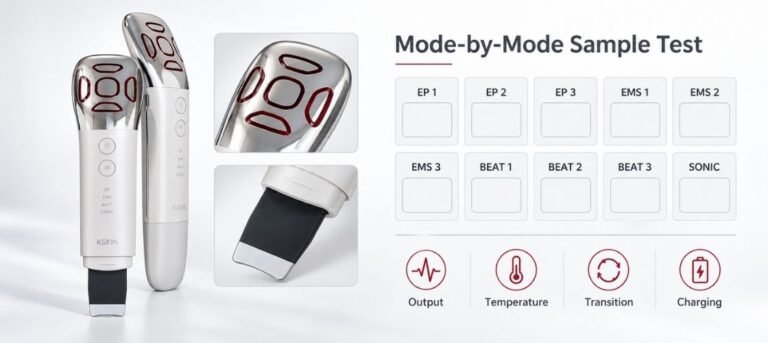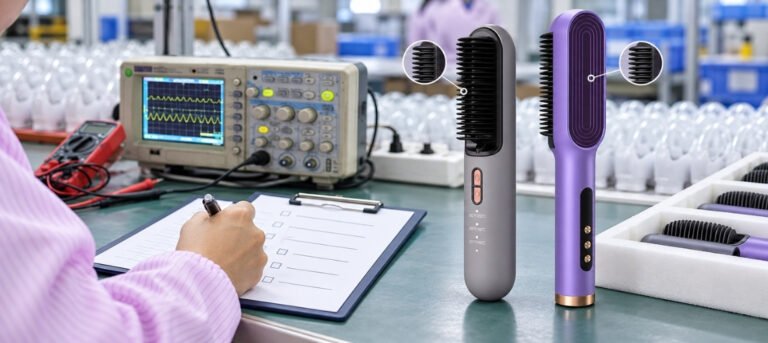

An ultrasonic hair care device offers a different product route from conventional straighteners, steam brushes and scalp-care combs, but its technical claims require careful verification.
An ultrasonic hair care device uses a driven ultrasonic component to create high-frequency mechanical vibration at metal treatment plates. With an approved treatment liquid present, that vibration can produce visible atomization across the working area. Buyers should verify the component specification, assembled-device output, activation logic, liquid compatibility, temperature rise, plate condition, cleaning method, charging system and evidence supporting every proposed hair-care claim.
What Is an Ultrasonic Hair Care Device?
An ultrasonic hair care device is a liquid-assisted hair-care platform rather than a conventional heated styling tool. It places a section of hair and an approved treatment liquid between two working surfaces, where high-frequency vibration acts on the liquid film during operation.
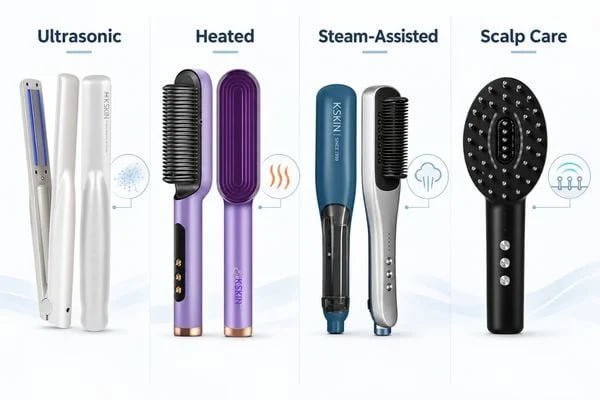
This product category should be separated from several related technologies:
- A heated straightener uses controlled surface temperature to shape hair.
- A steam straightening brush combines heat with a heated water or steam path.
- An LED or microcurrent scalp comb applies optical, electrical or massage functions to the scalp.
- An ultrasonic hair care device uses a vibrating treatment interface to act on an approved liquid applied to the hair.
The KD881 ultrasonic hair care device is one example of this platform. Its primary commercial direction is a differentiated hair-care routine rather than straightening, curling or scalp stimulation.
How Does the Ultrasonic Working System Operate?
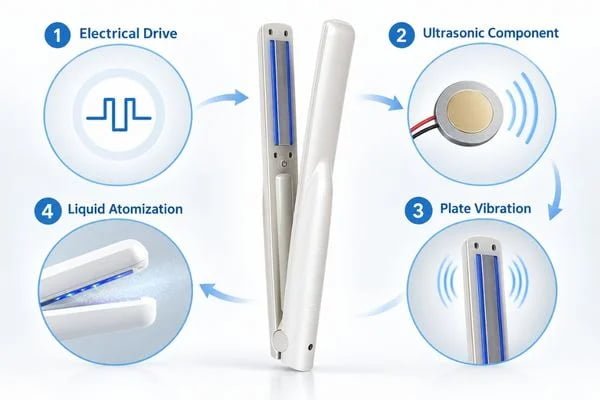
The visible product appears simple, but its operation depends on the interaction between the drive circuit, ultrasonic component, treatment plates, control logic and liquid.
Electrical Drive and Ultrasonic Component
The control circuit supplies an electrical signal to a piezoelectric ultrasonic component. The component converts that signal into high-frequency mechanical vibration, which is transferred to the metal working area.
For the current KD881 technical baseline, the specified ultrasonic-head component has a center frequency of 650 kHz. This is a component specification. It should not automatically be presented as proof that every assembled unit produces an identical measured mechanical output under all operating conditions.
A complete technical review should distinguish among:
- the ultrasonic component specification;
- the electrical signal supplied by the control circuit;
- the mechanical output of the assembled working plate;
- the atomization observed with a defined test liquid;
- any claimed result on treated hair.
Each level requires different evidence.
Plate Closure and Activation Logic
On the KD881 platform, closing the treatment plates activates the ultrasonic working area. The indicator changes state, an operating sound may be heard and the ultrasonic cycle begins.
The control system also limits each continuous activation period. Reopening and closing the plates starts another cycle, while the complete device has a separate automatic shut-off function.
This logic should be checked on the actual sample rather than inferred from a demonstration video. Buyers should verify:
- whether plate closure activates the device consistently;
- whether opening the plates stops the active cycle;
- whether repeated closing restarts it correctly;
- whether indicator and audible feedback match the instructions;
- whether activation remains stable after repeated cycles;
- whether different samples follow the same timing and response.
Liquid Film and Atomization
When an approved liquid is present in the working area, ultrasonic vibration can disturb the liquid film and produce fine droplets or visible mist.
The result depends on more than frequency. Liquid viscosity, surface tension, formulation, applied quantity, temperature and the condition of the working surface can all affect atomization. Research into ultrasonic drop atomization also shows that fluid properties and driving conditions influence droplet formation.
For this reason, a water-drop demonstration can confirm that visible atomization occurs under one condition, but it cannot establish compatibility with every hair mask, lotion, oil or treatment formula.
How Is It Different from Heated and Steam-Assisted Hair Tools?
An ultrasonic hair care device should not be evaluated using the same criteria as a straightener or steam brush.
| Product System | Primary Mechanism | Main Product Direction | Main Buyer Verification |
|---|---|---|---|
| Ultrasonic hair care device | High-frequency plate vibration with an approved liquid | Liquid-assisted hair-care routine | Ultrasonic activation, atomization, liquid compatibility, temperature rise and residue |
| Heated straightening tool | Controlled contact heating | Straightening and shaping | Temperature accuracy, heat-up time, recovery and surface safety |
| Steam-assisted styling tool | Heat with a controlled steam path | Steam-assisted straightening | Temperature, steam output, water path, leakage and scale |
| LED or microcurrent scalp comb | Optical, electrical and massage functions | Scalp-care routine | Mode logic, output conditions, contact and claims evidence |
The wider K·SKIN hair styling tool range includes these different product systems because they support different consumer routines.
The KD881 is not designed around temperature-controlled straightening or curling. It may still generate heat during operation, so it should not be described as completely heat-free unless temperature measurements support that wording.
It is also different from a steam device. Visible mist created by ultrasonic vibration is not the same as steam produced by heating water.
What Should Buyers Verify in the Ultrasonic Output?
A supplier should be able to show more than a component frequency and a visible mist demonstration.
Confirm the Exact Sample Version
Before testing, record the identity of the sample and its supporting documents:
- product model;
- specification revision and date;
- ultrasonic component version;
- control-board or program version;
- battery and charging configuration;
- treatment-plate material;
- manual revision;
- test-liquid name and batch;
- sample identification number.
This prevents results from one prototype, component or commercial version from being applied to another.
Separate Component Frequency from Assembled Output
A component specification confirms the intended ultrasonic part. An assembled-device test evaluates how that part performs after installation in the housing and connection to the control circuit.
Buyers should ask the supplier to explain:
- how the ultrasonic component is identified;
- how the electrical drive is checked;
- how assembled output is verified;
- whether the test records frequency, vibration or another defined output;
- what acceptance range is used;
- how production units are checked against the approved sample.
A slight operating sound, indicator light or visible mist can support an operational check. None of these observations alone establishes the complete ultrasonic output.
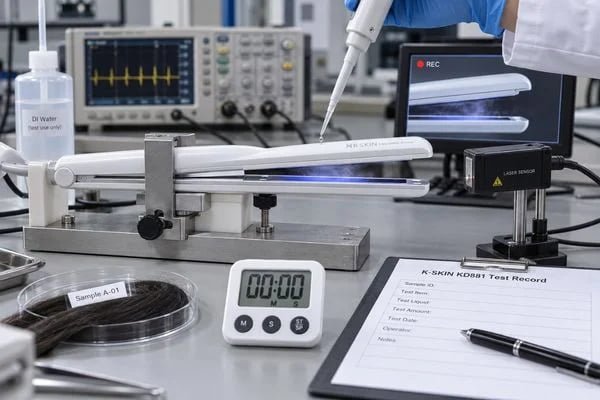
Use Controlled Atomization Conditions
An atomization comparison should keep the test conditions consistent.
| Test Condition | Information to Control |
|---|---|
| Liquid | Formula, batch, viscosity or other relevant properties |
| Applied quantity | Defined amount for each cycle |
| Hair sample | Length, weight, condition and starting moisture |
| Environment | Temperature and humidity |
| Working area | Clean and dry before each test |
| Cycle | Closure time, number of passes and rest interval |
| Sample count | Several units from an agreed sample set |
| Records | Video, observations, measurements and abnormalities |
The buyer should compare repeated cycles and several samples. One successful demonstration on one unit does not establish production consistency.
Why Does Treatment-Liquid Compatibility Matter?
The device and the treatment liquid function as a system during use. Changing the formula can change atomization, residue, cleaning and material exposure.
Formulation Variables
Relevant variables may include:
- viscosity;
- surface tension;
- water, oil and solvent content;
- suspended solids;
- salts or other potentially corrosive ingredients;
- drying behavior;
- residue after repeated use;
- interaction with plastics, silicone and metal surfaces.
A formulation that works in a pump bottle or ordinary hair routine may not behave correctly between vibrating treatment plates.
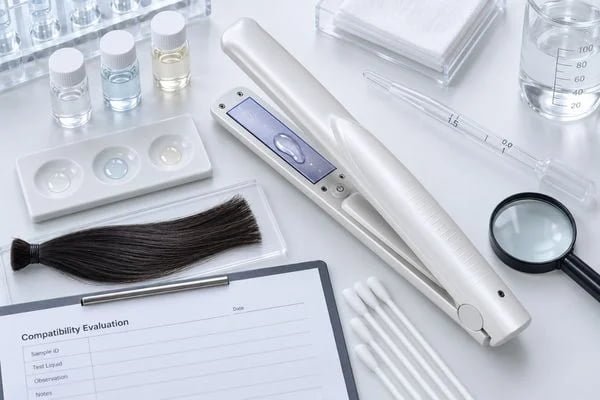
Compatibility Testing
Each proposed commercial formula should be evaluated with the intended product version and use method.
The test should review:
- whether the liquid spreads across the working area;
- whether atomization is stable;
- whether the liquid leaks into unintended areas;
- whether residue affects plate closure or activation;
- whether the working surfaces stain, corrode or change finish;
- whether plastics or seals swell, crack or discolor;
- whether the device can be cleaned using the approved method;
- whether performance changes after repeated cycles.
If a buyer changes the formula, concentration, fragrance, preservative system or other relevant ingredient, compatibility may need to be reviewed again.
Unsupported Compatibility Assumptions
The KD881 instructions do not support unrestricted use with every liquid. Hair colorants, perming products, seawater and other unapproved liquids should not be treated as compatible.
Phrases such as “works with any hair mask or oil” should therefore be avoided unless the complete formulation range has been evaluated. A safer commercial approach is to identify the approved treatment liquid or define a compatibility-review process.
How Should Buyers Evaluate the Plates and Mechanical Structure?
The treatment plates are the working interface between the ultrasonic system, liquid and hair. Their condition affects both operation and user experience.
Sample evaluation should include:
- plate alignment when open and closed;
- closing smoothness;
- hinge stability;
- surface flatness and finish;
- scratches, burrs, stains or coating defects;
- consistent closure activation;
- housing gaps near the working area;
- hair movement through the plates;
- snagging or excessive pulling;
- residue around plate edges and the hinge;
- surface condition after repeated cleaning.
A product can produce visible mist and still fail mechanical acceptance because of uneven closure, unstable activation, surface defects or difficult cleaning.
The supplier should define which plate, hinge and assembly characteristics are controlled during production. These checks should connect to the signed sample and approved specification through the manufacturing and quality-control process.
Should Temperature Rise Be Tested?
Yes. Ultrasonic does not automatically mean cold operation.
The current KD881 technical information states that the device can generate heat during use. Buyers should measure the temperature of the treatment plates, nearby housing and accessible surfaces during repeated operating cycles.
The test should define:
- starting temperature;
- room conditions;
- approved test liquid;
- number and duration of cycles;
- measurement locations;
- maximum recorded temperature;
- cooling behavior;
- variation among samples.
Temperature results should be evaluated against the approved product specification and requirements for the destination market. They should not be converted into a hair-care benefit unless a separate performance test supports that claim.
What Should Buyers Check in Charging and Control Logic?
Charging should be verified against the exact commercial version because the main unit, cable, charging base and recommended power source may differ by project.
Check:
- battery specification;
- charging input;
- supplied cable and connector;
- charging-base inclusion;
- charging-state indicator;
- full-charge indicator;
- actual charging time;
- runtime under ultrasonic operating load;
- low-battery behavior;
- automatic shut-off;
- repeated charge and discharge performance;
- agreement among the product, label, manual and specification.
Battery capacity does not by itself predict usable runtime. Actual runtime depends on the load, control logic, battery condition and test method.
When an electrical or charging configuration changes, related labels, instructions, reports and packaging information should be reviewed as part of the same version change.
How Should Cleaning and Residue Be Evaluated?
The main product body should not be rinsed under a tap or immersed in water. Cleaning must follow the approved instructions for the commercial version.
A sample review should determine:
- which surfaces require cleaning after each use;
- which cloth or cleaning material is permitted;
- whether a small amount of water or an approved cleaner may be used;
- whether abrasive, corrosive or volatile cleaners are prohibited;
- whether residue remains around the plate edges or hinge;
- whether repeated cleaning changes the finish;
- whether the device functions normally after cleaning;
- whether users can complete the process without exposing the charging area to liquid.
A marketing image showing droplets on the plates does not support a waterproof claim for the complete device.
Which Claims Can the Evidence Support?
Buyers should separate technical configuration, functional output and hair-performance claims.
| Claim Level | Example | Evidence Needed |
|---|---|---|
| Product configuration | The device uses an ultrasonic component | Approved component specification and controlled product records |
| Functional output | The device produces visible atomization with an approved liquid | Defined assembled-device test |
| Application claim | The device distributes an approved liquid across a hair section | Repeatable use test with a documented method |
| Cosmetic performance | Improved smoothness, shine or combability | Controlled hair-tress testing with defined measurements and comparator |
| Structural claim | Repairs damaged hair or increases penetration into the hair cortex | Specific scientific evidence matching the device, liquid, method and wording |
| Biological or medical claim | Treats hair loss or changes follicle activity | Appropriate regulatory review and a substantially different evidence package |
The terms “ultrasonic,” “650 kHz” and “atomization” describe technology or observable operation. They do not independently prove hair repair, nutrient penetration, collagen restoration, permanent smoothing or another consumer result.
For the United States, the FTC advertising substantiation policy requires advertisers to have a reasonable basis for objective product claims before those claims are published.
If a paired cosmetic treatment liquid is marketed in the European Union, its claims should also be reviewed against the common criteria for truthfulness and evidential support under Commission Regulation (EU) No 655/2013.

What Safety and Documentation Questions Should Buyers Ask?
Applicable requirements depend on the target market, final product version, charging configuration, intended use and claims.
IEC 60335-2-23:2026 covers the safety of household and similar electrical hair-care appliances, including battery-operated products and appliances that incorporate spray-producing functions. However, publication of an IEC standard does not mean that a particular product is certified, and national adoption or transition arrangements may differ. Buyers should review the current requirements for their destination market through the official IEC 60335-2-23:2026 information and qualified compliance parties.
The document review should confirm:
- the exact model and product version;
- the report holder and manufacturer;
- the market covered by the document;
- the battery, cable, charging base and adapter configuration;
- accessible-surface and temperature considerations;
- moisture and cleaning conditions;
- labels and instruction requirements;
- whether later product changes affect earlier evidence.
Company certifications, patents and product test records have different purposes. Buyers can review available K·SKIN credentials, but every document still needs to be matched to the exact KD881 version and commercial project.
Ultrasonic Hair Care Device Sample Verification Checklist
| Verification Area | What to Record | Main Red Flag |
|---|---|---|
| Sample identity | Model, version, component and document revisions | Sample cannot be matched to a controlled specification |
| Ultrasonic activation | Plate-closing response and repeated-cycle logic | Intermittent or inconsistent activation |
| Component and output | Component frequency specification and assembled-device test | Only a marketing frequency is provided |
| Atomization | Approved liquid, quantity, conditions and repeatability | Only one water-drop demonstration is available |
| Plate structure | Alignment, finish, hinge and hair movement | Snagging, uneven closure or surface defects |
| Temperature | Plate and housing temperature during repeated use | Product is called heat-free without measurement |
| Liquid compatibility | Residue, corrosion, staining and material change | Supplier claims compatibility with every formula |
| Cleaning | Approved method and post-cleaning condition | Complete product is described as waterproof without evidence |
| Battery and charging | Input, charging time, runtime and indicators | Manual, label and specification disagree |
| Claims | Exact wording and matching evidence | Atomization is presented as proof of repair or penetration |
| Documentation | Specification, instructions, reports and packaging | Different product versions are combined |
Questions Buyers Should Ask the Supplier
- Which product specification and control version does this sample represent?
- Is the stated frequency a component center frequency or an assembled-device measurement?
- How is ultrasonic output checked during sample approval and production?
- Which liquid was used for the atomization demonstration?
- Which formula properties require compatibility review?
- How does the supplier evaluate residue and repeated cleaning?
- What temperature rise occurs during repeated operating cycles?
- Which charging configuration belongs to the proposed commercial version?
- Which hair-care claims have model-specific performance evidence?
- Which reports match the final market, configuration and order version?
Frequently Asked Questions
Is an Ultrasonic Hair Care Device a Hair Straightener?
No. Its main function is liquid-assisted ultrasonic hair care rather than temperature-controlled straightening or curling. It should not be evaluated as a conventional styling iron.
Does Ultrasonic Mean the Device Is Completely Heat-Free?
No. The device may generate heat during operation. Plate and housing temperatures should be measured under defined operating conditions before any low-heat or heat-free wording is considered.
Can Any Hair Mask, Oil or Treatment Liquid Be Used?
No. Each intended formula should be reviewed for atomization, viscosity, residue, material compatibility, corrosion and cleaning. Only an approved liquid should be represented as compatible.
Is Visible Mist Enough to Prove Ultrasonic Performance?
No. Visible mist confirms atomization under the demonstrated conditions. Buyers should also verify the ultrasonic component, assembled-device output, activation logic and repeatability.
Does a 650 kHz Component Prove That the Device Repairs Hair?
No. Frequency is a technical characteristic. Hair repair, improved shine, easier combing or increased ingredient penetration are separate claims that require appropriate tests.
Conclusion
An ultrasonic hair care device should be evaluated as a complete system. The ultrasonic component, drive circuit, treatment plates, control logic, liquid formulation, temperature, battery and cleaning method all affect the final commercial product.
A reliable sourcing decision requires more than a frequency value or a visible mist demonstration. Buyers should confirm the exact product version, reproduce output under controlled conditions, approve the intended treatment liquid and limit every claim to the evidence available for that device, formula and use method.