A multifunction beauty device can power on, change its display and still leave important functions unverified. Buyers need an approval record that connects each selectable mode to its actual output, controls and operating limits.
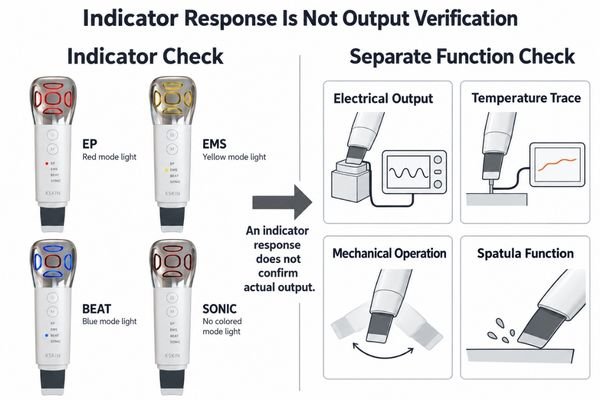
A multifunction beauty device sample test should cover every permitted mode and intensity level, then check transitions, linked functions, charging behavior and shutdown. Match each observation to the approved product version and a defined acceptance requirement. A changing indicator confirms a display response; it does not by itself verify electrical output, temperature control, mechanical operation or a claimed beauty benefit.
Freeze the version before building the mode matrix
Begin with a sample identity record: model, hardware revision, control-program revision where available, electrical configuration, battery reference, treatment-head arrangement, accessories and manual revision. Identify each physical sample separately.
Ask the supplier to confirm which specification applies to the proposed order. A product name or shared housing does not establish that two samples use identical control logic or output settings.
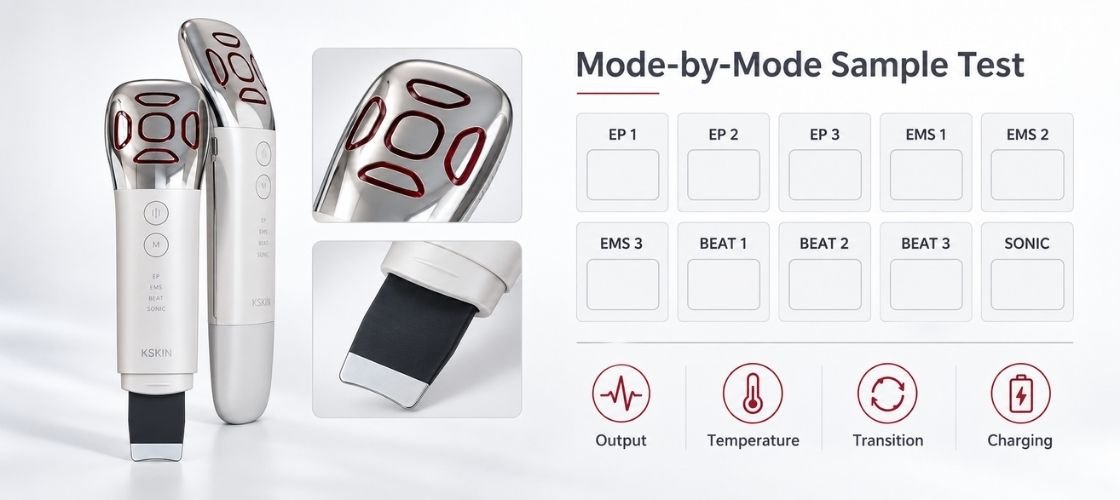
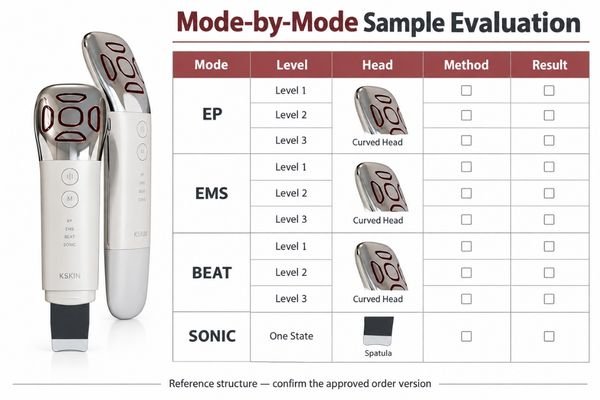
The KD8086 dual-head multifunction facial beauty device provides a concrete example. Its documented layout combines a spatula end with a curved treatment head. Its modes are EP, EMS, BEAT and SONIC. The reviewed A1 specification and A1 manual identify three adjustable levels for EP, EMS and BEAT, while SONIC has no adjustable intensity level.
This configuration has ten selectable mode-and-level states: three each for EP, EMS and BEAT, plus SONIC. Record all ten as the starting coverage for functional review; the count does not establish ten independent technologies or proven benefits.
Separate three kinds of information in the test record:
- Expected behavior from the applicable controlled specification.
- Measured or observed behavior from the identified sample.
- Commercial claims that require evidence beyond basic functional operation.
Do not fill the results column by copying the specification. A requirement describes what should happen; it is not proof that a sample met it.
Build a mode-by-mode approval matrix
Use the following KD8086 reference structure to prepare the evaluation, then confirm it against the order version. The table describes documented behavior to check, not completed sample-test results.
| Mode | Selectable levels | Documented behavior to verify | Additional evidence needed |
|---|---|---|---|
| EP | 1, 2 and 3 | Curved-head operation, red mode light, linked warming and specified vibration behavior | Electrical-output record, temperature trace and activation-condition checks |
| EMS | 1, 2 and 3 | Curved-head operation, yellow mode light and no commanded warming | Electrical-output record and transition checks |
| BEAT | 1, 2 and 3 | Curved-head operation, blue mode light and no commanded warming | Electrical-output record and mode-specific output characterization |
| SONIC | One non-adjustable state | Spatula operation without the colored mode light | Evidence of actual spatula operation using a suitable method |
Mode-linked lights are not independently selectable light-treatment functions. Do not add separate light modes to the matrix unless the approved configuration actually provides them.
For each applicable row and level, record the head used, required contact or test load, starting battery condition, operating duration, measurement method and acceptance reference. Where vibration or output depends on a contact condition, include that condition explicitly.
Give each state its own result. A single entry reading “all modes work” cannot show which level was measured, which head was active or what evidence supports approval.
Verify output separately from indicators
Electrical output
For modes with electrical output, ask a qualified engineer to define the measurement circuit, load, instrument, contact arrangement and relevant waveform measurements. Identify whether recorded values are peak, peak-to-peak, average or root-mean-square values where applicable.
Keep the test load and measurement method consistent when comparing levels or equivalent samples. Numbers obtained with different loads or methods should not be treated as directly comparable.
Verify that each level meets its own approved requirement. Do not assume level 3 is three times level 1, or that identically numbered levels in different modes represent the same output. Different mode labels also do not establish different measured waveforms without supporting records.
Buyer acceptance checks should use suitable fixtures and methods, rather than judging electrical output by sensation on a person's skin.
Spatula operation and vibration
In SONIC mode, verify that the intended spatula function activates and remains consistent under the agreed conditions. A visible response in a demonstration can support a functional observation, but it does not establish a calibrated frequency, output power or skin outcome.
Do not borrow a frequency value from another skin scrubber. The mode name alone is insufficient evidence for a numerical specification.
Assess vibration according to the documented activation conditions. Record whether it starts, stops or changes as specified. Avoid treating audible sound or hand-feel as a substitute for an instrumented measurement when the acceptance requirement is quantitative.
Indicators
Check the selected mode, level display and actual function together. A correct light with missing output is a different finding from correct output with an incorrect indicator; both need a traceable deviation record.
For SONIC, distinguish the absence of a colored mode light from the state of other indicators. Do not turn “no mode light” into an assumption that every indicator must be off.
Test transitions and linked functions
Stable operation within a mode is only part of beauty device mode validation. Test how the device enters and leaves each state.
For the documented KD8086 sequence, follow EP → EMS → BEAT → SONIC and check the return through the cycle. Verify startup behavior and the specified level-reset behavior against the applicable specification, rather than assuming the device remembers the last setting.
Include transitions from different selectable levels. A sequence checked only at the default level can miss behavior that occurs after the user has changed intensity.
| Transition or event | Buyer verification question |
|---|---|
| Startup | Does the device enter the specified mode and default level? |
| Level change | Do the level indication and actual output match the new setting? |
| Mode change | Do the intended head, output and indicators change together? |
| Leaving EP | Does commanded warming stop as specified? |
| Entering SONIC | Does spatula operation activate, with no unsupported level adjustment? |
| Manual shutdown | Do operating functions stop according to the requirement? |
| Automatic shutdown | Does the device stop within the approved session timing? |
| Charging connection | Does the required charging interlock operate from every mode? |
Distinguish a linked function from a user-selectable combination. If warming automatically accompanies EP, that is part of the EP test. It does not authorize treating warming plus every other mode as an available combination.
Also distinguish residual heat from active heating. A head may remain warm after a transition; a temperature reading alone does not identify whether the heater remains commanded on. Ask engineering to define how the transition is assessed.
Record temperature over time
For warming modes, establish measurement locations, instrument suitability, ambient conditions, contact or fixture conditions, battery state and observation timing before testing. Match the acceptance range to the approved version and method.
A single reading cannot describe warm-up, stabilization or behavior near the end of a session. Record a trace or scheduled readings that show the relevant stages. Include observations after leaving the warming mode where the transition requires verification.
Keep intended treatment-head warming separate from unintended heating elsewhere. The head, hand-contact areas and charging connection may require different evaluation criteria; do not apply one temperature target to every surface.
If unexpected heating or other potentially unsafe behavior occurs, stop the review and refer it for qualified assessment. Commercial sample evaluation does not replace the applicable product-safety assessment.
Check charging, battery state and session timing
The reviewed KD8086 A1 specification requires operating functions to stop when the charging connector is attached and the unit enters charging mode. Test that event from each operating mode, with the approved cable and compatible charging source.
Confirm the charging indication, behavior after cable removal and response to the next permitted startup action. Do not assume that unplugging should automatically resume operation unless that behavior is specified.
Check whether the device maintains its required mode behavior across the agreed battery operating range. Define the battery conditions and record how they were established; stated capacity alone cannot demonstrate consistent output.
For session timing, agree when the timer starts and what should happen after a mode change, manual restart or charging event. Test each relevant sequence. Do not infer timer-reset logic from a general automatic-shutoff statement.
Keep runtime testing distinct from session duration. One automatic session ending normally does not establish total runtime, charging time or performance across a full discharge.
Evaluate both heads and the supplied accessories
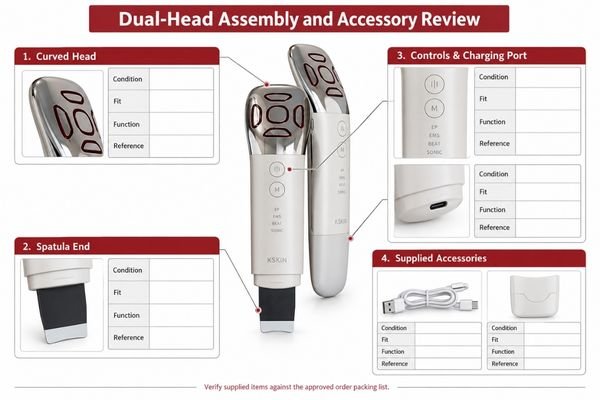
Inspect the spatula and curved head as separate functional areas. Record surface condition, alignment, assembly fit and the interface between each head and the housing. Compare observations across identified samples of the same version.
Check the actual supplied accessories and packaging list. Confirm the cable connection, protective components where supplied, and how the device is held during packing. Do not assume that every item visible in a marketing image is included in the order.
Review the permitted cleaning method for each user-accessible area. A dual-head design does not establish that the complete device can be rinsed, immersed or described as waterproof.
After any agreed handling or transport evaluation, repeat the relevant mode and charging checks. An unchanged exterior does not demonstrate that the internal functions remain within specification.
Define acceptance before assigning pass or fail
Use a status system that keeps incomplete work visible. The following is a proposed project-record structure, not a set of universal numerical limits.
| Status | Meaning | Required action |
|---|---|---|
| Pass | The identified sample meets the specified criterion under the recorded conditions | Retain the result and source requirement |
| Fail | The result does not meet the agreed criterion | Record the deviation, investigate and define a correction |
| Not tested | The required check has not been performed | Keep the approval item open |
| Inconclusive | The method, conditions or requirement cannot support a decision | Resolve the gap and repeat the check |
| Not applicable | The feature is absent from the approved configuration | Record the configuration-based reason |
For each result, retain sample ID, mode, level, test conditions, method, instrument reference where relevant, observed value, acceptance limit and reviewer. Attach recordings or traces that can be matched to the same run.
Describe deviations with the selected state, test conditions and observed behavior. An illustrative entry might read: “The level indicator changed, but measured output remained unchanged under the defined load.” This example describes a possible finding, not a reported KD8086 test result.
Set sample quantity and repetition requirements with the quality team according to the project. A small evaluation can reveal obvious variation but cannot establish a production defect rate.
Keep function approval separate from claims and certification
EP, EMS, BEAT and SONIC are mode identifiers. Confirming that they operate as specified does not prove lifting, nutrient absorption, tissue effects or another cosmetic or therapeutic outcome.
For every proposed listing statement, ask whether the evidence demonstrates a control feature, a measured physical output or an end-user result. Keep the wording within that evidence category. Mode-linked colored lights should not become an unsupported light-therapy claim.
Likewise, a test procedure in a specification is not a completed report. Request actual results when approval depends on a reliability or performance test having been performed.
Use the K·SKIN credentials page for supporting-document context, then request the evidence applicable to the selected model and market. Check the original holder, model scope, version and destination-market applicability. A company-level document does not prove that every function of a particular product has been tested or certified.
Freeze the approved reference and control changes
Before sample approval, confirm that the record covers:
- Every permitted mode and level.
- The correct head and actual output for each state.
- Mode transitions, default settings and linked functions.
- Temperature behavior under defined conditions.
- Charging interlock, indicators and session timing.
- Both head assemblies and the supplied accessories.
- Deviations, corrections and required repeat checks.
- Matching specifications, labels, instructions and test records.
Retain the identified approval sample and the final mode matrix. If a control program, head assembly, battery, charging component or relevant material changes, review which tests must be repeated before accepting the revised version.
Connect this record to the agreed manufacturing and quality-control process. Define which checks belong to development validation and which become routine production inspections. A development test plan should not be presented as evidence that every shipped unit underwent every test.
FAQ
Must every intensity level be checked?
Every selectable level needs coverage in the functional approval matrix. The engineering team should define the measurement depth and repetition needed for each state. One successful maximum-level check does not demonstrate that all lower levels behave correctly.
Can the indicator light confirm that a mode works?
It confirms an indicator response. Verify the intended output separately and check that it agrees with the selected mode and level. Keep colored mode indicators distinct from independently controlled treatment functions.
Does every possible combination need testing?
Test the combinations and transitions that the approved configuration permits, plus the required interlocks. Do not invent combinations the user cannot select. Any abnormal-condition testing requires a defined method and qualified personnel.
Can one passing sample represent the production order?
A passing sample can become an identified approval reference, but it does not establish the conformity of a whole order. Agree production controls, inspection scope and change-management requirements separately.
What if a mode has no measurable acceptance requirement?
Keep its approval status open. Ask for a requirement and a suitable method before assigning a pass. A display label, subjective sensation or marketing description should not fill that gap.
Approve a documented configuration
A complete mode test connects each selectable state to an expected behavior, an appropriate method and a recorded result. It also checks what happens between states, when charging begins and when the operating session ends.
When evaluating the K·SKIN home beauty device range, request the matching specification, manual and sample configuration first. Use the completed mode matrix and resolved deviations to define the version your purchasing and quality teams approve.