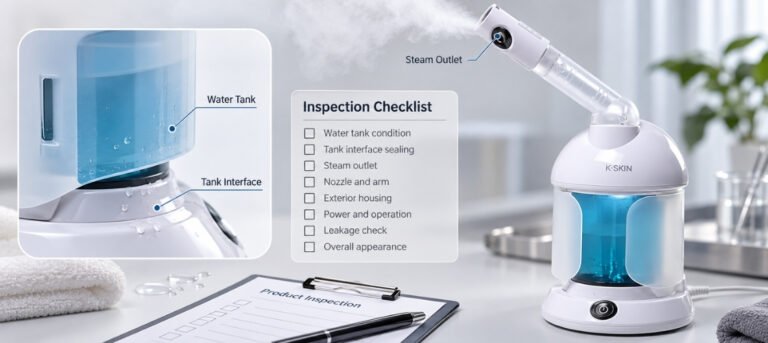
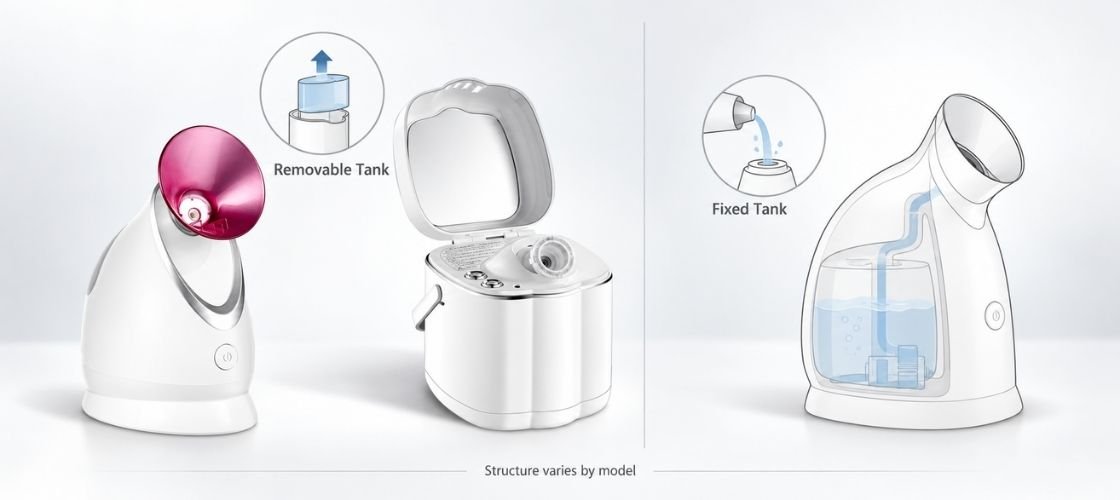
Water-tank design affects more than how a facial steamer is filled. For private-label buyers, it changes the handling sequence, inspection points, packaging arrangement and instructions that must be verified before an order is approved.
A removable vs fixed facial steamer tank comparison should focus on filling, draining, access and assembly. Removable tanks allow separate handling but require checks at the cap and tank connection. Fixed tanks keep the reservoir within the appliance and depend on suitable fill and drain access. Neither design alone proves easier cleaning, lower leakage risk or better reliability.
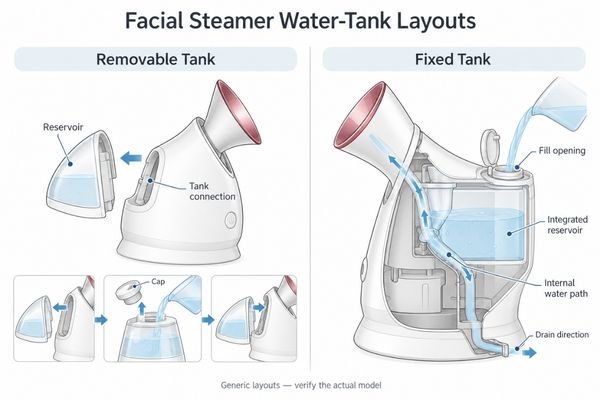
Define what is removable before comparing products
For purchasing purposes, a removable tank is a water reservoir that the user is instructed to detach during normal filling or maintenance. A fixed tank remains in the appliance during those tasks. A reservoir that a technician can remove during servicing is not necessarily user-removable.
Keep the water reservoir separate from the heating chamber in the comparison. Removing a supply tank does not mean that the heater, internal passages or every water-contact surface becomes accessible.
Identify the actual arrangement from the model-specific manual and sample. Ask the supplier to demonstrate the permitted filling and draining sequence without dismantling the housing. Record which components the user handles, which remain installed and which require authorized service.
KD2331A and KD2332: verify the structure, not the label
Model-specific instructions provide a firmer basis for classification than appearance alone. The KD2331A C2 manual describes lifting out the water tank, unscrewing its cap, filling it and reinstalling it. The KD2332 A0 manual also describes a removable filling tank.
The current KD2331A product page includes tank removal and reinstallation in its sample checks. The KD2332 product page identifies a removable-tank design. Both documented configurations therefore belong on the removable-tank side of the comparison.
Use these models to examine removable-tank handling, while confirming the documentation for the proposed order version. The fixed-tank column below is a design-level comparison, not a claim that either model uses a fixed reservoir.
Compare the tasks the buyer must approve
| Buyer question | Removable tank | Fixed tank | Evidence to request |
|---|---|---|---|
| How is water added? | The reservoir can be handled separately according to the manual | Filling takes place with the reservoir in the appliance | Filling demonstration, opening location and fill-limit instructions |
| What must be reassembled? | Tank, cap and any user-handled connection components need correct positioning | Normal filling does not require removing and reseating the reservoir | Component identification and assembly instructions |
| What can be inspected? | Visibility depends on the detached tank's opening and geometry | Visibility depends on access through the approved openings | Photographs of accessible surfaces and a sample demonstration |
| How is water removed? | Tank emptying and appliance draining may be separate tasks | Draining depends on the appliance's permitted orientation and outlet | Illustrated drainage sequence |
| Where should sealing be checked? | Review the cap and tank-to-body interface, plus the remaining water path | Review fill closures and the remaining water path | Relevant drawings and a defined leakage-check method |
| What needs packaging protection? | Confirm how the tank and any loose parts are secured | Confirm protection for the integrated assembly and closures | Finished packaging sample and evaluation records |
Use the table to define inspection work, then compare observations from the exact configurations under consideration before assigning a quality advantage.
Evaluate filling as a complete handling sequence
Removable tanks: access and reinstallation
Ask an evaluator to follow the supplied instructions from an empty, cool, disconnected appliance. Observe the grip, removal direction, cap operation, fill-level visibility and reinstallation sequence.
Check whether the user can identify the correct orientation without forcing the tank. Where the design provides a seating reference, verify that the instructions explain it. Record awkward handling or unclear steps rather than assuming that detachment automatically makes filling convenient.
The opening also matters. A detached reservoir with a restricted opening may offer limited internal access. Assess the actual opening and permitted maintenance method before advertising easy cleaning.
Fixed tanks: fill access and appliance handling
For a fixed-tank candidate, examine how water reaches the fill opening without taking the reservoir out. Confirm whether the instructions specify a filling accessory, how the limit is read and whether the appliance must be repositioned.
Observe access around nearby controls, vents and the power connection. Do not assume the steam outlet is also a filling point. Ask for clear identification of the approved opening and a demonstration that follows the manual.
Compare the number and clarity of handling steps. A design with fewer detachable parts can still have an inconvenient fill opening; a removable tank can still require careful alignment.
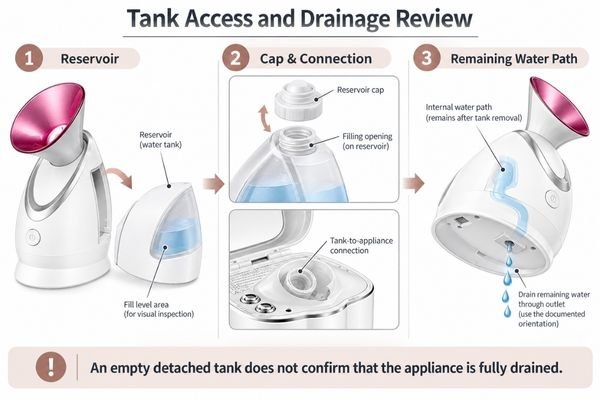
Separate tank cleaning from complete drainage
A removable reservoir may be easier to carry or inspect independently, but the buyer still needs to establish what remains inside the appliance after it is emptied.
The reviewed KD2331A and KD2332 manuals distinguish removal of water from the tank from draining the main unit. This is a useful purchasing distinction: an empty detached tank is not proof that the complete water system has been emptied.
Request a demonstration of the approved after-use sequence. Confirm the required shutdown, disconnection and cooling conditions from the current manual before handling or draining the appliance. Do not transfer a cooling interval from another model or an older document.
Review three areas separately:
- Reservoir: which surfaces can be inspected and maintained through approved access points?
- Cap and connection: what user maintenance is permitted, and how is correct reassembly explained?
- Remaining water path: how does the manual address drainage and maintenance without opening the electrical housing?
For a fixed-tank design, check whether the specified drain orientation is practical and clearly illustrated. For either design, avoid claims that every internal surface is accessible unless the structure and approved procedure support them.
Access and handling observations do not validate cleaning chemicals, descaling recipes, hygiene claims or dishwasher compatibility. Each requires separate support for the exact materials and product version.
Treat leakage risk as a verification question
A removable tank has a connection that must work after removal and reinstallation. That makes seating and sealing relevant inspection points, but it does not establish a higher defect rate than a fixed design.
Similarly, a fixed reservoir is not automatically leak-proof. Its closures and water path still require appropriate checks. Comparative reliability claims need comparable test evidence, not a count of detachable parts.
Ask the supplier to identify the relevant sealing components and their controlled revisions. Where a cap, seal or outlet mechanism is present, check that the sample corresponds to the documented arrangement. Do not infer hidden components from an external photograph.
During evaluation, distinguish water spilled during filling, moisture transferred on a wet tank surface and water escaping from an unintended location. Record where and when moisture first appears. Dry the exterior as directed before a check so that observations are interpretable.
If unexpected water is found near electrical parts, stop the evaluation and refer the unit for qualified assessment. A visual water-path check is not a substitute for electrical-safety testing.
Use a repeatable sample review
The following framework is a buyer evaluation plan, not a record of completed tests or a universal acceptance standard. Agree sample quantity, repetitions, methods and criteria with the responsible engineering or quality team before starting.
1. Identify the samples and documents
Record model, sample ID, electrical version, tank and cap references, relevant seal revision, manual revision and packaging configuration. Confirm which parts are intended for user removal.
Define water type, permitted fill quantity, starting condition and normal operating position. When comparing different designs, respect each model's limits rather than forcing an identical fill quantity into both.
2. Review unpowered handling
Follow the approved removal, filling, closing and installation sequence where applicable. Record difficulties, ambiguous instructions and visible component condition. Photograph the relevant positions without dismantling protected areas.
For a fixed tank, document filling and draining with the reservoir installed. For a removable tank, include both detached handling and correct reseating.
3. Observe the approved operating sequence
Have a competent evaluator operate the complete appliance according to its instructions and the agreed method. Record water-path observations at defined stages, including after shutdown and cooling.
Do not introduce arbitrary inversion, overfilling, blocked outlets or live manipulation of the tank. Any abnormal-condition or safety testing needs an appropriate procedure and qualified personnel.
4. Repeat handling and review changes
Use an agreed repetition count to assess removal and reinstallation, or filling and draining, as applicable. Track the condition of the actual components and repeat the relevant functional checks.
Record observations before and after the sequence. A successful short review supports a limited sample conclusion; it does not establish lifetime durability or production-batch reliability.
5. Close deviations against the same configuration
If a tank, cap, seal or instruction changes, identify the affected checks and repeat them as needed. Keep the revised part references linked to the approval sample and purchasing specification.
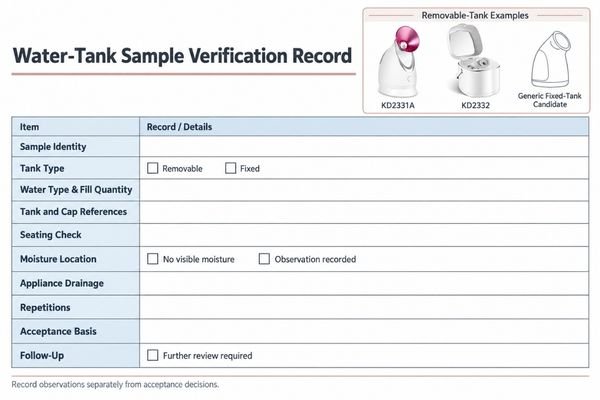
| Record field | What to capture |
|---|---|
| Sample identity | Model, version, sample ID and relevant component references |
| Conditions | Water type, fill quantity, operating position and starting condition |
| Method | Handling sequence, observation stages, repetitions and equipment used |
| Observation | Moisture location, seating behavior, drainage and visible component changes |
| Acceptance basis | Agreed project requirement and responsible reviewer |
| Follow-up | Required action, revised component or document, and repeat-check result |
Check packaging and replacement-part assumptions
Confirm whether the tank is shipped installed or separately secured. Review the actual packing sequence and protection around the cap, connection and any protruding features. Do not choose a shipping arrangement solely because the tank can be removed.
Evaluate the complete proposed packaging, then check the tank fit and relevant functions after the agreed transport assessment. Packaging for one model or revision should not be assumed suitable for another.
A detachable tank also does not guarantee that replacement tanks are available. Before making a service promise, request the part reference, compatible model revisions, supply conditions and any required replacement checks.
For a fixed design, ask which repairs are authorized and whether they require a service facility. Do not turn an engineering service procedure into an end-user instruction.
A useful after-sales guide should identify the model and version before giving advice. It should distinguish filling spills, incomplete seating, drainage questions and faults requiring service, without instructing customers to open the appliance.
Choose for the channel using demonstrated handling
For e-commerce, assess whether the filling, seating and drainage sequence can be explained accurately through the manual and a short demonstration. For retail, check whether staff can demonstrate the design without improvising instructions.
For distributors managing several versions, give particular attention to part compatibility and document control. Similar-looking tanks should not be treated as interchangeable without confirmation.
Use the sample review to identify likely support questions. Compare actual service data after launch before claiming that either architecture reduces support costs.
Connect the agreed water-system checks to the broader manufacturing and quality review, including incoming component identification, assembly verification and change control. The project inspection plan should specify what is checked and against which approved reference.
Buyer approval checklist
- Confirm whether the reservoir is user-removable in the applicable manual.
- Match tank, cap and relevant connection parts to the proposed sample version.
- Observe filling and reassembly without forcing components or improvising access.
- Verify tank emptying and appliance drainage as separate tasks where required.
- Confirm which surfaces and components the user may maintain.
- Agree a water-path evaluation method and record its conditions and limits.
- Check the finished packaging arrangement and any post-transport verification.
- Confirm replacement-part availability and compatibility before promising service support.
- Review diagrams and wording against the approved handling sequence.
- Retain the approved sample and record changes that require further verification.
FAQ
Is a removable tank always easier to clean?
No. Detachment can improve handling, but access depends on the opening, internal geometry and permitted cleaning method. The heating chamber and internal passages may remain inaccessible even when the supply tank is removed.
Does a fixed tank eliminate sealing checks?
No. Review the closures and water path present in the actual design. Eliminating routine tank removal does not prove leak-free construction or remove the need for sample and production checks.
Can a removable tank be refilled while the steamer operates?
Do not infer that permission from removability. Follow the exact model's shutdown, disconnection and cooling instructions. The reviewed KD2331A and KD2332 instructions require stopping and cooling before the specified refilling procedure.
Can one replacement tank serve several models?
Only when compatibility is verified for the relevant model and component revisions. Similar shape or capacity is insufficient. Confirm fit, connection behavior and the required checks before supplying a replacement.
Does tank design determine steam output or runtime?
Removability alone establishes neither. Evaluate output and operating duration on the complete appliance under documented conditions and within its instructions. Keep those results separate from observations about tank handling.
Approve the water system, not just the tank description
The purchasing decision depends on whether users can fill, assemble, drain and maintain the selected configuration as intended, and whether the supplier can control the relevant parts and instructions. Removable and fixed layouts each require evidence at their actual handling and sealing points.
When comparing the K·SKIN facial steamer range, request matching samples, manuals and water-system details before assigning a tank category or making a convenience claim. Use the documented sequence and evaluation records to approve the version your business will sell.