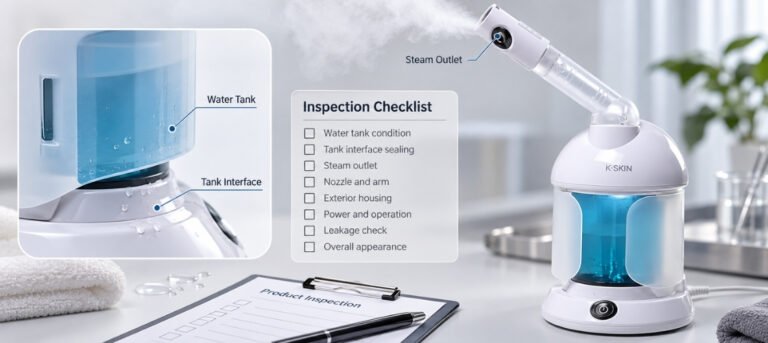
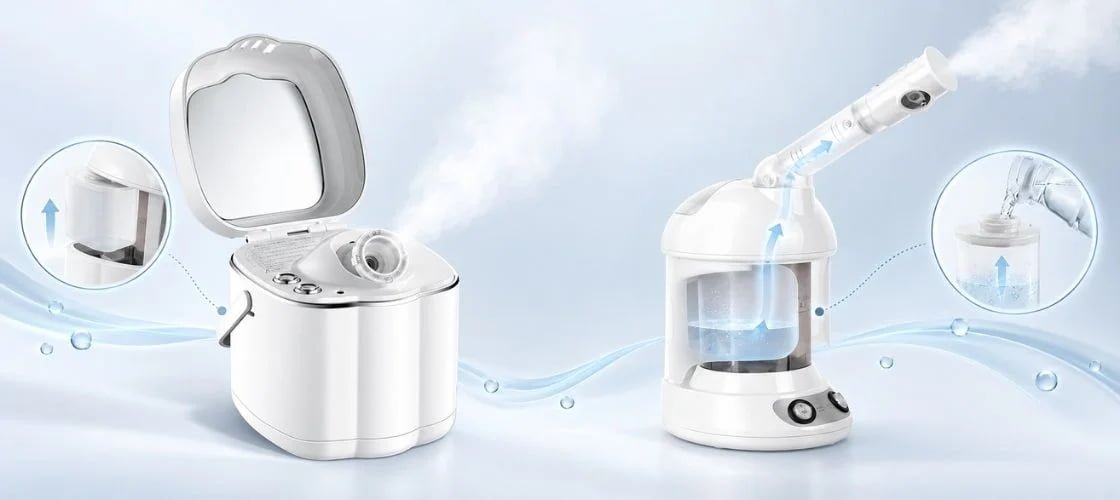
Cleaning and descaling are part of facial steamer product design. Buyers need to evaluate how the water system can be drained, inspected, maintained, validated and explained to users.
Facial steamer cleaning and descaling should be designed around the complete water path rather than treated as a generic after-use instruction. The approved method must match the tank design, drainability, heater and seal materials, target-market water hardness and electrical-safety limits. Any cleaner, concentration, contact time, rinsing step and maintenance interval should be validated for the exact model before publication.
For brands, importers and product managers, an effective cleaning strategy begins before the instruction manual is written. Tank access, residual-water drainage, seal placement, heating-chamber geometry, steam-path accessibility and material selection all affect what users can safely maintain.
These factors need to be reviewed when comparing facial steamer platforms or approving a new private-label configuration.
What Is the Difference Between Cleaning, Flushing and Descaling?
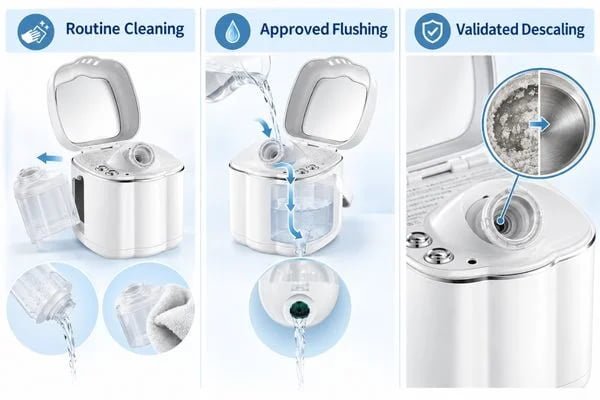
These terms are often used interchangeably, but they describe different maintenance tasks and should not be covered by one vague instruction.
Routine cleaning removes surface moisture and accessible residue. Flushing moves clean water through an approved part of the water system. Descaling targets mineral deposits attached to the tank, heating chamber or water path. A procedure suitable for routine cleaning is not necessarily effective or safe for descaling.
A product manual should clearly distinguish between these maintenance levels.
| Maintenance Level | Primary Purpose | Typical Scope | Main Design Question |
|---|---|---|---|
| After-use care | Remove residual water and surface moisture | Tank, approved drain point and housing | Can the user empty the system without contacting hot water? |
| Routine cleaning | Remove accessible residue and keep surfaces dry | Removable tank, tank cap and approved exterior surfaces | Are the cleanable areas visible and reachable? |
| Water-path flushing | Remove loose residue from an approved internal section | Tank outlet, feed area or other approved pathway | Can the pathway be flushed and completely drained? |
| Descaling | Remove attached mineral deposits | Heating chamber or other scale-prone surfaces | Has the method been validated for every water-contact material? |
| Service cleaning | Inspect or clean inaccessible internal components | Enclosed heater, internal tubing or electrical assembly | Must the work be performed by trained service personnel? |
The manual also needs to define the boundary between user maintenance and service work. Users should not be encouraged to open an electrical housing or insert tools through a steam outlet to reach internal deposits.
Why Does Scale Form Inside a Facial Steamer?
Scale formation depends on water chemistry, heating conditions, operating cycles and how much water remains inside the appliance after use.
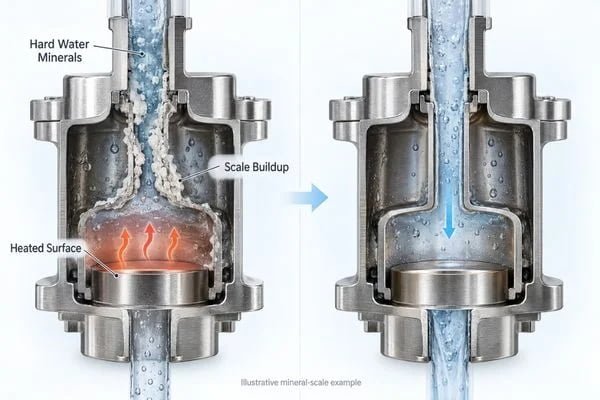
Water hardness is mainly associated with dissolved calcium and magnesium. When hard water is heated, mineral deposits can form on heating surfaces and inside water passages. Repeated heating and evaporation can concentrate these minerals, while residual water and incomplete drainage may allow deposits to accumulate between operating cycles.
The U.S. Geological Survey explanation of water hardness notes that heating hard water can produce calcium carbonate deposits. These deposits may reduce equipment efficiency and restrict water flow.
Water hardness is not interchangeable with total dissolved solids. TDS includes a broader range of dissolved substances, while hardness primarily describes calcium and magnesium content. The USGS guidance on dissolved solids also explains that calcium and magnesium can precipitate on heated surfaces and impede water flow.
A useful water-quality record should therefore state exactly what was measured. A value described only as “TDS” does not fully define the water’s scaling potential.
Water Quality Is the First Preventive Control
Using the approved water type can reduce the mineral load before descaling becomes necessary. Current K·SKIN facial steamer instructions generally specify distilled or purified water and prohibit adding substances such as essential oils, lotion, milk or herbal liquids directly to the water tank.
The final requirement, however, must follow the approved manual for the exact model and market version. “Purified water” is not a universal mineral specification, and its composition can vary according to the source and treatment method.
If a facial steamer includes an aromatherapy function, aroma materials should remain in the designated compartment or on the aroma pad. They should not enter the water path unless the approved product design and instructions expressly permit it.
Which Parts of the Water Path Must Be Designed for Maintenance?
A removable tank is only one part of the system. Scale can also develop downstream in areas the user cannot see.
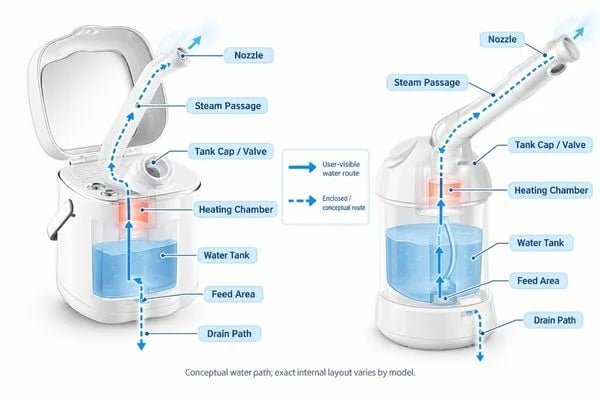
Maintenance design should follow the water from filling to steam release: tank, cap, valve, seals, feed area, heating chamber, steam passage, nozzle and drain path. Each location should be reviewed for access, drainage, material compatibility, deposit visibility and foreseeable misuse. A clean tank does not prove that the heating chamber or steam outlet is clean.
The following questions can identify maintenance weaknesses before a product reaches the market.
| Water-System Area | Design Review Question | Possible Maintenance Risk |
|---|---|---|
| Water tank | Can it be filled, emptied and visually inspected? | Residual water, hidden residue or overfilling |
| Tank cap and valve | Can the user reinstall them correctly? | Leakage, poor water delivery or seal displacement |
| Seals | Are they compatible with the approved cleaning method? | Swelling, hardening, cracking or loss of compression |
| Feed area | Can remaining water leave the area after use? | Stagnant water or concentrated deposits |
| Heating chamber | Where will minerals attach during repeated heating? | Slower heating, reduced output or localized buildup |
| Steam passage | Is the pathway narrow, long or difficult to flush? | Restricted flow or unstable steam delivery |
| Nozzle | Can it be inspected without inserting tools? | Blockage, droplets or unsafe user intervention |
| Drain path | Can the appliance be emptied in a controlled direction? | Contact with hot water or water entering the housing |
| Aroma compartment | Is it separated from the water circuit? | Oils or residue entering the heater and steam path |
Drainability deserves as much attention as tank capacity. A product may have a convenient filling system yet still retain water in the heating chamber or at an internal low point.
The product should also guide the user toward the correct draining direction. Tilting the appliance toward an unapproved side may direct water into switches, ventilation openings or electrical components.
Is a Removable Water Tank Always Easier to Maintain?
A removable tank can improve access, but it also introduces additional interfaces that must remain correctly assembled and sealed.
A removable tank may make filling, emptying and visual inspection easier, but it does not make the entire water path accessible. It also adds a cap, valve, seal and tank-to-body connection that require fit and leakage checks. A larger integrated water system may reduce handling steps but still needs a clear filling, draining and inspection strategy.
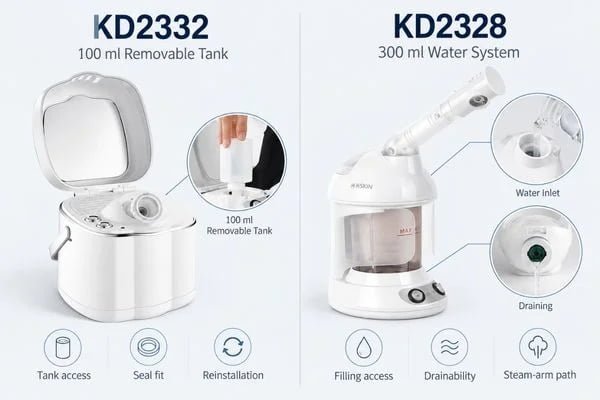
The KD2332 multifunction facial steamer uses a removable 100 ml water tank. During sample evaluation, buyers should inspect the tank cap, water outlet, sealing surfaces and the fit between the tank and the main unit. The unit should also be checked after repeated removal and reinstallation.
The KD2328 large-tank facial steamer uses a 300 ml water system and a 360-degree adjustable steam arm. Its maintenance review should cover filling access, water-level visibility, residual-water drainage, the longer steam-delivery structure and the connection between the main unit and adjustable arm.
| Evaluation Point | Removable-Tank Platform | Large-Tank Platform |
|---|---|---|
| Tank handling | Tank can be removed for filling and emptying | Filling and draining depend more heavily on appliance layout |
| Visual inspection | Tank surfaces may be easier to inspect | Visibility must be checked on the actual sample |
| Sealing | Additional tank interfaces require fit and leakage checks | Fill-cap and internal water-path sealing remain important |
| Heating-chamber access | Usually still limited | Usually still limited |
| Reassembly risk | Tank, cap or seal may be installed incorrectly | Fewer removable interfaces may reduce some handling errors |
| Cleaning instructions | Must explain removal, draining and correct reinstallation | Must explain filling limits and approved draining direction |
Neither layout should be approved from photographs alone. The actual sample must demonstrate whether water can be added, used, emptied and stored without creating an avoidable maintenance problem.
How Should an Approved Descaling Method Be Defined?
A descaling instruction is a controlled product procedure, not a general household recipe.
Before recommending vinegar, citric acid or another descaling agent, the manufacturer should verify its effects on every water-contact material and on the appliance’s operating safety. The approved procedure must specify the agent, concentration, contact time, temperature, rinsing method, draining direction and applicable product version. Without that evidence, the manual should not recommend the chemical.
An approved method should answer all of the following questions:
- Which model and engineering revision does the procedure cover?
- Which cleaning or descaling agent is permitted?
- What concentration or dilution ratio is required?
- Where should the solution be placed?
- Must the appliance remain switched off, or is an operating cycle part of the validated procedure?
- How long may the agent remain in contact with the tank, heater, seals and steam path?
- How many rinse cycles are required?
- How should the remaining liquid be drained?
- What cooling and unplugging steps are required?
- Which cleaners, tools and additives are prohibited?
- What symptoms require the user to stop and contact service?
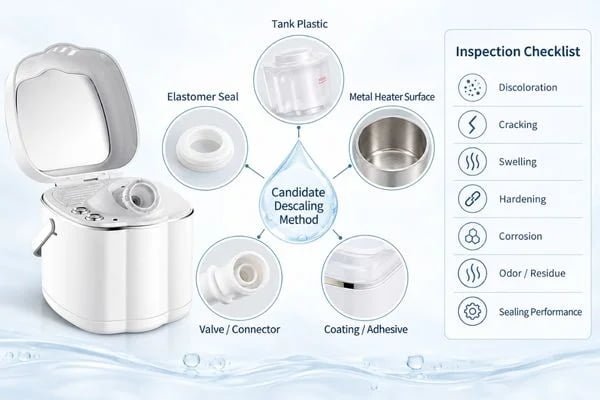
Acid resistance cannot be inferred from the tank material alone. A descaling solution may also contact elastomer seals, heater surfaces, coatings, adhesives, valves or internal connectors. Compatibility assessment should examine discoloration, cracking, swelling, hardening, corrosion, odor, residue and loss of sealing performance.
A method approved for one facial steamer should not automatically be copied to another model. Different tank structures, heater materials and internal water paths may require different procedures.
How Should Cleaning and Descaling Be Validated?
Validation should measure both deposit removal and the condition of the product after cleaning.
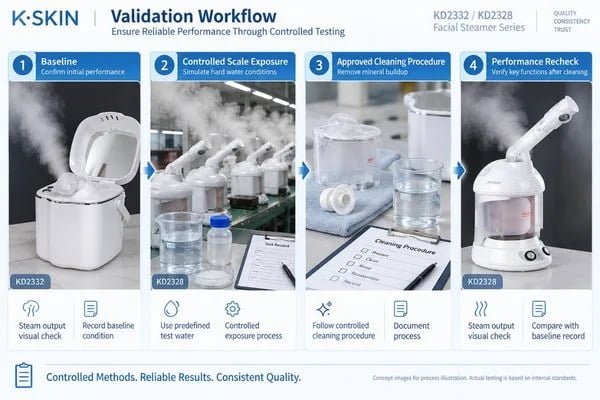
A useful validation compares the same product version before scale exposure, after controlled exposure and after the proposed cleaning procedure. Test conditions should identify water hardness, fill volume, operating cycles, cooling periods, cleaning-agent variables and the measurement method. Acceptance criteria must cover output recovery, leakage, droplets, materials and applicable electrical-safety checks.

A preliminary development review can use two or three equivalent units to identify obvious variation, but such a small sample does not provide statistical proof of future production quality.
1. Establish the Baseline
Record the model, revision, electrical version and sample number. Under controlled conditions, measure:
- cold-start time to visible steam;
- steam output over a fixed period;
- full-cycle output behavior;
- abnormal droplets or spitting;
- water leakage;
- operating noise;
- residual water after approved draining.
2. Define the Scale-Exposure Conditions
Use a documented challenge condition that reflects the intended market or a defined robustness study. Record:
- water hardness in mg/L as CaCO₃;
- water source or preparation method;
- fill volume;
- number and duration of operating cycles;
- cooling time between cycles;
- whether residual water is removed or retained;
- ambient conditions where relevant.
Intended-use testing and foreseeable-misuse testing should be recorded separately. If the manual requires distilled water, a hard-water challenge can help assess robustness, but it should not be presented as the normal operating condition.
3. Apply the Candidate Cleaning Procedure
Control the cleaner concentration, volume, contact time, temperature, operating state and rinsing steps. Where practical, photograph deposits before and after cleaning from the same angle and under the same lighting.
4. Repeat the Performance Checks
Compare warm-up behavior, output, droplets, leakage and residual water with the original baseline. Inspect all accessible water-contact parts and relevant seals.
Recovered steam output alone is not enough. A method should not pass if it removes scale but damages a seal, leaves an odor, causes corrosion or increases leakage.
5. Repeat the Cleaning Cycle
One successful cleaning event does not establish long-term compatibility. The proposed process should be repeated according to the maintenance and product-life assumptions used for the project.
The method, sample identity, results and deviations should remain linked to the approved commercial version. This forms part of broader manufacturing and quality control, particularly when a change affects materials, seals, the heater or the user manual.
What Should the Manual and After-Sales System Include?
Cleaning design is incomplete if users and service teams cannot follow the same approved process.
The manual should state the permitted water, prohibited additives, after-use drainage steps, cooling requirements, cleanable areas, approved descaling method and service limits. After-sales records should distinguish scale-related symptoms from leakage, incorrect assembly, component failure and contamination so that field feedback can support corrective action instead of leading to one generic diagnosis.
A complete manual should cover:
- approved water type;
- maximum fill level;
- prohibited liquids and additives;
- safe shutdown, unplugging and cooling;
- disposal of residual water after use;
- tank and exterior cleaning;
- model-specific descaling instructions, when validated;
- prohibited cleaners and tools;
- drying and storage;
- troubleshooting and service contact points.
Maintenance frequency should be tied to validated conditions. A fixed instruction such as “descale monthly” may be too frequent for one market and inadequate for another. Water hardness, operating frequency, product design and performance symptoms should all be considered.
After-sales teams should also avoid assuming that reduced steam output always means scale. Relevant symptoms may include:
| Reported Symptom | Possible Areas to Check |
|---|---|
| Longer warm-up time | Power condition, heater performance, mineral deposits or water delivery |
| Reduced steam output | Scale, low water supply, restricted steam path or heater condition |
| Intermittent steam | Water level, tank fit, valve operation, protection response or deposits |
| Abnormal droplets | Condensation, startup condition, water level, steam-path restriction or product position |
| Leakage | Tank cap, seal position, valve, assembly fit, crack or incorrect draining |
| Unusual odor | Stored residual water, unapproved additives, contamination or material condition |
Field complaints should be linked to the model, revision, market, water-use history and returned-product findings. Repeated patterns can then inform manual revisions, design changes, incoming-material controls or production checks.
Frequently Asked Questions
What water should be used in a facial steamer?
Use the water specified in the approved manual for the exact model. Current K·SKIN facial steamer instructions generally require distilled or purified water. Tap water, mineral-rich water and unapproved liquids may increase the risk of deposits or malfunctions.
Can vinegar or citric acid be used to descale every facial steamer?
No. An acid should be used only when the manufacturer has approved its concentration, contact time, rinsing procedure and compatibility with the specific model. A method found online or supplied for another appliance should not be assumed to be safe.
Does a removable water tank prevent scale buildup?
No. It may improve tank access and drainage, but minerals can still accumulate in the feed area, heating chamber or steam path. The complete water system must be considered.
How often should a facial steamer be descaled?
There is no reliable universal interval. The requirement depends on the approved water type, local water hardness, usage frequency, heater design, drainability and validated maintenance procedure.
Can essential oils be added directly to the water tank?
Only if the approved instructions for the model expressly allow it. For K·SKIN models with a designated aroma pad or compartment, aroma material remains outside the water tank. Adding oils or other substances to the water path may affect heating, seals, steam delivery and product life.
Conclusion
Facial steamer cleaning and descaling should be treated as a product-system decision. Tank access matters, but so do the heating chamber, seals, steam passage, drain path, water requirements and user instructions. A practical design allows safe after-use drainage and provides a model-specific maintenance method supported by material and performance evidence.
For B2B buyers, the key question is not whether a supplier describes the product as “easy to clean.” The supplier should be able to identify the cleanable areas, permitted water, approved procedure, validation conditions, acceptance criteria and document revision that apply to the commercial version being evaluated.