Two facial steamers can look quite different on a product page yet leave a buyer asking the same question: which one fits our customers? Tank size and nozzle design help answer it—once you look beyond the specifications.
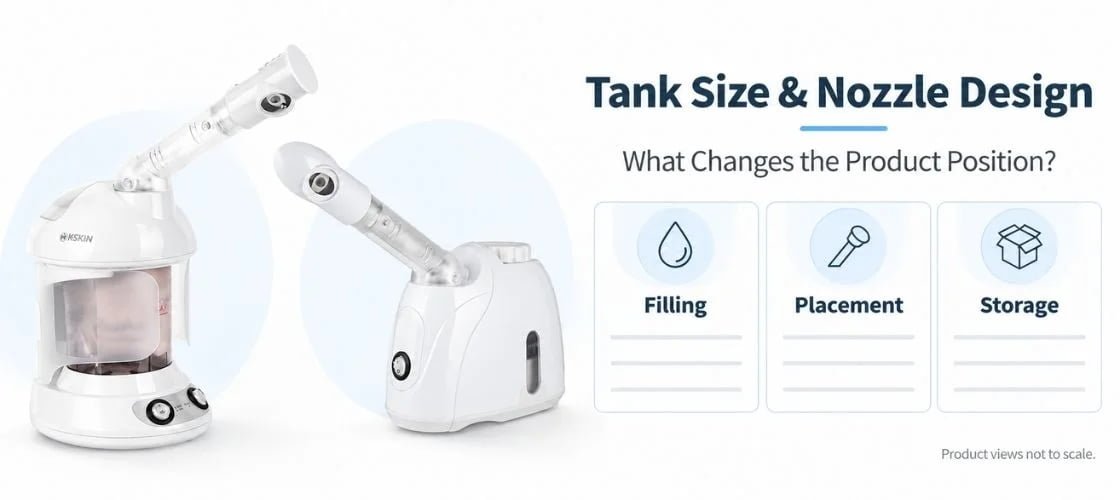
Facial steamer tank size and nozzle design influence how a product fits into the customer’s routine: filling, positioning, using, emptying and storing it. Those practical differences can give a model a clear retail role. A bigger tank doesn’t automatically mean a longer permitted session, and a longer nozzle doesn’t promise better results. The strongest positioning connects a useful design feature with an experience the selected product can support.
What the Tank Number Tells You—and What Customers Still Need to Know
A capacity figure is easy to compare. Its value takes a little more explaining.
For a brand considering a larger-tank model, the buying question is whether that capacity makes sense within the intended routine. A customer still has to find space for the appliance, fill it correctly and empty it afterward. The product story becomes more convincing when it explains that whole experience.
Nozzle design works in much the same way. A long tube or adjustable arm can give a product a distinctive appearance, but customers need to understand how it fits their setup. Otherwise, the difference remains largely visual.
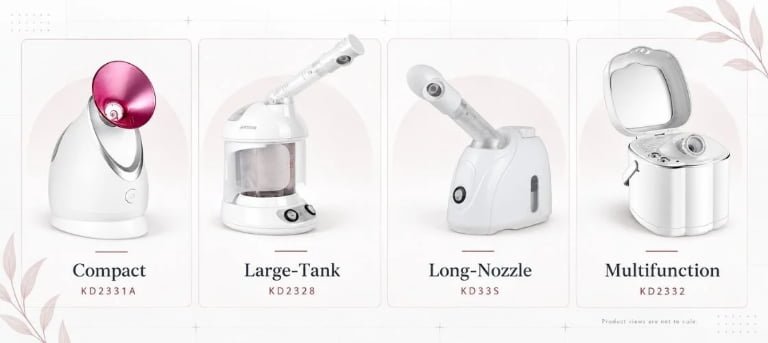
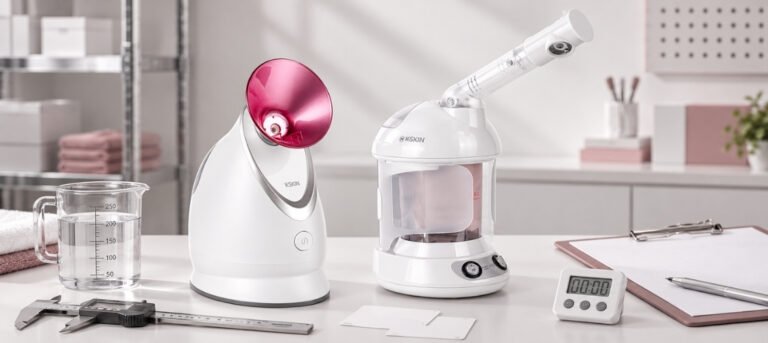
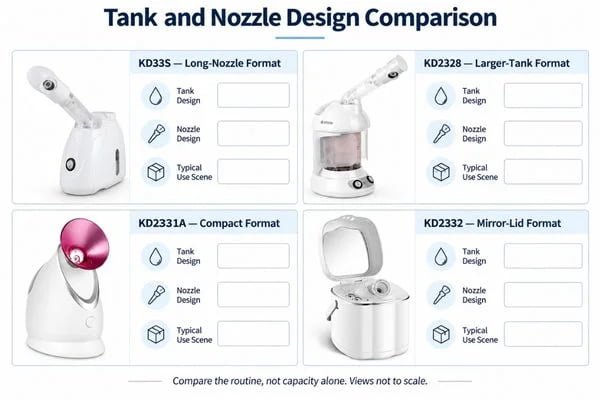
Four models in the K·SKIN facial steamer range show why these features deserve a closer look:
| Model | Capacity reference | What to explore on the sample |
|---|---|---|
| KD33S | 100 ml in the current product reference | How the adjustable long nozzle fits the intended tabletop setup and storage space |
| KD2328 | 300 ml in the reference configuration | Filling access and the way its adjustable steam arm works within the routine |
| KD2331A | Confirm the capacity for the quoted version | Access for filling, tank reinstallation and nozzle positioning within a compact format |
| KD2332 | 100 ml in the reference configuration | Space for the removable tank, adjustable nozzle and open mirror lid |
Before these reference figures appear in a retail comparison, the specification, instructions and quoted sample should agree.
KD33S and KD2332 are a useful example: both have a 100 ml reference capacity, yet their layouts offer different things to evaluate. Tank volume alone would miss much of that distinction.
What Extra Capacity Means for the Routine
The KD2328 large-tank facial steamer offers a 300 ml reference tank. That is a visible difference from the 100 ml references above. The next question is whether the difference matters enough to the intended customer to influence the purchase.
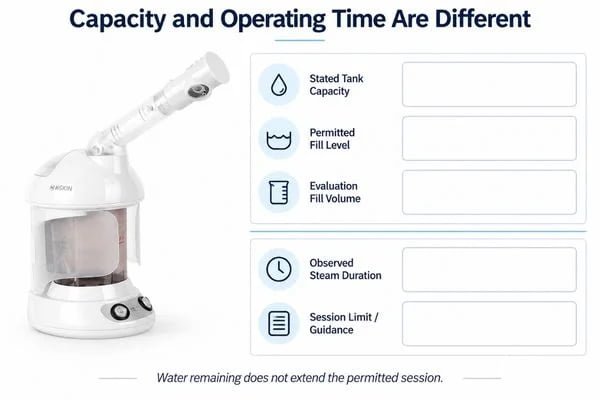
Capacity and Session Length Answer Different Questions
There are three quantities worth keeping separate: the stated tank capacity, the permitted fill level and the amount used in an evaluation. Their relationship needs to be clear in the selected specification and instructions.
Operating time needs context too. How long an appliance produces steam is different from how long its instructions permit or recommend a facial-care session. Having water left in the tank does not mean the customer should extend the session.
Nor does a 300 ml tank establish three times the operating duration of a 100 ml tank. Heating arrangements, output behavior and operating procedures may differ between models. A meaningful comparison comes from observing the actual versions under recorded conditions.
“Less frequent filling” might be a useful selling point, but it needs a defined routine and supporting evidence. It should never imply that water can be left in the appliance between uses when the instructions require emptying it.
Filling Is Only Half the Water-Handling Experience
Imagine evaluating the sample from the moment it comes out of storage. Can the evaluator reach the opening easily, see the filling limit and close or seat the parts without uncertainty? After the permitted use, how straightforward is the emptying process?
These details give substance to a convenience claim. A larger tank can be relevant to the range while still requiring a filling or handling sequence that needs careful explanation.
Space matters throughout. The customer needs room to fill the appliance, use it and handle it after cooling—not simply a place where the body fits when everything is closed.
How Nozzle Design Changes the Setup
A long nozzle changes where the outlet sits in relation to the body. For a buyer evaluating a particular tabletop arrangement, that can be a useful distinction to explore.
The KD33S long-nozzle facial steamer makes that question especially clear. Its product presentation should help customers understand the placement, rather than leave them to infer a benefit from the shape.
Useful Adjustment Depends on the Whole Arrangement
“Adjustable” deserves a demonstration. A joint might rotate horizontally, while another design allows a different movement. The useful range is the movement the supplied version permits and can hold reliably.
On a sample, it helps to see the sequence from the customer's perspective: position the appliance, make the permitted adjustment and locate the controls. Is the filling opening still accessible? Does the chosen position hold? Does anything feel awkward or unclear?
Adjustment must stay within the documented range and sequence. A movable joint is not, by itself, permission to reposition the nozzle during hot operation.
Nozzle Reach and User Distance Are Separate Measurements
A body-footprint measurement leaves out nozzle projection, movement, cable routing and access around the appliance. Those details belong in the operating setup.
The outlet-to-user distance also remains governed by the applicable instructions. Extending a nozzle farther from the body does not give the user permission to move closer to hot steam.
For retail copy, stay close to the benefit you can demonstrate: the placement and permitted adjustment. Claims about cooler steam, finer mist, wider coverage or greater safety need appropriate evidence of their own. The length of the tube cannot establish them.
The Product Has Three Sizes: In Use, Stored and Packed
A closed product can look compact while needing more room when opened. An extended nozzle arrangement may also have a different permitted storage position. Both matter when a retailer is deciding where the product belongs.
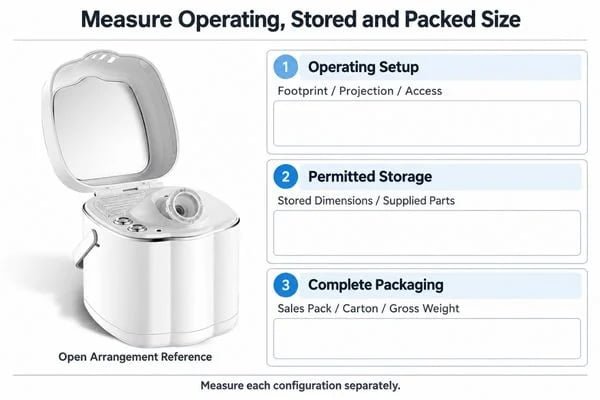
For KD2332, the flip-up mirror and adjustable nozzle make the open arrangement relevant. The removable tank needs access as well. A single closed-unit measurement won't explain that experience to a customer or a merchandising team.
Give Packaging the Same Attention as the Display
A projecting nozzle or movable arm needs suitable support in the pack. Its presence does not automatically mean a higher damage rate; it means the packaging has a particular job to do.
Look at where the insert supports the parts, whether anything can move in transit and how the product is unpacked. If a part arrives detached, the assembly instructions become part of the first-use experience. Removability should not be confused with permission for routine user disassembly.
The packaging sample should contain the actual order configuration, including accessories and instructions. An appropriate transport evaluation then has something specific to assess. Its findings need to identify the packaging version, sample count and conditions, with functional checks where relevant. An intact outer box tells only part of the story.
For the cost comparison, use finished-pack and carton dimensions and weights. A smaller tank does not guarantee a smaller box, and bare-device dimensions won't give you a dependable freight comparison.
Make the Difference Relevant to the Sales Channel
“Suitable for e-commerce” does little to distinguish one steamer from another. A more useful brief identifies the channel's actual needs: package limits, display space, demonstration opportunities, target price and the explanation customers will need before buying.
Online, product imagery has to do some of the work that an in-store demonstration would do. Show scale, the operating arrangement and any part that opens or moves. A tightly cropped image may flatter the product while leaving the customer uncertain about the space it needs.
In a store, assess the display in the state customers will actually see. If adjustment is part of the proposition, a clear demonstration can explain it. Live use must suit the instructions and setting; a static display may be the more appropriate choice.
Pricing follows the same logic. Extra tank volume or another joint does not set a premium by itself. The quoted configuration, packaging, logistics and support costs need to fit a proposition the customer can understand.
A larger-tank model and a long-nozzle model could offer two distinct choices. To make that distinction useful, explain what each changes in the routine. Giving both the same broad promise of “better facial steaming” leaves the buyer with little more than appearance and price to compare.
For brands also planning a hair styling range, our mini vs full-size hair straightener brush comparison explores the same positioning question in a different product category. It examines how intended tasks, handling, packaging and price position can distinguish SKUs, rather than treating size alone as a reason to add another model.
Convenience Includes What Happens After the Steam Stops
It is easy to focus a demonstration on the moment steam appears. The customer also lives with the shutdown, cooling, emptying and storage steps. They deserve a place in the buying decision.
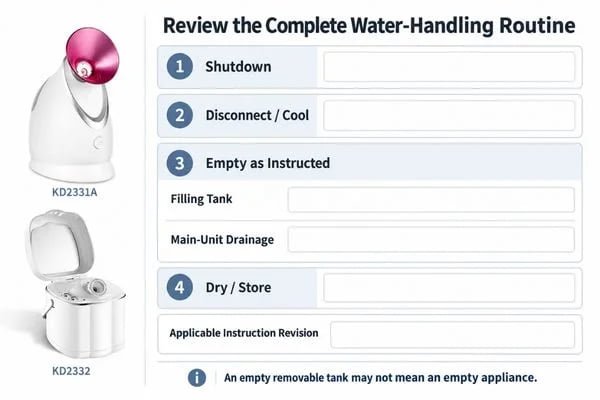
A Removable Tank Is Not the Whole Water System
The reviewed KD2331A and KD2332 instructions distinguish emptying the filling tank from draining the main unit. Removing an empty tank therefore does not necessarily mean that the appliance has been emptied completely.
That distinction is worth explaining clearly in the manual and support material. During evaluation, follow the selected model's shutdown, disconnection and cooling procedure, then its prescribed emptying steps. Observe which parts need handling and where water remains visible. There is no need to improvise a draining direction or tip a hot operating unit to investigate it.
Nozzle instructions need similar clarity. Customers should understand the permitted adjustment, any allowed removal and the after-use treatment of the steam path. A product can match its technical specification and still be confusing if the listing suggests a different movement or sequence.
Where real service records are available, they can help distinguish misunderstandings from water-handling problems, physical damage and functional faults. Without comparable records, no return-rate advantage should be assigned to a particular tank or nozzle design.
Use Samples to Test the Difference You Plan to Sell
The proposed selling point gives the evaluation a purpose. Easier placement calls for a defined setup and adjustment task. Capacity-related convenience calls for a look at filling, permitted operation and after-use handling, rather than a stopwatch beside visible steam.
Set Up a Comparison You Can Explain
Start with identified samples and matching electrical versions, heater configurations, specifications and manual revisions. The record should include water type, fill volume, starting water temperature, ambient conditions, sample count and the endpoint of each observation. Where measurements are involved, include the instruments and methods.
Testing each model at its permitted fill level describes those complete configurations. Using a common fill quantity asks a different question and is appropriate only when that amount is permitted for every model and suits the method. Neither approach, by itself, compares the whole customer experience.
Walk Through the Complete Routine
- Measure the operating setup, permitted storage arrangement and access clearances.
- With the appliance off and cool, follow the filling and nozzle-setup instructions. Note difficult access or unclear steps.
- Operate within the manual's limits, observing warm-up, output continuity and whether the nozzle holds its selected position.
- At the defined endpoint, complete shutdown, cooling and emptying. Note observable residual water and handling difficulties.
- Pack the dry, cooled product in the proposed retail packaging. Review support for the parts, unpacking and the relevant transport-evaluation requirements.
- Compare the findings with the planned listing and packaging language. Keep the claims that the evidence supports and narrow or remove the rest.
Agree acceptance criteria in advance, and distinguish observations from specification targets and purchasing requirements. This is an evaluation method, not a report of completed tests on the four models.
Steam and hot-water assessments require suitable controls and competent personnel. Keep cold handling checks separate from formal stability, protection or transport assessments; an ordinary operating review should not become an improvised tip-over or destructive test.
Decide What the Product Should Be Known For
By this point, a feature list should be turning into a clear buying reason. The aim is to explain why a particular combination of capacity and nozzle layout belongs in the range—and what makes that explanation credible.
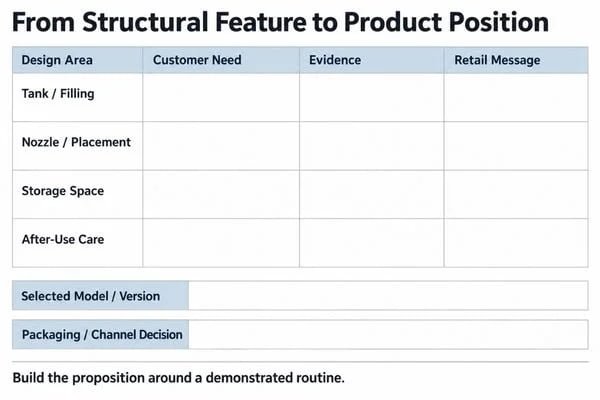
| Possible product proposition | What would support it | Decision it helps the buyer make |
|---|---|---|
| Capacity-related convenience | Approved filling information and an observed routine within the instructions | Whether the benefit is worth the space, package and cost |
| A better fit for the intended tabletop setup | Permitted nozzle movement, setup measurements and position-holding observations | How to demonstrate and present the product |
| Compact storage | Measurements in the permitted stored state, including supplied parts | Whether it fits the intended shelf or storage requirement |
| Straightforward after-use care | A demonstrated shutdown, cooling, emptying and storage sequence | What the manual and support material need to explain |
| A broader feature-led offer | Verified functions and a clear account of their use | Whether the model merits a separate SKU or price position |
Before approving the product, bring together the capacity and filling limit, nozzle movement, operating clearances, after-use instructions, complete pack and version-matched documents. An unresolved detail belongs with the affected decision until it is answered; a similar model's specification is no substitute.
The facial steamer product-line matrix compares compact, large-tank, long-nozzle and multifunction formats. Together with the sample findings, it can help you decide whether a shortlisted model adds something your range needs.
Frequently Asked Questions
Tank capacity and nozzle movement also raise questions about retail claims, intended use and customization.
Can a 300 ml Tank Be Advertised as Offering Three Times the Use of a 100 ml Tank?
Capacity alone cannot support that comparison. “Use” might mean steam-production time, a recommended session or several separate routines. Define the claim and support it with the relevant versions, instructions and test method. A larger water volume should never imply a longer recommended exposure to steam.
Does a Long Nozzle Make a Facial Steamer Suitable for Salon Services?
No. Professional-duty suitability depends on the intended use and operating limits of the exact version. A salon may sell a home-use steamer to its customers without that product being suitable for repeated use during professional services.
Can an Adjustable Nozzle Be Moved While Steam Is Coming Out?
Follow the selected version's instructions. A nozzle can be mechanically adjustable while requiring adjustment before operation. The manual and demonstration should make that sequence clear, rather than leave the customer to guess.
Can We Add Essential Oil to a Larger Tank?
The permitted water and additives depend on the model, not its capacity. Where a separate aroma compartment is provided, use only its approved materials and accessories according to the instructions. That compartment does not authorize pouring oil into the water tank.
Is a Different Tank or Nozzle Just a Private-Label Change?
A structural change needs a technical feasibility and scope review. It may affect the water path, steam arrangement, assembly, packaging or supporting documentation. Treat it separately from a logo or artwork change, with the necessary assessment agreed before the revised product is promised.
Conclusion
A facial steamer earns a clear position when its design makes sense for the routine being sold. Tank size, nozzle layout, filling access and after-use handling all contribute. The useful selling point is the practical difference a customer can understand and the selected product can support.
If you're deciding which format belongs in your range, a facial steamer sourcing and private-label discussion can start with your channel, intended setup and target position. Those details give the sample review a clear purpose and help define the right packaging and development scope before committing to the product.