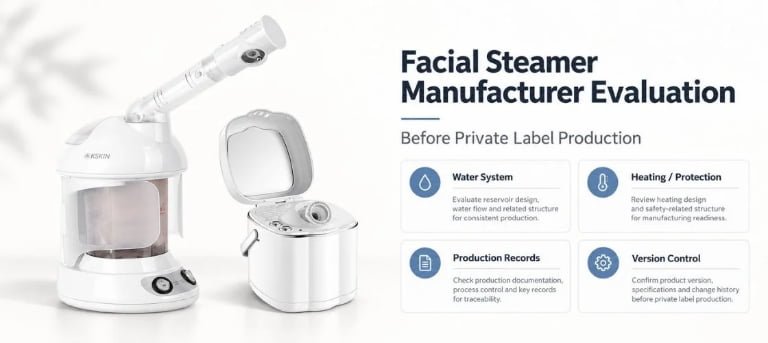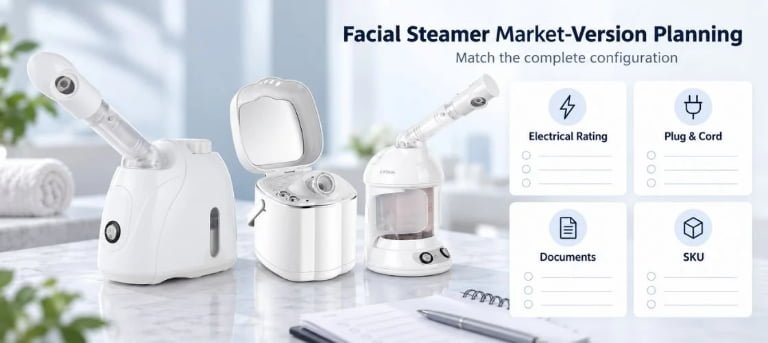
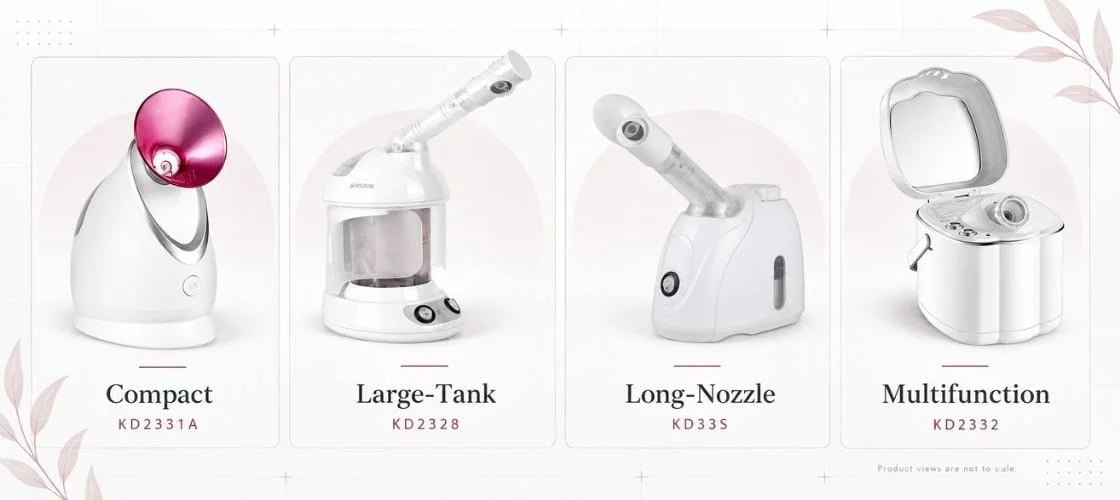
A facial steamer range needs a reason for each SKU. Buyers comparing several designs must decide which differences matter to their channels, which require sample verification, and which merely add complexity to inventory and support.
Choose facial steamer types for private label by matching each architecture to a distinct buying scenario. Compact designs emphasize space, large-tank designs raise water-capacity considerations, long-nozzle designs emphasize positioning, and multifunction designs add features to evaluate. Build the range around verified configurations, packaging and support requirements; neither tank size nor feature count establishes performance, retail price or commercial suitability.
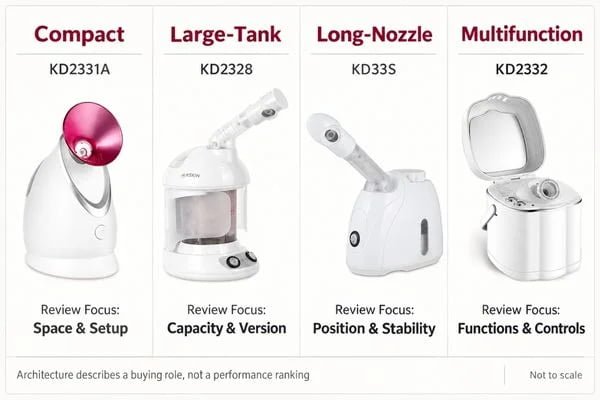
Start with architecture, then define the commercial role
Compact, large-tank, long-nozzle and multifunction are useful buying descriptions. They are not mutually exclusive engineering categories. A compact model can have an adjustable nozzle, and a multifunction model can also have a removable tank.
For a product-line decision, identify the feature that gives each model a clear role. Then check whether that role remains useful after considering packaging, instructions, configuration and the buyer's intended channel.
The following matrix uses four models in the K·SKIN facial steamer range. The proposed roles are assortment hypotheses for buyers to evaluate, rather than claims about established demand or sales performance.
| Architecture and model | Documented design features | Possible assortment role | Key verification before selection |
|---|---|---|---|
| Compact: KD2331A | Compact tabletop format, adjustable nozzle and separate aroma-pad arrangement | A candidate where storage and display space are important | Confirm operating clearance, usable nozzle adjustment and the complete packed configuration |
| Large-tank: KD2328 | Large-tank format and adjustable steam arm | A differentiated water-capacity option | Confirm the approved tank capacity, heating version, filling procedure and measured operating behavior |
| Long-nozzle: KD33S | Long adjustable nozzle and a designated aroma-pad arrangement | A positioning-led alternative to a conventional tabletop layout | Check nozzle adjustment, position retention, tabletop stability and storage arrangement |
| Multifunction: KD2332 | Removable tank, mirror lid and separately controlled light function | A feature-led option with several elements to demonstrate | Confirm the supplied functions, control behavior, cleaning access and instructions for each feature |
For a numerical comparison, use the approved dimensions, power ratings and operating limits for each selected version, supported by matching samples. Keep historical configurations separate.
Compact: evaluate usable space, not appearance alone
KD2331A provides the compact reference in this comparison. Its format may suit a range in which storage or display space is a purchasing constraint, but that suitability needs measurement.
Record the space occupied during use, including nozzle adjustment, lid movement, cable routing and any clearance required by the manual. Measure the stored unit separately. A small body does not automatically mean a small usable setup or a smaller shipping carton.
The buying question is whether the model meets a defined space requirement while retaining acceptable filling, emptying and maintenance access.
Large-tank: separate capacity from operating duration
The KD2328 large-tank facial steamer represents the capacity-led architecture. Its adjustable arm also affects positioning, so the selection should consider the complete assembly.
A larger tank alone does not establish a longer permitted session, stronger steam or faster heat-up. Those conclusions require model-specific instructions and measurements under stated conditions. Different heating versions must also be distinguished before comparing specifications or approving samples.
Ask whether the intended customer has a meaningful reason to choose this format. Then verify the filling method, handling space, permitted operation and storage requirements. Do not turn capacity into an unsupported promise of continuous professional use.
Long-nozzle: make positioning part of sample evaluation
The KD33S long-nozzle facial steamer offers a positioning-led alternative. Evaluate its nozzle in the intended tabletop arrangement, using the operating distance and setup described in the applicable manual.
Check whether the selected position remains stable, whether adjustment is clear to the user and how the assembly is protected in storage and transport. Record the sample reference and observations so that any adjustment can be checked again.
Keep the function description specific to the approved configuration. A long nozzle does not establish a different mist temperature, stronger output or additional treatment capability. An aroma-pad arrangement also does not authorize adding arbitrary substances to the water tank.
Multifunction: identify what each added feature contributes
The KD2332 multifunction facial steamer combines a removable tank, mirror lid and separate light control.
Assess each feature independently: how the tank is removed and reseated, how the lid is handled, and whether the controls clearly distinguish the light function from steam operation. Confirm these details on the supplied version.
Describe the light as a light function unless suitable evidence supports a more specific claim. Its presence does not establish phototherapy or a skin-treatment outcome. Likewise, a multifunction label does not prove higher performance or justify a particular retail premium.
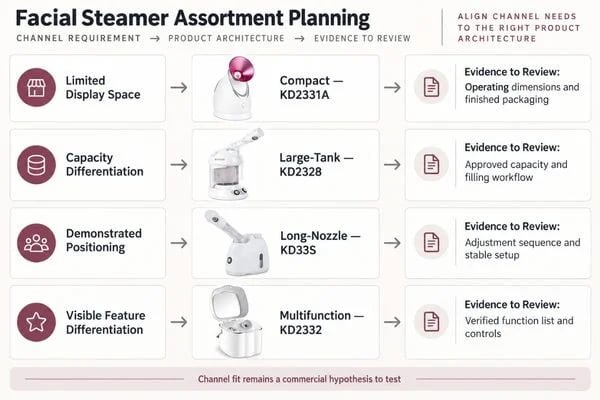
Match the range to channels and price tiers
Channel selection should start with the buyer's actual constraints. Record available shelf space, listing requirements, package limits, demonstration opportunities and the support team’s ability to explain the product.
| Channel or merchandising constraint | Architecture worth evaluating | Evidence needed for a buying decision |
|---|---|---|
| Limited display or storage space | Compact | Operating and stored dimensions, shelf layout and finished packaging measurements |
| Customers need a clearly differentiated water-capacity option | Large-tank | Approved capacity, permitted operating instructions and a demonstrated filling workflow |
| Product positioning can be demonstrated in store or on video | Long-nozzle | Clear adjustment sequence, stable setup and accurate usage instructions |
| A feature-led assortment needs visible functional differences | Multifunction | A verified function list, understandable controls and evidence supporting every advertised benefit |
These are starting points for channel testing. They do not establish that one architecture will sell better online, command a higher margin or produce fewer returns.
For price-tier planning, obtain comparable quotations for defined configurations. Include the electrical version, accessories, packaging, labeling and agreed inspection requirements. Add freight and other destination-specific costs using current quotations and the buyer's own cost model.
Only then decide whether a model belongs in an entry, mid-range or higher-priced position. Feature count is not a reliable substitute for this calculation. A nominally simpler unit may have a different landed cost once packaging and order configuration are included.
Compare packaging and logistics at the finished-SKU level
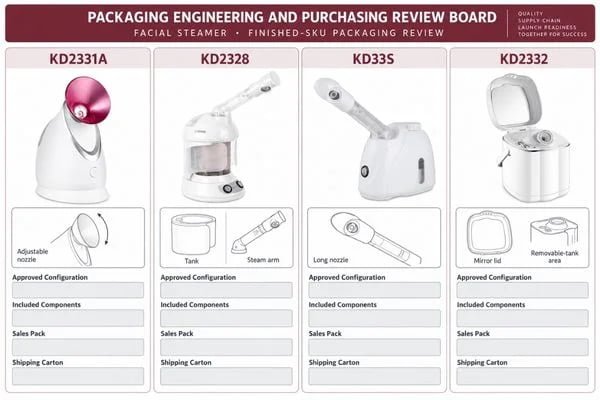
Product dimensions and packed dimensions answer different questions. Request measurements for the operating assembly, stored assembly, individual sales pack and shipping carton. Record the configuration behind every measurement.
For each candidate, confirm which parts arrive assembled, which accessories are included and how the purchaser removes and replaces the product in its packaging. A long nozzle, movable arm, mirror lid or removable tank creates a different packing task to inspect. The presence of these parts does not, by itself, prove greater damage risk.
Ask for a packaging sample that matches the proposed order. Inspect protection around protruding components and movable parts, and agree any transport evaluation appropriate to the shipment. Do not assume that packaging approved for one model also protects another.
Use a consistent comparison record:
- Approved model and configuration reference.
- Included components and their packing positions.
- Sales-pack dimensions and gross weight.
- Carton dimensions, quantity and gross weight.
- Assembly and unpacking instructions.
- Packaging evaluation method, results and unresolved changes.
Where dimensions or weights remain unconfirmed, keep the logistics comparison open. An estimated carton size should not become the basis of a final freight or margin commitment.
Evaluate service requirements before expanding the range
Each additional stock-keeping unit (SKU) requires accurate manuals, product listings, spare-part references, troubleshooting instructions and version records. Review the work required to maintain those materials before adding a model.
Run a short support exercise with the proposed samples. Ask someone unfamiliar with the product to locate the permitted water instructions, identify the controls, explain the normal shutdown process and follow the documented after-use procedure. Record where the instructions need clarification.
For the compact model, pay attention to access around the tank and nozzle. For the large-tank model, verify filling and handling instructions. For the long-nozzle model, check positioning and storage guidance. For the multifunction model, check whether each control and function can be explained without unsupported benefit claims.
If aroma-related accessories are supplied, identify the designated location and the exact permitted materials in the applicable instructions. Do not write one generic essential-oil instruction for the entire range.
These exercises help define support requirements. They do not establish comparative failure rates, warranty costs or customer satisfaction without actual records.
Build a portfolio with a distinct reason for each SKU
Offering all four architectures is one option, not a requirement. Start by writing a one-sentence reason for each proposed listing. If two reasons are effectively identical, investigate whether the models provide enough meaningful differentiation to justify separate inventory.
A compact model and a long-nozzle model could form a two-SKU trial focused on storage and positioning. A capacity-led model could be considered where buyers have a documented need for that distinction. A multifunction model could be evaluated where the extra features have a clear merchandising role and suitable support materials.
Validate these planning examples against customer feedback and the buyer’s own demand and margin data before committing to inventory.
For each proposed SKU, record:
- The customer or channel requirement it addresses.
- The feature that differentiates it from the nearest alternative.
- The approved configuration and target market.
- The quotation and packaging assumptions.
- The evidence needed before listing or ordering.
- The result that would justify keeping, changing or removing it from the range.
Set commercial review criteria using the buyer's own business data. Avoid assigning universal sales thresholds or assuming that a more complex product must become the flagship.
Use a common sample record with architecture-specific checks
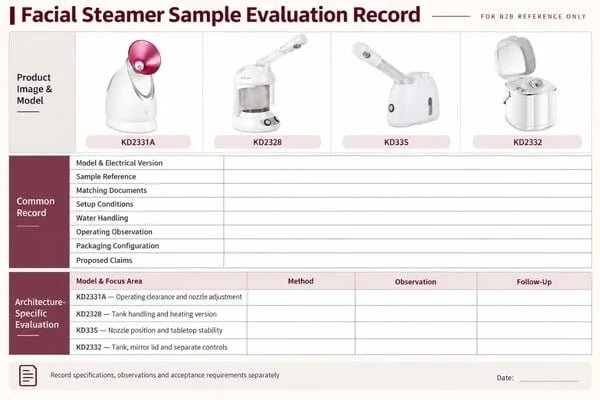
A useful sample evaluation has a shared record format and separate checks for each design. This makes comparisons traceable without forcing every product into an unsuitable procedure.
| Evaluation item | Common record | Architecture-specific attention |
|---|---|---|
| Identification | Model, electrical version, sample reference and matching documents | Confirm any heating or feature variant before comparison |
| Setup | Permitted surface, operating clearance and documented positioning | Adjustable arm or nozzle movement; mirror-lid clearance |
| Water handling | Approved filling, emptying and after-use procedure | Tank removal and reseating, fill access and handling arrangement |
| Operation | Method, conditions, observations and applicable instructions | Separate controls and model-specific permitted operating limits |
| Packaging | Complete supplied configuration and packing sequence | Protection and placement of movable or protruding components |
| Claims | Exact proposed listing statement and supporting evidence | Capacity, aroma compatibility and additional-function descriptions |
If heat-up or steam output matters to the assortment decision, agree a valid measurement method and record the conditions. A comparison using a common water quantity is only appropriate when that quantity is permitted for every tested model. A full-tank operating observation answers a different question and must respect each model's instructions.
Do not infer measured output from rated power, or operating duration from capacity. Record actual observations separately from supplier specifications and buyer acceptance requirements.
Keep certification review model-specific. Verify the document’s legal entity, model scope, applicable version and market before using it in a listing or purchasing decision. A shared brand or product category does not extend one report to the whole portfolio.
Product-line approval checklist
Before approving the initial assortment:
- Write a distinct channel or customer requirement for every proposed SKU.
- Match each sample to its specification, manual and electrical configuration.
- Confirm capacities and dimensions from the approved version before publishing comparisons.
- Obtain comparable quotations with accessories and packaging clearly defined.
- Measure operating, stored and packed configurations separately.
- Review water-handling, control and after-use instructions on each sample.
- Record any performance comparisons with their methods and limitations.
- Check every additional-function claim against suitable evidence.
- Verify model and entity coverage for relevant compliance documents.
- Assign an owner to maintain listings, manuals and version changes.
Keep unresolved items attached to the affected SKU, with an owner and a required follow-up. Close each gap using evidence for that configuration before approving the related cost, listing claim or order requirement.
FAQ
Should a new private-label range include all four architectures?
Only if each has a defined role and the buyer can support the resulting inventory and documentation. A smaller initial assortment can be evaluated against specific channel requirements before adding another architecture. The appropriate number depends on the buyer's commercial plan.
Can a large-tank facial steamer be marketed for continuous salon operation?
Tank size does not establish professional-use suitability or a permitted duty cycle. Confirm the intended use and operating limits in the applicable product documentation. Selling through a salon retail channel is different from approving repeated use in professional services.
Can several models share one private-label instruction manual?
Shared branding and layout are possible planning choices, but the content must accurately cover every included model. Controls, electrical versions, water instructions, accessories and operating limits must remain identifiable. Do not replace model-specific requirements with a generic range description.
Does a multifunction model justify a higher retail price?
That is a commercial hypothesis to test. Confirm what each function does, what buyers value and what the finished configuration costs. Additional controls or accessories alone do not prove greater demand, better results or a sustainable price premium.
Can one facial steamer report support the entire product line?
Only the products and configurations within the document's verified scope can be considered covered by it. Check the model list, legal entity, report purpose and market applicability. Similar appearance or a common brand is not sufficient evidence of coverage.
Choose the range around verified differences
A useful facial steamer product line gives each SKU a distinct purpose supported by its actual configuration. Compare architecture, handling, packaging and support requirements alongside commercial assumptions, and keep measured results separate from catalogue descriptions.
Use the K·SKIN facial steamer range to identify candidate models, then request the matching specifications, samples and packaging information for the intended market. Approve the assortment once those records support the differences the buyer plans to sell.
For your next product review, explore facial steamer sourcing and private label options.