A scalp comb can light up, vibrate and display several levels without establishing the benefits advertised on its packaging. Buyers need to connect each proposed claim to the exact sample, operating conditions and supporting evidence.
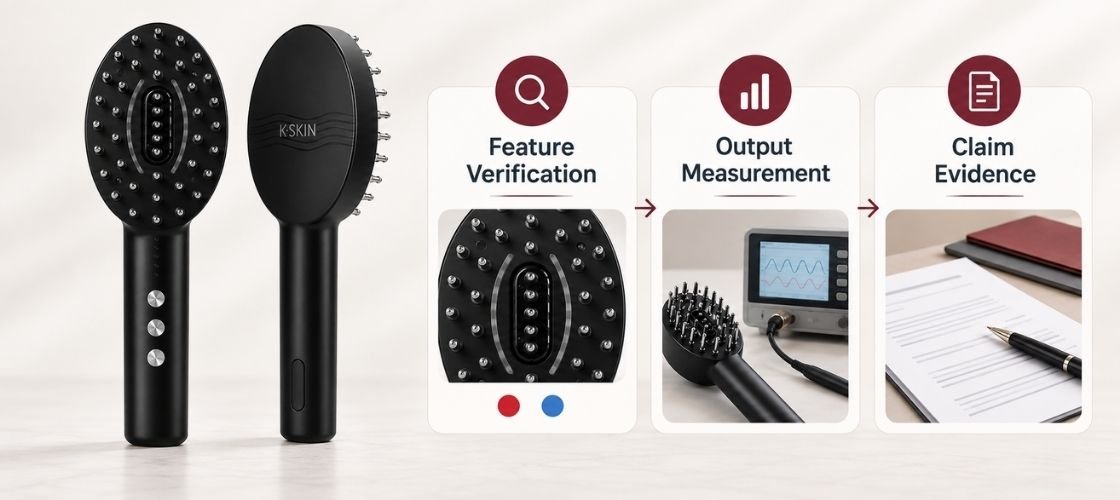
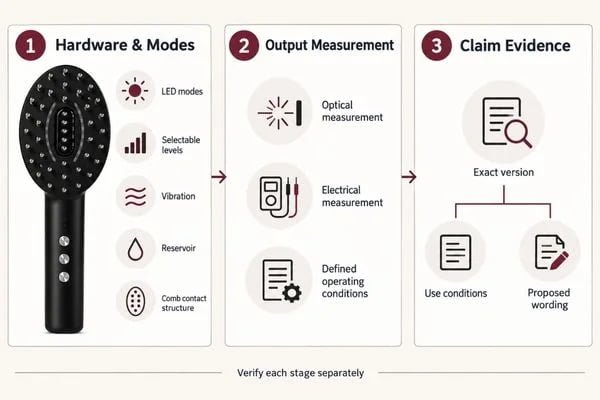
Verify LED and microcurrent scalp comb claims in three stages: confirm the hardware and operating modes, measure the relevant output under defined conditions, and review evidence for any claimed outcome separately. Visible light, selectable levels and vibration do not establish hair-growth or treatment benefits. Approve commercial wording only within the evidence available for the exact product version and intended market.
What Does the KD3802 Feature Description Establish?
The KD3802 LED Microcurrent Scalp Massage Comb is presented as a rechargeable platform combining red and blue LED modes, five-level RP microcurrent control, vibration, elastic metal massage teeth and a liquid-reservoir structure.
This identifies the functions buyers should investigate. It does not establish a measured optical dose, a current value at the contact surface or a biological effect.
The KD3802 A1 manual identifies electrode comb teeth, separate mode controls, level indication and a removable reservoir. Its operating instructions describe LED selection, adjustable levels and vibration control. Use those references to prepare a sample check, then confirm that the supplied hardware and manual belong to the commercial version under review.
Ask the supplier to define “RP microcurrent” in engineering terms. A feature name is not a waveform specification or a universally applicable test method. Likewise, a mode label describes a control selection; it does not independently validate a benefit for the named body area.
Keep the review specific to KD3802. Do not apply a specification or test record for a similarly named model or suffix version unless its coverage is explicitly established.
Which Evidence Supports Each Type of Claim?
Start with the exact wording intended for the product page, packaging and sales materials. Classify each statement before deciding what to request.
| Proposed statement | Evidence to review | What that evidence alone does not establish |
|---|---|---|
| The comb has red and blue LED modes | Version-matched specification and functional observation | Exact wavelength, optical output or treatment effect |
| The device provides selectable output levels | Control specification and measured output at each setting | Equal steps between levels or greater benefit at a higher setting |
| The product provides vibration massage | Confirmed mechanism and repeatable operating checks | Improved circulation or another physiological outcome |
| The LED has a stated wavelength or irradiance | Suitable measurement record for the relevant source and finished configuration | An effective dose at the scalp or a clinical result |
| The product delivers a stated current | Defined load, contact arrangement, waveform and measurement record | The same current under every user condition or a health benefit |
| The product improves a hair or scalp outcome | Evidence designed to substantiate that specific outcome and use condition | Unrelated outcomes, different versions or unrestricted market claims |
A component specification can help identify what was designed into the device. A finished-device measurement answers a different question: what the assembled sample delivered under the recorded conditions.
Keep both records where they are relevant. Do not replace an output test with a photograph of the component, or describe the component supplier’s nominal value as a measured result from the finished comb.
How Should Buyers Verify the LED Function?
Separate Visible Operation From Optical Measurement
First check whether the intended LEDs activate, switch and stop according to the approved control sequence. Record the sample identity and selected mode in any demonstration video.
This establishes observable operation. A bright photograph cannot provide a reliable wavelength or irradiance value. Camera settings, exposure and editing also make photographs unsuitable for comparing optical output between samples.
If the commercial wording includes a wavelength, request spectral data with the measurement method and applicable tolerance. If it includes optical output, ask what quantity was measured, in which units and at which location.
A measurement of the light source does not establish the output at the intended contact plane. NIST’s work on radiometric LED measurements illustrates the use of suitable detectors and defined radiometric quantities rather than visual brightness as the measurement basis.
Define the Measurement Geometry
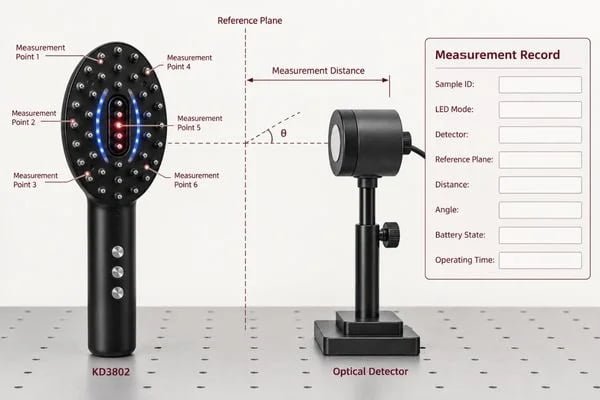
Ask the optical laboratory to document:
- The model, sample identifier and hardware version.
- The LED mode and operating level, where relevant.
- The detector, calibration status and measured quantity.
- The measurement distance, angle and reference plane.
- The locations measured across the relevant area.
- The operating time and battery condition during measurement.
- The uncertainty and acceptance criteria used to interpret the result.
For a scalp-contact product, also ask how the test arrangement relates to the comb teeth, intended contact and possible obstruction by hair. A measurement made directly in front of an exposed LED should not be presented as a demonstrated dose reaching the scalp.
Do not infer a particular red or blue wavelength from color alone. Until an applicable measurement supports a numerical statement, keep the description at the verified mode level.
What Should a Microcurrent Output Record Include?
Identify the Electrical Contact Path
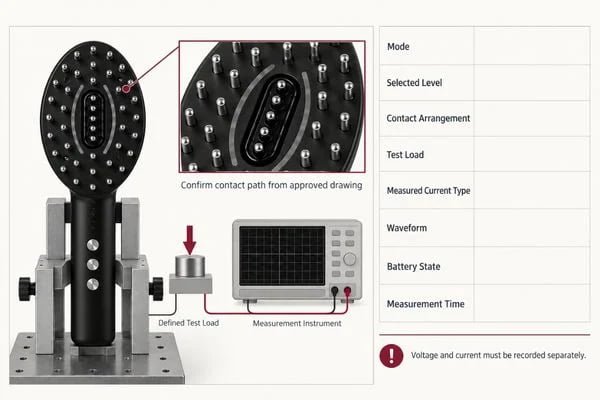
Ask for an engineering explanation of the intended output contacts and return path. Confirm which parts of the comb participate in the circuit and how the test fixture reproduces the specified contact arrangement.
A metallic-looking tooth should not automatically be treated as an electrode. Use the approved drawing or engineering record to identify its role. Where a reservoir or formulation is involved, ask which conditions are permitted for evaluation rather than assuming any liquid can be used.
Do not use a person’s reported sensation as the current measurement. Sensation is an observation, not a calibrated output record. Electrical characterization should be performed by qualified personnel with a suitable fixture and defined load.
Request the Waveform and Load Conditions
A useful microcurrent output verification record should identify:
- The measured output current and whether the value is peak, average, root mean square (RMS) or another defined quantity.
- The waveform, polarity, pulse timing and repetition rate, as applicable.
- The test load and why it was selected.
- The contact locations and fixture arrangement.
- The instrument, probe or current-measurement method and relevant settings.
- Results for each mode and selectable level.
- The battery condition and measurement time within the operating session.
- Sample count, individual results, tolerances and measurement uncertainty.
Require voltage and current to be identified separately. A voltage value, including a peak-to-peak voltage, is not a current measurement. Do not convert it into a published microcurrent figure without a justified method and the necessary load and waveform information.
Check the Relationship Between Settings and Output
Record the displayed level alongside the measured result. If a supplier describes levels as increasing output, ask for data showing the specified progression under the same conditions.
Do not assume that five selectable levels mean five equal increments. Nor does a higher setting establish a stronger consumer benefit.
Ask whether the output remains within the agreed limits as the session progresses and under the battery conditions defined in the test plan. Where contact detection or interrupted-contact behavior is specified, include those states in the review. Avoid inventing a universal current target or acceptance limit for every scalp comb.
How Should Vibration, Controls and Sample Consistency Be Checked?
Vibration should be evaluated as its own function. A motor response does not prove that the electrical output or LED mode is operating correctly at the same time.
Create a mode table showing what each button action should do. Check startup, mode changes, level changes, vibration selection, shutdown and restart against that table. Distinguish a brief vibration used as button feedback from continuous massage operation.
For the contact structure, inspect tooth alignment, movement where designed, return after compression and surface condition. Record loose parts, uneven contact or damage against the sample identifier. Do not turn a satisfactory visual inspection into a claim about skin compatibility or treatment performance.
Compare multiple samples using the same sequence and conditions. The evaluation record should state how many units were checked and retain individual observations. One successful demonstration cannot establish production consistency.
Include any specified automatic shut-off in the comparison. Confirm its approved timing before testing rather than borrowing a duration from another version.
Connect the accepted reference to the subsequent manufacturing and quality-control review. Changes to the LED, control board, output circuit, contact assembly or relevant software should trigger a review of the evidence affected by that change.
How Should Manuals and Commercial Claims Be Reviewed?
Keep Product Instructions Within the Confirmed Scope
Review the manual supplied with the actual sample, including permitted operating conditions, charging restrictions, cleaning instructions, warnings and accessory or formulation requirements.
For a product with a reservoir, distinguish physical compatibility from any claimed benefit of combining the device with a liquid. A removable container does not establish that every formulation is suitable or that the device improves its absorption.
Historical instructions and marketing materials may contain wording that has not been substantiated for the current commercial project. Their presence in the document set does not make those statements suitable for reuse.
Narrow the Claim to What Has Been Verified
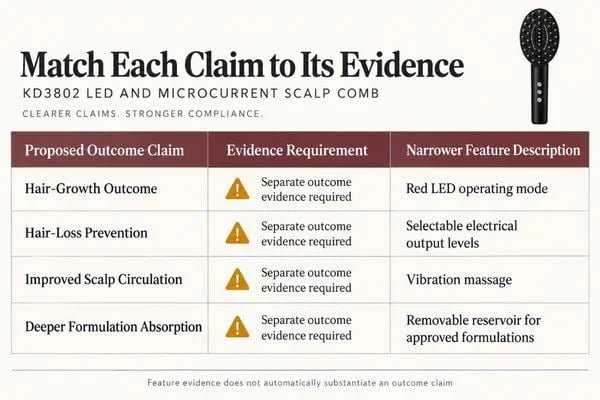
Use a claim register that links each proposed sentence to its source and limitations. The following examples show how to reduce unsupported implications; the narrower wording still requires confirmation for the actual version.
| Wording that needs separate outcome evidence | Narrower feature description to evaluate |
|---|---|
| Red light stimulates hair growth | Includes a red LED operating mode |
| Microcurrent prevents hair loss | Provides selectable electrical output levels, where verified |
| Massage improves scalp circulation | Provides vibration massage |
| The comb drives serum deeper into the scalp | Includes a reservoir for specifically approved compatible formulations |
| Higher intensity produces better results | Provides selectable levels with documented output characteristics |
The narrower descriptions report product features. They do not substantiate the original outcome claims.
For U.S. advertising, the FTC’s Health Products Compliance Guidance addresses substantiation for both express and implied claims. It also considers the overall impression created by words and images. Review health-related wording against the evidence before publication, and check the applicable requirements separately for other destination markets.
Do not pair restrained text with an image that implies follicle activation, deeper penetration or a before-and-after result. The illustration must respect the same evidence boundary as the words.
Can Safety Reports, Certificates or Patents Support Performance Claims?
Read the document’s actual scope before using it. A report assessing electrical safety or electromagnetic compatibility does not, by that scope alone, establish LED performance, delivered microcurrent or a hair-growth outcome.
Likewise, a design patent should not be used as evidence that an electrical function works or produces a physiological benefit. Keep technical measurements, safety documentation and rights records in separate parts of the evaluation.
For any file presented through a supplier’s credentials and documentation, confirm the original applicant or holder, model coverage, version, date and relevant test conditions. A document stored or shared by a company does not automatically establish that company’s ownership of it.
If the report names another entity, retain that name and clarify its relationship to the supplied product. Do not replace it with the seller’s name or imply that unresolved ownership and applicability questions have been settled.
What Should Buyers Approve Before Commercial Release?
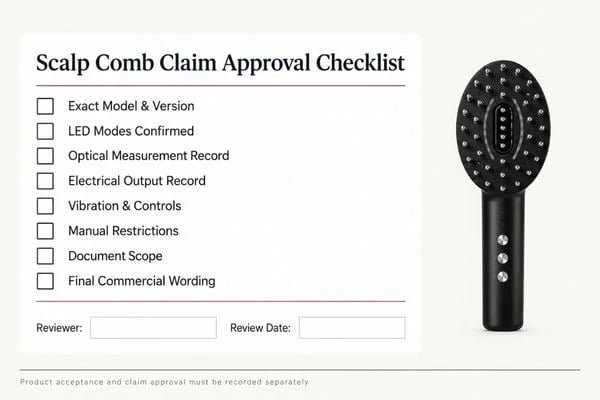
Use a short release checklist that separates product acceptance from claim approval:
- Match the sample, specification and manual to the same model and version.
- Confirm the LED modes, electrical controls, vibration and contact structure.
- Request optical measurements for any numerical LED claim.
- Review current measurements with their load, waveform and contact conditions.
- Compare the specified modes and levels across the agreed sample set.
- Verify operating, cleaning, charging and formulation restrictions in the manual.
- Map each report to its actual legal entity, sample and assessment scope.
- Link every proposed commercial claim to evidence that supports that wording.
- Check packaging, listing images and demonstration videos for unsupported implications.
- Record which component or configuration changes require renewed review.
If a numerical output remains unverified, withhold that number. If a benefit lacks suitable evidence, remove the benefit rather than relying on a disclaimer. Confirmed features can still be described within their documented scope.
Frequently Asked Questions
Can a Supplier Video Replace an Output Test?
A video can document button actions, visible LED operation and the sample being demonstrated. It cannot replace calibrated optical or electrical measurements. Request the underlying records for any numerical statement and ensure they identify the same version shown in the video.
Does a Stronger Tingling Sensation Confirm More Microcurrent?
No. Do not rank output or safety by perceived sensation. Request measurements under defined load and contact conditions. A subjective observation should remain separate from the electrical result and should not be used to infer a beneficial effect.
Can a Published Study About Red Light Support This Comb?
Not automatically. Review whether the studied device, output, exposure conditions, intended use and measured outcome are relevant to the proposed claim. General research does not establish that the particular comb delivers the studied conditions or achieves the same result.
Does a Branded Version Need Its Claims Reviewed Again?
Review the final wording and images even when the hardware is unchanged. Branding can introduce new implied benefits. If the product, contact system, LED or output controls also change, determine which existing measurements remain applicable and what must be rechecked.
Should Missing Efficacy Evidence Stop Every Product Discussion?
It should stop unsupported efficacy claims. Buyers can continue evaluating documented features and commercial fit while keeping unverified benefits out of the proposed positioning. Product safety and applicable market requirements still need their own assessment.
Conclusion
Evaluate a scalp comb by connecting its hardware, operating states and measured outputs to the exact claims being proposed. LED activation, selectable levels and vibration are useful verification points, but none should be expanded into an unproven hair or scalp outcome.
Buyers reviewing K·SKIN’s Hair Styling Tools can apply this review to the KD3802 scalp-care platform. Request the version-matched specification, manual and relevant output records, then approve the product description only as far as that evidence supports it.