
A private-label launch can meet the supplier’s overall order minimum and still fall short for a particular color, box or accessory. Buyers need to understand which requirement sets the quantity before committing to inventory.
Private label beauty device MOQ depends on the selected platform, branding, colors, packaging, accessories, component requirements and market versions. Ask whether each minimum applies to the whole order or an individual configuration. A workable starting quantity requires agreement on those conditions, including any separate material commitments. There is no single quantity that can be applied reliably to every project.

What Does the Quoted MOQ Actually Cover?
MOQ means minimum order quantity. For a buyer, the useful definition is the smallest order the supplier agrees to accept for a clearly specified product and commercial arrangement.
The scope attached to that number matters. An MOQ per model does not necessarily permit any combination of colors, plugs and packaging within the total. A minimum for printed boxes also does not automatically equal the minimum number of finished devices you must receive.
Before comparing quotations, ask the supplier to distinguish:
- Finished-product MOQ: the minimum quantity of the agreed device configuration.
- MOQ per variant: any separate requirement for a color, electrical version or accessory set.
- Packaging MOQ: the quantity required for each box, insert or printed-material version.
- Material commitment: components or packaging that must be purchased even if some remain unused after the first order.
- Shipment quantity: how many completed units will be delivered in each agreed shipment.
Record the unit beside every quantity. “Pieces” could refer to devices, retail boxes, accessories or complete sets. Do not compare these as though they were interchangeable.
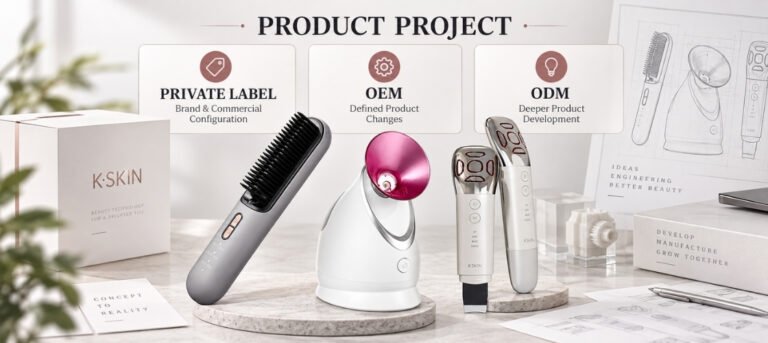
K·SKIN’s Private Label service confirms that commercial conditions depend on the exact model and branding scope. Its published approach does not give one MOQ for all projects. Use a project-specific quotation to establish the quantity for your selected configuration.
Which Requirements Can Set the Minimum Quantity?
Ask for the main constraint behind the quotation. The following table is a review framework, not a schedule of confirmed minimums.
| Area to review | What to ask the supplier | What the answer should identify |
|---|---|---|
| Base product | Does the proposal use an existing configuration or require a separate production run? | Exact model, version and production basis |
| Color and finish | Is there a separate minimum for each requested appearance? | Quantity per color or finish and approval conditions |
| Logo application | Does the marking method introduce setup work or a batch requirement? | Method, placement, setup charge and quantity basis |
| Packaging | Which items have their own ordering minimums? | Box, tray, manual and label quantities by version |
| Accessories | Can the requested set use available approved components? | Included items, separate sourcing needs and minimums |
| Electrical version | Are the requested plug, voltage or charging configurations already supported? | Version-specific availability and quantity requirements |
| Validation | Are sample or pilot quantities required separately? | Purpose, quantity, acceptance basis and cost allocation |
Start With the Exact Base Product
Identify the product before asking for the lowest quantity. A category name such as “facial steamer” leaves the supplier to choose the platform, electrical version, accessories and packaging assumptions.
Use the K·SKIN product range to identify a starting platform, then request the current specification for the version being quoted. A catalogue listing alone does not confirm stock, a production slot or availability for your intended market.
Ask whether the proposed quantity depends on current stock or planned production. If a small order is offered from stock, confirm what can actually be branded and whether the same arrangement would apply to a reorder.
Separate Color From Logo Requirements
A request for a brand color and a request for a logo should be priced and evaluated separately. They can involve different materials, preparation and approval steps.
For color, state whether you can accept an existing option or need a specific reference. Ask whether the quoted minimum applies to every color and whether the finish changes the requirement. For the logo, provide the artwork, location and intended size, then request confirmation of the suitable application method.
Do not treat “no new product mold” as evidence that customization has no quantity implications. Request a separate explanation of setup charges and minimum quantities so you can see which change affects each condition.
Check Packaging and Accessories Individually
Ask the supplier to list the retail box, protective insert, manual, labels and accessories included in the quote. A single line reading “custom packaging included” does not explain whether each language or artwork version has a separate minimum.
Where a packaging order exceeds the first device order, request written terms for the balance. Establish who pays for it, where it will be stored, how it is identified and what happens if the artwork changes before reuse.
Apply the same questions to a branded pouch, additional attachment or other requested accessory. Confirm compatibility and availability before assuming that an accessory can be added at the finished-device MOQ.

How Do Multiple SKUs Change the MOQ Discussion?
A stock-keeping unit, or SKU, identifies a distinct commercial configuration. For this review, list every version you expect to order separately, including differences in color, electrical configuration, accessories and packaging.
Consider a proposed launch with two colors and two market versions. If every combination will be sold, the buyer is planning four configurations. The total order does not establish whether any one configuration meets its applicable minimum. This is a planning example, not a supplier quantity offer.
Build a simple allocation sheet before asking whether the order can be combined:
| Field | What to record for each SKU |
|---|---|
| Product identity | Model and controlled version |
| Appearance | Color, finish and logo reference |
| Electrical configuration | Applicable voltage, frequency, plug or charging version |
| Pack contents | Device, accessories and included printed materials |
| Market presentation | Destination, languages and artwork version |
| Quantity | Initial order quantity for that exact combination |
| Supplier confirmation | Applicable minimum and whether any quantities can be combined |
Then ask which requirements are shared across the order and which remain separate. Two SKUs may share a device platform while requiring different printed materials. Conversely, similar packaging does not prove that electrical versions can share the same production conditions.
Only use a combined-order assumption after the supplier confirms it. Do not reduce the SKU list to one total when requesting a quotation and introduce the variant split after approval.

Do Components, Testing or New Tooling Affect MOQ?
If the project requests a different component or technical configuration, ask whether that change introduces a separate procurement requirement. Record the approved part or configuration, the quantity commitment and the handling of any unused balance.
Also distinguish commercial order quantities from quantities needed for evaluation. A sample request, a validation batch and a production order serve different purposes. Ask whether samples are included in the purchased quantity, charged separately or consumed during testing.
The supplier should explain why a proposed validation quantity is needed and identify the applicable method or project plan. Do not accept “testing requires it” as a complete explanation of a large commercial MOQ. Equally, do not assume a smaller purchase removes the need for relevant product verification.
Changes to structure, electronics or core functions should be reviewed through the OEM/ODM development process. That review should separate development and tooling expenditure from recurring unit prices and material commitments. Paying a tooling fee does not, by itself, establish an unrestricted right to order any quantity.
Keep the technical approval tied to the exact version. A component substitution offered to reduce MOQ still needs review for its effect on the specification and supporting documentation.
How Can Buyers Request a Lower Starting Quantity?
Ask for alternatives that change a specific requirement. A general request to “reduce MOQ” gives the supplier little information about what the buyer can adjust.
Useful options to evaluate include:
- Retaining a suitable existing product configuration.
- Launching fewer colors or commercial versions initially.
- Selecting an available color or supported marking method.
- Using an existing packaging structure with approved artwork changes.
- Removing an optional accessory that creates a separate sourcing requirement.
- Separating a setup charge from the unit price, if the supplier offers that arrangement.
Request a revised quotation for each practical option. The response should state what changes, which minimum is reduced, and what costs or responsibilities remain. These are negotiation options, not guaranteed ways to obtain a lower MOQ.
Compare Inventory Exposure as Well as Device Quantity
A smaller finished-device order can still require a larger packaging or component purchase. Before accepting it, compare the full commitment:
- Devices purchased for the first order.
- Separately purchased packaging or components.
- Setup, sample, development and agreed validation charges.
- Storage or later handling charges, where applicable.
- Conditions for using the remaining materials in future orders.
Ask whether a staged delivery means a smaller purchase commitment or simply later shipment of goods already purchased. Record payment timing and responsibility for the remaining stock rather than assuming that deferred delivery reduces inventory exposure.
Do not lower the starting quantity by silently changing materials, omitting necessary verification or accepting incomplete labels. Any alternative should still match the approved product and intended market requirements.

What Should Buyers Confirm Before Accepting an MOQ?
Use an MOQ-specific checklist alongside the quotation. It should make the commercial assumptions visible without repeating the entire development brief.
- Identify the exact model and version covered by the offer.
- Record the initial quantity for each color, electrical version and packaging configuration.
- Ask whether every minimum applies per order, model, SKU, color or packaging version.
- Confirm which materials or quantities the supplier has agreed can be combined.
- List packaging and accessories included in the finished-unit price.
- Separate one-time charges from recurring unit prices and material purchases.
- Confirm the quantity, payment, storage and reuse terms for any unused materials.
- Identify samples or test units that will not become saleable inventory.
- Confirm what must be approved before the commercial terms become firm.
- Record quotation validity and the changes that would require a new MOQ review.
Ask the supplier to return these answers against the same configuration sheet. Keep the response with the approved quotation so purchasing, product and operations teams work from one version.
Watch for Unexplained Quantity Changes
Pause the commercial decision if the MOQ changes without an identified change in scope or supply conditions. Ask for the revised basis in writing.
Other points needing clarification include a total-order MOQ with no variant rules, an accessory shown in the sample but excluded from the quote, or a packaging balance that no party has agreed to own or store. An unexplained condition is a reason to ask for clarification, not proof of supplier misconduct.
The useful outcome is a clear choice: accept the stated configuration and commitment, revise the requirement that drives it, or evaluate another suitable platform.

Frequently Asked Questions
Can an Annual Forecast Satisfy the First-Order MOQ?
Do not assume so. Separate the forecast from a confirmed purchasing commitment. Ask whether the supplier offers an arrangement based on scheduled orders, what the buyer must commit to and what happens if actual demand differs. Record those terms before relying on forecast volume in the quotation.
Can Several Brands Share One MOQ?
Ask specifically. The products may share a base platform while logos, artwork, labels or packaging remain separate. Request confirmation of the minimum for each brand configuration and any quantities that can be combined. A shared product model alone does not establish the answer.
Does a Sample Order Establish the Production MOQ?
No. A sample quotation covers its stated evaluation scope. Ask for a separate commercial quotation identifying the production version, branding, packaging and order conditions. Confirm whether sample charges are treated separately or credited under any agreed arrangement.
Will a Repeat Order Have the Same MOQ?
Confirm it when reordering. Provide the previous approved version and identify any changes to color, artwork, accessories or market configuration. Ask whether the earlier quantity basis still applies and whether retained materials remain suitable and available for use.
Can We Change Packaging After Agreeing on the Quantity?
Request a change review before authorizing revised artwork or materials. Ask whether the change affects quantities already ordered, preparation work, unused inventory, price or timing. Record the revised commercial terms and packaging reference before production proceeds.
Conclusion
A useful MOQ discussion identifies the requirement behind each minimum and the exact configuration it covers. Compare quantities at the model, variant and material level, then assess the full purchase commitment rather than only the number of finished devices in the first shipment.
For a K·SKIN project, prepare the selected platform, target market, proposed SKU quantities and essential branding requirements. Share them with the project team to request a configuration-specific review and confirm which alternatives are practical before committing to the launch order.