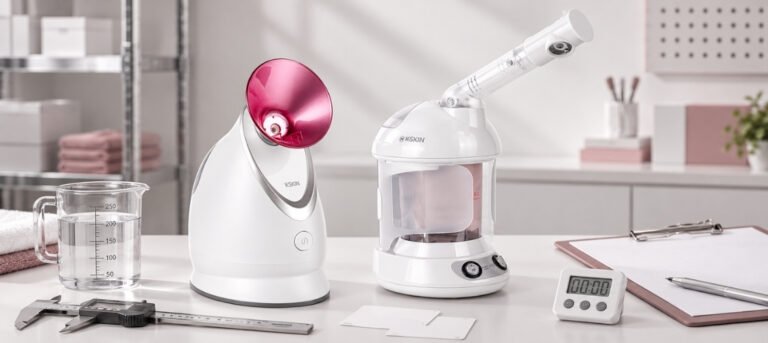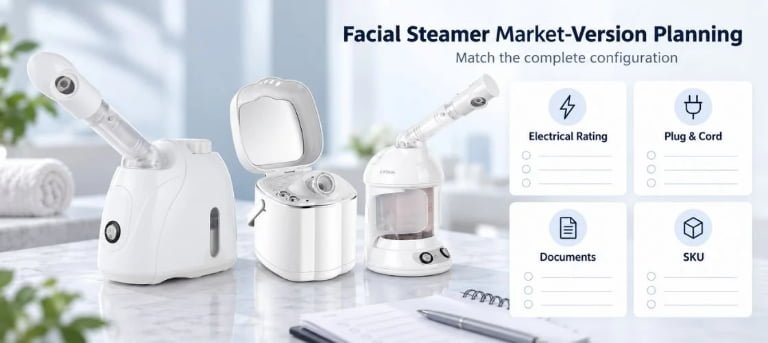
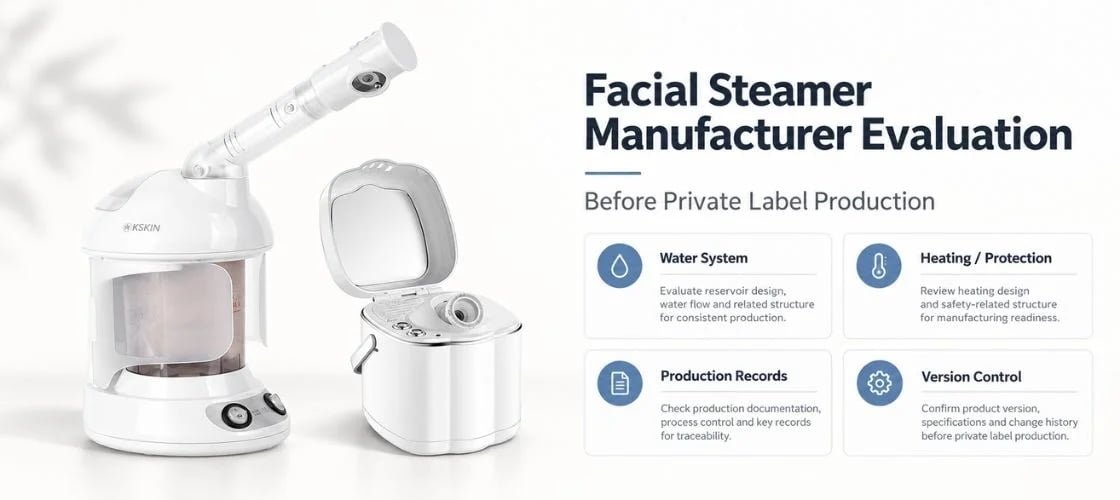
Seeing a sample produce steam is a useful first step. For a private-label project, the next question is whether the supplier can reproduce that performance in the version your brand will order, pack and support.
To evaluate a facial steamer manufacturer, connect the proposed product with its water-system engineering, heating and protection evidence, production controls and version records. Comparable samples, packaging checks and corrective-action records help buyers assess how the supplier manages the complete device. The aim is a clear evidence base for the exact configuration being ordered, including how findings and changes will be handled.
Establish Who Will Supply and Manufacture the Product
A sales company, engineering team and production site may have different responsibilities within one project. Clarifying those roles early makes technical discussions easier and helps buyers understand who can approve a correction if a sample or batch needs attention.
| Project role | What to establish | Evidence to request |
|---|---|---|
| Contracting seller | Who issues the quotation, accepts the order and handles commercial remedies | Consistent company details and agreed terms |
| Engineering team | Who defines the water, heating and control configuration | Responsible contact and version-specific technical documents |
| Manufacturing site | Where the proposed version will be assembled and checked | Identified site, relevant process review and production records |
| Quality and release team | Who evaluates findings and authorizes product or batch release | Inspection responsibilities and approval records |
Several legal entities can contribute to the arrangement. What matters is that their roles are clear and any manufacturing or authorization claims have supporting records. Buyers should be able to follow the proposed order from the contracting seller to the people responsible for building and checking it.
Factory photographs can help introduce the site and its activities. Their value grows when the supplier can connect them to the relevant process and explain a corresponding production record. A photograph on its own cannot establish that a particular model is being manufactured there.
Match the Supplier to the Facial Steamer Platform You Need
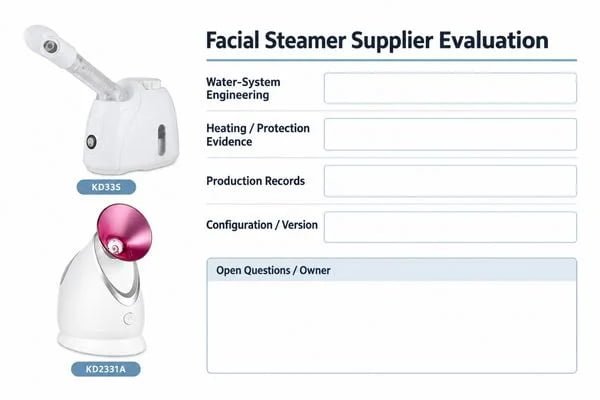
The most useful evidence concerns the platform your brand intends to sell. K·SKIN's current facial steamer range includes KD33S, KD2328, KD2331A and KD2332. Each format brings a different set of questions into the supplier review.
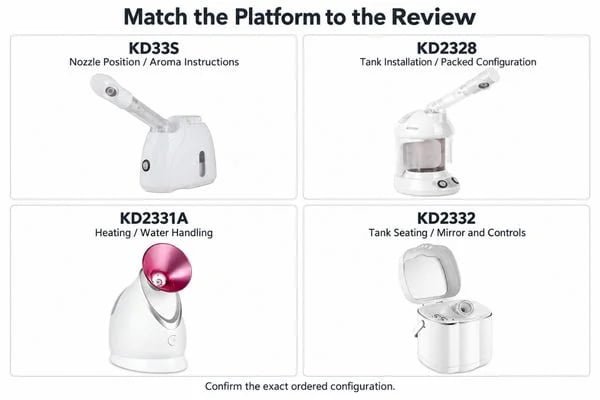
| Platform reference | Product direction | Questions to bring into the supplier review |
|---|---|---|
| KD33S | Long-nozzle warm-mist format with a designated aroma compartment | How are nozzle positioning, compartment instructions, filling and water-system assembly checked? |
| KD2328 | Larger-tank tabletop format | How are tank installation, sealing, steam-arm behavior and the packed configuration verified? |
| KD2331A | Compact facial-steamer format | Which heating, nozzle and water-handling configuration defines the quoted version? |
| KD2332 | Multifunction format with a removable tank, mirror and separate light control | How are tank seating, drainage, moving parts and the quoted light configuration kept consistent? |
These references help focus the discussion. The ordered version still needs to be matched to its specification, instructions and sample; approval for one configuration or market should not be extended to another without review.
For KD33S, the aroma compartment is a feature to check alongside its permitted materials and instructions. Its presence does not authorize additives in the water tank. For KD2332, the additional light function brings another control and configuration into the review, without establishing a therapeutic effect or better steam performance.
If your project requires a different tank, nozzle or housing, ask the supplier whether the requirement can be met within an existing platform, through controlled engineering changes or with new tooling. Our guide to choosing between an existing product platform and new tooling helps structure that discussion around product fit, validation scope and development commitments.
Test Engineering Knowledge With Water and Heating Questions
An informative engineering discussion connects the supplier's explanation with parts, operating conditions and inspection records. Buyers can ask focused questions about the proposed version without requesting every confidential design drawing.
Follow the Water Path Through the Product
A useful starting point is a walkthrough of filling, tank installation, seals, the water path and the steam outlet. The engineering team can then explain where installation errors, assembly variation or damaged parts could affect operation and how those conditions are checked.
On a removable-tank platform such as KD2332, tank seating and the cap or seal arrangement are relevant points. On a long-nozzle format such as KD33S, the discussion also includes permitted movement and how the nozzle holds position during the approved routine.
The explanation should distinguish expected condensation from unintended leakage and abnormal water carryover. If moisture appears on a sample, noting its first location, timing and repeatability gives the supplier a clearer basis for investigation.
Connect Heating and Protection to Documented Functions
The heater, thermal controls, indicators and claimed protection functions need to be understood as a system. PTC heating identifies one element; the supplier's explanation and records should show what the complete protection arrangement does.
For a low-water or automatic shut-off claim, the useful questions concern the defined function, operating conditions and evidence. Steam stopping, an indicator changing and heater power being disconnected are different observations. The review needs to establish which one supports the particular claim.
Abnormal-operation and electrical safety checks require qualified personnel and appropriate methods. Buyer demonstrations should follow the supplied instructions; deliberately blocking outlets or operating outside permitted conditions is not a suitable substitute for those checks.
Make Sample Review Demonstrate the Proposed Version
Sample evaluation shows how the product behaves and how the supplier works with findings. A clear record makes that discussion more productive than relying on a short steam demonstration, especially when several versions or samples are being compared.
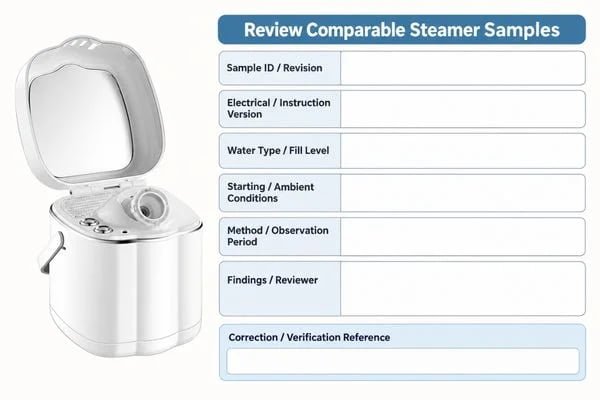
Agree Comparable Conditions
Each sample record should identify the model, revision, electrical rating, instruction version and relevant configuration. Water type, fill level, starting condition, ambient conditions and observation period provide the context needed to interpret its behavior.
The review can follow steam output through the permitted operating cycle while checking tank installation, controls, nozzle positioning and the prescribed draining or cleaning routine. Equivalent samples should be evaluated using the same method, with a sample quantity agreed for the purpose of the review.
For measurements, define the location, instrument and acceptance criteria. Visible steam does not establish particle size, and one temperature reading does not describe the whole steam path. Any numerical claim needs a record that measures the quantity being claimed.
Use Findings to Assess the Supplier's Response
Inconsistent output or unexplained moisture creates an opportunity to see how the supplier investigates. The response should identify the affected sample, how the condition was reproduced, the established cause and the proposed correction.
A replacement sample can keep the evaluation moving, but it is more informative when accompanied by a change record. Reviewing the corrected version under relevant conditions, including any connected functions, helps establish whether the finding has been addressed.
Accepted samples provide a product reference for the project. Manufacturing controls are then needed to check whether production follows that reference consistently.
Follow the Controls From Components to Finished Units
Manufacturing capability becomes easier to assess when critical parts can be followed through assembly, functional checks and release records. K·SKIN's manufacturing and quality overview identifies water-system, heating, steam-output and leakage-related checks for facial steamers. The project discussion should connect the applicable checks to evidence for the selected version.
Look for Controls at the Relevant Assembly Stages
A process review might follow tank and seal verification, water-path assembly, heater and control installation, electrical checks and final functional inspection. At each relevant stage, the supplier can explain how deviations are detected and affected units identified.
An example record is particularly helpful when it connects the product or batch reference, check performed, acceptance basis, result and responsible reviewer. The review should also establish how proposed part substitutions are assessed before entering production.
Relevant records can be redacted to protect confidential information. They still need enough model, configuration, result and traceability detail to answer the qualification question. Removing those details can leave a genuine record with little practical value to the buyer.
Review Wet Testing, Drying and Rework
Where functional testing uses water, filling, draining, drying and packing deserve their own process discussion. The supplier should explain these steps for the actual product and production arrangement.
If remaining water is attributed to factory testing, the corresponding procedure and record help clarify that explanation. Residual moisture by itself establishes neither that a test took place nor that the unit is ready for shipment.
Rework needs the same connection between action and evidence. A repaired or adjusted unit should receive the checks relevant to the correction before release. Results recorded before the work describe the earlier condition, not the corrected unit.
Match Documents to the Private-Label Configuration
The model name is the starting point for document review. A complete comparison also connects the commercial product, electrical ratings, instruction set and supporting evidence to the version quoted and sampled.
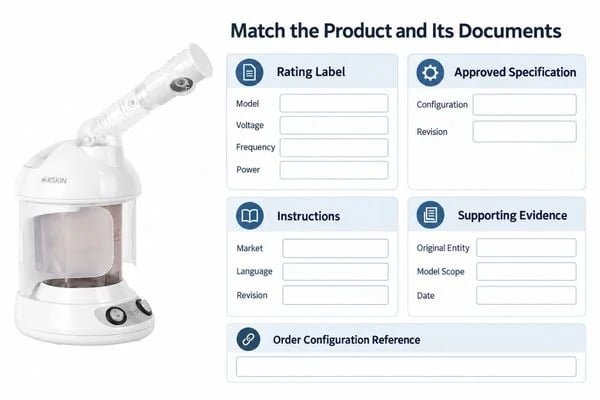
Keep Model and Electrical Versions Traceable
Review voltage, frequency, rated power, plug and cord together. Separate electrical versions should remain identifiable as separate configurations; their availability does not establish dual-voltage capability in one unit. Changing the plug alone does not establish suitability for another electrical supply.
If a report uses a factory model code while the website uses a commercial reference, a documented mapping helps establish the relationship. It needs to describe the exact configuration, beyond a similar appearance or related name.
The rating label, manual, approved specification and order record should agree. Older documents may remain useful background, but any differences need an explanation of which version applies to the order.
Preserve Evidence Roles and Scope
For relevant reports and certificates, the review should cover the applicant, manufacturer, holder where applicable, model scope, tested configuration, standard or method, date and destination-market applicability. Current status should be checked where required; an issue date or catalog logo alone is insufficient.
Where the contracting seller differs from the named manufacturer or applicant, the relationship needs supporting information. Keeping the original legal names intact makes the roles visible. Possession of a document does not establish ownership by the supplier's current sales company.
Quality-system and product-specific evidence serve different purposes. A quality-management certificate can inform the organizational review, but it cannot replace the records needed for the proposed steamer and its market configuration.
Include Packaging and Corrective Action in the Commercial Review
The evaluation also needs to consider the packed product and the support available after delivery. Discussing packaging and fault handling alongside the technical review gives buyers a clearer basis for comparing commercial offers.
Evaluate the Actual Packed Configuration
Check how the insert supports the tank, nozzle, lid and supplied accessories. The packing list, retail box and master carton should describe the version used in the agreed transport evaluation.
After that evaluation, the review should cover damage and relevant functional or water-system checks. Tank seating, nozzle movement and sealing may need attention even when the carton appears intact.
The evidence behind a transport claim should identify the method, packed configuration, sample quantity, conditions and results. A drop-test requirement in a specification sets an expectation; a completed record shows what was evaluated. A packaging photograph does not replace either.
Assess How the Supplier Closes a Defect
A useful corrective-action example follows the problem through containment, confirmed cause, correction and verification. For a recurring water-system defect, the discussion should explain what changed in the product or process and how recurrence is checked.
Commercial terms should make fault reporting, required evidence, agreed remedies and responsibility for costs or replacements clear. Parts availability and warranty arrangements also need confirmation for the particular project.
MOQ and timing can then be compared against the selected model, electrical version, branding, packing and review scope. When those items are defined, differences between quotations become easier to interpret.
Use an Evidence-Based Supplier Scorecard
A scorecard helps keep the evidence organized while making open questions visible. Its purpose is to support a qualification decision, with potential release-blocking issues recorded separately from the total.
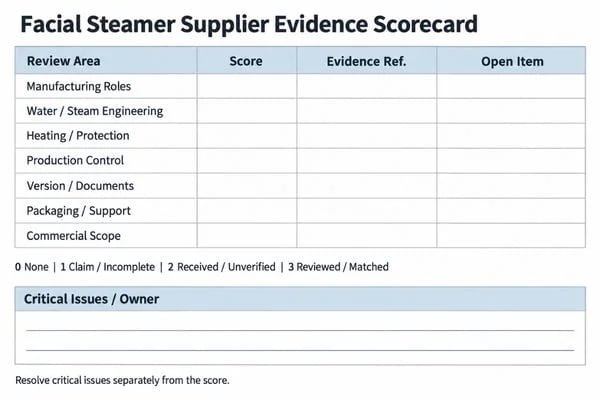
One suggested buyer-side scale is: 0 for no evidence supplied, 1 for a claim or incomplete record, 2 for relevant records received but not yet verified, and 3 for evidence reviewed and matched to the proposed configuration. Use these as internal planning categories, not a certification rating or universal supplier standard.
| Review area | Evidence to assess | Finding that needs attention |
|---|---|---|
| Manufacturing roles | Seller, engineering and site responsibilities with supporting records | The proposed manufacturing arrangement cannot be explained |
| Water and steam engineering | Version-specific technical explanation and evaluation records | Leakage or unstable operation is dismissed without investigation |
| Heating and protection | Defined functions and relevant verification evidence | Protection claims rely only on heater terminology |
| Production control | Component, assembly, functional and rework records | Results cannot be connected to the product or batch |
| Version and documents | Matching ratings, instructions and evidence scope | A wrong electrical version or unresolved document mismatch remains |
| Packaging and support | Packing validation and a traceable corrective-action example | The supplier offers only generic packing claims or replacement samples |
| Commercial scope | Quotation assumptions, quantity basis and agreed remedies | Essential work or responsibility is left outside the quotation |
Scores should reflect the evidence reviewed, with a responsible person identified for remaining checks. An unresolved safety concern or incorrect electrical version still needs resolution, regardless of how well the supplier performs in other areas.
Record the Decision Before Authorizing Private Label Production
The qualification outcome should make the next step clear. A supplier may have sufficient evidence to continue sampling while still needing to close items before production release. Recording that distinction helps both parties understand the scope of the decision.
Use this handover checklist:
- Record the contracting seller, manufacturing site and technical contacts.
- Identify the selected model, revision and target-market configuration.
- Agree the water-system, steam, control and protection review scope.
- Retain sample identities, observations and supporting results.
- Confirm relevant manufacturing checks and rework controls.
- Resolve document, rating and legal-role mismatches affecting the order.
- Approve branding, instructions, labels and the complete packed version.
- Confirm quotation scope, quantity commitments and defect remedies.
- List open items, responsible people and the decision each item prevents.
- Separate supplier qualification, sample approval and production authorization.
Potential safety issues, repeatable unresolved leakage and wrong rated versions should hold the affected approval while they are investigated. Less critical gaps can be assigned for closure before the stage they affect, allowing useful project discussions to continue without treating uncertainty as approval.
FAQ
These questions address practical limits that can arise during a facial steamer supplier review.
Must a Supplier Offer All Four Facial Steamer Formats?
No. The useful question is whether it can support the platform and commercial version your project needs. A focused range with traceable engineering and production evidence can give buyers more to evaluate than a broad catalog with little supporting detail.
Can a Remote Review Replace an On-Site Factory Audit?
A remote review can help assess documents, roles and selected process records. How far it can support the decision depends on access and evidence quality. If an important process or traceability question remains unresolved, a targeted site visit or independent inspection may be appropriate before commitment.
What If the Supplier Cannot Share Its Full BOM?
The discussion can focus on information needed to evaluate critical parts, configuration control and substitution procedures. Relevant redacted records or a controlled review may help, provided the arrangement preserves enough evidence to assess safety and product consistency.
Can a Third-Party Pre-Shipment Inspection Replace Supplier Qualification?
Pre-shipment inspection assesses the batch against an agreed scope. Supplier qualification helps establish the manufacturing arrangement and the basis for the product being ordered. Both should connect to the same controlled specification; batch inspection cannot resolve an undefined product version or incomplete approval basis.
Does Selling Through a Salon Make a Home-Use Platform Suitable for Professional Duty?
The sales channel does not define permitted use. Where repeated professional operation is required, the buyer needs intended-use confirmation and supporting evidence for that configuration. Retailing a home-use product through a salon does not establish a broader duty rating.
Conclusion
Evaluating a facial steamer manufacturer means following the proposed product through its water and heating systems, samples, production controls, documents and packing. The supplier's response to findings is part of that assessment: it shows how corrections and configuration changes are documented and verified.
Begin with the K·SKIN facial steamer platforms that fit your intended range, then review the evidence for the version your brand will order. A clear product reference, agreed checks and a documented decision give both buyer and supplier a more useful starting point for private-label production.
For your next product review, explore facial steamer sourcing and private label options.