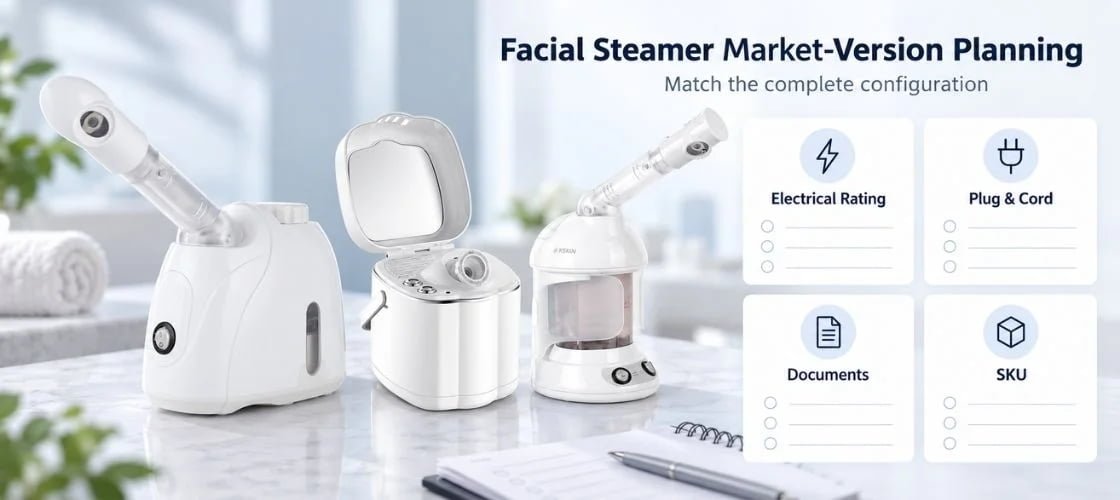
A facial steamer can arrive with the expected plug and still be the wrong version for an order. Importers need to align the electrical configuration, product documents and packed SKU before approving samples or allocating stock.
Plan each facial steamer market version as a complete configuration: rated voltage and frequency, plug and cord, relevant components, rating label, instructions, supporting documents and SKU. A plug adapter does not establish electrical compatibility. Confirm the exact version for each destination, evaluate matching samples and keep that identity traceable through production, packing and the customer-facing product listing.
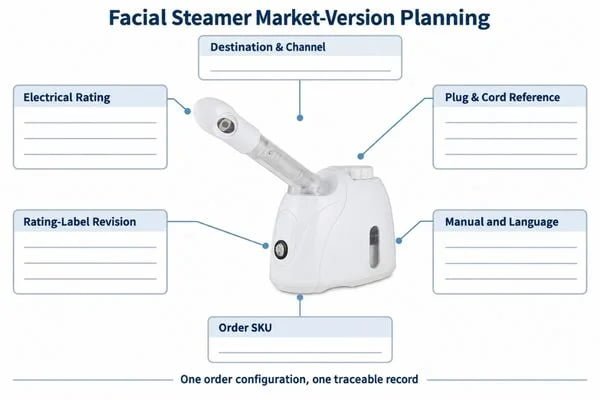
Define the destination before choosing the electrical version
“EU plug” or “export version” leaves too much unresolved. Start with the destination country, sales channel and intended use, then ask the supplier to identify a suitable configuration and the evidence available for it.
Confirm commercial availability alongside electrical suitability. A historical document or retained sample may describe a configuration that is no longer offered, or one that is unavailable for the intended territory or channel.
Create a market-version record for each proposed configuration using the fields below. Identical housings can conceal different electrical builds.
| Planning field | What the buyer should specify or confirm |
|---|---|
| Destination and channel | Exact country or jurisdiction, sales route and any project-specific restrictions |
| Product identity | Commercial model, factory model where different, and approved revision |
| Electrical rating | Rated voltage or range, frequency and power for the finished appliance |
| Plug and cord | Applicable plug specification, complete cord assembly and relevant construction details |
| Product definition | BOM revision and the components that distinguish this electrical version |
| Labels and instructions | Rating-label artwork, manual revision, required languages and responsible-party details |
| Supporting evidence | Reports and other required documents matched to the configuration and market |
| Commercial identification | Order code, SKU, barcode where used, and packing specification |
Assign responsibility for confirming local requirements and the product configuration. Resolve missing fields before finalizing the quotation, using evidence for the intended version rather than copying another market’s record.
Use model records to identify the electrical version
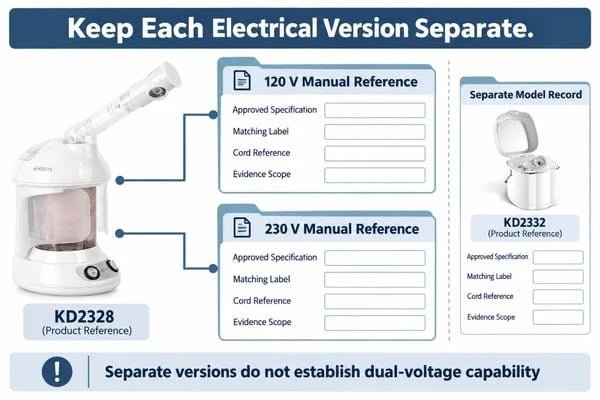
Retained records for KD2328, KD2331A, KD2332 and KD33S show how electrical configurations can differ within a model range. The table identifies specific document versions. Confirm the approved specification and labeling for the actual order before selecting a build.
| Model | What the reviewed records show | What still needs confirmation for an order |
|---|---|---|
| KD2328 | Separate PTC manual versions list 120 V / 60 Hz and 230 V / 50 Hz, both at 350 W. A tube-heater A1 specification dated October 30, 2025 lists 220 V / 50 Hz and 400 W. | The intended heating construction, rating, plug, manual and supporting evidence must belong to the same version. |
| KD2331A | The C2 bilingual manual lists 220 V / 50 Hz and 280 W. The October 12, 2021 specification also records 220 V / 50 Hz and 280 W. | Confirm the actual supplied revision and destination configuration; these records do not establish every available export version. |
| KD2332 | The A0 manual dated November 1, 2018 lists 220 V / 50 Hz and 280 W. The October 27, 2025 A1 specification records the same electrical values. | Matching ratings across documents do not establish identical construction, packaging or current approval status. |
| KD33S / K33S | The K33S A1 engineering specification dated December 5, 2024 describes alternative 220 V and 110 V PTC components and corresponding cord choices. | Confirm the complete finished-device rating, frequency, construction and evidence for the selected configuration. Component options do not prove dual-voltage operation. |
Separate voltage variants from dual-voltage capability
Separate manuals stating different voltages document different configurations. Neither manual establishes that an individual appliance can operate at both voltages.
Alternative heater parts in an engineering document represent manufacturing choices. Buyers and end users should not use that list as instructions for converting an appliance. A dual-voltage claim needs explicit support in the approved specification, appliance marking, instructions and applicable evidence for the unit concerned.
Do not turn a single rating into a range. A record stating 220 V does not by itself authorize a 220–240 V claim, and a 50 Hz record does not establish 50/60 Hz operation.
Keep factory and commercial model references traceable
The official KD33S product page explains that some factory records use K33S for the KD33S commercial model. Preserve both identifiers when requesting documents, then verify the rated configuration and revision covered by each record.
The KD2332 product page also leaves target-market voltage, plug and supporting documents for confirmation. Use the page to identify the platform, then confirm the configuration for the order.
Specify the complete plug and cord assembly
Facial steamer voltage and plug selection involves more than choosing a pin shape from a photograph. Ask for the plug specification and cord assembly that will actually be fitted to the approved version.
The review should identify relevant component references, cord markings and ratings, length, entry arrangement and any applicable fuse, polarization or protective-earth requirements. Have the responsible technical reviewer confirm which features apply to the appliance design and destination. Do not infer its protection class from the number of visible pins.
Distinguish the cord rating from the appliance rating
A voltage or current marking on a cable or plug describes that component’s rating. Check the finished steamer’s operating voltage on its appliance rating label and approved specification. A higher voltage printed on the cord does not extend the appliance’s operating range.
A simple travel adapter changes the physical connection; it does not convert voltage or frequency. Electrical Safety First makes this distinction in its travel-adapter safety guidance.
Define the intended connection arrangement before sample approval. An adapter cannot resolve an unverified electrical configuration. Check the product instructions before considering a voltage converter, since its use may be prohibited for the supplied version.
Approve the rating label and manual together
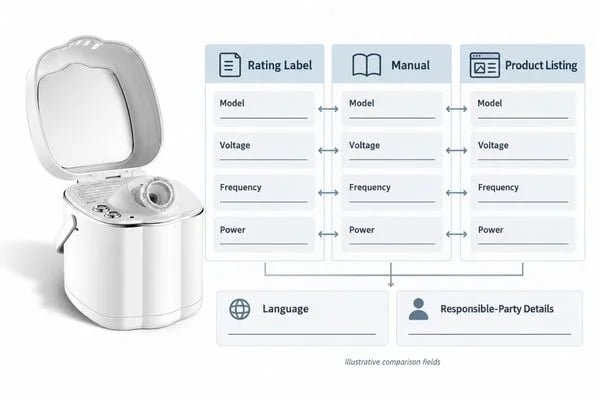
The label, instructions and product listing should describe the same appliance. Review them as a set, with the sample and specification beside them, before approving artwork or translation.
Check electrical information in every place it appears
Compare the model reference, voltage, frequency and power across the relevant files. Inspect both language sections of a bilingual manual and every market-specific panel of the packaging. An old rating can survive in a specification table even after the main artwork has been updated.
Check the operating instructions for the correct plug, switches, filling procedure and accessories. Translation approval should include a technical comparison with the supplied version, not just a language review.
Record any conflicting fields and request a controlled correction. Resolve the intended rating through the approved product definition; neither the most frequently repeated value nor a convenient catalog entry settles the discrepancy.
Confirm languages and legal roles for the destination
Language and responsible-party information require a market-specific review. For example, the UK government's guidance for electrical equipment supplied in Great Britain requires clear, understandable English instructions and sets out manufacturer and importer responsibilities. See the Great Britain electrical-equipment guidance. This is one jurisdiction's framework, not a complete international labeling checklist.
Preserve the actual legal entities in original reports. The seller, manufacturer, importer and document holder may have different roles. Adding K·SKIN branding does not automatically change the applicant or manufacturer named in an existing test report.
Match supporting documents to the rated configuration
Check more than the model name on a document. Review its rated voltage and frequency, product revision, relevant construction, tested sample, standards, date and intended market scope.
A report limited to a stated electrical range does not automatically cover a separate lower-voltage version. Review applicability again if the heater, control board or cord assembly changes while the model name stays the same.
Ask the supplier to explain the connection between the order specification and the submitted evidence. Where the scope is unclear, seek confirmation from the responsible technical team and, when necessary, the issuing laboratory or certification body.
Keep different document functions separate:
- A safety report addresses the sample and safety requirements within its recorded scope.
- An EMC report concerns electromagnetic compatibility within its stated scope; it is not a substitute for electrical-safety evidence.
- A materials-related document does not establish plug suitability or correct mains operation.
- A company management-system certificate does not certify every facial steamer configuration.
The K·SKIN credentials page is a starting point for requesting available records. Review the original copies against the intended order, including their legal entities and any limitations, rather than treating a document collection as blanket market approval.
Give each saleable configuration an unambiguous identity
Purchasing, production, packing and the warehouse need a practical way to distinguish versions. An electrical difference hidden in an email is easily lost when the sales model and product color remain the same.

Connect the SKU to controlled documents
Use a distinct SKU or an equally clear controlled variant identifier whenever configurations need separate ordering or stock handling. Choose a code format that reliably identifies one defined product and pack.
For each identifier, link the approved specification, BOM revision, plug and cord reference, label artwork, manual, accessories and packing instructions. Record which versions of the supporting documents apply.
Avoid a description such as “KD2328 export” if several electrical builds could satisfy it. Include the approved rating and configuration reference in the purchase-order description or linked specification.
Decide which differences can share a configuration
Two destinations may be able to use the same hardware while needing different instructions or commercial packs. Check the complete configuration before sharing hardware across destinations, even when their plugs look similar.
Make the sharing decision only after the relevant electrical, documentary and market requirements are confirmed. Where the hardware is shared, retain separate pack or language identifiers if needed for fulfillment. Where the hardware differs, keep the corresponding BOM and inspection references distinct.
A later component or artwork change should trigger review of the affected configurations. Do not apply a revision to every SKU simply because it belongs to the same model family.
Evaluate a sample that represents the intended market version
Check whether the sample has the intended cord, label and internal configuration before testing. A showroom unit with temporary parts may support appearance and handling review while leaving electrical-version approval open.
Establish the sample identity and test conditions
Record the sample number, model, revision, electrical rating, cord reference and document set. Photograph the appliance label, plug, cord markings and packed contents so the evaluation record can be traced to the unit received.
Have competent personnel confirm the supply and connection before energizing the sample. Functional evaluation should use the intended rated supply under an agreed method. Assign electrical-safety and abnormal-condition testing to suitably qualified personnel with appropriate equipment.
For a steam-performance check, define:
- Sample quantity and identification for each version.
- Actual supply voltage and frequency, with suitable measurement records.
- Water type, fill quantity and starting temperature.
- Ambient conditions and whether the appliance starts cold or after conditioning.
- Nozzle position, operating mode and the definition of first stable steam.
- Observations or measurements required, acceptance criteria and the source of those criteria.
Control the starting conditions when comparing versions. A warm sample and a cold sample may produce different results for reasons unrelated to voltage. Set heat-up and steam-output criteria from the approved project requirements rather than treating this checklist as a source of universal limits.
Record approval separately for each configuration
Connect the results to the exact version evaluated. Approval of one electrical build should not silently release another, even when both use the same enclosure and nominal power.
If the supplier proposes carrying evidence across versions, request the technical justification and any additional verification needed. A passing functional check on one unit does not establish compliance for every market or consistency across future batches.
Run a version check before packing and listing
Check the customer-facing offer as well as the packed product. The correct appliance can still be shipped with the wrong manual or allocated to a listing that describes another electrical version.
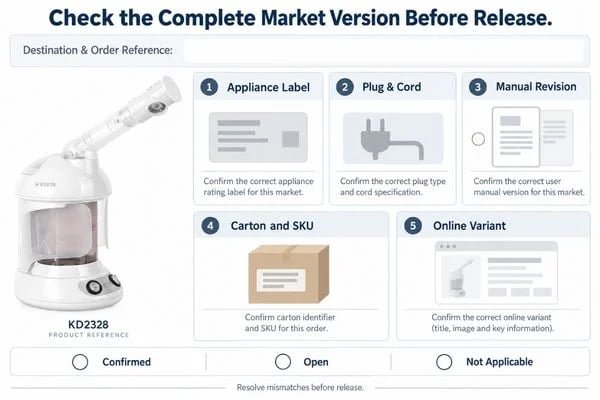
Use this checklist before releasing the affected order:
- Confirm the destination and channel against the approved commercial scope.
- Match the purchase-order item to the approved electrical configuration and BOM revision.
- Check the fitted plug and cord against the approved reference.
- Verify that the appliance label agrees with the specification and supplied unit.
- Confirm the correct manual revision, language and accessory instructions are packed.
- Match available evidence to the model, rated version and applicable market requirements.
- Check SKU, barcode where used, carton marks and warehouse allocation.
- Compare the listing's voltage, frequency, plug image and included items with the actual stock.
- Remove unsupported “dual voltage,” “universal” or “worldwide compatible” claims.
- Resolve substitutions and document mismatches before release, retaining the decision record.
Record each item as confirmed, open or not applicable, with the supporting evidence or reason. Assign unresolved mismatches for review before release; a scheduled shipment does not close them.
Keep earlier stock identifiable after a revision. Returns and replacement units also need the correct electrical version; a matching model name or housing color is not enough for a replacement decision.
FAQ
Does offering 110 V and 220 V versions make a facial steamer dual voltage?
No. Separate manufacturing options do not establish that one appliance supports both supplies. Require explicit documentation for the individual unit, including its approved rating, instructions and applicable evidence. Do not combine separate catalog entries into a dual-voltage claim.
Can “110 V” and “120 V” be used interchangeably in an order?
Do not substitute one for the other without confirmation. Use the exact approved rating or range, together with frequency. Ask engineering to resolve differences between a quotation, appliance label and supporting documents before the order is released.
Is a report showing K33S relevant to a KD33S order?
The official KD33S page identifies K33S as a factory reference used in some records. That helps explain the naming relationship, but applicability still depends on the actual rated configuration, revision and document scope. Retain the mapping with the order documents.
Can one multilingual manual cover several market versions?
Potentially, if it clearly identifies the applicable configuration and gives correct instructions for each supplied version. Review the electrical information, plug descriptions, warnings and language requirements. A shared manual should not leave the user to guess which rating applies.
Can a distributor send surplus stock to another country?
Reassess the destination before reallocating it. Confirm the electrical configuration, plug, labeling, instructions, applicable documents and commercial availability for the new channel. A warehouse transfer does not change the appliance's rating or extend its evidence scope.
Approve the version that will actually be supplied
The physical unit, specification, evidence and commercial identifiers should all describe the same facial steamer configuration. Resolve differences before sample approval and carry the agreed version through production, packing and fulfillment.
When evaluating the K·SKIN facial steamer range, provide the destination, channel, proposed model and required electrical configuration. Request matching sample and document references before approving the version for your order.
For your next product review, explore facial steamer sourcing and private label options.