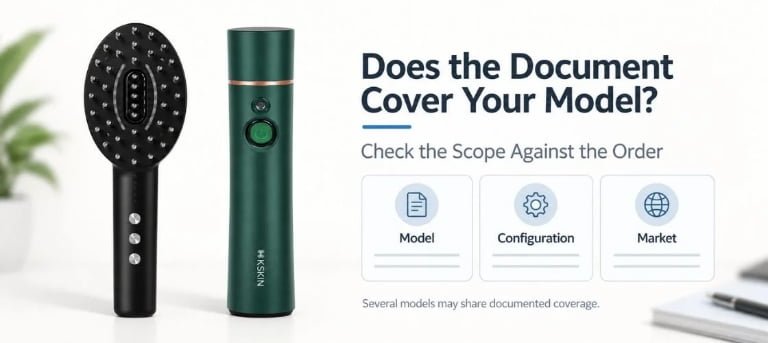

A supplier proposes a replacement component after sample approval. The model number stays the same, and the delivery date remains unchanged. The buyer now needs to determine whether the existing approval still covers the revised product.
Every proposed product change needs an impact review, but not every change requires the full test program to be repeated. Revalidation is needed where existing evidence no longer adequately supports the revised configuration. Define the change, trace its effects on safety, function, compliance and packaging, then agree the necessary checks and approvals before releasing the affected version.
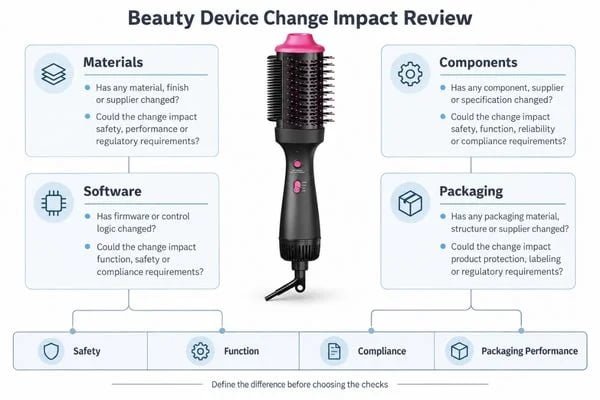
Start with the difference, not the supplier's label for it
A supplier may describe a change as “minor” or a replacement as an “equivalent part.” Ask what those terms mean in the proposed configuration. Neither description establishes that previous results still apply.
Product revalidation involves repeating or extending evaluation to determine whether a changed version still meets the relevant agreed requirements. It can involve selected checks rather than a complete repeat of development testing. Certification decisions remain subject to the applicable scheme and responsible body.
Describe the old and proposed conditions
Request a comparison that identifies the approved reference and the proposed replacement. For a component change, include the part number, manufacturer, specification revision and relevant construction differences. For software, identify the release and changed behavior. For packaging, identify the material, dimensions, layout and packed configuration affected.
Connect the request to the device model, bill of materials (BOM), electrical version and target markets. A component described as equivalent at one rating may differ in another characteristic relevant to the finished device.
Also separate a planned change from an unapproved substitution already found in production. The latter needs containment and identification of affected units while the technical review proceeds. A later approval should not erase that history.
Decide which earlier conclusions the change could invalidate
Identify which earlier conclusions depend on the part, material, setting or package being changed. A replacement may function on its own while leaving unanswered questions about its interaction with the rest of the device.

Follow the connections through the device
For a heating component, review more than the nominal power. Ask whether the change affects mounting, temperature sensing, control behavior, nearby materials or protective functions. The assessment should establish which of these relationships the replacement actually affects.
For a water-path seal, examine its interfaces with the tank or housing, assembly method and specified operating conditions. A material comparison alone may not answer whether the assembled joint remains suitable.
For a battery substitution, compare the cell or pack specification with the charging system, protection arrangement, physical fit and relevant documentation. Matching capacity does not establish equivalence at finished-device level.
Choose a justified review outcome
The review may lead to one of three practical outcomes:
- Document update only: the review establishes that the change does not affect the relevant physical or functional requirements, and any applicable external document approval is addressed.
- Targeted revalidation: identified characteristics or interfaces need new evidence, while the basis for retaining other results is recorded.
- Broader reassessment: the changes are substantial, interact across systems or cannot be bounded confidently using the available evidence.
These are project decisions, not universal regulatory categories. Record why the chosen scope is adequate, including why particular checks are not repeated. A decision that no additional testing is needed should identify the evidence supporting it.
Use a change matrix to scope the work
Connect each proposed difference to the requirements it could affect and the evidence needed for a decision. The examples below help buyers frame that discussion; they do not prescribe a mandatory test program or acceptance limit.
| Proposed change | Questions for the impact review | Possible evidence to request |
|---|---|---|
| Housing color, resin or coating | Is only the appearance changing? Are material grade, additives, thickness or contact surfaces affected? | Material comparison, finish sample, relevant compatibility or safety assessment |
| Heater, sensor or control board | Could temperature behavior, protection, electrical operation or assembly change? | Component comparison, circuit review and agreed finished-device checks |
| Battery or charging component | Does the new configuration remain compatible with charging, protection and physical constraints? | Cell or pack records, integration assessment, relevant performance and safety evidence |
| Tank, seal, tube or nozzle | Could fit, leakage, flow, steam delivery or cleaning access change? | Revised drawings, material records and assembled-system evaluation |
| Firmware or control settings | Which modes, timing, outputs, indicators or protective responses are affected? | Change log, version identity and a defined regression test record |
| Packaging material or insert | Does the revised pack retain and protect the same device and accessories? | Packed samples, dimensional review and appropriate transport evaluation |
| Label, manual or market version | Have ratings, instructions, claims, responsible entities or applicable document scopes changed? | Controlled artwork review and relevant technical or compliance confirmation |
| Assembly process, tooling or production location | Can the proposed process reproduce the approved characteristics? | Process comparison, relevant build records and a justified verification plan |
A single request may occupy several rows. A smaller carton can require a new insert, a different accessory position and revised packing instructions. Review that combined configuration rather than approving each drawing in isolation.
Check the changes that are easy to underestimate
The size or cost of a change tells buyers little about its technical impact. A small software edit can affect several operating states, while a clearly bounded text correction may need no physical testing.

A color approval does not approve a material substitution
Ask whether a new color uses the same resin grade, supplier, additive system and manufacturing conditions. Where those differ, have the relevant technical reviewer assess the implications instead of relying solely on the color sample.
Keep appearance approval separate from material acceptance. A finish may meet the buyer's visual preference while the supporting material information remains incomplete.
Software needs an identifiable version and regression scope
If firmware changes a timer, temperature setting or operating sequence, request a description of the intended behavior and the related functions selected for regression testing. Include applicable start-up, mode changes, restart behavior and protective responses in the scope discussion.
Record how the firmware version is identified on the evaluated sample and controlled during production. A file called “new firmware” is not a reliable release reference. Testing should use the intended hardware and software combination.
Packaging performance belongs to the packed configuration
Review a packaging change with the actual device, accessories, protective materials and shipping arrangement it will contain. Equal box dimensions do not establish equal protection, and a successful fit check does not establish transport performance.
Ask the packaging reviewer which earlier evidence remains representative and what evaluation is needed for the changed pack. Define the relevant handling or distribution conditions before choosing a method. Do not treat one generic drop height as a universal acceptance rule.
Confirm whether certificates and reports still apply
Buyer approval, successful internal checks and continued certification coverage are separate questions. A report describing the old configuration cannot be assumed to cover a changed construction simply because the sales model name is unchanged.
Review the exact model, technical version, listed components where relevant, standards, market scope and original legal entities. Ask the issuing laboratory or certification body to confirm the required review when the change may affect its documentation or authorization.
For example, UL's published guidance says construction changes to UL Certified products should be submitted for acceptance before implementation on products bearing UL Marks. This is a scheme-specific example, not evidence that a particular K·SKIN product holds UL certification. See UL's guidance on changes to certified products.
An amended report may rely on previous results, require selected additional testing or support a wider reassessment. Read the revision record and its stated scope. A conclusion about one amendment is not permission to make another change without review.
For K·SKIN projects, the credentials and product-document review page provides a starting point for requesting available records against the exact configuration and market. Preserve the applicant, manufacturer and holder names shown in the original documents; a commercial relationship does not automatically transfer those roles.
Define the revalidation plan before testing revised samples
Before requesting revised samples, define the version to evaluate, the questions the evaluation must answer and the acceptance criteria. This gives the supplier a clear build requirement and the buyer a basis for approval.

Make each result traceable
For every selected check, record:
- The affected requirement and reason for repeating the evaluation.
- The sample identity, build revision and hardware or firmware combination.
- The sample quantity and rationale appropriate to the evaluation.
- The method, equipment, environmental conditions and operating sequence.
- The acceptance criterion and its approved source.
- The responsible evaluator, required record and release decision owner.
Where a comparison is useful, evaluate the approved and proposed versions under comparable conditions. A difference between samples can be informative, but similarity alone does not prove conformity to every applicable requirement.
Use production-intent parts where the result will support production release. Identify temporary components or manual adjustments and explain what they prevent the evaluation from establishing.
Review results against the final configuration
Review the recorded results against the criteria agreed before testing. If the revised sample fails, identify the cause, update the proposed solution and determine which checks the next revision needs.
Do not combine a passing result from one revision with a passing result from another as though both describe a single approved unit. The final evidence package needs to support the configuration that will actually be built.
If a product modification expands into a new technical configuration, use the OEM/ODM development review to clarify engineering scope and deliverables before committing to the revised schedule.
Notify the buyer and control the production transition
A technically acceptable change can still produce the wrong shipment if purchasing, assembly and packing use different revisions. Agree notification and approval responsibilities early enough to prevent the proposed version entering routine production before the required decisions.
Make the approval specific
The change request should state the reason, before-and-after difference, affected models and markets, evaluation results, revised documents, cost or schedule implications and intended implementation point.
Define who accepts appearance, who approves the technical assessment, who addresses applicable compliance questions and who authorizes implementation. An approval email should identify which decisions it covers and which remain open.
Keep permission to build evaluation samples distinct from permission to produce commercial quantities. If a temporary deviation is accepted, specify its scope, quantity or duration, traceability and closure conditions. It must not bypass an unresolved safety or applicable compliance requirement.
Identify where the old version ends
Use an identifiable batch, serial range, production order or other controlled boundary. Review purchased components, work in progress, finished stock, spare parts and packaging materials affected by the change.
Record the agreed disposition of earlier stock. Do not assume that all old units are unacceptable, or that all old and new parts can be mixed. Compatibility and release status need a specific decision.
Update the BOM, drawings, work instructions, inspection references and physical sample where relevant. Verify the first affected build against the released revision and retain the previous records for traceability.
Use a release checklist that exposes unresolved decisions
Before authorizing implementation, use the checklist below to confirm that the technical decision and production instructions agree. Assign an owner and a required decision to any unresolved item.

| Release question | Evidence to check |
|---|---|
| Is the difference fully defined? | Approved baseline, proposed revision and before-and-after comparison |
| Have connected effects been reviewed? | Impact assessment covering relevant product, process, packaging and market requirements |
| Is the revalidation scope justified? | Selected checks, retained evidence and reasons for exclusions |
| Do the results describe the released version? | Identifiable samples, methods, criteria and completed evaluation records |
| Are external decisions closed where required? | Applicable laboratory or certification-body response and updated documents |
| Has the buyer accepted the relevant changes? | Approval scope, responsible roles and commercial implications |
| Can production identify the correct version? | Released documents, material identification and updated references |
| Is the stock transition controlled? | Implementation boundary and disposition of affected old or mixed stock |
Pause implementation where the supporting decision is missing. Common warning signs include an undisclosed replacement already in production, test results with no sample revision, an unchanged report offered without scope review, or an instruction to use up old parts without checking compatibility.
FAQ
Does buying the same specified component from another distributor require retesting?
Start by verifying the actual manufacturer, part identity, specification and traceability. A distribution-channel change is different from replacing the component itself. The review may focus on sourcing controls, but any uncertainty about the delivered part or applicable approval conditions needs resolution before treating it as unchanged.
Can several small changes be approved together?
Yes, provided each is identifiable and the combined configuration is assessed. Separate approvals can miss interactions. Make clear which sample contains which changes and whether the evidence supports that complete combination.
How many samples are enough for revalidation?
There is no single quantity suitable for every change. The method, product risk, expected variation and applicable requirements should inform the number. Agree the rationale with the responsible technical team or laboratory; do not treat a single working sample as proof of consistent production.
Can a change be accepted without repeating physical tests?
That can be appropriate when a documented review establishes that existing evidence remains adequate and any required external review is complete. Keep the justification and approval traceable. The record should explain why additional tests were unnecessary for that specific change.
What if the original component becomes unavailable urgently?
Identify the affected orders and available alternatives, then assess the proposed replacement against the approved configuration. Consider schedule adjustments or a controlled evaluation build while the necessary review proceeds. Supply pressure does not establish equivalence or authorize an unreviewed substitution.
Keep the approval attached to the version being built
Beauty device change control starts with a defined difference and ends with evidence that supports the released configuration. Repeat the evaluation affected by the change, retain earlier evidence only where justified and give production an unambiguous implementation point.
When discussing a change with K·SKIN, bring the approved baseline, proposed difference, target markets and affected orders to the manufacturing and quality review. Confirm the verification scope, responsibilities and implementation boundary before approving the revised version.