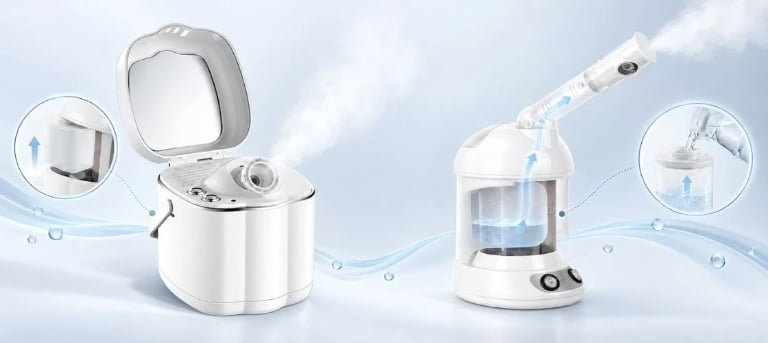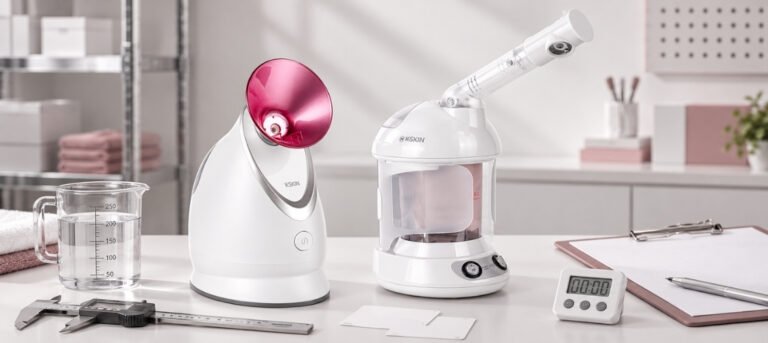

A hair hood and a facial nozzle give one steam base two distinct uses. Buyers need to understand how each attachment delivers steam, how the assembled unit handles and which components belong in the commercial kit.
A 2-in-1 hair and facial steamer heats water in a shared base and sends steam through the fitted attachment. A hood provides the hair-steaming arrangement; a facial spray tube directs the outlet toward the face. Buyers should evaluate both assemblies separately and confirm the accessory bundle, because two supported applications do not necessarily mean two attachments are included in the box.
How the shared base produces and delivers steam
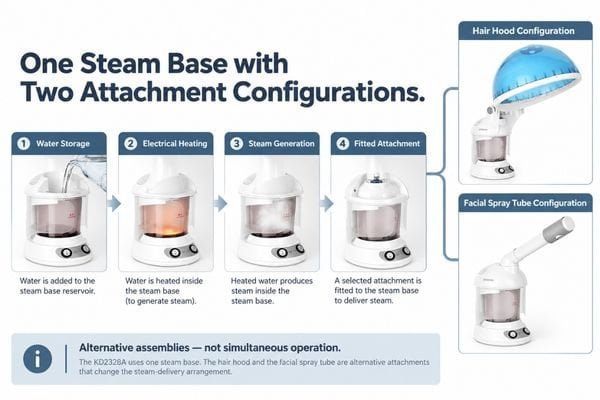
The KD2328A is a corded warm-steam platform. Its basic working sequence is water storage, electrical heating, steam generation and delivery through the installed attachment. Changing the attachment changes the delivery arrangement; it does not create a second independent steam generator.
That makes the connection and attachment part of the performance review. A functioning heater does not by itself show how steam reaches the hood or facial outlet.
For a sample review, trace the accessible parts: filling opening, water reservoir, main-unit attachment socket, connector and final outlet. Ask for an assembly drawing or demonstration when a connection is unclear. Do not infer an internal pump, valve or separate heater from the external appearance.
Confirm which heating version the sample represents
KD2328A documentation describes more than one heating version. The June 2016 specification describes PTC heating and 350 W, while the October 2025 A1 heating-tube specification describes a stainless-steel heating tube and 400 W. These records cannot be combined into one specification for an unidentified sample.
This distinction matters when comparing warm-up, electrical input and supporting documents. Record the sample's rating label and match it to the applicable specification before testing. A higher wattage alone does not establish better steam distribution under the hood or a more suitable facial output.
The shared parameter table lists a 300 ml tank. That capacity alone cannot establish session duration: usable fill level, operating conditions and output also matter. Request runtime records for the ordered version.
What changes between the hair hood and facial spray tube?
The two attachments connect to the same base but create different working arrangements. The hood surrounds the intended hair area, while the facial tube provides a directed outlet. Their connections, positioning and handling need separate checks.
Hair steaming uses the hood and its connector
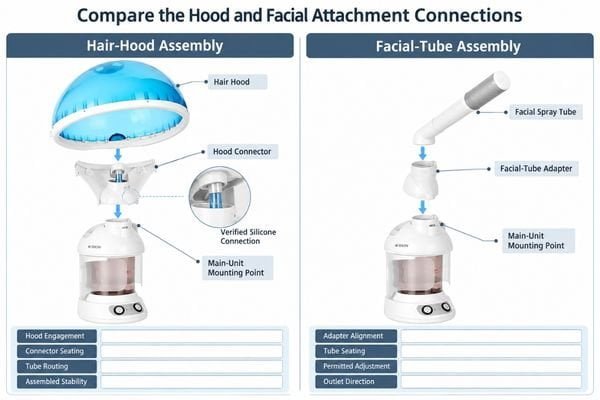
The KD2328A assembly description identifies a hood, connector and silicone tube connection. The hood engages with the connector, which mounts to the main unit to form the hair-steaming assembly.
With the hood fitted, assess the space available for the intended hair arrangement and how the hood sits over the user position. Check the complete assembly on the proposed tabletop, including the stability of the base.
Inspect attachment engagement and tube routing on the supplied sample. Look for loose seating, awkward assembly or a connection under strain—details that a promotional photograph may not reveal.
Facial steaming uses an adapter and spray tube
The facial arrangement uses a separate adapter and spray tube at the main-unit mounting point. The reviewed assembly instructions describe aligning the adapter with the mounting opening and fitting the tube to it.
With the facial tube fitted, check outlet direction, permitted adjustment, connection seating and the operating distance specified for the ordered version. Repeat the output evaluation in this arrangement even if the hood configuration performed satisfactorily.
The KD2328A product page currently lists the hair hood in the standard bundle and the facial spray tube as optional. Specify both assemblies if the retail offer is intended to include both applications. “2-in-1” describes the platform's supported arrangements, not simultaneous use of the hood and tube.
Does the ion/ozone switch change what “2-in-1” means?
KD2328A materials describe a steam switch and a separately operated function labeled ion or ozone. Selecting hair or facial use depends on the fitted attachment, rather than this additional switch.
During sample evaluation, check that the switch labeling, indicators and operating instructions agree. Record which states the supplied version allows and whether the controls respond as described. An illuminated switch confirms an indication; it does not measure the output associated with that function.
The existence of an ion/ozone function does not by itself substantiate disinfection, sterilization, skin treatment or hair repair. Nor can visible mist density establish ion output or a biological effect.
If this function is central to the proposed product positioning, request output and safety evaluations for the exact configuration and intended conditions. Until those records support a specific claim, describe the documented function and controls without adding efficacy promises.
How should buyers compare steam delivery in both configurations?
Evaluate the hood and facial tube as two assemblies built around the same base. Keep the electrical version, specified water type, fill level, starting condition and test environment consistent where the comparison requires it. Record the sample quantity and each unit's identity.
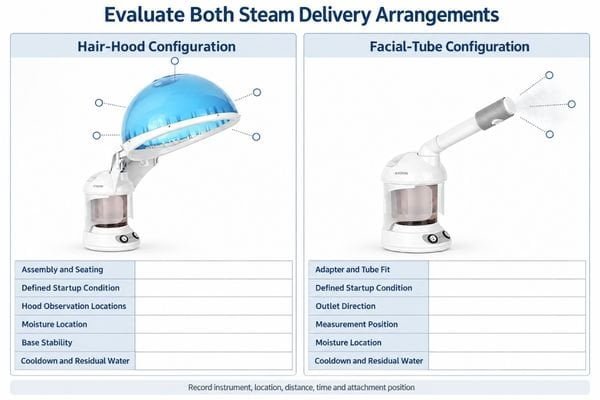
Set up comparable sample records
Use the operating instructions for the permitted setup and session. Have competent personnel define the measurement method and any safety-related checks; a buyer demonstration should not involve touching hot outlets, deliberately blocking the steam path or exposing a person to an unverified test condition.
The worksheet below sets out checks to perform and record; it does not report measured KD2328A results.
| Evaluation point | Hair-hood configuration | Facial-tube configuration |
|---|---|---|
| Assembly | Hood engagement, connector seating and silicone tube routing | Adapter seating, spray-tube fit and permitted adjustment |
| Startup | Time to the defined operating condition with the hood fitted | Time to stable outlet behavior with the tube fitted |
| Steam delivery | Distribution at defined locations in the intended hood working area | Output behavior at the specified direction and measurement position |
| Water observations | Moisture at the hood, connector and base, recorded by location | Moisture at the outlet, adapter and base, recorded by location |
| Stability | Support of the assembled hood and base in the intended setup | Base stability with the tube in permitted positions |
| End of session | Residual water and handling after the specified shutdown and cooldown | Residual water and handling after the specified shutdown and cooldown |
Distinguish visible output from measured performance
A dense white plume is not a temperature measurement. A temperature recorded near an outlet is also not automatically the temperature throughout the hood or at the intended user position.
For temperature measurement, record the instrument, location, distance, elapsed time and attachment position alongside each reading. A single “steam temperature” without those conditions is difficult to use in a purchasing decision.
Record droplets by when and where they appear. Moisture on a cooling surface, droplets expelled from an outlet and water escaping around a connection are different observations. Investigate the source before describing all of them as leakage or dismissing them as normal condensation.
After the prescribed cooldown and reassembly, repeat the relevant observations. This helps determine whether the initial result depended on one particular attachment fit or starting condition.
What should buyers check about water, cleaning and attachment changes?
The reviewed KD2328A operating text specifies distilled or purified water and prohibits adding substances such as essential oils directly to the tank. It describes aromatherapy material in a designated facial-tube compartment, where that accessory is supplied and the instructions permit its use.
Make this distinction explicit in every manual language. Customers should be able to identify where aromatherapy material is permitted and whether their bundle includes the required accessory.
Check the fill marking and closure on the sample. Confirm that the instructions show how to fill, close, empty and store the actual unit. Do not borrow a water recommendation or cleaning method from another steamer model.
Assess cleaning access after both uses
Ask for a demonstration of the approved cleaning and draining procedure after each attachment configuration. Look at the hood connection, facial tube and any designated compartment, as well as the tank. Record where water remains and which parts the user is permitted to remove.
The product instructions require unplugging for filling and cleaning and cooling before relevant handling. Make sure the final manual clearly explains the sequence for changing attachments, including shutdown and cooldown. Do not present conversion between hair and facial use as a change to make while the unit is operating.
For a combined kit, check where the unused attachment can dry and be stored. These handling requirements affect whether switching between the two uses is practical for the intended customer.
What exactly belongs in the commercial kit?
A combined hair and facial steamer needs an accessory list that defines each complete assembly. Specify the intended applications and connecting parts alongside the main unit in the quotation.

Specify the parts that complete each application
For hair steaming, confirm the hood and connecting components. For facial steaming, confirm the adapter and spray tube. Check any covers or other supplied pieces against the assembly instructions. Photograph the actual approved kit laid out before packing so that inspection has a clear reference.
Older KD2328A materials show both applications, but a photograph of both arrangements does not settle the contents of a current order. The approved bundle should control the retail description, instruction illustrations and packing list.
Evaluate the packed and assembled sizes separately
The base dimensions do not describe the space occupied by the fitted hood. Measure the assembled setup that the intended customer will use, then measure the complete packed kit for logistics.
Check how the hood, tube and connectors are supported inside the box. Inspect them again after the agreed packaging evaluation and confirm that they still assemble correctly. A visually intact base does not establish that every attachment has arrived in usable condition.
For the manual, verify that the illustrations match the supplied components and clearly distinguish the two configurations. If the facial tube is omitted, the box should not imply that facial use is available immediately from the contents supplied.
When does a combined steamer make sense for the buyer's range?
A combined platform is worth evaluating when the intended customer has a reason to use both arrangements and space to handle and store the attachments. The commercial value depends on that routine, not simply on the number of functions printed on the box.
If the offer is primarily facial steaming, compare the assembled KD2328A facial version with a dedicated facial steamer platform. Consider working space, setup, cleaning and the parts the customer must manage. If hair steaming is the main purpose, assess the hood configuration first and decide whether the facial accessory adds value for that channel.
A salon-oriented photograph does not establish continuous operation or a particular number of back-to-back sessions. For a salon supply project, ask for the permitted session, refill, cooldown and cleaning sequence, then review it against the expected workload.
Before planning a launch, confirm the available configuration and supply conditions for the intended territory and channel.
What should be settled before approving a KD2328A sample?
Approve each offered configuration as the customer will receive it, including assembly, operation, cleaning and packaging. Retaining only the base as a reference leaves the attachment fit and kit contents unrecorded.

- Match the rating label to the exact heating and electrical version.
- Identify the supplied hood, connector, adapter and facial tube by the approved accessory list.
- Check assembly and seating for each included configuration.
- Record startup and steam-delivery observations separately for the hood and tube.
- Define any temperature measurement by location, distance, time and method.
- Investigate outlet droplets and water at connections under the permitted operating conditions.
- Confirm switch behavior without converting it into an unverified efficacy claim.
- Review water, filling, draining, cleaning and attachment-change instructions.
- Evaluate assembled working space, unused-part storage and complete-kit packaging.
- Confirm that the retail description and manual match the contents of the box.
Retain the tested attachment list with the sample record. If a connector, hood, tube or heating version changes, review the observations affected by that change before carrying the earlier approval forward.
FAQ
Can the hair hood and facial spray tube be used at the same time?
The documented arrangements use different attachments at the main-unit mounting point. Treat them as alternative configurations. Do not advertise simultaneous operation without a specifically documented and verified design that supports it.
Does every KD2328A order include the facial spray tube?
No. The current product listing treats it as optional. Include the tube and its required connecting parts in the order specification when the customer is supposed to receive a complete two-application kit.
Can buyers compare two samples by wattage alone?
No. First identify the heating and electrical version, then compare the relevant steam-delivery results with the same attachment and defined conditions. Rated power alone does not describe distribution under the hood, outlet behavior or usable session duration.
Can aromatherapy liquid be poured into the water tank?
The reviewed KD2328A instructions prohibit adding essential oils and similar substances directly to the tank. Where aromatherapy use is permitted, the instructions identify a designated facial-tube compartment. Confirm that the supplied accessory and final manual support that use.
Does steam output prove hair repair or a skin-treatment effect?
No. Demonstrating steam generation or an operating ion/ozone switch does not establish those outcomes. Keep product descriptions within the documented functions unless matching evidence supports a specific additional claim.
Choose the attachment system as carefully as the steam base
KD2328A combines a shared steam base with two distinct attachment arrangements. Evaluate the heating version, hood and tube fit, steam delivery, cleaning access and actual kit contents together. Approve the complete configurations intended for sale.
Buyers considering the K·SKIN home beauty device range can start with the intended hair or facial application, target market and required kit contents. Use those choices to request a matching sample and compare both complete configurations before approving the commercial product.