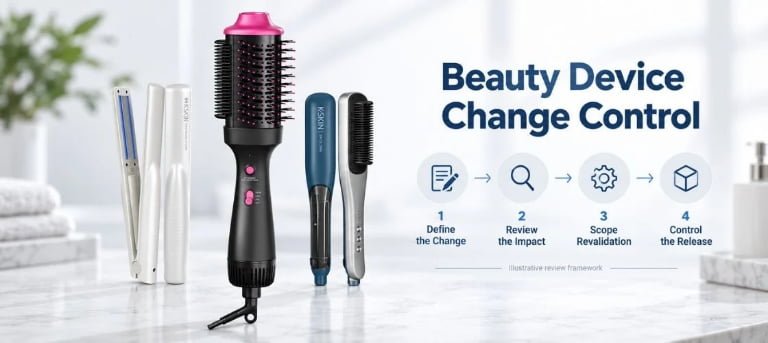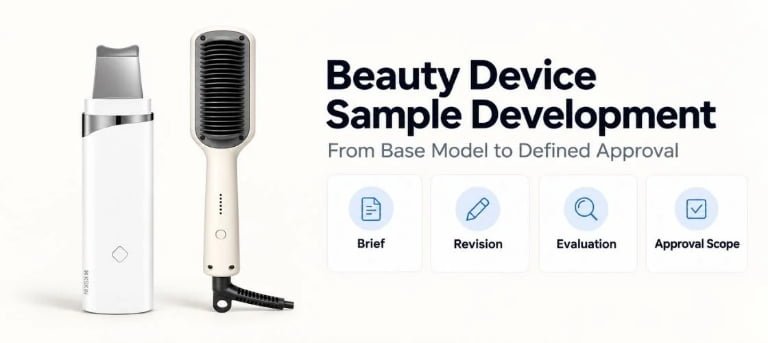
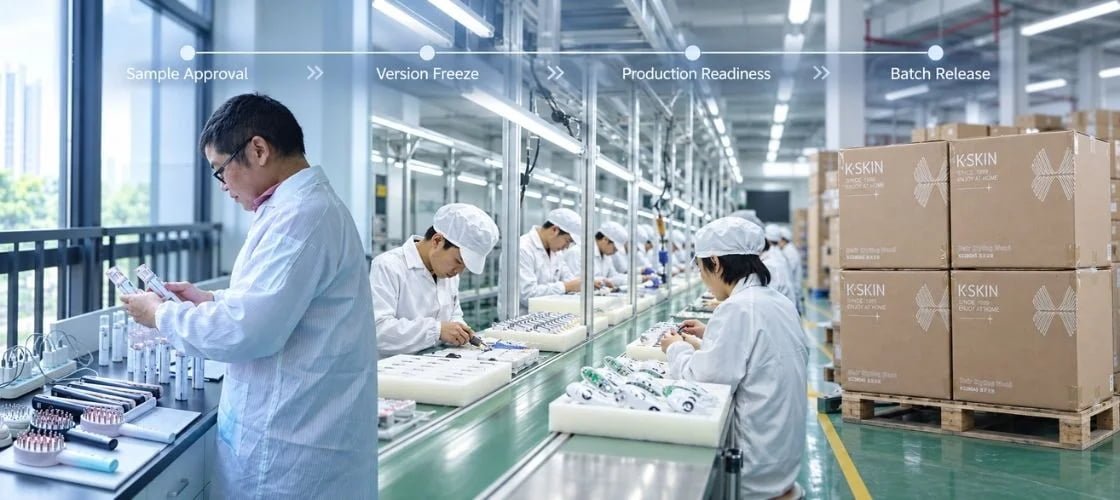
A sample approval email can reach purchasing, engineering and quality teams before they have agreed on the same version. Before production starts, buyers need to establish exactly what was accepted and what still needs work.
After a beauty device sample is approved, confirm the approval scope, freeze the intended product version, align the technical and commercial documents, review applicable evidence, and define production checks. Where the project warrants it, evaluate a pilot run before volume production. Sample approval alone does not authorize component substitutions, establish market compliance, or release a production batch for shipment.
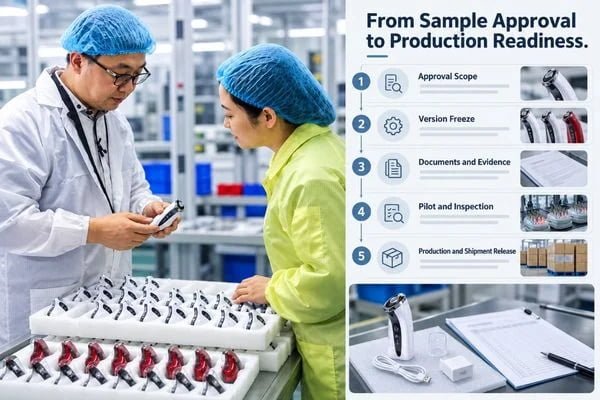
1. Confirm what the sample approval actually covers
Separate approval scope from the next authorization
Before scheduling production, clarify what the buyer accepted: appearance, functional performance, packaging artwork or the complete commercial configuration. A message saying “sample approved” can mean different things to each team.
Record the model, revision, electrical configuration, sample identity, evaluation scope and approval date. Identify the person authorized to approve each part of the project. Approval of a color by marketing does not settle engineering questions about a revised heating system.
Specify the next authorized activity—another sample, material preparation, a pilot build or volume production—and any conditions attached to it.
Make open items visible
List anything the sample did not represent, such as a temporary cable, provisional label, unfinished manual or substitute component. Assign an owner, required evidence and decision point to each item.
If the device functions are accepted but branded packaging is unfinished, record those as separate decisions. Production needs to know which parts of the retail product remain open.
2. Freeze the product version that production will follow
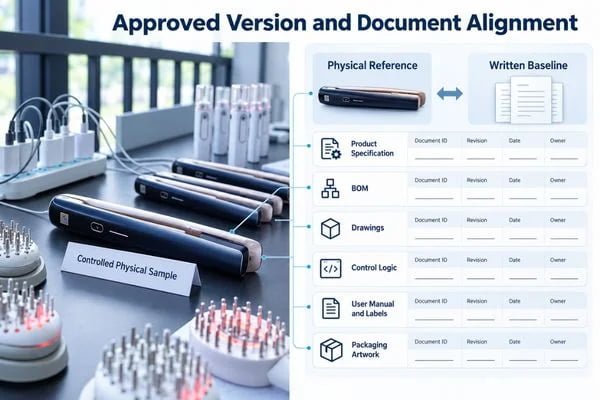
Connect the physical reference to controlled documents
Create a version list connecting the approved sample to the specification, bill of materials (BOM), relevant drawings, software or firmware identification, color reference and packaging files. Include the destination-market configuration and accessories where applicable.
Give each file an identifiable revision. Several documents named “latest” leave purchasing and assembly without a reliable reference.
Define the controlled physical reference, often called a golden sample, and identify where it is held. Record its condition and the characteristics it represents. The sample supports appearance and handling comparisons, while written requirements define items that cannot reliably be judged from an intact unit.
Resolve mismatches before release
Compare the reference sample, document list and order configuration. If they disagree, determine the intended version and obtain the appropriate approval before updating the affected reference.
A visually unchanged unit can contain a different battery, heater or control board. Do not use appearance alone to accept an internal substitution. Keep earlier samples traceable to their revisions, even when they are withdrawn from active use.
A version freeze gives later changes a defined starting point.
3. Prepare a production document package
Define what each team needs to build and check
The document package should let purchasing obtain the agreed materials, production assemble the agreed version and quality personnel verify it. The exact contents depend on the product and development scope.
The following table is a starting point for agreeing the document package. Adapt it to the product and project:
| Document or reference | Buyer check | Decision it supports |
|---|---|---|
| Approved specification | Model, revision, functions and applicable electrical configuration match the sample | What the finished device must meet |
| Controlled BOM or agreed component schedule | Relevant component identities and permitted alternatives are defined | What purchasing and assembly may use |
| Drawings and assembly requirements | Critical fit, dimensions and assembly details have a controlled reference | How the product is reproduced |
| Firmware or control identification, where applicable | Modes, timing and configuration correspond to the validated version | Which operating behavior is approved |
| Appearance references | Color, finish, logo placement and workmanship criteria are identifiable | What visual acceptance means |
| Inspection instructions | Method, acceptance criteria and required records are defined | How conformity is checked |
| Packaging and commercial files | Accessories, labels, manuals and artwork match the order | What the customer will receive |
Agree access and revision responsibilities
The buyer may not receive every proprietary design file. Agree which controlled records, extracts or verification evidence are needed, who maintains the full documents and how the approved revision can be confirmed.
Address tooling, software and design rights in the project terms; sample approval alone does not establish ownership.
Assign responsibility for issuing revisions and withdrawing obsolete instructions from active use. Keep historical files traceable without allowing them to remain ambiguous production references.
4. Review compliance and evidence for the frozen configuration
Match the evidence to the product being ordered
Review the target markets, intended claims and commercial configuration with the responsible compliance function. Confirm what evidence is required for the actual project and what remains outstanding.
For each relevant certificate or test report, compare the model coverage, tested configuration, document date, scope and named legal entities. A report for an earlier version may need further review if the approved version changes a relevant component or function.
Sample approval is a buyer decision. It does not establish that a product has met every applicable market requirement, or that a particular seller holds a certificate issued to another entity.
Decide what outstanding evidence prevents
For each document, record whether its verified scope is sufficient, clarification is needed or further testing remains outstanding.
Specify which activity the unresolved item prevents. Permission to prepare packaging should not be mistaken for permission to ship into the target market.
If the evidence names another applicant, manufacturer or certificate holder, preserve that name and verify the relationship needed for the proposed use. Do not change the document's identity to match the current sales company.

5. Confirm materials, purchasing and commercial readiness
Prevent substitutions from entering through procurement
Ask purchasing to confirm the materials and components against the frozen version. Identify shortages, proposed alternatives and long-lead items before they become urgent assembly decisions.
A proposed alternative should enter a change review, even when it fits physically or appears to have a similar nominal rating. Determine what verification is needed and obtain the required approval before using it in the released configuration.
If the project allows early material preparation, record which items may be ordered and at whose authorization. Keep that decision separate from permission to assemble or ship.
Reconfirm the quotation and order scope
Check whether the final configuration matches the quotation: quantity by SKU, color, electrical version, accessories, packaging, inspection scope and delivery terms.
Resolve any differences in cost, timing or responsibility before treating the earlier quotation as a production commitment. Sample approval does not automatically settle payment terms, tooling arrangements or the cost of additional validation.
For Private Label projects, keep the approved branding and commercial files connected to the selected product platform. Deeper changes to the product need the corresponding engineering review, rather than being treated as packaging adjustments.
6. Decide whether a pilot run is needed
Define the question the pilot must answer
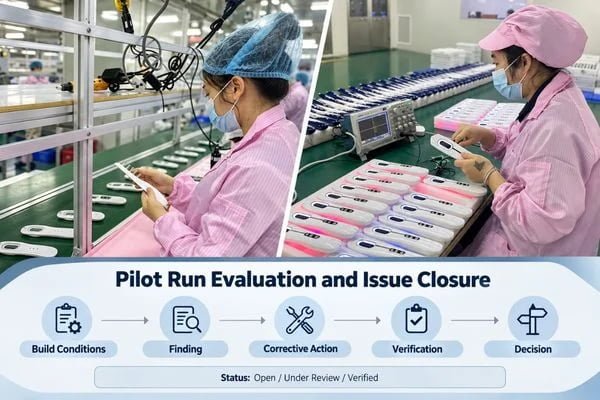
A pilot run can help evaluate whether the intended production process reproduces the approved configuration. Consider it when the project introduces meaningful changes to tooling, assembly, materials, electronics or packaging, or when the available production evidence is insufficient.
Agree the pilot quantity, build conditions, checks and decision criteria around the risks it needs to evaluate. The same build size or sequence will not suit every project.
Record which production-intent materials, tools and processes are used. If a pilot still relies on temporary parts or manual adjustments, document those limitations instead of presenting it as proof of full production readiness.
Close findings with evidence
Review build consistency, assembly problems, functional results and packaging fit against the agreed criteria. Connect each issue to the affected units and configuration.
When an issue is reported as “fixed,” ask for the cause, corrective action and verification of the revised condition.
Determine whether the finding requires another build, selected revalidation, document updates or a hold on production release. A successful pilot supports a decision within its recorded scope; it does not prove that every future batch will conform.
7. Translate approval into an inspection plan
Define checks at the stages where they are useful
Agree relevant incoming, in-process and finished-product checks. The plan should follow the actual technical system and the points where a deviation can be detected and contained.
For each check, identify the characteristic, method, equipment where needed, acceptance criterion, recording requirement and responsible role. Numerical limits should come from the approved requirements and applicable review, not from a generic checklist.
The manufacturing and quality-control overview provides context for connecting an approved version to production checks and final commercial review. For an order, request the inspection arrangements that apply to that specific configuration.
Agree how failed or uncertain results are handled
Define the response to a failed check: identification of affected material, containment, review, corrective action and verification before release.
If a sampling plan is used, agree its scope and decision rules. Sample approval and batch sampling answer different questions; neither should be used as a substitute for the other.
Set acceptance criteria before inspecting the batch. Otherwise, both parties can inspect the same units and reach different decisions.
8. Keep packaging and post-approval changes under control
Approve the complete commercial pack
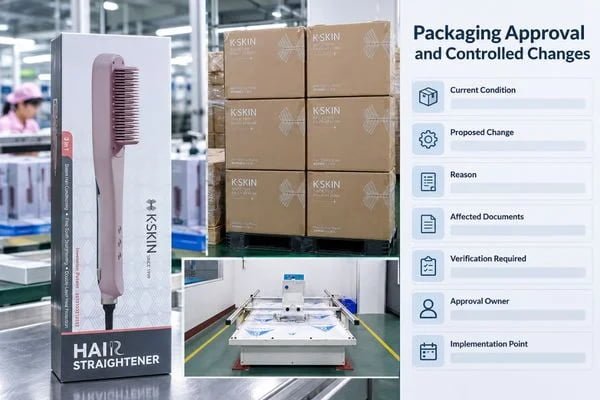
Review the device together with its accessories, protective inserts, labels, manual, sales box and shipping configuration where specified. Confirm artwork revisions, languages and identifiers against the order.
A signed device sample does not automatically approve a later manual or box. Conversely, approval of print artwork does not establish that the finished packaging fits and protects the product as intended.
Retain a reference or records for the commercial pack appropriate to the project. Keep confidential customer details out of any public photographs or case materials.
Define what happens when a change is proposed
Require the change request to identify the old and proposed condition, reason, affected documents and units, verification needs, approving roles and implementation point.
Match the review to the effect of the change. A label correction and a battery substitution can require very different verification.
Update the physical reference when the change affects what it represents. Update the written baseline and evidence where needed, and distinguish any earlier stock from the newly approved revision.
9. Separate production release from shipment release
Authorize production against a defined baseline
Before volume production, confirm that the released configuration, required documents, material readiness, applicable validation and inspection arrangements are aligned. Record the authorizing decision and any permitted limits.
Treat a production schedule as a planning document. A planned start date alone does not close technical issues or authorize a configuration that remains undefined.
Review the actual batch before shipment
Shipment release concerns what was produced and packed. Review the required inspection results, deviations, approved changes, commercial configuration and shipping documentation for the batch.
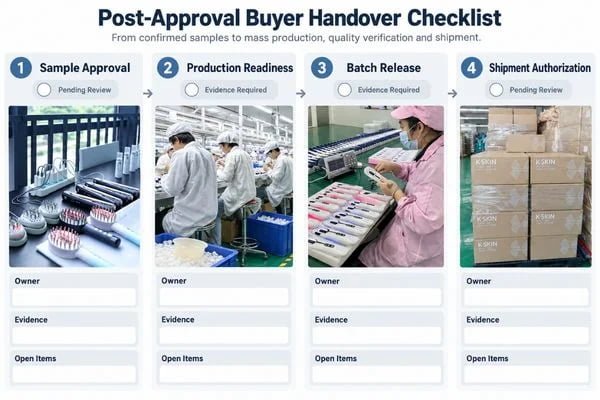
| Decision | Evidence to review | Boundary |
|---|---|---|
| Sample approval | Identified sample and agreed evaluation results | Covers the recorded sample and approval scope |
| Production readiness | Frozen version, documents, materials and applicable validation | Supports preparation or production within the authorization |
| Batch release | Required production and inspection records, with deviations addressed | Concerns the identified production batch |
| Shipment authorization | Applicable release records, finished pack and shipping arrangements | Does not follow automatically from an earlier sample approval |
Agree who owns each decision and how it is recorded. These review points may be combined or arranged differently under the project terms.
10. Use a post-approval handover checklist
Confirm the baseline and readiness evidence
- Identify the approved sample and record its model, revision and approval scope.
- List unresolved items, owners and required decisions.
- Confirm the specification, BOM, drawings and applicable control version.
- Identify the controlled physical reference and its location.
- Reconcile the order, quotation and approved configuration.
- Review applicable evidence for model, version, market and legal-entity scope.
- Confirm material availability and review proposed alternatives.
- Decide whether a pilot run is needed and record its evaluation criteria.
Confirm execution and release responsibilities
- Issue the agreed inspection methods, acceptance criteria and recording requirements.
- Approve accessories, labels, manuals and finished packaging.
- Define the change-review and implementation process.
- Close relevant validation or pilot findings with verification evidence.
- Record who authorizes production and under what conditions.
- Agree the batch and shipment release records required before dispatch.
For each checklist item, enter the evidence, owner and status. Turn any missing information into an assigned action before the handover ends.
FAQ
Can a supplier start buying materials immediately after sample approval?
Only within the authorization and commercial terms agreed for the project. Identify the permitted materials and revision, unresolved risks and any limits on further activity. Approval of the sample alone should not be read as an unlimited purchasing or production instruction.
Is a pilot run necessary for every order?
Not automatically. Review product and process changes, existing production evidence and the consequences of a failure. A pilot is useful when it addresses a readiness question that the available records cannot answer. Its scope and quantity should follow that question.
What if the supplier cannot share its complete BOM?
Agree the information and verification access needed to confirm the approved configuration. This may include controlled extracts, agreed critical-component references or a reviewed document schedule. Protect proprietary information while keeping component changes and revision identity verifiable.
Can production continue while an approval item remains open?
Determine what the open item affects and which activity, if any, can proceed without prejudging its resolution. Record the authorization and limits. Do not use conditional permission to bypass unresolved requirements affecting product safety, applicable compliance or the released configuration.
Does a repeat order need another readiness review?
Confirm that the intended version, materials, market configuration and commercial requirements remain unchanged and that the supporting records still apply. Review changes or unresolved issues before relying on an earlier approval. The depth of the review should follow the actual differences and risks.
Turn sample approval into a controlled production decision
The next step after sample approval is to give purchasing, production and quality teams the same product definition. Connect the sample to its documents, close the relevant open items and record who authorizes production and shipment.
For a project moving into K·SKIN OEM/ODM development and production-readiness review, bring the approved configuration, remaining changes, target markets and readiness questions to the discussion. Confirm the route and required evidence for that project before committing to volume production.