Sample approval is often treated as the end of product development. For B2B buyers, the harder question is what production should follow once that approval has been given.
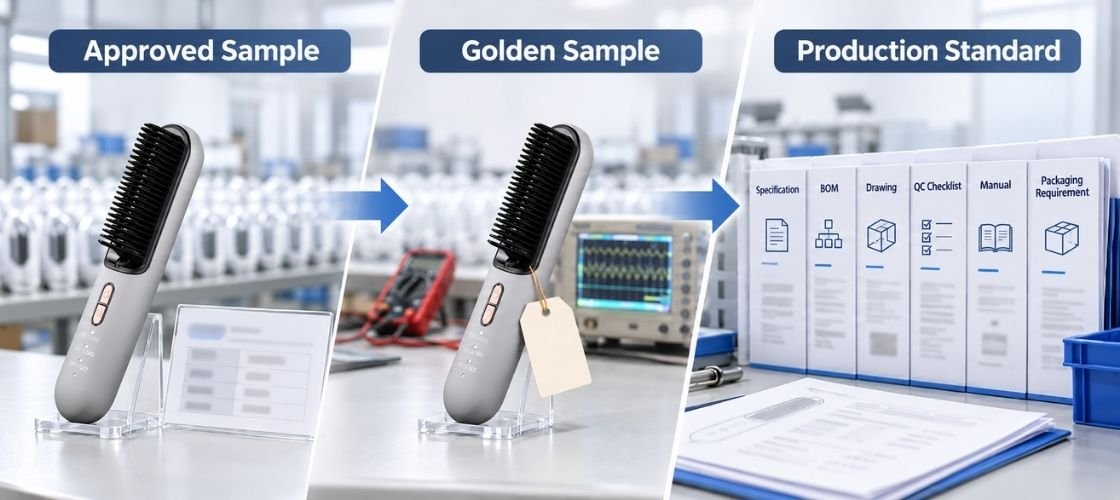
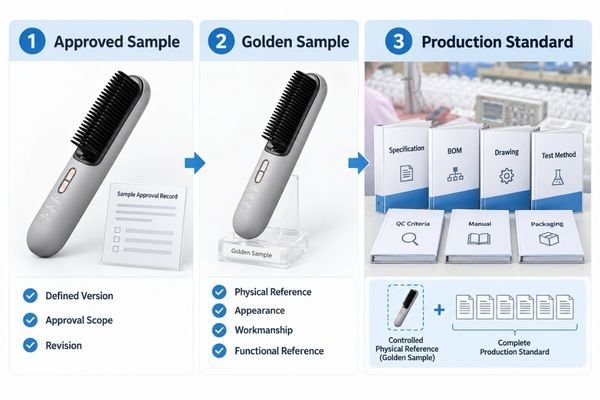
An approved sample records that a defined product version has passed an agreed approval scope. A golden sample is a controlled physical reference representing the accepted product. A production standard is broader: it combines approved samples with the specifications, BOMs, drawings, tolerances, test methods, packaging requirements and change controls needed to reproduce the product consistently.
These terms are related, but they are not interchangeable.
An approved sample answers:
Which submitted version has the buyer accepted, and what does that approval cover?
A golden sample answers:
Which physical unit should production and inspection use as a controlled visual and functional reference?
A production standard answers:
What complete set of controlled requirements defines what the factory is permitted to produce?
The distinction matters because a physical sample cannot show every requirement. Two units may look identical while using different heaters, batteries, electronic components, firmware, internal water-path parts, coatings or packaging materials.
For buyers working within a beauty device manufacturing and quality-control process, the safest approach is to use the physical sample and written specifications together. The physical reference and documented product definition need to support each other.
| Reference | What It Primarily Controls | What It Cannot Reliably Control Alone |
|---|---|---|
| Approved sample | Approval status of a defined submitted version | Every production requirement unless the approval scope is documented |
| Golden sample | Physical appearance, construction, feel and other observable reference characteristics | Hidden components, numerical tolerances, test limits and every process requirement |
| Production standard | Complete requirements for repeatable production and inspection | It still requires controlled implementation and verification on the factory floor |
What Does an Approved Sample Actually Mean?
An approved sample is a sample that has passed a defined review. What matters is not the word “approved,” but what was reviewed, which revision was tested and what the approval authorizes next.
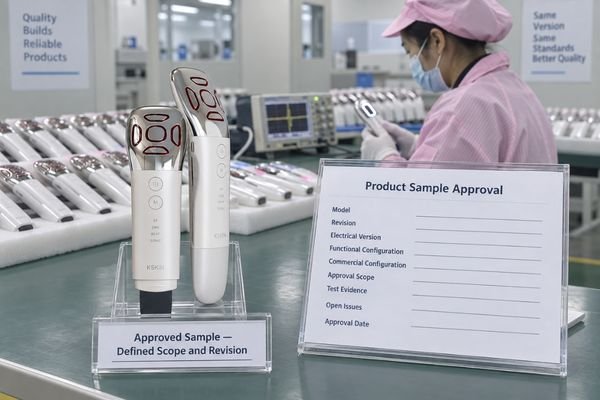
Sample approval should identify the exact model, revision and commercial configuration, the requirements evaluated, any unresolved items and the approval status. Approval may cover engineering performance, appearance, branding, packaging or the complete commercial version. Unless the scope is recorded, two parties can use the phrase “approved sample” while believing that different things have been approved.
A sample can be approved at different stages of a project.
For example:
- an engineering sample may be approved for the direction of the heating system;
- a housing sample may be approved for color and surface finish;
- a branding sample may be approved for logo position;
- a packaging sample may be approved for print and insert layout;
- a complete commercial sample may be approved before production release.
These approvals are not necessarily equivalent.
A sample that successfully demonstrates one requirement may still contain temporary components, provisional packaging or unfinished commercial details.
Approval Needs a Traceable Identity
At a minimum, the approval record should clearly identify the reference.
| Approval Record | What Should Be Clear |
|---|---|
| Model | Exact product model |
| Revision | Engineering or commercial revision being approved |
| Electrical version | Voltage, frequency, plug or charging configuration where relevant |
| Functional configuration | Modes, settings and agreed functions |
| Physical version | Materials, finish, color and assembly configuration |
| Commercial configuration | Branding, labels, manual, accessories and packaging |
| Approval scope | What was actually reviewed and accepted |
| Test evidence | Relevant evaluation records |
| Open issues | Items not included in final approval |
| Approval date | When the decision became effective |
This follows the same principle used in structured sample evaluation: the physical sample must remain connected to its specification and revision instead of being treated as an unidentified object.
An approved sample can become a production reference, but only when the project has reached the appropriate stage and the sample represents the version intended for production.
What Is a Golden Sample?
“Golden sample” is a common sourcing and manufacturing term for a controlled physical reference used after product approval. Because the exact terminology varies between companies and industries, each project should define what the term means before relying on it.
A useful golden sample is a traceable physical unit that represents the final accepted product closely enough to support production and inspection. It should normally reflect production-intent materials, components, tooling, finish and assembly rather than a specially hand-finished prototype. It should be identified, dated and protected from uncontrolled modification, but it remains only one part of the quality standard, not the entire standard.
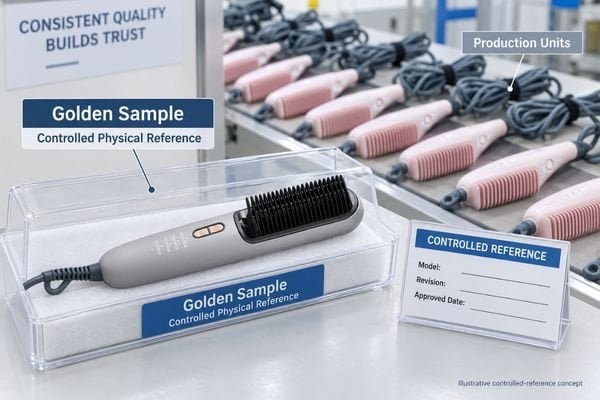
Industry quality guidance commonly describes a golden sample in manufacturing as a final approved physical reference used alongside specifications, BOMs, drawings, tolerances, QC requirements and test criteria.
That last point matters.
The term “golden” can create the false impression that the sample contains the complete product definition. It does not.
A physical unit can be useful for reviewing:
- color and finish;
- housing fit;
- visible assembly quality;
- button feel;
- logo position;
- surface texture;
- comb or nozzle geometry;
- accessory appearance;
- packaging presentation;
- general functional behavior.
It is much less reliable as the sole reference for:
- exact component part numbers;
- battery supplier and cell specification;
- heater construction;
- PCB revision;
- firmware version;
- component tolerances;
- hidden water-path materials;
- numerical test limits;
- market-specific labeling requirements.
Not Every Approved Sample Should Become the Golden Sample
This distinction helps prevent a common sourcing mistake.
Imagine that a buyer approves an early sample because its styling performance and appearance are acceptable. Before production begins, however, the project changes the PCB revision, heater supplier and packaging configuration.
The earlier sample remains historically “approved” for the scope that was reviewed.
It should not automatically remain the final physical production reference.
The production-intent version needs to be reviewed after the relevant changes, and the controlled reference should be updated when necessary.
That is why the K·SKIN OEM/ODM development process separates prototype iteration, validation and production readiness instead of treating the first accepted prototype as the end of development.
What Is a Production Standard?
A production standard is the controlled definition used to manufacture, inspect and release the product repeatedly. It is not necessarily a single document and should not be reduced to one physical sample.
The production standard should define both what the product is and how conformity will be verified. Depending on the project, it can include the approved BOM, drawings, specifications, approved physical references, functional requirements, test methods, inspection criteria, software or firmware revision, labels, manuals, packaging requirements and change-control records. Together, these items define the version that production is expected to reproduce.

For a beauty-device project, the controlled package may include:
| Production-Control Item | Example of What It Defines |
|---|---|
| Product specification | Model, electrical configuration, functions and principal parameters |
| BOM | Approved components, materials and part references |
| Engineering drawings | Dimensions, assembly relationships and tolerances |
| Approved physical sample | Appearance, finish, workmanship and other physical references |
| Firmware or software reference | Approved control version where applicable |
| Functional test method | How defined product functions are checked |
| Product-specific QC criteria | Heating, airflow, steam, electrical output, charging or other relevant checks |
| Workmanship standard | Acceptable and unacceptable visible conditions |
| Label requirements | Rating label, warning information and market-specific content |
| Manual | Approved language and operating information |
| Packaging specification | Retail box, inserts, accessories and shipping configuration |
| Inspection requirements | What is checked and the applicable acceptance basis |
| Change record | Approved deviations and revision history |
The specific package depends on the product.
A hair styling tool may require tighter control over the heater, temperature sensor, comb structure and electrical configuration. For hair straightener brushes, the relationship between tooth geometry and hair movement can also be evaluated through a structured tooth design and hair-glide test.
A facial steamer may require control over the heater, tank, water path, nozzle, protection logic and leakage-related checks.
A home beauty device may require control over the working head, electronics, output characteristics, charging system and operating modes.
The principle is the same: production needs enough controlled information to reproduce the approved version without relying on individual memory.
The current ISO 9001 quality management framework also emphasizes documented information and the planning, implementation and control of processes needed to meet product and customer requirements. It does not prescribe a universal “golden sample” procedure for beauty devices, but the broader control principle is consistent: repeatability depends on controlled processes and information.
Which Reference Wins If the Sample and Specification Do Not Match?
A golden sample is useful only when it agrees with the rest of the approved product definition. If the physical sample, drawing, BOM or specification contradicts another reference, production should not be asked to follow whichever one is most convenient.
A conflict between an approved sample and controlled documentation should trigger clarification before production continues. The project should define the authority of each reference and correct the inconsistent item. Critical dimensions, components, electrical requirements, compliance-related information and test limits should be documented explicitly rather than inferred from the appearance or behavior of a physical sample.
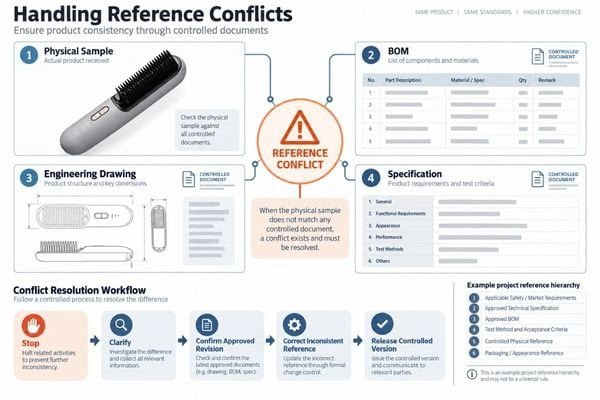
Consider the following examples.
The Housing Color Matches but the Material Does Not
The production unit visually matches the golden sample, but the resin grade specified in the BOM has been substituted.
A visual comparison cannot determine whether the substitution is acceptable.
The material change requires review against the controlled product definition.
The Sample Works but the Heater Part Number Has Changed
A straightener brush may still reach the expected temperature with a different heater.
That does not prove that warm-up behavior, temperature distribution, electrical load, long-term consistency or applicable verification remains unchanged.
The component change should be evaluated through change control.
The Packaging Matches but the Rating Label Is Wrong
A physical packaging sample may look correct while carrying information for another electrical or market version.
The controlled label specification and destination-market requirements must remain part of the approval basis.
The Drawing Changed but the Golden Sample Did Not
If an approved structural change affects tooth spacing, tank geometry, blade mounting or another physical feature, an old golden sample may no longer represent the released revision.
The physical reference should be reviewed and replaced or clearly retired where appropriate.
A useful project defines a reference hierarchy instead of assuming that “the golden sample always wins.”
For example:
- applicable safety, regulatory and market requirements;
- approved technical specifications and controlled engineering requirements;
- approved BOM and revision-controlled component definitions;
- agreed test methods and acceptance criteria;
- approved physical references for the characteristics they are intended to represent;
- commercial packaging and appearance references.
The exact hierarchy can vary by project, but it should never be ambiguous.
What Should Buyers Freeze Before Production Release?
Product freeze is the point at which the technical and commercial product definition is sufficiently controlled for repeatable production. It should occur after the relevant validation, not simply because a buyer has said that one sample “looks good.”
Before production release, freeze the product identity, technical configuration, approved components, critical dimensions, functions, test requirements, physical references and commercial configuration. Confirm that the documents and sample references point to the same revision. Any unresolved substitution, temporary component or open engineering issue should remain visible rather than being silently absorbed into the production version.
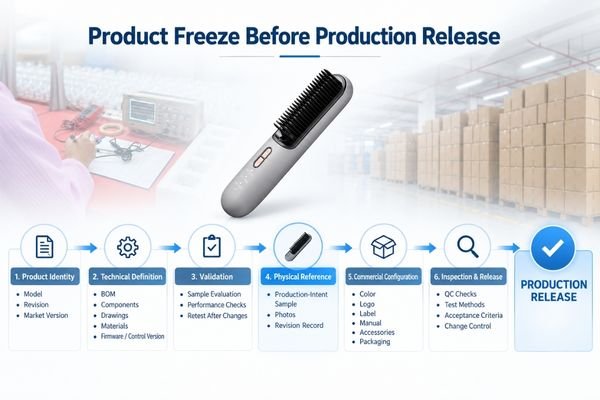
A practical production-release check should confirm:
Product Identity
- model;
- revision;
- destination-market version;
- corded or charging configuration where applicable.
Technical Definition
- approved BOM;
- critical component references;
- drawings;
- materials;
- firmware or control version where relevant;
- agreed functions and settings.
Validation
- required sample evaluations completed;
- defined performance checks completed;
- open failures closed or formally documented;
- affected items retested after meaningful changes.
Physical Reference
- correct production-intent sample identified;
- photos retained;
- sample revision recorded;
- reference protected from uncontrolled modification.
Commercial Configuration
- color and finish;
- logo and decoration;
- rating label;
- instructions;
- accessories;
- retail packaging;
- shipping configuration where specified.
Inspection and Release
- QC checks defined;
- test methods identified;
- acceptance criteria agreed;
- inspection responsibilities clear;
- change-control route defined.
K·SKIN’s manufacturing and quality-control framework follows the same basic logic: production is based on the confirmed product version, approved references and relevant project requirements rather than an isolated showroom sample.
What Happens When the Product Changes After Approval?
Production control works only if the approval records are updated when the product changes. Otherwise, the project gradually accumulates several conflicting versions of what is supposed to be “correct.”
A post-approval change should be reviewed for its impact before entering routine production. The affected specification, BOM, drawing, test method, physical reference or commercial document should be updated where necessary. If the change affects a characteristic represented by the golden sample, a new controlled physical reference may also be required. The previous revision should remain identifiable rather than quietly disappearing.
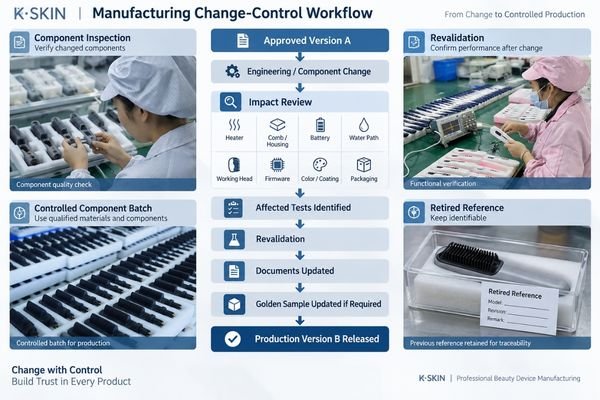
Not every change requires every test to be repeated.
The scope should reflect the impact.
| Change | Typical Areas to Review |
|---|---|
| Heater change | Heat-up, temperature control, distribution, electrical behavior |
| Comb or housing change | Dimensions, assembly, hair interaction, accessible surfaces |
| Battery change | Charging, runtime, protection, fit and electrical behavior |
| Water-path component change | Fit, leakage, flow or steam-related behavior |
| Working-head or blade change | Mechanical fit, output-related behavior and user interaction |
| Firmware change | Modes, timing, controls, protection logic and indicators |
| Color or coating change | Appearance, surface quality and material compatibility where relevant |
| Packaging change | Product fit, accessories, labels, manual and shipping configuration |
After reviewing the impact, the project should decide whether to:
- update documentation only;
- inspect a revised component;
- issue a revised sample;
- repeat selected validation;
- create a new golden sample;
- or release a new production revision.
This is also why an approved sample should never be stored without identification. Six months later, the team needs to know whether the sample on the shelf represents Revision A, Revision B or an intermediate engineering build.
Frequently Asked Questions
Is an approved sample the same as a golden sample?
Not automatically. “Approved sample” describes the approval status of a submitted sample for a defined scope. A golden sample is normally a controlled physical reference intended for later production or inspection. An approved sample may become the golden sample when it represents the correct production-intent version and is formally controlled for that purpose.
Can a golden sample replace the BOM and engineering drawings?
No. A physical sample is useful for appearance, workmanship and other observable characteristics, but it cannot reliably define every internal component, material specification, numerical tolerance, firmware revision or test requirement. The physical reference should be used together with controlled documentation.
How many golden samples should a buyer keep?
There is no universal required number. The project should retain enough controlled references for the parties that genuinely need them, such as the factory, buyer or inspection function. More important than quantity is ensuring that each retained sample represents the same approved revision and is clearly identified.
What if production matches the golden sample but does not match the specification?
Do not assume that matching the physical sample automatically makes the production acceptable. Identify the conflict, confirm the approved revision and determine which reference is incorrect. Update the incorrect document or sample through controlled approval before normal production continues.
When should a golden sample be replaced?
Review the reference whenever an approved change affects a characteristic represented by the physical sample. Changes to the housing, color, finish, structural components, controls, working heads, comb geometry, accessories or packaging may require an updated reference. Internal changes may instead require updated documentation and targeted revalidation even when the product looks unchanged.
Conclusion
Approved samples, golden samples and production standards serve different purposes. An approved sample records a decision about a specific version. A golden sample gives production and inspection a controlled physical reference. The production standard combines that reference with the BOM, specifications, drawings, test methods, acceptance criteria and commercial requirements needed to reproduce the approved version consistently.
Brands, importers and distributors preparing a project for volume production can review K·SKIN’s manufacturing and quality-control process and OEM/ODM development process, or contact the project team with the product version, customization scope and production-control requirements that need to be defined before release.