A straightener brush can look well designed yet behave very differently once real hair moves through its working zone. Tooth geometry deserves its own sample-evaluation process.
Hair-glide performance depends on the complete tooth layout: tooth pitch, clear gap, height, taper, row alignment, protective-tooth position, edge condition and surface finish. B2B buyers should not approve the design from appearance or a single smooth pass. The layout should be checked against defined dimensions, representative hair tresses and repeatable operating conditions.
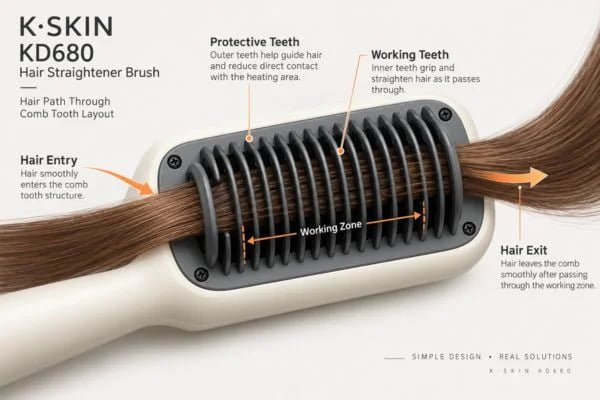
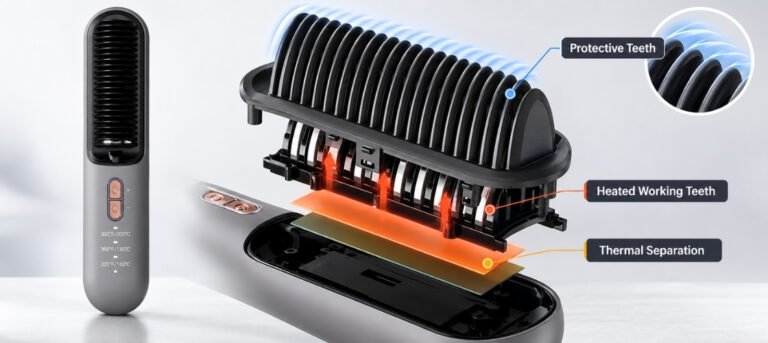
The tooth system has to perform several tasks at the same time. It must guide a section of hair into the working zone, maintain useful contact during the stroke, release the hair without abnormal snagging, and limit direct access to hotter internal surfaces.
Those requirements can conflict. A narrower passage may increase control of a small hair section but also increase congestion when a denser tress enters the same space. Taller protective teeth can increase separation from heated structures, but they also change how deeply hair reaches the working zone.
For buyers comparing hair styling tool platforms, this means that terms such as “anti-scald comb,” “smooth glide,” or “anti-pull design” should be treated as design descriptions until they are supported by the approved sample and an agreed test method.
A useful evaluation should answer four questions:
| Buyer question | Evidence to review |
|---|---|
| Does the geometry match the approved design? | Drawing, dimensions and sample inspection |
| Can representative hair enter and move through the working zone consistently? | Controlled hair-tress testing |
| Are abnormal snagging or pulling events repeatable? | Pass records, defect photos and optional force measurements |
| Can production reproduce the approved tooth structure? | Multiple samples, dimensional checks and change control |
Which Tooth-Layout Variables Affect Hair Entry and Glide?
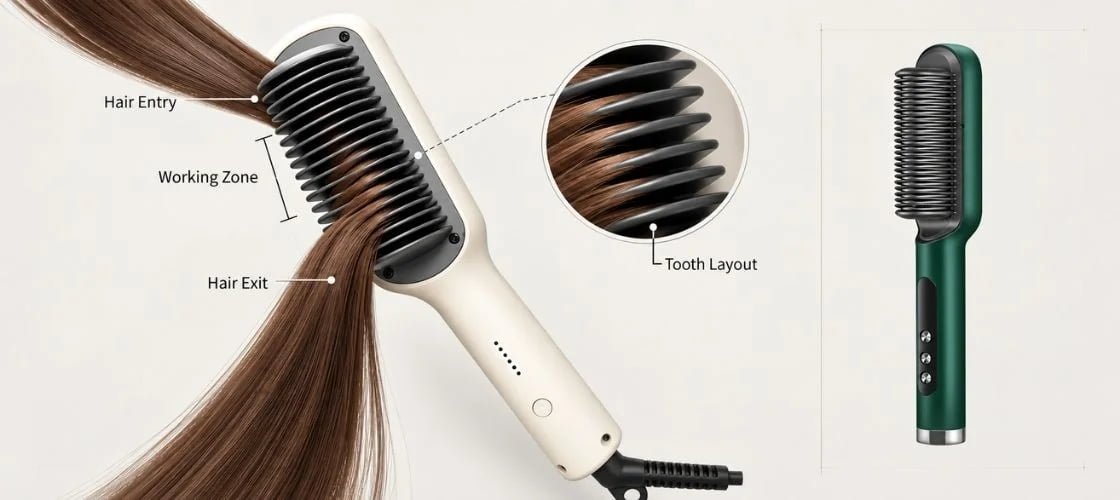
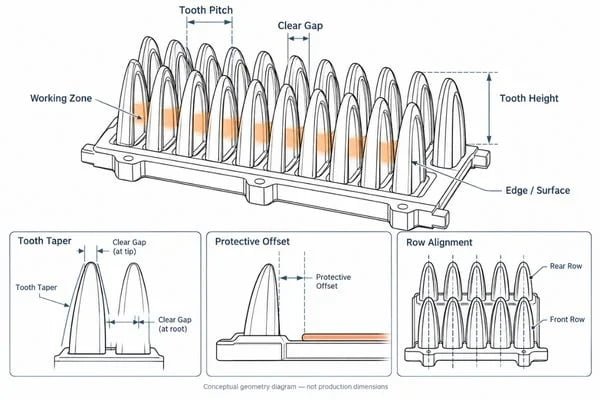
A tooth layout is more than the visible distance between two comb teeth. Several dimensions and surface details determine how hair enters, separates and travels through the brush.
Buyers should distinguish tooth pitch from the actual clear gap between adjacent surfaces, then review tooth height, cross-section, taper, row pattern, protective offset, edge radius and surface condition. Two brushes with a similar visual tooth density can create different hair paths because their usable gaps, tooth profiles and working-zone geometry are not the same.
Tooth Pitch and Clear Gap
Tooth pitch is normally the center-to-center distance between adjacent teeth. Clear gap is the physical space left between the opposing surfaces of those teeth.
They should not be treated as the same measurement.
A tapered tooth can have one gap near its root and another near its tip. An alternating layout can also create different passage widths depending on where the hair sits inside the brush.
For sample approval, the drawing or inspection plan should therefore define where each critical gap is measured.
Tooth Height and Protective Offset
Tooth height affects how far a section of hair can enter the comb structure. It also influences how the brush separates the scalp or skin from internal heated components.
Protective teeth may extend beyond heated or conductive working structures. This can help reduce direct access to hotter areas during normal use, but the arrangement should not automatically be interpreted as a guarantee against contact or burns.
Safety performance must be evaluated separately under the applicable product requirements.
Tooth Cross-Section, Taper and Row Pattern
The same nominal spacing can behave differently when the tooth shape changes.
| Design variable | Why it matters during sample evaluation |
|---|---|
| Tooth cross-section | Changes the surface presented to the moving hair section |
| Taper | Changes the available passage as hair moves deeper into the comb |
| Row alignment | Determines whether adjacent rows create straight or staggered paths |
| Tooth height | Influences entry depth and working contact |
| Protective-tooth position | Changes the route between accessible and heated structures |
| Working-zone width | Influences how much hair can be handled in one controlled pass |
There is no single layout that is automatically better for every product position. A compact brush intended for smaller styling sections may require a different balance from a larger brush intended to handle longer or denser sections.
Edge Condition and Surface Finish
Small manufacturing defects can matter more than a large difference in nominal tooth spacing.
Inspect the following areas closely:
- mold flash around tooth edges;
- unintended burrs or sharp features;
- coating accumulation;
- damaged or deformed teeth;
- inconsistent tooth alignment;
- rough transitions between molded and conductive parts;
- gaps that vary visibly across the same working zone.
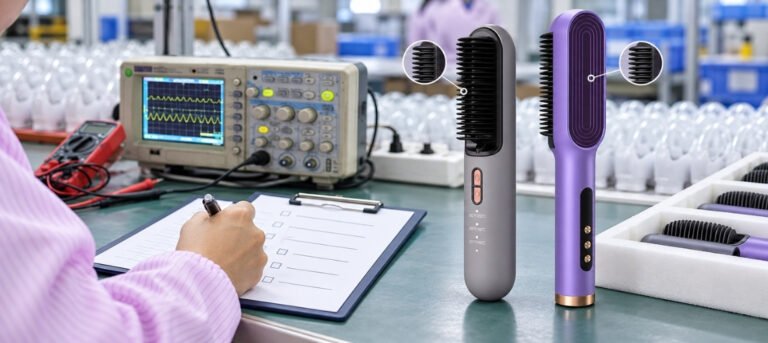
These conditions should be inspected before a hair-glide test. Otherwise, a product may appear to have a geometry problem when the actual cause is molding, finishing or assembly variation.
The tooth system also works together with the thermal structure. Buyers evaluating both subjects should separate mechanical hair-glide behavior from heating performance rather than assuming that one test proves the other.
Why Can the Same Tooth Layout Behave Differently on Different Hair Tresses?
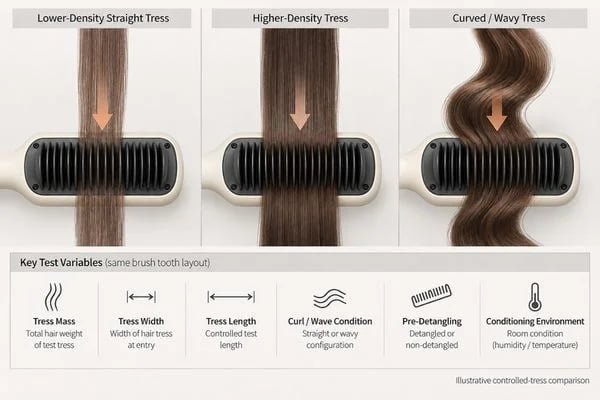
Hair itself is part of the test system. A brush cannot be meaningfully compared if one sample is tested with a thin straight tress and another with a dense, highly curved tress.
Hair diameter, curvature, tress mass, width, length, surface condition and previous detangling can change mechanical resistance during a pass. For comparative sample testing, buyers should control the tress specification and preparation as carefully as the brush settings. A “smooth” result has little value when the hair sample and operating method are undefined.
Instrumental hair research commonly evaluates combing resistance with controlled hair tresses, repeated passes and defined test conditions. For example, published combing-force research using controlled hair tresses standardizes the hair sample, environmental conditions, equipment and repeated measurement cycles.
That laboratory method is not a universal straightener-brush standard, but the principle is directly useful for sourcing: change fewer variables if you want a meaningful comparison.
A separate study on instrumental hair evaluation also notes that hair curvature and fiber interactions can affect combing resistance independently of surface smoothness. This is one reason buyers should avoid using one hair type as evidence for every intended user group. See the discussion of hair curvature and frictional-force measurement.
Tress Variables to Control
| Variable | What to define before comparison |
|---|---|
| Hair source or specification | Use the same source or documented equivalent |
| Hair condition | Virgin, treated, bleached or another defined condition |
| Tress mass | Keep the amount of hair consistent |
| Tress width | Maintain the same entry width |
| Tress length | Use a consistent effective stroke length |
| Curl or wave condition | Record the tress geometry used |
| Pre-detangling | Use the same preparation procedure |
| Conditioning environment | Keep temperature and humidity reasonably consistent |
| Previous test history | Avoid comparing heavily reused tresses with new ones |
A sourcing program does not need a research laboratory for every early comparison. It does need enough control to make the result repeatable.
If the test operator changes the tress, section size, angle, speed and starting condition at the same time, differences between products cannot be attributed confidently to the tooth design.
How Should Buyers Run a Repeatable Hair-Glide Test?
A useful hair-glide test should recreate the path through the brush while controlling the variables that commonly distort a comparison. The procedure can begin with a practical sourcing test and become more instrumented when necessary.
Use multiple samples of the same approved version, a documented hair-tress specification and the same operating sequence for every unit. Fix the temperature setting, tress size, entry depth, brush angle, stroke length, stroke direction and approximate speed. Record every abnormal snag, interrupted pass, visible hair accumulation and repeatability issue instead of reducing the test to a subjective “smooth” or “rough” score.

Step 1: Confirm the Sample Version
Before testing, record:
- model number;
- electrical version;
- sample or engineering revision;
- comb assembly version;
- housing and tooth materials where specified;
- temperature-control configuration;
- any engineering changes made since the previous sample.
Do not compare two visibly similar samples until their versions are confirmed.
Step 2: Inspect the Tooth Structure Before Adding Hair
Measure and photograph the relevant geometry.
Depending on the project, this can include:
- overall working-zone dimensions;
- selected tooth pitch locations;
- clear gaps at defined heights;
- tooth height;
- protective-tooth offset;
- row alignment;
- damaged or distorted teeth;
- molding flash and surface defects.
Do not infer dimensions from marketing photographs. Use the approved drawing, specification or a documented measurement method.
Step 3: Standardize the Hair Tress
Select the tress specification according to the intended product position.
The same tress should be used across the samples being compared, or equivalent tresses should be prepared to the same documented criteria.
Pre-detangle each tress using the same method before the test. If one tress starts with existing knots and another does not, the result is not comparable.
Step 4: Define the Operating Conditions
Record the conditions before testing:
| Test condition | Example of what should be fixed |
|---|---|
| Temperature setting | Same selected level for all units |
| Stabilization point | Same defined point before the first test stroke |
| Hair-section size | Same documented tress mass and width |
| Entry location | Same position in the working zone |
| Insertion depth | Same defined depth or reference point |
| Brush angle | Same approximate operating angle |
| Stroke direction | Same direction for every comparison |
| Stroke length | Same effective travel distance |
| Stroke speed | Keep operator speed reasonably consistent |
| Repetitions | Use the same number of passes per unit |
If temperature is part of the project, it should be verified separately rather than assumed from the display setting.
Step 5: Record Events, Not Just Impressions
A simple sourcing test can log observable events:
| Event | Record |
|---|---|
| Normal pass | Tress travels through without an abnormal interruption |
| Snag | Hair movement is suddenly interrupted at a localized point |
| Pull event | Operator experiences a distinct increase in resistance |
| Incomplete pass | Brush cannot complete the defined stroke normally |
| Hair accumulation | Fibers collect around a specific tooth area |
| Visible fiber breakage | Broken fibers are observed after the defined procedure |
| Tooth deformation | Tooth alignment or shape changes during testing |
| Abnormal surface contact | Tress repeatedly catches a seam, edge or transition |
These definitions should be agreed before the comparison starts.
Step 6: Add Force Measurement When the Project Requires It
For deeper engineering evaluation, a force gauge, tensile tester or texture-analysis system can move the test beyond operator perception.
Published hair-science methods demonstrate that combing resistance can be measured instrumentally with controlled tresses and repeated cycles. The purpose in a straightener-brush project is not to copy a cosmetic-research procedure exactly, but to apply the same principle of controlled mechanical comparison.
Useful outputs can include:
- peak resistance during the stroke;
- average or median resistance over the defined travel;
- location of abnormal force peaks;
- number of snag-related peaks;
- variation between repeated passes;
- variation between multiple product units.
There is no universal pull-force threshold that should be copied into every straightener-brush project. Acceptance criteria should be established from the intended product, approved baseline, test method and project risk.
What Should Buyers Record as Pass/Fail Evidence?
A sample is not fully approved when the team simply agrees that it “feels smooth.” Approval should connect the physical comb structure to measurable dimensions and repeatable test evidence.
A strong approval record combines tooth dimensions, workmanship inspection, controlled hair-tress results and multi-unit consistency. Pass/fail limits should come from the approved drawing, baseline sample and project-specific acceptance criteria. Hair-glide testing should remain separate from electrical and thermal safety verification, because smooth passage through the comb does not prove compliant surface temperatures or protective performance.
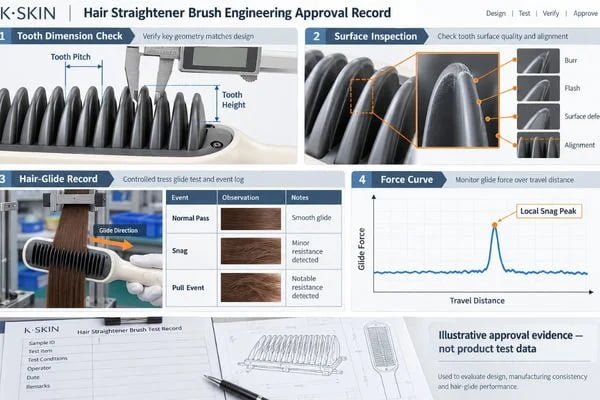
A practical approval matrix can look like this:
| Evaluation item | Evidence | Acceptance basis |
|---|---|---|
| Tooth dimensions | Drawing and dimensional record | Approved drawing tolerance |
| Row alignment | Inspection photos or fixture check | Approved sample or drawing |
| Surface condition | Close-up inspection | Defined workmanship standard |
| Hair entry | Controlled tress passes | Project-specific criteria |
| Snag events | Repeated-pass log | Approved baseline or agreed limit |
| Pull resistance | Force data where required | Project-defined comparison basis |
| Hair accumulation | Photos and event count | Agreed sample standard |
| Unit consistency | Multiple product samples | Sampling plan |
| Thermal accessibility | Separate temperature and safety testing | Applicable requirements |
Hair-glide approval should not replace safety evaluation.
The current IEC 60335-2-23:2026 standard for appliances for skin or hair care includes requirements relevant to hair-care appliances, including accessible surface temperatures and clarification of testing for products using PTC heating elements. It does not establish a universal hair-glide acceptance value.
That distinction matters when evaluating an “anti-scald” tooth structure. The comb geometry can be inspected as part of the product design, while the finished appliance still needs the applicable thermal, electrical and abnormal-operation evaluation for its target market.
Once a layout is approved, changes to tooth dimensions, molding, coating, materials or surrounding heated structures should not be treated automatically as cosmetic changes. They may alter hair entry, accessible surfaces, heat transfer or repeatability.
K·SKIN’s manufacturing and quality-control framework separates approved product versions from uncontrolled production changes. Projects involving structural changes should move through an agreed OEM/ODM development and validation scope.
How Should KD680 and KD380K Be Evaluated Differently?
Two straightening brushes can belong to the same product category without requiring the same hair-glide priorities. Intended use, working-zone dimensions and styling position should determine the sample plan.
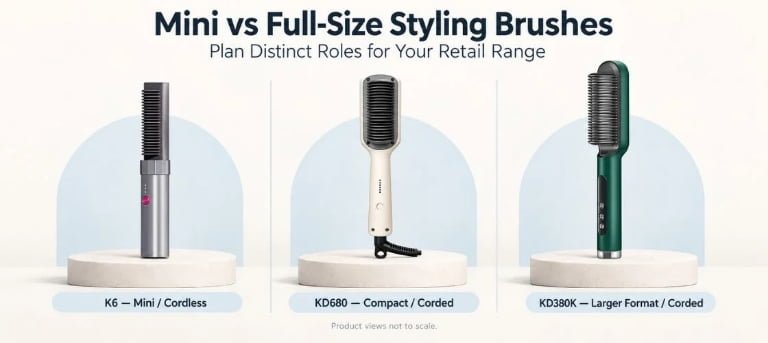
The KD680 and KD380K can be evaluated with the same core method—geometry inspection, controlled tresses, repeated passes and defect recording—but their test emphasis should reflect their different product positions. KD680 is a compact corded platform suited to smaller styling sections, while KD380K is a mainstream ionic straightening-and-shaping platform intended for broader everyday styling use.

The KD680 compact hair straightening brush is positioned as a compact corded platform for everyday straightening, smoothing, short-hair styling and bang styling.
For KD680 sample evaluation, useful questions include:
- Can a smaller hair section enter the intended working zone consistently?
- Do shorter sections remain controlled through the complete pass?
- Are edge and outer-tooth areas free from abnormal catching?
- Does the compact geometry remain easy to position around shorter styling areas?
- Are tooth spacing, alignment and visible workmanship consistent across several units?
The KD380K ionic hair straightening and curling brush is positioned as a mainstream corded styling platform supporting straightening, inward styling, curling and frizz smoothing.
For KD380K, buyers should place more emphasis on:
- consistency across the longer working zone;
- behavior with different documented section sizes;
- repeated passage through representative target-market hair tresses;
- row alignment and assembly consistency;
- whether the tress remains controlled during both straightening and shaping motions.
These are evaluation priorities based on each platform’s intended use. They are not evidence that one tooth architecture performs better than the other.
The approved sample should remain the reference.
If the project changes tooth spacing, tooth height, comb material, surface coating, row layout or the relationship between protective and heated structures, repeat the relevant dimensional, hair-glide and thermal checks before approving the revised version.
Frequently Asked Questions
Is narrower tooth spacing always better for straightening?
No. Narrow spacing may increase control of some hair sections, but it can also increase congestion or resistance with denser tresses. The correct spacing depends on the complete tooth geometry, intended styling section, product position and validated sample performance.
Can an anti-scald comb structure guarantee that the brush will not burn the user?
No. Protective teeth can help separate accessible areas from hotter working structures, but finished-product safety depends on the entire thermal and electrical design. Accessible-surface temperatures and other safety requirements should be evaluated under the applicable standard for the destination market.
How can a buyer test whether a straightener brush pulls hair?
Start with a controlled hair-tress procedure. Keep the tress, section size, product setting, insertion depth, angle, stroke length and repetition count consistent. Log snag and pull events. For higher-risk or engineering comparisons, add an instrumented force measurement.
Should one hair type be used to approve the tooth layout?
One defined tress can support a controlled engineering comparison, but it should not be used to claim suitability for every hair type. If the target market includes materially different hair characteristics, include representative tresses in the validation plan and document the conditions for each.
Does changing the comb-tooth structure require a new sample evaluation?
Usually, yes. Changes to spacing, height, taper, material, coating, row pattern or protective-tooth position can affect hair entry, glide, accessible surfaces and thermal interaction. The impact should be reviewed and the affected tests repeated before production approval.
Conclusion
Hair-straightener-brush tooth design should be approved as an engineering system rather than a visual feature. Tooth pitch, clear gap, height, taper, alignment, protective offset and surface condition all influence how a defined hair section enters and travels through the working zone. A useful evaluation combines dimensional inspection with controlled hair-tress testing and clear event records across multiple samples.
Brands, importers and distributors evaluating a new platform can review K·SKIN’s hair styling tools or contact the project team with the target market, product platform, intended hair-use profile and sample-validation requirements. Structural comb changes can then be reviewed against the correct development and validation scope before production approval.