A mini brush can look like an easy addition to a styling range. The harder question is what customers will buy it for—and whether that role is different enough from the larger brush already on the shelf.
Choose mini and full-size hair straightener brushes around distinct styling tasks, rather than size alone. A mini format may suit targeted fringe work and touch-ups; a larger format needs evaluation for broader styling routines. Compare usable comb area, handling, heat behavior, power requirements, packaging and price position. Add both only when sample evidence and clear product messaging support separate reasons to buy.
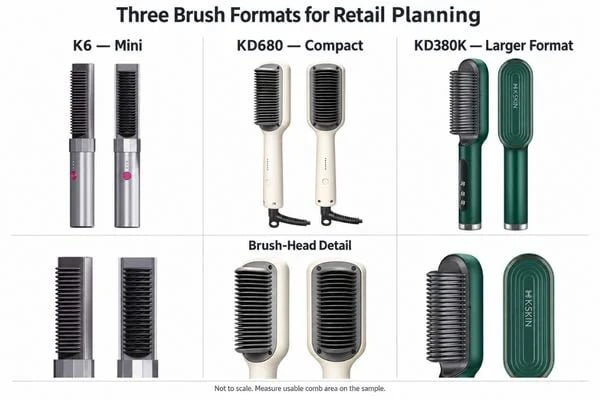
Give Each Brush a Job Before Giving It a Price
“A smaller version of our main brush” describes an object. It doesn't yet explain why someone would choose it. For retail SKU planning, that distinction matters: the customer needs to recognize a useful difference before comparing prices.
Start With the Styling Task
Separate targeted work—such as shaping a fringe or adjusting a small section—from a broader straightening-and-shaping routine. Then identify the intended hair lengths, section sizes and handling conditions. These become the brief for sample evaluation, rather than assumptions made from product photographs.
A narrow styling surface may be worth evaluating for precise positioning. Whether it actually provides better control depends on the comb geometry, grip and task. A larger brush should also earn its place through sample performance; its dimensions alone don't establish faster styling or better results.
Decide Whether the Products Complement Each Other
A useful product pair gives the customer two understandable choices. One might address a home styling routine, while the other focuses on fringe adjustments and smaller sections. That is a positioning proposal to validate, not a promise that every customer needs both.
If the two listings use nearly identical photographs, benefits and styling demonstrations, the distinction probably needs more work. Adding a second size won't resolve an unclear proposition.
Compare Mini, Compact and Larger Formats Separately
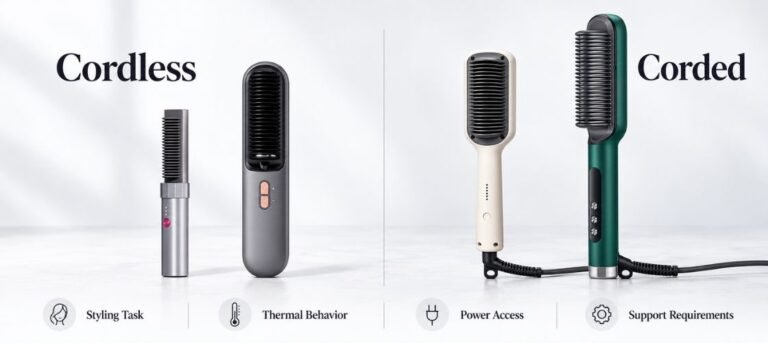
The choice isn't always a simple mini-versus-full-size split. A compact corded brush can sit between a narrow cordless tool and a larger home-styling platform. It deserves its own assessment instead of being grouped with every other small brush.
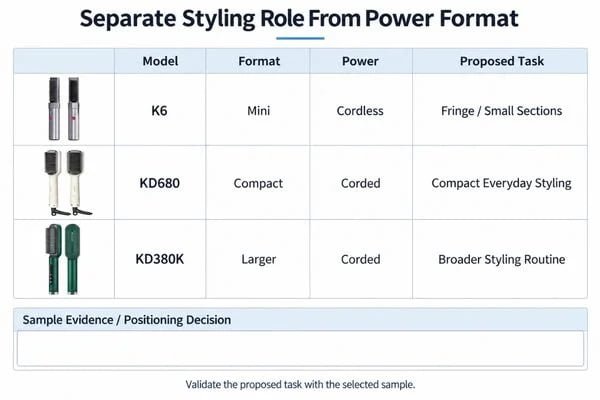
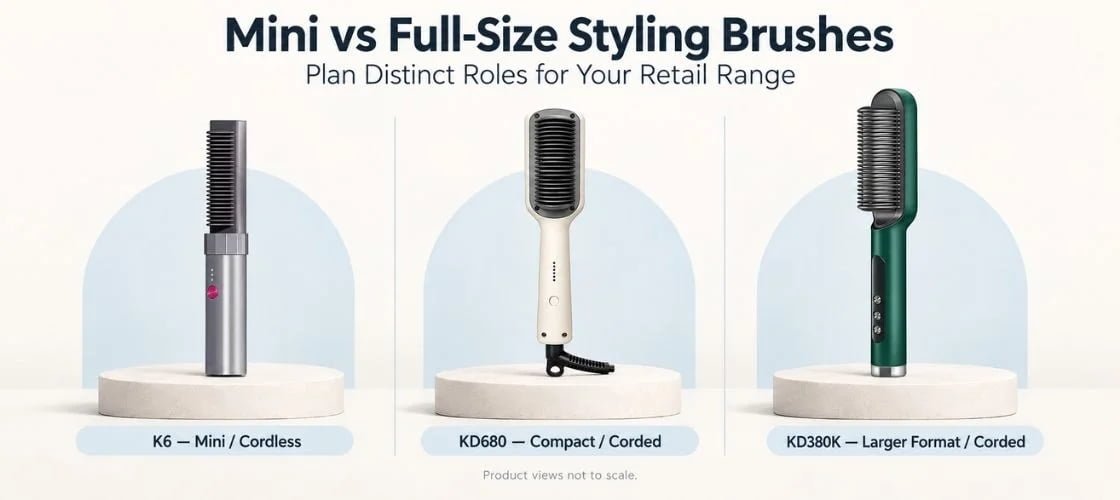
Three K·SKIN models illustrate the distinction:
| Model | Documented product direction | Power format | Question for the retail buyer |
|---|---|---|---|
| K6 | Mini brush for bangs, fringe and small-section touch-ups | Rechargeable cordless | Is the targeted task useful enough to justify a dedicated product? |
| KD680 | Compact hair straightening brush | Corded | Does a compact mains-powered option fit the intended everyday styling range? |
| KD380K | Larger straightening-and-curling brush platform | Corded | Does the sample support the broader styling routine planned for the main SKU? |
The K6 cordless mini bang styling brush has a targeted role. It should not be presented as a full-size replacement without evidence for the routine being claimed.
The KD680 compact hair straightening brush offers a different comparison: compact handling with a corded supply. Small does not automatically mean cordless.
The KD380K straightening-and-curling brush provides the larger platform in this comparison. Here, “full-size” describes its proposed range position, not an industry-standard size category.
Before turning these roles into a specification chart, confirm the quoted version. Where source records differ, dimensions, weight and temperature settings need to be tied to the selected sample rather than combined into one supposedly definitive specification.
Measure the Comb Area That Does the Work
Overall length is useful for a package drawing. It tells you much less about how the brush engages a hair section. A long handle, protective cap or outer comb can affect the silhouette without providing an equivalent increase in heated styling area.
For the physical comparison, record the usable comb length and width, tooth arrangement, grip dimensions and total device weight. Keep those measurements separate. A photograph with all three products resized to fill equal boxes can obscure exactly the differences a buyer needs to see.
Compare Access and Coverage as Different Qualities
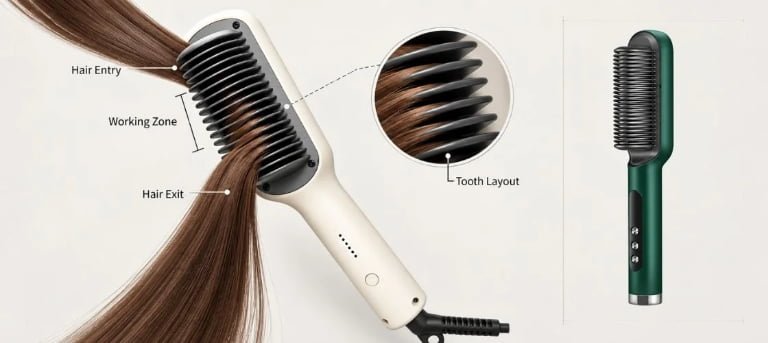
For targeted styling, observe how easily an evaluator can position the comb on the intended small section. Does the handle obstruct the view? Is the grip comfortable for the movement? Does hair enter and leave the comb cleanly?
For a broader routine, look at the section the brush can engage effectively and the number of movements needed to reach the agreed result. A wider body does not necessarily mean more useful contact with the hair. Tooth layout and section preparation still matter.
This is where a mini brush can have a clear role without claiming to match a larger tool. Evaluate the precision task on its own merits. If you also want to claim suitability for a broader routine, test that separately and show the limits of the result.
Keep Power and Heat Settings in Their Proper Place
Power format affects the routine around the product: preparation, access to an outlet, charging and storage. It should inform the range decision without becoming a shortcut for judging styling quality.

Compare a Completed Task, Not Just Rated Power
A rated wattage or maximum temperature is not a direct measure of styling speed. Ask how the sample behaves during the task: time to the defined ready condition, temperature response during hair contact, repeated passes and the result at the agreed endpoint.
Temperature controls also need a practical review. Can evaluators understand the selected setting and ready indication? Are buttons easy to operate without accidental changes? More settings may give a different control experience, but the count alone doesn't prove better styling.
Where a setting value differs between a specification, manual and product page, resolve its applicability to the sample before publishing it. A comparison can still discuss product roles while a non-core numerical field remains unconfirmed.
Include the Preparation That Customers Will Need
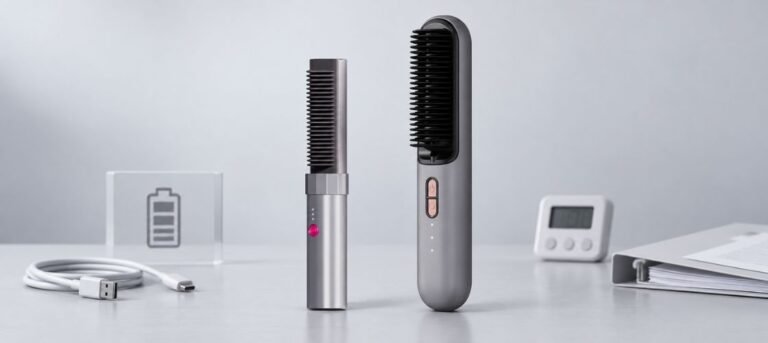
For K6, the reviewed configuration uses a rechargeable battery and USB Type-C charging. Its specification states that connecting the charging cable exits heating operation; do not describe it as a brush that styles while charging. Confirm the instructions and charging arrangement for the version supplied.
For the corded KD680 and KD380K, include outlet access, cable handling and the correct electrical version in the assessment. A plug that fits an outlet does not, by itself, establish electrical compatibility.
The comparison should reflect the complete routine. A useful result is that a sample completed a defined task under recorded conditions—not an unsupported promise of unlimited corded use or a fixed number of cordless sessions for everyone.
Build a Price Position Around a Clear Difference
A smaller product does not have to be the cheapest item in the range. Nor does a larger body automatically support a premium. Price positioning needs to make sense alongside the task, sample experience, included accessories and service requirements.
For example, a brand could evaluate a dedicated fringe tool alongside a main home-styling brush. Another might prefer a compact corded SKU as its core offer. These are commercial options, not forecasts of demand or recommendations that every retailer should stock all three.
Let the Channel Shape the Presentation
In e-commerce, the listing needs to communicate scale and intended use without relying on the customer seeing the product in person. Show the brush in a relevant styling context and make the power format easy to find. “Mini” alone leaves too much to interpretation.
On a physical shelf, assess the finished pack and the distinction between adjacent SKUs. Can a buyer understand the difference from the front panel and a short explanation? Does the demonstration match the use shown on the package?
For a bundle or gift set, consider whether the second brush adds a distinct task and whether the set remains easy to explain. A bundle can look more substantial while offering little additional value if both products are presented as doing the same job.
Keep the financial comparison on a consistent basis: quoted configuration, packaging, logistics, channel costs and the support assumptions used by your team. There is no reliable price ladder to copy from dimensions alone.
Review Packaging and Return Expectations Together
The device is only part of what the customer receives. A narrow brush can still need space for protection, instructions and accessories. A compact body therefore does not automatically mean the smallest retail pack or lowest shipping cost.
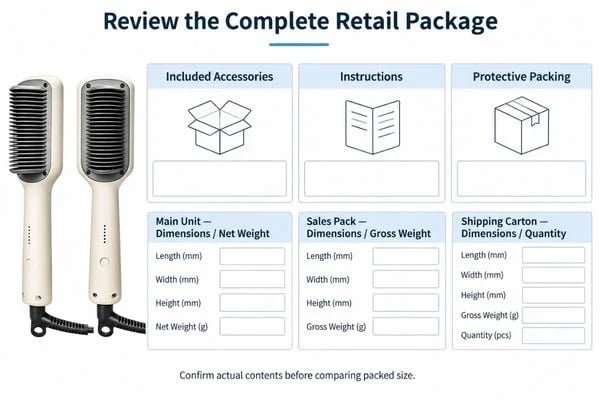
Measure the proposed sales pack and shipping carton after the contents have been agreed. Record unit gross weight, carton quantity and carton dimensions alongside the main-unit measurements. Comparing one model's bare-device weight with another's packed weight will distort the decision.
Check Whether the Product Story Sets the Right Expectation
Return planning should begin with the promises made before purchase. A small-section tool advertised as an all-purpose replacement creates a different expectation from one clearly shown shaping a fringe.
Review the product page, package, demonstration and instructions together. Pay particular attention to:
- The styling area and hair tasks shown in photographs.
- Whether the product is cordless or needs outlet power during use.
- Which cable, cap or other accessories are actually included.
- How heat settings and ready indications are explained.
- The permitted cooling and storage sequence.
These are potential sources of misunderstanding to examine, not measured return causes for these models. If the business has genuine customer feedback, use it to refine the review rather than inventing a return-rate forecast.
Portability claims need the same care. A protective cap or pouch should not imply permission to pack away a hot appliance. Follow the selected version's instructions and evaluate the complete carrying set, including whatever is needed to recharge or power it.
Run Sample Comparisons That Reflect the Intended Purchase
A useful comparison needs two views: how each brush performs its proposed job, and how it behaves on any task the products are said to share. Combining those into one vaguely defined “styling test” can produce a misleading winner.
Separate the Intended Task From the Shared Task
For K6, define the small-section or fringe task being considered. For the larger platform, define the broader routine. For KD680, identify the particular task that would justify its compact corded position.
Then select any genuinely shared task for a controlled comparison. If the products require different section sizes, record that difference and why it was used. Treating every brush identically can be just as misleading as changing conditions without explanation.
Before testing, agree the hair-tress identity and preparation, sample versions, evaluator method, permitted settings, starting battery condition or electrical supply, ambient conditions and desired endpoint. Record the sample count. Keep use within the applicable instructions; any formal safety assessment belongs with suitably qualified personnel.
Record What Happened During the Task
- Inspect each sample and match it to its specification, label and instructions.
- Measure the device and usable comb area, then document the agreed setup.
- Record preparation and time to the defined ready condition.
- Run the intended task, noting section size, passes, handling interruptions and observable pulling or snagging.
- Record the result at the agreed endpoint and repeat under the defined method.
- Review cooling, storage, accessories and packaging as part of the complete product experience.
If a decision depends on temperature measurements, use a defined instrument and method with specified measurement locations. An indicator or display reading should not be presented as a measured surface-temperature result.
| Evaluation point | Record | How it helps the range decision |
|---|---|---|
| Small-section positioning | Access, grip, control and observed handling issues | Tests whether a targeted SKU has a useful role |
| Broader styling task | Section size, passes, completion time and result under the recorded method | Tests the proposed main-SKU routine |
| Heat behavior | Method, settings and observations during the task | Checks whether the styling claim has relevant support |
| Power and preparation | Charge state or supply, ready condition and interruptions | Shows what the routine requires in practice |
| Finished package | Contents, dimensions, gross weight and instruction clarity | Connects the product experience with the commercial offer |
Set acceptance criteria before judging the samples. Pass/fail limits should come from the project's agreed requirements and applicable obligations, not from arbitrary scores added after testing. These steps describe work to perform; they are not published test results for the three models.
Choose the Smallest Range With Distinct Reasons to Buy
You don't need three sizes simply because three platforms are available. Start with the clearest proposition, then add a product only when it addresses a useful gap that the existing SKU cannot explain or serve adequately.
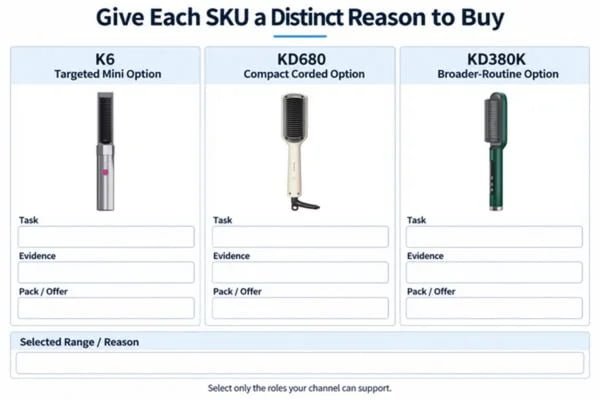
| Proposed range | When it is worth evaluating | What needs to be demonstrated |
|---|---|---|
| One core brush | The channel has one clear styling proposition | The selected sample supports that routine and commercial offer |
| Core brush plus targeted mini | A separate fringe or small-section task fits the audience | The mini has a clear role, supported performance and understandable messaging |
| Compact corded plus larger corded | Handling or feature differences could support separate positions | The distinction remains meaningful beyond a small size or price change |
| Three-format range | The channel can explain and support all three roles | Each SKU has its own task, package, economics and support requirements |
Before approving the assortment, confirm:
- The intended styling task and target customer for each SKU.
- The exact sample version and unresolved specification fields.
- Evidence for any shared-task or performance comparison.
- The complete package and included accessory list.
- A cost comparison using the same quotation and logistics basis.
- Product-page and packaging language that accurately distinguishes the models.
- Required documents for each selected version and destination market.
If a product's only remaining distinction is that it looks slightly smaller, consider whether the range really needs it. A narrower, better-explained assortment may be the more manageable commercial choice; that judgment should follow the channel brief and evidence, rather than a fixed SKU formula.
Frequently Asked Questions
Some practical questions remain even after the product roles are clear, especially when moving from samples to a retail offer.
Can We Call a Mini Brush a Full-Size Replacement?
Only if the specific replacement claim is supported for the routine being advertised. A successful fringe demonstration does not establish performance across a broader styling task. Otherwise, describe the mini's targeted role and show it honestly.
Does Compact Mean Cordless?
No. KD680 is a compact corded platform, while K6 is rechargeable and cordless during permitted operation. Keep size and power format separate in comparison charts and retail copy so customers can understand both.
Should a Mini Brush Always Have a Lower Retail Price?
No fixed price relationship follows from size. Evaluate the quoted configuration, packaging, features, support costs and channel proposition. A target price is a commercial decision to test, not a product fact that can be inferred from dimensions.
Do We Need Every Hair Type in the First Sample Review?
Begin with representative hair conditions for the intended audience and task. Record what was included and keep claims within that scope. Broader hair-type claims need broader supporting evidence; one successful tress is not enough to represent everyone.
Can All Three Models Use the Same Instructions or Compliance Documents?
Do not assume that they can. The power arrangements, controls and intended tasks differ, and each document needs a model-and-version scope review. Shared branding can give the range a consistent appearance without making its technical instructions or evidence interchangeable.
A single certificate may cover more than one model when its scope and supporting documents include them. Our guide to beauty device certificate coverage explains how to check the model list, configuration differences and destination-market relevance before relying on the same document across the range.
Conclusion
Mini versus full-size is a product-line question before it is a size comparison. The stronger assortment gives each brush a clear task, then checks whether its comb format, handling, heat behavior and complete package support that role. Small should not imply equivalent full-size performance, and larger should not imply automatic superiority.
For a K·SKIN project, use the hair styling tools range to shortlist the relevant platforms, then request version-matched samples and specifications. Compare K6, KD680 and KD380K around the roles your channel actually needs before deciding how many SKUs to launch.
For your next product review, explore hair straightener brush project options.