A finished ultrasonic skin scrubber sample may look ready for market while still hiding differences in output, spatula assembly, control logic, charging behavior, or unit-to-unit consistency.
An ultrasonic skin scrubber sample should be approved only after the exact product version has been identified and its ultrasonic operation, spatula condition, controls, charging behavior, assembly quality, and consistency have been checked under defined conditions. Visual appearance or a simple water-spray demonstration alone is not enough to approve the commercial version.
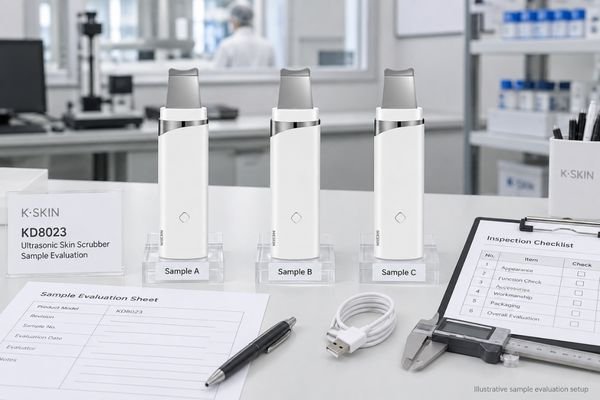
For brands, importers, and distributors, sample evaluation involves more than demonstrating that a device can switch on. Its purpose is to determine whether the sample represents a product version that can be approved, documented, and reproduced in production.
This evaluation should also remain separate from formal compliance testing. A sample may perform as expected during a commercial evaluation while still requiring additional safety, EMC, market-access, labeling, or other verification for its destination market.
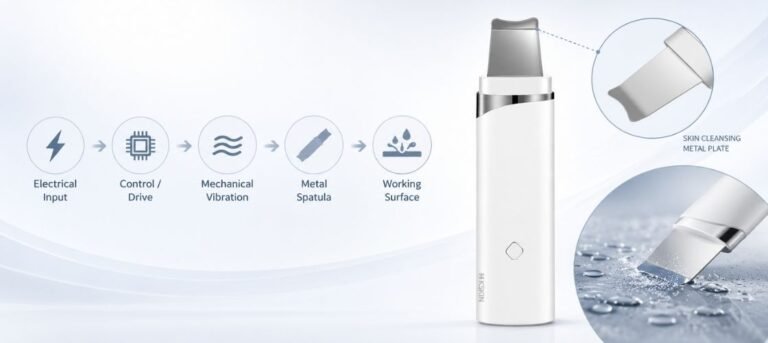
Buyers who first need to understand the operating principle can review How Does an Ultrasonic Skin Scrubber Work? before moving on to sample approval.
What Should Be Confirmed Before Testing a Skin Scrubber Sample?
Before testing begins, confirm the model, revision, operating modes, charging configuration, supplied accessories, test method, and acceptance basis. Every sample being compared should be evaluated under the same defined conditions. Without this preparation, differences in procedure can easily be mistaken for differences in product performance.
The sample should first be treated as an identified product version rather than simply as “the skin scrubber.”
Record the basic information before operating it:
| Item | What to Confirm |
|---|---|
| Sample identity | Model and product revision |
| Functional version | Approved operating modes and control sequence |
| Power configuration | Charging input and supplied charging accessories |
| Test procedure | Same procedure for all units being compared |
| Test medium | Same defined water-based condition where applicable |
| Test duration | Consistent observation period |
| Sample quantity | Multiple units where practical |
| Acceptance basis | Approved specification and project requirements |
For a product such as the K·SKIN KD8023 ultrasonic skin scrubber, the current product reference includes ultrasonic and EMS functions, Cleansing, Infusion, and Lifting modes, USB charging, a 5 V / 1 A charging input, and 3 W rated power.
These values apply to that specific product version and should not automatically be used for unrelated skin scrubber models.
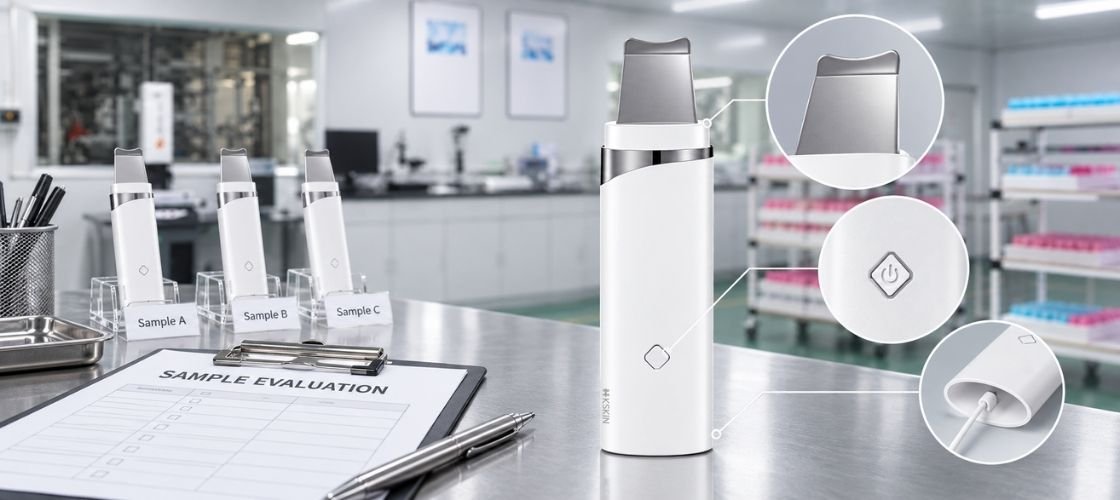
Evaluating multiple samples is preferable to approving a single presentation unit. Three units can be useful for an early commercial comparison when available, but this should not be treated as a universal compliance or production-sampling rule.
How Should Buyers Evaluate Ultrasonic Output?
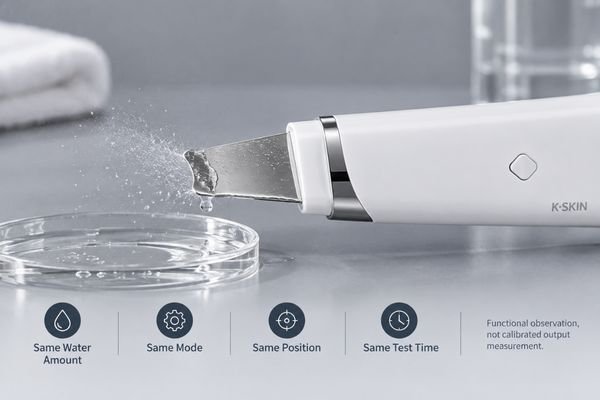
Ultrasonic output evaluation should confirm that the intended function activates, remains stable throughout the test period, and behaves consistently across comparable samples. A visible response from water droplets or a water film on the spatula can provide a useful functional observation, but it is not a calibrated measurement of ultrasonic frequency or output power.
Confirm Function Activation
Begin by confirming that selecting the intended operating mode activates the expected function.
An indicator light alone is not sufficient evidence. The control system may display the selected mode even when the working component is not behaving as expected.
Record:
- whether the function starts consistently;
- whether activation is immediate or delayed;
- whether the output stops unexpectedly;
- whether the unit behaves differently after repeated starts;
- whether any abnormal sound or intermittent behavior appears.
Do not assign a numerical output value without appropriate measurement equipment. The purpose of this check is to verify functional behavior against the approved product reference.
Use a Repeatable Functional Test
Applying water to the spatula is a common way to make ultrasonic activity visible. This can be useful when comparing samples, but only if the test conditions are controlled.
Keep the following variables consistent between units:
- water quantity;
- water position on the spatula;
- blade orientation;
- selected mode;
- starting condition;
- observation period;
- test sequence.
If Sample A receives a thin water film while Sample B receives several times more water, the resulting spray patterns do not provide a meaningful comparison.
The same principle applies to photographs and videos. A dramatic mist image may show that the spatula is active, but it does not establish the actual ultrasonic frequency, electrical output, or performance efficiency.
Check Output Stability
Do not assess the product from its first few seconds of operation alone.
Observe the function at several points during a defined operating period. A simple record can include:
| Observation Point | What to Check |
|---|---|
| Start | Function activates correctly |
| Early operation | Output remains consistent |
| Mid-session | No interruption or obvious weakening |
| End of test period | Function remains stable |
| Restart | Product returns to normal operation |
Record any clear change before deciding whether it results from the product, the power condition, or the test method.
Compare Multiple Samples
Sample approval should consider consistency, not simply whether one unit operates.
Compare the units using the same procedure and look for:
- delayed activation;
- visibly weaker response;
- intermittent output;
- unusual sound;
- inconsistent mode behavior;
- abnormal variation between samples.
A difference does not automatically prove that a unit is defective, but its cause should be understood before approval.
How Should the Stainless-Steel Spatula and Blade Assembly Be Inspected?
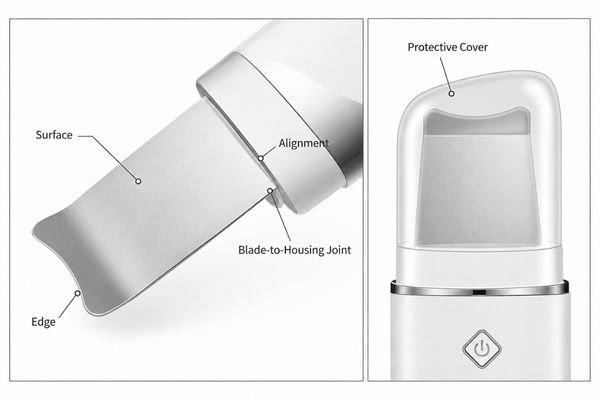
The spatula should be evaluated as both a working component and a user-contact surface. Buyers should inspect its surface finish, edge condition, alignment, fixation, connection to the housing, protective cover, and cleaning accessibility against the approved sample or specification.
Surface and Edge Condition
Inspect the spatula under good lighting before and after functional testing.
Look for:
- scratches;
- dents;
- contamination;
- discoloration;
- visible burrs;
- irregular edges;
- surface damage.
The evaluation should not introduce a universal blade thickness, edge radius, hardness, or surface-roughness limit. Where dimensional requirements exist, compare the sample with the approved drawing, product specification, or reference sample.
Alignment and Fixation
The spatula should sit in the housing consistently with the approved construction.
Check for:
- visible deformation;
- unexpected movement;
- inconsistent positioning;
- an uneven blade-to-housing transition;
- loose assembly;
- gaps that differ noticeably between samples.
A mechanically inconsistent spatula should not be approved simply because its ultrasonic function activates.
Protective Cover
If the product includes a spatula cover or dust cover, evaluate it as part of the complete sample.
Check whether it:
- fits the approved product correctly;
- can be installed and removed without excessive force;
- remains secure during normal storage;
- protects the spatula from contact and contamination;
- matches the approved commercial configuration.
Cleaning and Maintenance
Skin scrubbers are commonly used with moisture on the skin, but positioning a product for wet-skin use should not automatically be interpreted as a waterproof claim.
Evaluate whether the spatula and nearby surfaces can be cleaned according to the intended instructions. Pay particular attention to residue-prone gaps and the transition between the metal spatula and the housing.
Do not introduce rinsing, immersion, or other water-exposure tests unless they are supported by the approved product specification and applicable requirements.
How Should Buyers Verify Controls and Operating Modes?
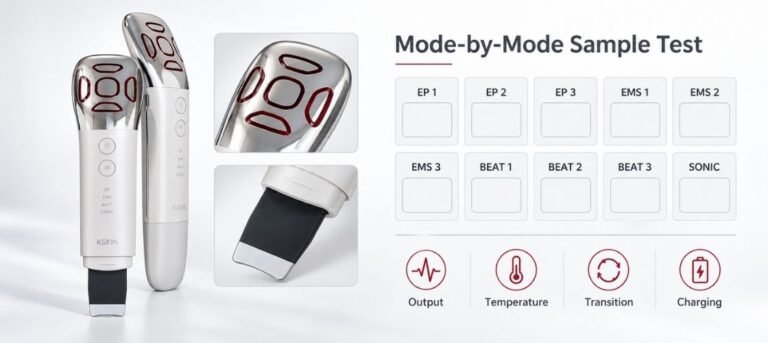
Control evaluation should cover more than button response. Buyers should verify the power sequence, mode-switching logic, indicators, actual function activation, restart behavior, and repeated operation against the approved version. The displayed mode should remain aligned with the function that is actually operating.
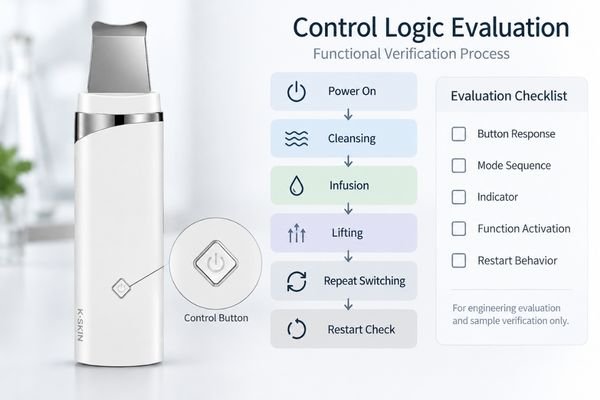
KD8023, for example, uses Cleansing, Infusion, and Lifting modes. Other skin scrubber platforms may have different mode structures, so testing should follow the approved product version rather than assume a generic three-mode arrangement.
A practical control check can record:
| Test | What to Record |
|---|---|
| Power on/off | Response is repeatable |
| Mode switching | Correct mode sequence |
| Indicator behavior | Indicator matches selected mode |
| Ultrasonic function | Intended function activates |
| EMS function | Behavior matches approved version |
| Repeated switching | No missed or unintended response |
| Restart behavior | Restart follows defined product logic |
| Session operation | No unexpected interruption |
Repeated switching is useful because one successful button press will not reveal an intermittent control issue.
EMS function also requires careful wording during evaluation. A sensation reported by a person is an observation, not a calibrated electrical measurement. Where engineering output data are required, they should come from an appropriate, defined measurement method rather than subjective sensation.
The same distinction applies to skincare claims. Sample approval should verify the product's functions and approved operating behavior, not use a single evaluation session to claim treatment results.
For U.S. marketing, the FDA guidance on cosmetic labeling claims explains that claims involving disease treatment or effects on the structure or function of the body can change how a product is regulated. Other markets have their own requirements and should be reviewed separately.
How Should Charging and Power Behavior Be Evaluated?
Charging evaluation should confirm the approved input, connector fit, charging indication, charging continuity, operation after charging, and consistency across samples. Battery capacity, charging time, runtime, or cycle-life claims should not be added unless they are supported by the approved specification or a defined test record for that product version.
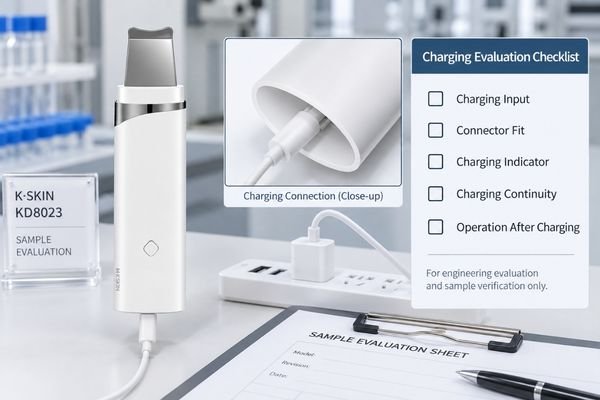
For KD8023, the current reference specifies USB charging, a 5 V / 1 A input, and 3 W rated power.
During sample evaluation, check the physical and functional charging behavior rather than merely connecting a cable and noting that an indicator appears.
A useful charging review includes:
- Confirm the charging input against the approved specification.
- Inspect the charging connector and supplied cable.
- Check for a loose or intermittent connection.
- Observe the charging indicator according to the approved operating logic.
- Confirm the defined completion indication where applicable.
- Compare charging behavior across multiple samples.
- Operate the device after charging and repeat the main functional checks.
- Record any abnormal heating or interruption using an agreed method.
If the project requires acceptance criteria for runtime, charging time, battery capacity, or battery aging, they should be defined separately and supported by the actual approved battery configuration.
For electrical safety projects in which the product falls within its scope, IEC 60335-1:2020 provides general safety requirements for household and similar electrical appliances, including DC-supplied and battery-operated appliances. The applicable standards, national requirements, and product-specific requirements should still be confirmed for the exact device and destination market.
What Other Checks Should Be Completed Before Sample Approval?
Output, blade, controls, and charging are the main functional areas, but approval should also cover appearance, assembly, dimensions, accessories, unit-to-unit consistency, and the final commercial configuration. A technically functioning sample can still be unsuitable for approval if the version being tested is not the version intended for production.
Appearance and Assembly
Inspect the complete product rather than focusing only on the spatula.
Review:
- housing fit;
- surface finish;
- button fit;
- visible gaps;
- cover fit;
- charging-port assembly;
- product markings;
- supplied accessories.
For the current KD8023 reference, the product dimensions are 187 × 46 × 20 mm, and the weight is approximately 97 g. These values can be checked when dimensions and weight form part of the approved specification.
Multi-Unit Consistency
A sample evaluation should determine whether different units behave like the same product version.
Compare:
- appearance;
- blade assembly;
- controls;
- ultrasonic function;
- charging behavior;
- accessories;
- packaging configuration.
One good unit does not establish production consistency. At the same time, an early commercial sample review should not be confused with a formal production sampling plan.
Accessories and Commercial Version
Before approval, verify that the sample represents the commercial configuration actually intended for production.
This may include:
- product color;
- logo;
- product label;
- charging cable;
- spatula cover;
- accessories;
- user manual;
- packaging;
- market-specific labeling.
A technically approved engineering sample and a commercially approved private-label version are not always the same product configuration. The final approval record should make that distinction clear.
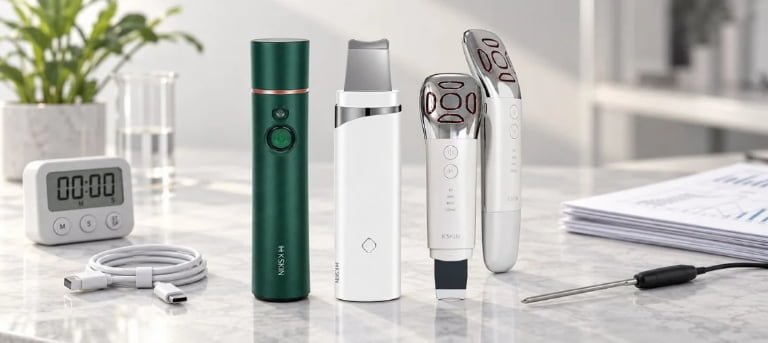
Buyers comparing broader device platforms can review the K·SKIN Home Beauty Devices range before deciding which product architecture best fits the project.
How Should Buyers Record Defects and Decide Whether to Approve the Sample?
Every issue should be recorded against a defined requirement and test condition. The practical decision is not limited to “good” or “bad.” A result may pass, require a specific revision, fail an important requirement, or be invalid because the test method itself was unreliable.
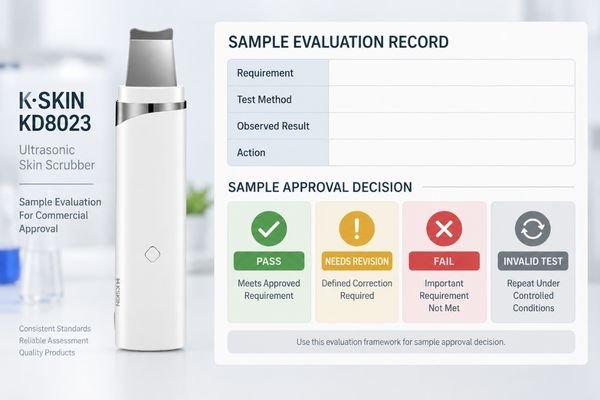
A simple decision matrix can help keep the review objective:
| Result | Meaning | Next Action |
|---|---|---|
| Pass | Meets the approved requirement | Record and retain as evidence |
| Needs Revision | Defined correction is required | Correct and retest |
| Fail | Important requirement is not met | Do not approve the version |
| Invalid Test | Test condition or method was unreliable | Repeat under controlled conditions |
Defect records should describe exactly what happened.
“Ultrasonic output bad” is less useful than a record identifying the sample, selected mode, test condition, observation time, visible behavior, and whether the same behavior appeared in other units.
When a correction is made, retest the affected item. A change to the blade assembly, control board, charging component, housing, or another relevant part may also affect related functions, so retesting should not automatically be limited to the original symptom.
What Should Be Frozen After the Sample Is Approved?
Once the sample passes the agreed evaluation, freeze the exact model, revision, functional configuration, charging version, appearance, accessories, labels, manuals, packaging, and relevant test records. The approved sample should become a controlled production reference rather than an unmarked unit identified only from memory or appearance.
The approval records should allow purchasing, engineering, quality, and the supplier to identify the same version later.
A basic approved-version record can include:
| Record | What to Freeze |
|---|---|
| Product identity | Model and revision |
| Functional configuration | Modes and approved behavior |
| Power configuration | Charging input and relevant components |
| Physical reference | Spatula, housing and appearance |
| Accessories | Cable, cover and supplied items |
| Documents | Labels and user manual |
| Packaging | Approved commercial packaging |
| Test evidence | Sample evaluation records |
| Open issues | Any approved exceptions or pending actions |
This approval process should then connect with production control. K·SKIN's Manufacturing & Quality approach uses the approved product version as the reference from sample confirmation through manufacturing and final review.
FAQ
How do you test an ultrasonic skin scrubber sample?
Begin by identifying the exact product version and defining the test conditions. Then evaluate the ultrasonic function, spatula condition, controls, charging behavior, assembly, and consistency across multiple units where practical. For each item, record the applicable requirement, test method, observed result, and required action.
Is water atomization on the spatula enough to verify ultrasonic output?
No. A controlled water-droplet or water-film test can provide a visible functional indication that the spatula is active, but it does not provide a calibrated measurement of ultrasonic frequency or output power. It is most useful for repeatable functional comparisons between samples tested under the same conditions.
What should buyers inspect on the stainless-steel spatula?
Inspect the surface finish, edge condition, alignment, fixation, deformation, connection to the housing, protective cover, and cleaning accessibility. Any dimensional criteria should come from the approved specification, drawing, or reference sample rather than from a generic industry value.
How many skin scrubber samples should be evaluated?
No single sample quantity applies to every commercial, compliance, or production evaluation. Multiple units provide more information than one. Three samples can be useful for an early commercial comparison when practical, but formal sampling requirements should be defined separately according to the project and test purpose.
Does passing a sample evaluation prove skincare performance or regulatory compliance?
No. Sample evaluation determines whether the tested product version meets the agreed commercial and functional requirements. It does not by itself prove skincare efficacy, certification, regulatory compliance, long-term reliability, or production-lot consistency. Each of those areas requires its own evidence and verification.
Conclusion
Ultrasonic skin scrubber sample approval should be based on a controlled comparison of the exact product version, not on appearance or a single successful demonstration. Output behavior, spatula quality, control logic, charging, assembly, and consistency all contribute to the approval decision.
The most useful outcome is not simply a sample marked “approved.” It is an identifiable commercial version supported by test records and clear configuration data that can be carried into production. Buyers evaluating an ultrasonic skin scrubber or another home beauty device can contact K·SKIN to discuss product configuration, sample evaluation, private-label requirements, and production planning.