
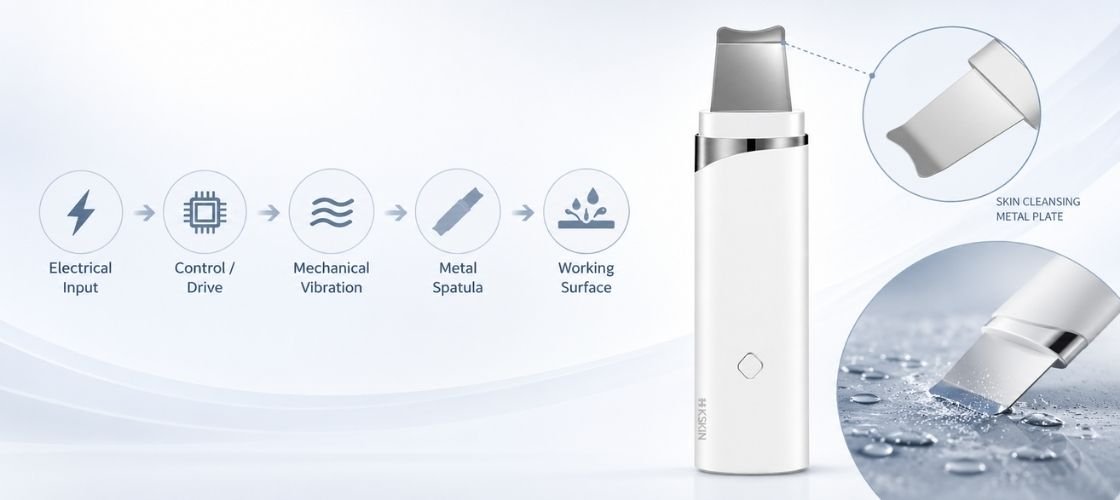
Ultrasonic skin scrubbers are often described simply as using “high-frequency vibration.” For product buyers, the more useful question is how that vibration is generated, transferred through the spatula, and verified on an actual sample.
An ultrasonic skin scrubber converts electrical input into mechanical vibration and transfers it through a metal spatula to the working surface. Buyers should look beyond the frequency number and assess the entire output chain: drive stability, spatula construction and mounting, operating mode, contact conditions, battery state, and repeatability across tests and samples.
What Is an Ultrasonic Skin Scrubber?
An ultrasonic skin scrubber is a handheld facial-care device built around a thin metal spatula that operates using high-frequency mechanical vibration.
Unlike a rotating cleansing brush, its working head does not rely on visible rotary motion. The spatula vibrates at a much smaller displacement and a higher rate, so normal operation may be easier to observe through the behavior of water or another suitable water-based medium on the working surface than by watching the metal blade itself.
From a buyer’s perspective, the product should be treated as a complete system rather than simply as a “vibrating spatula.” That system normally includes the power source, control electronics, a vibration-generating element or assembly, the mechanical connection to the spatula, the spatula itself, and the operating interface.
Many ultrasonic systems use piezoelectric materials to convert electrical energy into mechanical vibration. The National Institute of Biomedical Imaging and Bioengineering explains this electrical-to-mechanical conversion in its overview of ultrasound transducers. The exact internal architecture of a consumer skin scrubber, however, should be confirmed from the specific product design rather than inferred from the general principle.
For sourcing projects, that distinction matters. Understanding the basic technology is useful, but approval should be based on the actual product version being evaluated.
How Does an Ultrasonic Skin Scrubber Generate Spatula Vibration?
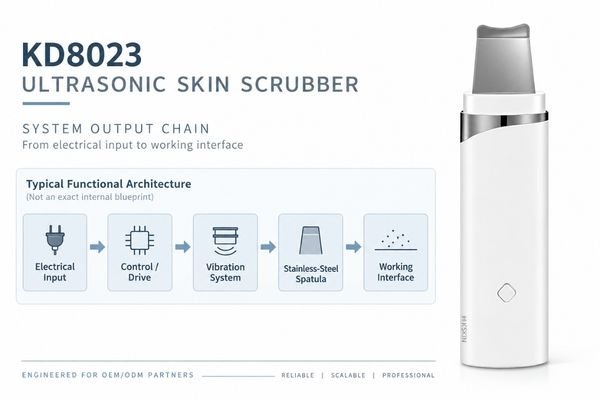
The basic output chain can be understood in five stages:
- The battery or power system supplies electrical energy.
- The control and drive circuit generates the required electrical signal.
- A vibration-generating system converts the electrical input into mechanical motion.
- The mechanical structure transfers the vibration to the metal spatula.
- The spatula operates in contact with the intended working medium and skin surface.
Each stage can affect the final result.
A product may power on correctly but still produce weak or unstable spatula behavior. The drive system may be operating, yet poor mechanical coupling between the vibration source and the spatula can affect the final output. Likewise, a well-designed spatula cannot compensate for an unstable electrical supply or inconsistent assembly.
Buyers should therefore avoid evaluating ultrasonic products by a single specification in isolation.
The useful sourcing question is not simply:
“Does this product have ultrasound?”
It is:
“Does the complete system produce the intended, repeatable spatula behavior under defined operating conditions?”
That question leads to a more useful sample-evaluation process.
Why the Spatula and Working Medium Matter
The metal spatula is the final mechanical interface between the internal system and the user’s routine. Its material, shape, surface finish, edge condition, mounting, and alignment are all part of product performance.
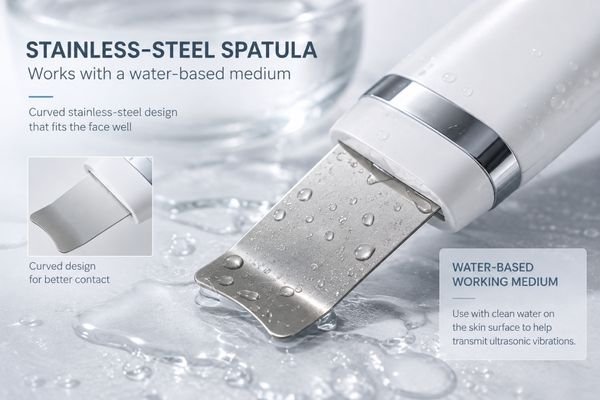
During sample inspection, buyers should check several basic characteristics:
- consistent spatula alignment;
- secure mounting without abnormal looseness;
- a smooth and consistent surface finish;
- a controlled edge condition;
- no visible deformation or damage;
- consistent assembly across multiple samples.
The operating condition also matters.
For example, the K·SKIN KD8023 Ultra-Slim Ultrasonic Skin Scrubber is designed around a stainless-steel spatula and ultrasonic operation for a wet-skin cleansing routine. When evaluating this type of platform, buyers should keep the water-based medium consistent instead of changing it randomly between tests.
Visible water movement or a fine spray around an active spatula can provide a useful functional observation. It should not be treated as a calibrated measurement of frequency or output.
Two samples may both create visible water movement while still differing in electrical output, mechanical coupling, or operating stability.
Why Frequency Alone Does Not Tell You Enough
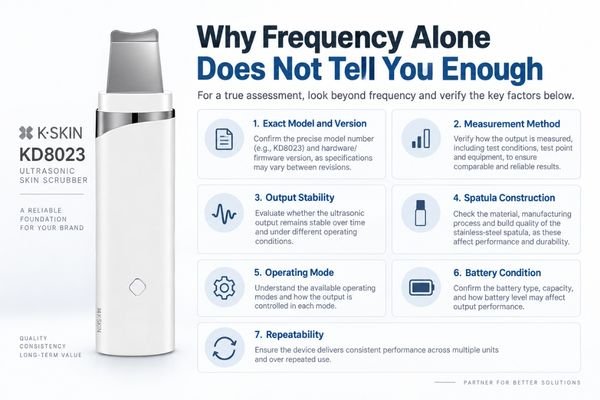
“Ultrasonic frequency” is often one of the first specifications buyers ask suppliers to provide. It is relevant, but it does not fully describe product performance.
Frequency describes how rapidly a vibration repeats. On its own, it does not describe the complete mechanical output at the spatula.
Several other factors can affect what happens at the working surface:
| Specification or Observation | What the Buyer Still Needs to Confirm |
|---|---|
| Nominal ultrasonic frequency | Exact model, version, and measurement method |
| High-frequency vibration | Whether operation remains stable during the test |
| Visible water movement | Whether the observation is repeatable under the same conditions |
| Metal spatula | Material, finish, mounting, and alignment |
| Multiple operating modes | Which output technology is active in each mode |
| Rechargeable power system | Whether operation changes with battery condition |
| One acceptable sample | Whether other samples behave consistently |
There is another practical reason to treat frequency claims carefully: the stated value must apply to the exact approved product version.
A historical document, supplier marketing sheet, or specification from a similar model should not automatically be applied to a current commercial version. If a frequency will appear in the product specification, packaging, manual, or marketing materials, the buyer should be able to trace the value to its source and confirm how it applies to the ordered version.
If the approved product documentation does not define a specific frequency, it is more accurate to describe the verified function than to introduce an unsupported number.
How Do Different Operating Modes Change the Output?
Multifunction skin scrubbers often combine more than one technology in the same housing. Buyers should not assume that every mode is simply a different ultrasonic intensity level.
The KD8023 is a useful example. Its current configuration includes Cleansing, Infusion, and Lifting modes, while the product platform combines ultrasonic operation with EMS.
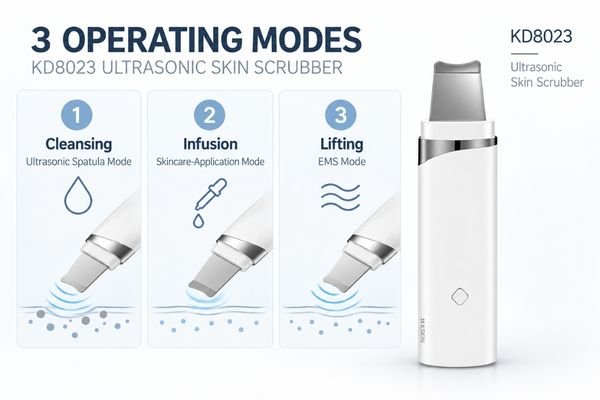
The modes should therefore be evaluated separately:
| Mode | Main Function to Verify | Buyer Check |
|---|---|---|
| Cleansing | Ultrasonic spatula operation | Activation, stability, and wet-medium behavior |
| Infusion | Model-defined skincare application mode | Actual operation against the approved manual |
| Lifting | EMS operation | Activation, control response, and version consistency |
This distinction becomes even more important when evaluating broader multifunction products.
For example, the KD8086 Dual-Head Multifunction Facial Beauty Device combines a stainless-steel spatula with several operating modes. Its SONIC function should not be interpreted as evidence that every other mode uses the same output mechanism.
For procurement teams, mode names are only a starting point.
A proper sample review should answer:
- What hardware is active in this mode?
- Is the output adjustable?
- What indicator confirms the selected mode?
- Does the sequence match the approved manual?
- Does the commercial sample behave consistently?
- Will the production version use the same configuration?
What Product Variables Affect Output and Repeatability?
Two skin scrubbers with similar marketing specifications can still behave differently because their final output depends on several interacting variables.
Electrical Drive
The drive circuit must deliver the intended signal consistently. Unstable power, component variation, or differences in control behavior can affect operation even when the housing and spatula look identical.
Mechanical Coupling
Mechanical energy must reach the spatula efficiently. Component mounting, bonding, fastening, and structural tolerances can all affect how vibration is transferred.
Spatula Construction
Material, thickness, geometry, surface finish, and attachment all matter. A visible change to the spatula should therefore be treated as more than a cosmetic modification when it could affect mechanical operation.
Power and Battery Condition
Rechargeable products should be evaluated under defined battery conditions.
A sample tested immediately after a full charge should not automatically be assumed to behave identically at a lower battery state. Whether the control system maintains consistent output should be verified against the approved design and test method.
Operating Medium
Water quantity, contact conditions, and the test method should remain reasonably consistent when comparing samples. Otherwise, differences in the test setup may be mistaken for differences in the product.
Assembly Consistency
One strong initial sample is not enough to demonstrate production repeatability.
The buyer ultimately needs confidence that the product can be assembled consistently enough to reproduce the approved behavior during production.
This is where product evaluation connects with manufacturing and quality control instead of ending with a single demonstration sample.
How Should a Buyer Evaluate an Ultrasonic Skin Scrubber Sample?
A useful sample test does not need to become a laboratory certification procedure. It does, however, need defined conditions and repeatable observations.
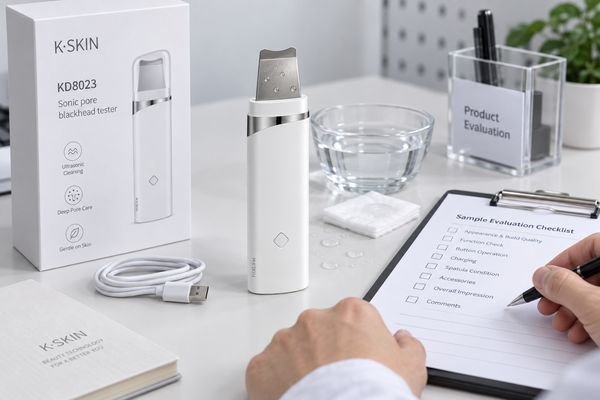
Step 1: Confirm the Sample Identity
Record the model, product version, and relevant sample identification before testing.
Wherever possible, the parameter sheet, manual, and product-specific technical documents should all refer to the same version.
Step 2: Inspect the Spatula and Assembly
Check:
- spatula alignment;
- surface finish;
- edge condition;
- mechanical security;
- housing fit;
- controls and indicators;
- charging interface.
Photographs documenting the sample condition are useful for later comparison.
Step 3: Standardize the Operating Condition
Use the same basic conditions when comparing samples.
Define:
- battery or charging state;
- working medium;
- operating mode;
- test duration;
- handling method;
- observation method.
Changing several conditions at once makes troubleshooting much harder.
Step 4: Verify Ultrasonic Operation
Confirm that the intended ultrasonic mode activates and remains stable throughout the test.
For a wet-use spatula system, observe the spatula and water-based medium using the same setup across repeated runs. Investigate abnormal interruptions, inconsistent start-up, or noticeable differences between samples rather than averaging them away.
A visible water effect is useful as a functional observation, but it should not be recorded as evidence of a specific frequency unless that frequency has been measured using an appropriate method.
Step 5: Check Each Additional Mode Separately
If the device also includes EMS or other functions, test each one independently.
Do not record “all modes working” simply because the device powers on or cycles through its indicator lights.
The output and user interface should match the approved product specification and instructions.
Step 6: Check Charging and Basic Electrical Behavior
For the KD8023 reference platform, the current product specification defines a 5 V / 1 A charging input and 3 W rated power.
These values help confirm the sample identity and electrical configuration, but they do not replace functional testing of the ultrasonic system.
Step 7: Repeat the Test
Run the same basic test more than once.
Where the sourcing stage allows, compare multiple samples rather than relying on one unit.
The objective is to assess repeatability:
- Does the same sample behave consistently?
- Do different samples behave similarly?
- Does the result remain acceptable after repeated operation?
- Are any differences associated with assembly, charging, or mode selection?
The exact acceptance criteria should come from the project’s approved requirements rather than a generic internet checklist.
What Evidence Should Support the Approved Product Version?
Sample approval becomes much more useful when the decision is supported by controlled evidence rather than memory or informal messages.
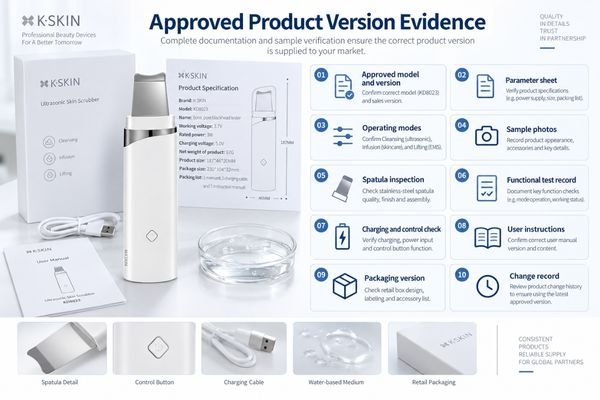
For an ultrasonic skin scrubber project, a practical approval file may include:
- approved model and version identification;
- current parameter sheet;
- approved operating-mode definitions;
- sample photographs;
- spatula and assembly observations;
- functional test records;
- charging and control observations;
- approved user instructions;
- approved product claims;
- packaging and labeling version;
- change records where relevant.
The aim is not to create paperwork for its own sake.
It is to prevent a common sourcing problem: the buyer approves one sample, but later documents or production use a different technical definition.
The approved sample, specification, and commercial materials should all describe the same product.
For a private-label project, this is especially important because branding, packaging, and instructions may be finalized at a different stage from product evaluation. Buyers can review the broader configuration process on the K·SKIN Private Label page.
What Does Ultrasonic Operation Prove—and What Does It Not Prove?
A working spatula confirms that a mechanical function is present. It does not automatically prove every marketing claim associated with that function.
| Verified Observation | What It Does Not Automatically Prove |
|---|---|
| Spatula vibration is present | Treatment of acne or other skin conditions |
| Water moves on the spatula | A specific frequency value |
| Cleansing mode activates | Guaranteed blackhead removal |
| Infusion mode operates | Increased ingredient penetration |
| EMS mode activates | A guaranteed lifting result |
| One sample works consistently | Long-term production consistency |
This distinction matters commercially as well as technically.
In the United States, the FDA’s information on cosmetics labeling claims explains that claims must be truthful and not misleading. It also states that claims involving the treatment of disease or effects on the structure or function of the body can change how a product is regulated.
Other markets have their own regulatory frameworks, so product claims should be reviewed for the intended destination market rather than copied from another brand, country, or historical sales document.
For buyers, the practical rule is straightforward:
A product mechanism, a functional demonstration, and a consumer outcome claim are three different things. Each requires an appropriate level of evidence.
Buyer Takeaway: What Should You Confirm Before Approval?
An ultrasonic skin scrubber should not be approved simply because it has a stainless-steel spatula, produces visible water movement, or carries an attractive frequency claim.
A stronger approval decision answers a more complete set of questions:
- Is the exact model and version identified?
- Is ultrasonic operation stable under defined conditions?
- Is the spatula correctly manufactured and assembled?
- Are the operating modes clearly separated?
- Are the electrical and charging specifications confirmed?
- Is the behavior repeatable?
- Do the specification and manual match the sample?
- Are marketing claims limited to what the available evidence supports?
- Will the approved configuration be controlled during production?
For buyers comparing compact facial-care platforms, the K·SKIN Home Beauty Devices range provides product-level references, while the KD8023 offers a focused example of an ultrasonic spatula platform.
The purpose of sampling is not simply to see whether a device turns on. It is to understand what the product actually does, define the version being approved, and create a reference that manufacturing can reproduce.
Frequently Asked Questions
Does a higher ultrasonic frequency automatically mean a better skin scrubber?
No. Frequency is one characteristic of the vibration system. Buyers should also consider output stability, mechanical coupling, spatula construction, operating conditions, power behavior, and repeatability. A higher published number does not automatically demonstrate better product performance.
How can I tell whether an ultrasonic skin scrubber is working?
Functional evaluation can include confirming mode activation, observing spatula behavior with a suitable water-based medium, and repeating the test under consistent conditions. Visible water movement can help confirm activity, but it is not a calibrated frequency measurement.
Should the supplier provide an exact ultrasonic frequency?
If an exact frequency is part of the approved product specification or marketing claim, it should be traceable to the exact model and version. Buyers should also understand how the value was defined or measured. If the approved documentation does not specify a value, an unsupported number should not be added.
Is EMS the same as ultrasonic vibration?
No. They are different output technologies. A multifunction product may include both, but buyers should identify which technology is active in each operating mode rather than treating all modes as different forms of ultrasound.
What should I request before approving a private-label skin scrubber?
Request the approved sample, current specification, operating-mode definitions, user instructions, relevant functional records, commercial configuration, and claim language for the intended market. These materials should all describe the same product version that will proceed toward production.