A brand can invest in a distinctive housing and still discover that the product does not fit its market. Before committing to tooling, buyers need to connect the proposed difference with a clear product requirement and a workable development scope.
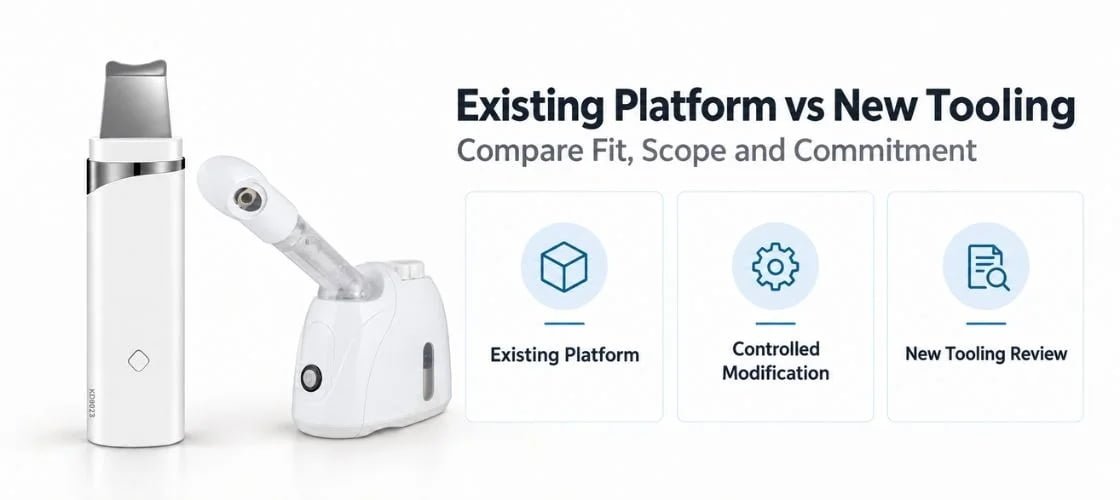
An existing product platform is a practical starting point when it meets the project's essential requirements. New tooling deserves consideration when a necessary structural difference cannot be achieved within the available platform and its value justifies the development commitment. Between those options, controlled engineering modifications may preserve useful parts of the base product. Compare fit, validation, investment and agreed rights before choosing.
What Are the Three Practical Development Routes?
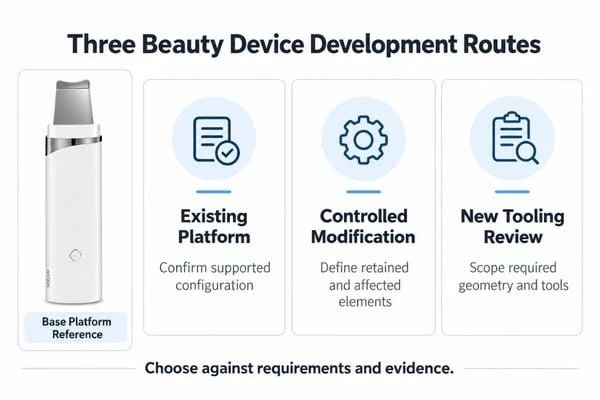
Choosing between an existing platform and new tooling rarely comes down to adding a logo or designing an entirely new device. A project may retain the core product while changing selected parts. Defining what stays and what changes gives the comparison a more useful starting point.
Existing Product Platform
This route starts with a product whose core functions and intended use already fit the project. The work focuses on an agreed commercial configuration, such as branding, supported colors, packaging, labels and approved accessories.
An existing platform still needs sample evaluation and confirmation of the target-market version. Its value lies in retaining suitable, documented product features, rather than assuming that every proposed variation is already available or covered by previous evidence.
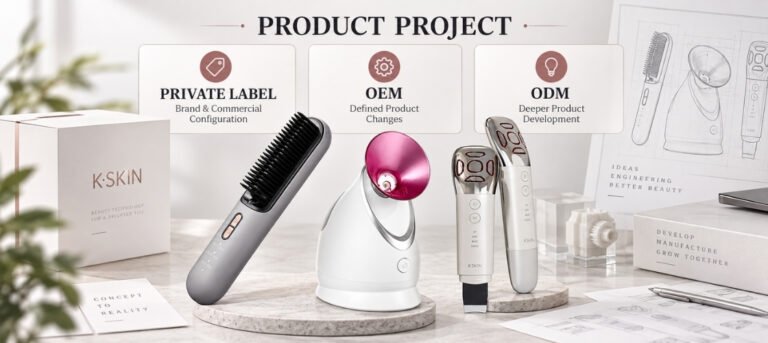
K·SKIN's Private Label framework follows this approach: evaluate the base product first, then define the commercial changes that the selected model can support.
Controlled Engineering Modification
Here, the base platform remains useful, but a defined requirement needs engineering review. The work could concern a control interface, material, accessory, electrical configuration or selected structural feature.
The review establishes whether the change can remain within the existing platform, needs a tooling modification, or requires a separate new part. A housing that looks unchanged does not establish that the engineering and validation work will be unchanged.
New Tooling
New tooling is considered where the required geometry or structural arrangement cannot be produced with the available tooling as it stands. The proposal should identify the affected parts and explain whether existing tools can be modified, individual tools added, or a broader set developed.
A new tool for one component does not necessarily mean an entirely new product architecture. Equally, keeping some familiar components does not establish that a revised device remains covered by the old approval package.
Does the Required Difference Justify New Tooling?
The strongest case for tooling begins with a specific product need. A different appearance may have commercial value, but that value should be described clearly enough to compare with the development work it creates. “We want something unique” is a direction, not yet a usable requirement.
Separate Essential Requirements From Preferences
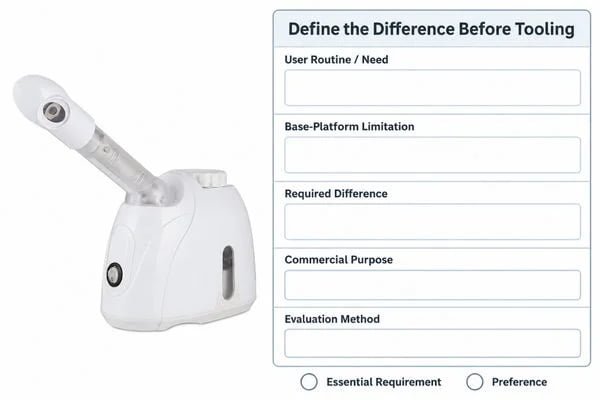
For each proposed change, ask what problem it solves and whether the base product can already solve it. A required cleaning access, handling feature or interface arrangement may have a different priority from a preferred silhouette.
A short requirement record can capture:
- The intended user routine or purchasing need.
- The limitation identified in the existing platform.
- The proposed difference and its expected commercial purpose.
- How the buyer will evaluate whether it meets the requirement.
- Which parts of the concept remain flexible.
This helps engineering teams explore alternatives. If the objective is easier handling, the discussion can examine feasible ways to achieve it instead of treating the first sketch as the only acceptable solution.
For hair styling projects, our comparison of hair straightener brushes and hot-air brushes explains how contact heating, airflow and permitted use conditions affect platform selection. Clarify which routine the product must support before deciding whether the available platform needs a structural change.
Compare the Value With the Added Scope
The proposed difference needs a place in the product range. It might support a distinct retail proposition, address a documented handling concern or enable a required accessory relationship. Those are objectives to evaluate, not performance improvements to claim before testing.
Where customer demand is still uncertain, a suitable existing platform may offer a way to explore the proposition before committing to deeper development. Where the existing product misses a mandatory requirement, however, branding changes will not close that gap.
Compare the Routes With a Decision Matrix
Use the matrix to identify the route worth investigating and the information still needed. It is a project-planning tool, not a numerical score that approves a design. An unresolved essential requirement should remain visible even if several other factors favor the same route.
| Decision factor | Existing platform | Controlled modification | New tooling |
|---|---|---|---|
| Core product fit | Suitable when essential functions and use conditions already fit | Useful when the base product fits but a defined gap remains | Worth investigating when required structural differences cannot be accommodated by the available platform |
| Differentiation | Focuses on supported commercial presentation and configuration | Adds a specific, reviewed product difference | Can support new geometry, subject to engineering feasibility and validation |
| Engineering scope | Confirm retained configuration and proposed commercial changes | Trace each change through affected systems | Define new parts, interfaces, tool requirements and retained systems |
| Evidence to review | Documents matching the selected version and market | Existing evidence plus an assessment of the change | A validation plan for the final configuration, with justified use of any retained evidence |
| Upfront commitment | Identify sample, setup, packing and material requirements | Add agreed engineering, revised samples and affected validation | Add scoped design, tooling, trials, revisions and production preparation |
| Quantity basis | Confirm minimums for the actual commercial configuration | Check revised components, materials and variants | Assess dedicated parts, tooling-related commitments and planned production quantities |
| Schedule basis | Verify availability, samples and approval dependencies | Allow for the agreed review and revision work | Plan design, tool-related work, trials and validation dependencies |
| Rights and access | Confirm permission to use the platform and supplied brand assets | Define rights relating to retained and newly developed elements | Specify tool ownership, use, maintenance, design-file access and any exclusivity separately |
The matrix can lead to three sensible outcomes: investigate a route, obtain missing information, or pause the proposed investment. It should not turn an incomplete specification into a confident recommendation.
What Costs Should Be Compared Beyond the Mold Quote?
A mold quotation covers only the scope listed in that quotation. Comparing routes becomes more meaningful when the buyer can see the work required to reach an approved commercial version, together with any continuing commitments. A lower unit price does not settle that comparison by itself.
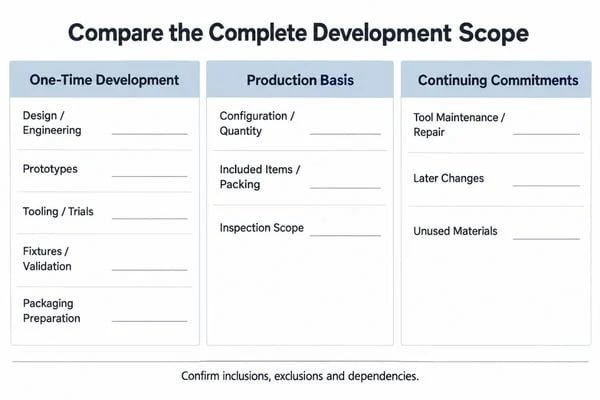
Separate One-Time Work From Production Costs
The comparison should identify which charges cover design and engineering, prototypes, tooling, tool trials, agreed revisions, fixtures, validation and packaging preparation. Each item needs a deliverable or scope description, not just a label such as “development fee.”
Production costs then need their own basis: the specified configuration, quantity, included items, packing and inspection requirements. Where suppliers propose different routes, their quotations should explain the differences in scope and exclusions.
Questions about tool maintenance, repair and later modification also belong in the commercial discussion. They may not affect the initial quotation in the same way, but they can affect subsequent orders and responsibility for keeping the project usable.
Consider Quantities and Schedule Dependencies Together
An order minimum can apply to the assembled product, a dedicated component, a color or a packing item. The buyer should understand what is being committed to and whether any unused materials remain their responsibility.
Timing should be tied to milestones and assumptions. A design review, a revised prototype and a tool trial answer different questions; a delay or finding at one stage may change the next. Ask which dates are estimates, what information they depend on and what would trigger a revised schedule.
There is no fixed tooling fee, MOQ or development duration that this matrix can assign to every beauty-device project. Comparable scope is more useful than an unsupported market average.
How Does the Validation Scope Change?
Validation starts by asking what evidence supports the final configuration. Whether a mold is new answers only part of that question. A revised control or material can require review without visible geometry changes, while a new molded part may retain other documented parts of the platform.
Identify What Is Retained and What Is Affected
Start with a record of the base configuration and the proposed differences. Engineering can then assess affected functions, interfaces, safety considerations, manufacturing processes, packaging and applicable market documentation.
For example, a proposed facial-steamer tank change raises questions about fit, sealing, water handling and cleaning. A styling-brush geometry change may require review of tooth arrangement, heated-area access and assembly interfaces. These are examples of review questions, not claims that a particular K·SKIN model supports the proposed changes.
The review should explain what can rely on existing evidence, what needs document checks, and what needs additional testing. Neither “same platform” nor “new mold” is enough to define the complete test program.
Give Each Sample Stage a Clear Purpose
An appearance prototype can help review proportions and layout. It should not be treated as proof of final material performance or production repeatability. Samples made through the proposed production process need checks appropriate to the decisions they are intended to support.
For each evaluation, record the configuration, sample quantity, method, conditions and acceptance basis. Findings should lead to a traceable design decision, revision or approval. A test proposal is still a proposal until the corresponding results exist.
The important question before tooling commitment is whether the planned evidence is sufficient for the next investment decision. Later production and shipment approvals remain separate decisions.
What Should Be Agreed About Tooling and IP?
The term “custom product” can conceal several different assets and rights. A useful project agreement identifies them separately so that the buyer understands what is being funded, what can be used and what remains part of the supplier's existing platform.
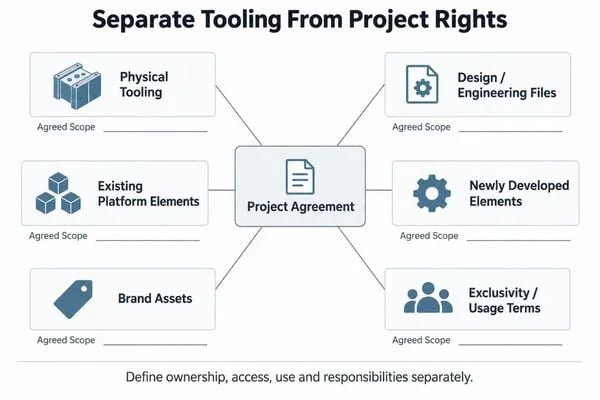
| Item to clarify | Questions for the project agreement |
|---|---|
| Physical tooling | Which tools are included, who owns them, where are they held and how can they be used? |
| Maintenance and changes | Who arranges maintenance, pays for agreed repairs and authorizes modifications? |
| Design and engineering files | Which files are deliverables, in what format, and what use or access is permitted? |
| Existing platform elements | Which structures, electronics, software or technical knowledge are retained, and what permissions apply? |
| Newly developed elements | How are ownership, use and any restrictions defined for project-specific work? |
| Exclusivity | Which product, configuration, territory, channel and period does an agreed restriction cover? |
| Brand assets | What authorization supports the logos, artwork and other assets supplied for production? |
A tooling invoice is not a complete description of these arrangements. The scope and agreements should address them before significant commitment, with appropriate legal review where needed.
Patent and design records also need separate attention. Where such documents are relevant, review the named right holder, jurisdiction, scope and current status. K·SKIN's credentials page provides a starting point for document discussions; the presence of a record there does not establish rights to a proposed custom design or ownership by the current selling company.
New geometry should not be described as patented, exclusive or protected without evidence supporting that specific statement.
Which Route Fits Different Project Situations?
The following hypothetical scenarios show how the matrix can guide a discussion. They are not completed K·SKIN projects, availability promises or measured cost comparisons. The route in each case still depends on the selected platform and engineering findings.
| Hypothetical project | Route to investigate | Next decision |
|---|---|---|
| A brand finds a device that meets its required routine and mainly needs branding and retail packing | Existing platform | Confirm the supported commercial configuration and evaluate its sample |
| A base device fits, but the brand requests a revised control function while preferring to retain the housing | Controlled engineering modification | Assess controls, connected systems and whether the housing can actually be retained |
| A facial-steamer concept requires a tank or nozzle geometry that the available product does not provide | Structural development and tooling review | Compare engineering alternatives and define the affected parts and validation work |
| A brand wants a distinctive shape, but has not defined its commercial purpose or essential functions | Further product definition before tooling commitment | Clarify the value of the difference and test the requirements against available platforms |
The first useful outcome is a scoped investigation, rather than an immediate purchase authorization. A supplier may propose a smaller change that meets the objective, or the review may show that deeper development is justified.
The buyer's preference for an existing platform or a new design should remain open to that evidence. A route is valuable because it meets the requirements on workable terms, not because it sounds more advanced.
What Must Be Confirmed Before Tooling Commitment?
A stage gate makes the next decision explicit: what evidence is needed before additional resources are authorized? The exact sequence depends on the project, but the buyer should be able to distinguish permission to investigate from permission to build tools or begin production.
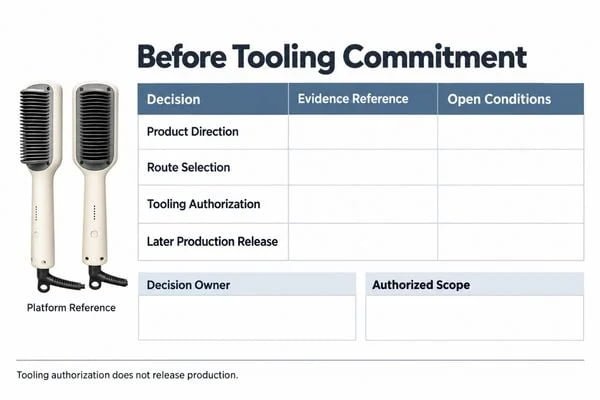
| Decision point | Evidence to review | Reason to obtain more information or pause |
|---|---|---|
| Product direction | Essential requirements, intended use, target market and purpose of the difference | The proposed change has no clear requirement or evaluation method |
| Route selection | Base-platform assessment, alternatives and feasibility findings | The tooling proposal is not connected to a defined product gap |
| Tooling authorization | Agreed design scope, planned validation, tool deliverables, quotation and rights arrangements | Responsibilities, deliverables or material assumptions remain unresolved |
| Later production release | Approved final configuration, relevant results and production-readiness records | A prototype approval is being treated as approval of the complete production version |
Before authorizing the tooling stage, use a short checklist:
- Record essential requirements separately from preferences.
- Identify the base platform, retained parts and proposed changes.
- Request the engineering rationale for modifying or adding tooling.
- Confirm which drawings and specifications define the authorized scope.
- Agree the purpose and limits of prototypes and tool-trial samples.
- Define validation responsibilities, methods and acceptance criteria.
- Compare quotation inclusions, exclusions and revision assumptions.
- Confirm quantity commitments and schedule dependencies.
- Document tooling, maintenance, file-access and agreed usage terms.
- Identify the person authorized to approve the next stage and subsequent changes.
Where an item remains open, record which decision it prevents. Some questions can be resolved during feasibility work; others need an answer before tooling is authorized. That distinction allows investigation to continue without treating uncertainty as approval.
Buyers can share these requirements through K·SKIN's project contact page to discuss the appropriate review scope. The initial discussion should make the intended difference and target market clear, even when the final engineering solution is not yet defined.
FAQ
These questions address practical issues that can arise while comparing an established platform with dedicated tooling.
Can One New Accessory Use Dedicated Tooling While the Main Device Remains an Existing Platform?
That is a route worth evaluating. The accessory still needs review for its interface, intended use, packaging and effects on the device. A separate accessory tool does not by itself establish that the complete project requires a new main-device architecture.
Does an ODM Project Always Require New Molds?
The project label does not establish its tooling scope. An ODM discussion may involve retained platform elements, controlled modifications or deeper development. The quotation and engineering scope should identify the actual tooling work rather than leave it implied by the acronym.
Can a Buyer Test Demand Before Approving the Final Tooling Scope?
An existing product or appropriately described prototype may help explore a proposition. It should be clear what that evaluation represents. Interest in a sample does not confirm demand for a different final configuration or demonstrate that the proposed production design meets its requirements.
What If the First Tool-Trial Sample Needs Revision?
Review the finding against the agreed requirements and record the proposed correction. The project terms should explain how revision scope, costs, responsibilities and schedule changes are handled. A first trial should not be assumed to include unlimited revisions or to establish final acceptance.
Does Tooling Approval Authorize Volume Production?
The approval needs to state its scope. Permission to make or modify tools is different from approval of the finished commercial configuration and release of a production order. Required sample results, documents and readiness checks should remain tied to the later production decision.
Conclusion
An existing platform is useful when its documented configuration fits the product requirements. Controlled modification can address a defined gap while retaining suitable elements, and new tooling can be evaluated where necessary structural differences justify the added commitment. The decision becomes clearer when product fit, validation, costs and rights are considered together.
Use K·SKIN's OEM/ODM development framework to structure that discussion around the difference you need, the available platform and the evidence required at each stage. Define the next investment decision carefully, then authorize it against an agreed scope rather than the promise of a more distinctive product alone.