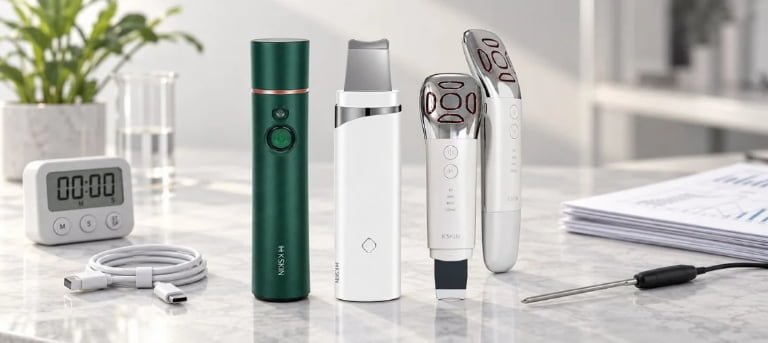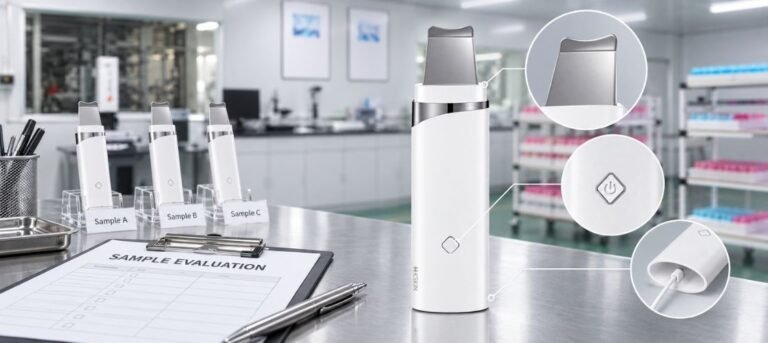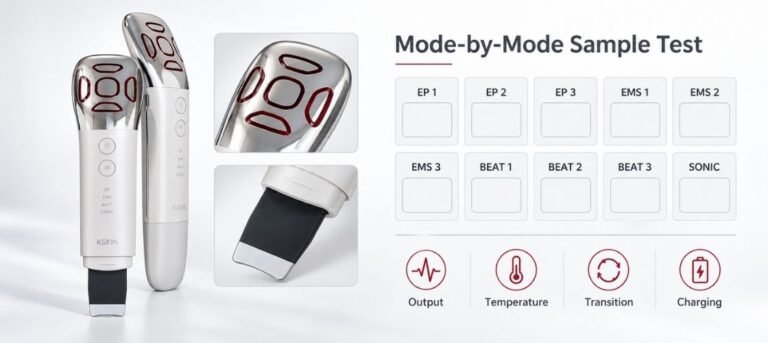
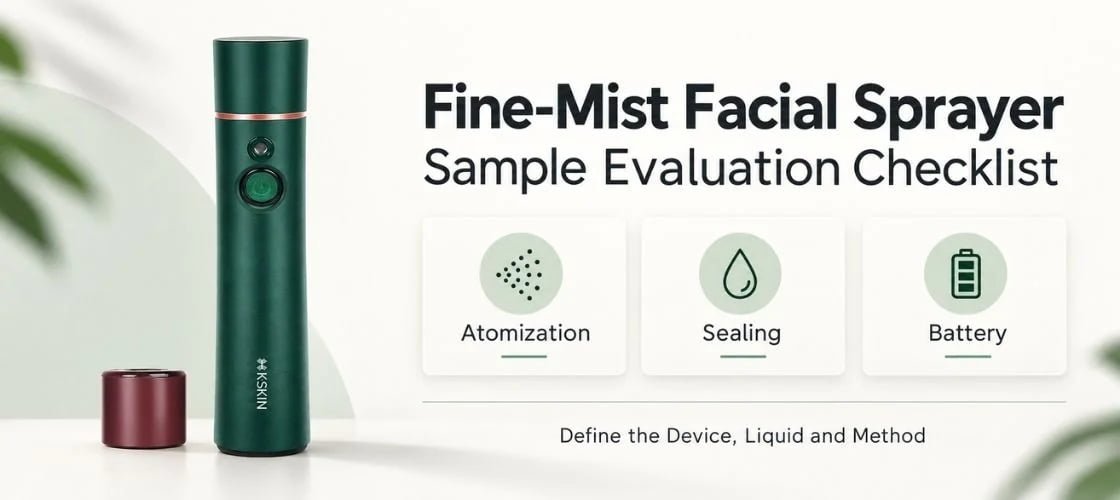
A short demonstration shows a sprayer at one moment. Buyers also need to know how it behaves after refilling, cleaning and repeated spray cycles with the liquid their brand actually plans to use.
Evaluate a fine-mist facial sprayer with a defined product version, approved liquid and repeatable method. The review should cover mist consistency, nozzle response, sealing, permitted positions, usable spray runtime, charging and cleaning recovery. Approval rests on those linked records. A visible plume can help compare operation, but droplet-size, skincare and runtime claims need evidence specific to the quantity or effect being described.
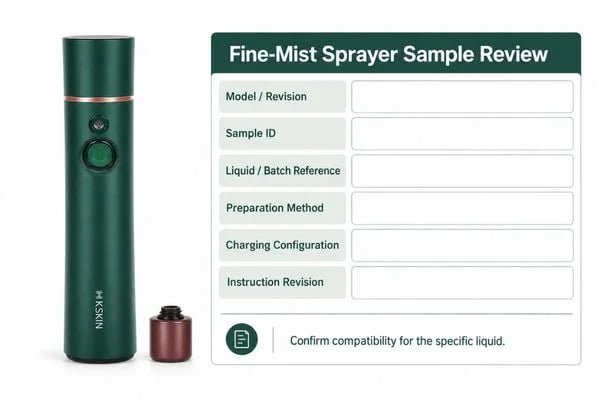
Define the Sample and Liquid Before Testing
Two samples with the same model name may still be difficult to compare if their nozzle assemblies, charge levels or test liquids differ. Establishing a common starting point makes later observations more useful and gives the supplier enough context to investigate a finding.
Identify the KD88SA Configuration
The KD88SA portable fine-mist facial sprayer is presented as a rechargeable platform with a detachable reservoir and press-and-hold control. It applies compatible water-based liquid as mist; it does not heat water to produce steam.
The sample record should identify the model and revision, nozzle and reservoir arrangement, charging input, supplied cable and instruction version. These details connect the physical unit to the specification and label that will define the order.
Older documents may help explain the product's history, but the supplier needs to identify which version is being offered. A battery capacity, dimension or runtime figure becomes useful to the approval decision only when it applies to that configuration.
Confirm the Formula Boundary
The intended toner or water-based serum deserves its own compatibility review. “Water-based” describes a broad category; it does not establish that every formulation will behave the same way in the liquid path and nozzle.
Keeping the liquid identity, formulation revision or batch reference, and preparation method in the test record allows another reviewer to understand what was used. If dilution is permitted, its agreed preparation also belongs in that record. Otherwise, a change in the test liquid can be mistaken for a difference between devices.
Oil-based, milky, particulate or high-viscosity liquids should not be assumed suitable. A formula outside the approved instructions needs a compatibility assessment before it is used in the sample. Approval with one liquid remains limited to that liquid and its documented conditions.
Establish a Repeatable Mist-Output Comparison
A consistent observation setup helps buyers see whether an apparent difference comes from the sample or from the way it was filmed. The useful comparison concerns repeatable spray behavior, rather than the size of the cloud in a single clip.
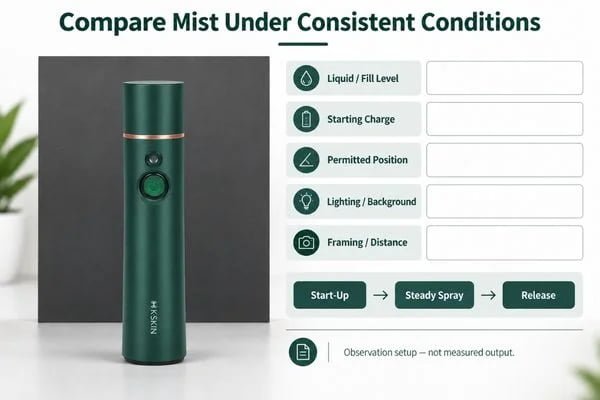
Keep the Observation Conditions Consistent
Begin with the approved liquid and fill level, an agreed starting charge and the permitted operating position. Keeping the background, lighting, camera framing and observation distance consistent makes the footage easier to compare. An unknown sample should be evaluated away from people, rather than investigated through facial application.
The recording should include start-up, steady spraying and release of the control over repeated permitted cycles. Look for a consistent plume, shifts or pulsing, larger drops and any liquid stream. These observations help define the question that needs further investigation.
A receiving surface at a fixed position can also help compare wetting patterns. That remains a qualitative check: a wet mark is not a measurement of airborne droplet size or evidence of absorption into skin.
Separate Appearance From Measured Claims
Where a product listing will include a numerical droplet-size claim, the supporting measurement needs to identify the method, tested liquid and product configuration. Its results should explain the reported quantity and distribution, rather than leave the buyer with one unexplained number.
Pressure claims need the same clarity about method, operating condition and measurement location. A dense plume or a “high pressure” description is not a measured result.
The observation record can support a judgment about application behavior under the test conditions. Claims about hydration improvement, tissue penetration, oxygen delivery or therapeutic effects require evidence beyond that spray evaluation.
Check the Nozzle, Controls and Start-Stop Behavior
The beginning and end of a spray cycle can be as informative as steady operation. They show how the control responds and whether the demonstration gives buyers an accurate picture of the routine they intend to offer.
For the KD88SA press-and-hold arrangement, compare the response when the control is pressed and released with the supplied instructions. The indicator can be reviewed at the same time, so that its meaning is clear for the selected version.
An outlet observation is more useful when it distinguishes a bead remaining after release, repeated dripping, a coarse jet and unintended continued operation. Those findings have different implications. Location, repeatability, instructions and agreed acceptance criteria help determine what needs action.
Pump sound can be included in the record. If noise is part of the commercial positioning, comparable operating conditions and recording positions are needed. A new rattle or a sound change alongside weaker output gives the supplier something to investigate; it does not identify the cause by itself.
Visible deposits, damage or a loose nozzle assembly should also be noted before any recovery work. An improvised cleaning tool or blockage-clearing method may change the sample and make the original finding harder to explain. Recovery therefore needs an approved procedure.
Review Sealing Across the Permitted Use Routine
Portability raises a practical question: how is the device meant to be used, emptied and carried? Operating-position checks and storage checks should reflect those instructions, without assuming that a filled sprayer is suitable for every orientation.
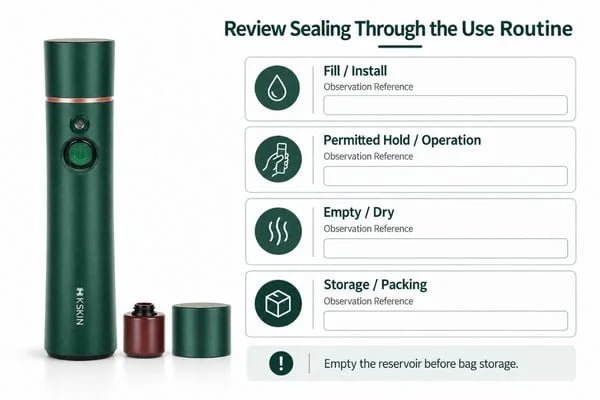
| Evaluation stage | What to observe | What to record |
|---|---|---|
| Filling and installation | Fill limit, cap fit, seating and assembly condition | Liquid, fill level, installation method and sample ID |
| Static hold | Moisture around the reservoir and interfaces in the permitted resting position | First wet location, observation period and repeatability |
| Operation | Output and unintended liquid escape within the permitted angle range | Position, control state, liquid level and finding |
| End of use | Outlet residue and behavior during the prescribed emptying routine | Where liquid remains and which instructions were followed |
| Storage or packing | Condition after the required draining, drying and packing steps | Prepared configuration and inspection findings |
The reviewed KD88SA instructions call for emptying the reservoir before carrying the device in a bag. Travel demonstrations and product copy should preserve that requirement, rather than suggest leak-free storage while filled.
When moisture appears, its first location and the conditions leading to it help distinguish an expected observation from unintended leakage. If the supplier describes a small amount in a particular location as normal, that explanation still needs to match the instructions and the sample. Unexplained leakage remains an open finding.
If liquid reaches the charging port or other electrical areas, or the unit shows abnormal heating or battery damage, stop the evaluation and obtain qualified review. Safety takes priority over completing the planned sequence.
Evaluate Battery Performance While the Sample Is Spraying
For a rechargeable sprayer, usable runtime means more than the length of time the unit can remain switched on. Buyers need to know how much acceptable spraying it delivers during the intended routine, including the effect of pauses and refills on the result.
Define Usable Spray Runtime
Agree the charging arrangement, full-charge indication, permitted spray periods and rest intervals before the trial. Active spraying time and total elapsed time should be kept separate, so that neither is presented as the other.
The endpoint also needs a definition. A low-battery indication, shutdown and output falling below an agreed requirement describe different limits. Choosing the endpoint in advance gives the runtime figure a clear meaning.
Liquid level matters alongside battery condition. An empty reservoir can interrupt spraying even when charge remains. If the trial requires refilling, stop and refill according to the instructions, keep liquid away from electrical areas and note the interruption. Extending the trial outside the approved liquid conditions would change the basis of the result.
Comparing output at relevant stages of the charge cycle helps show when acceptable spraying ends. That may be earlier than the point at which the device can no longer turn on, which is why the output requirement belongs in the runtime method.
Review Charging as a Separate Check
The permitted input, connector, cable and power source define the charging arrangement. A useful record follows charging from a known starting condition through the indicator changes, while noting connector fit and unusual behavior. An indicator changing color is one observation, not independent proof of charging performance or electrical safety.
Spraying while connected to charging power should only be evaluated where the approved instructions permit it. A USB connection alone does not establish fast charging, compatibility with every charger or permission to operate while charging.
Repeating the method can help compare samples and cycles. The sample quantity and number of repetitions should suit the evaluation purpose; this checklist does not prescribe a universal regulatory sample size.
Check Residue, Cleaning and Restart Performance
A successful clean-water demonstration leaves another question open: how will the sprayer behave after use with the intended formula? Reviewing residue, cleaning and restart together helps buyers assess the routine beyond its first spray cycle.
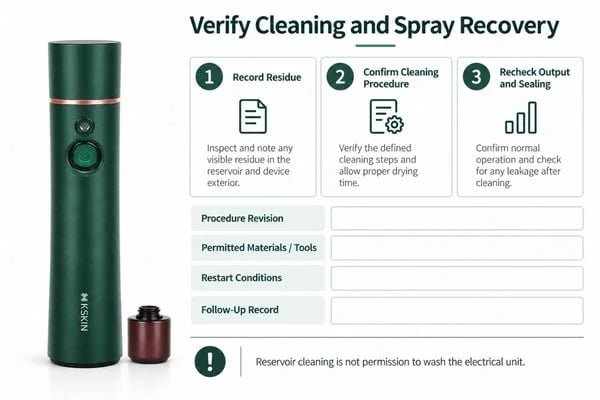
Review Residue Under Defined Conditions
After the planned spray sequence and prescribed emptying, inspect the reservoir, cap, seals and visible outlet area. The record should describe where liquid or deposits remain and how long the sample stood before cleaning or restarting.
The restart check should follow the intended routine. If output changes after an idle period, reproducing that condition gives the supplier a basis for examining the formula, liquid path, cleaning method or other relevant parts of the configuration.
A short trial can expose questions that deserve further work. It does not establish long-term material compatibility or resistance to every type of deposit.
Use One Approved Cleaning Procedure
A clear cleaning procedure identifies removable parts, permitted agents or tools, rinsing restrictions, drying and precautions around the charging port. Instructions for cleaning the reservoir should not be interpreted as permission to wash the complete electrical unit.
Where instruction versions disagree about a cleaning agent, the supplier needs to clarify the procedure before it is used or published. Solvent flushing, outlet blocking and disassembly should not be added as informal recovery methods.
After cleaning, repeat the relevant output and sealing checks under comparable conditions. The useful result is whether the original finding has been resolved and remains resolved during the agreed follow-up. A plume that briefly returns does not, by itself, close a recurring blockage issue.
Match Materials and Documents to the Tested Configuration
Formula compatibility includes the parts the liquid touches as well as the spraying result. The supplier's review should identify the reservoir, seals and relevant liquid-path materials, including changes proposed for the commercial version.
The evidence needs to reflect the intended formula and use conditions. A housing material description does not identify every wetted part, and a brief successful trial cannot establish compatibility throughout storage and repeated use.
For battery and product records available through the supplier's credentials and evidence review, the useful comparison covers model or battery reference, configuration, scope, date and original applicant or manufacturer. Keeping the legal names as recorded preserves the document's identity.
Each record also answers a particular question. A battery transport document does not measure finished-device spray runtime, and a patent describing a leak-resistant structure does not show that this sample passed a leakage test. Those performance questions need their own supporting results.
Classify Findings Before Accepting a Revised Sample
Findings become easier to manage when each one has a next action and a clear basis for closure. The table below offers a buyer-side framework; acceptance limits and relevant safety requirements still need to be agreed for the project.
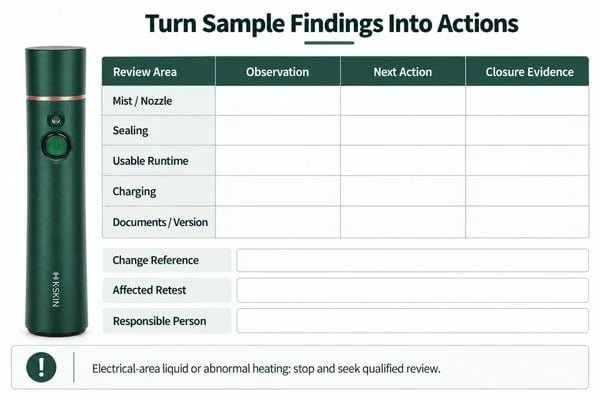
| Finding | Suggested buyer action | Evidence needed for closure |
|---|---|---|
| Liquid reaches an electrical area, abnormal heating or battery damage | Stop use and obtain qualified assessment | Investigation and evidence supporting safe disposition |
| Repeatable unintended leakage | Hold approval of the affected configuration | Established cause, correction and relevant retest |
| Unstable mist, coarse jet or recurring blockage with an approved liquid | Investigate the sample and method before acceptance | Traceable failure conditions and corrected output records |
| Runtime falls short of the agreed output-based requirement | Review the charge condition, liquid supply and device load | Comparable runtime results and an explained correction or specification review |
| An isolated residue mark with uncertain origin | Reproduce and classify the observation | Location, conditions and repeatability record |
| Label, manual or charging information does not match the sample | Resolve the version mismatch before approval | Aligned documents and confirmed sample identity |
A revised sample is more useful when the supplier explains what changed: a part, setting, process or instruction. Connected functions then need an impact review. A nozzle change may affect output and the battery test condition, while a seal change calls for relevant fit and leakage checks.
K·SKIN's manufacturing and quality framework provides context for discussing inspection and change control. Approval of the corrected sample still rests on its own records and their relationship to the configuration being ordered.
Freeze a Complete Sample Approval Record
Once the findings are closed, the physical sample and its supporting records should form one identifiable reference. Connecting the liquid, methods, results and documents makes that reference useful to production and to anyone reviewing a later change.
Use this fine-mist facial sprayer sample checklist before release:
- Identify the model, revision, sample IDs and charging configuration.
- Confirm the liquid identity, preparation and compatibility boundary.
- Record comparable fill, charge, position and observation conditions.
- Check start-up, mist consistency, nozzle behavior and stop response.
- Review sealing in permitted use and storage configurations.
- Record usable spray runtime, refills, rest periods and the endpoint.
- Verify charging behavior against the specified power arrangement.
- Review residue, approved cleaning and restart performance.
- Match relevant material, battery and product documents to the sample.
- Close findings with correction records and affected retests.
- Retain an identified reference sample with aligned instructions, labels and packing details.
- Agree production inspection items and the process for subsequent changes.
Sample approval defines the reference the buyer intends to order. Production-lot inspection and shipment release are later checks against that reference, not outcomes established by the sample trial alone.
Sample approval also does not establish the supplier's broader manufacturing capability. For an example of extending product-level checks into manufacturing roles, engineering evidence, production controls, document alignment and corrective action, see our guide to evaluating a facial steamer manufacturer. A fine-mist sprayer uses a different liquid-delivery system, so its supplier review still needs to be adapted to the sprayer's own configuration and risks.
FAQ
These questions address issues that can remain after the main output, sealing and battery checks.
Can One Approved Formula Support a Listing for All Water-Based Serums?
No. The result covers the tested formula and configuration under the recorded conditions. Other formulations need an appropriate compatibility review. Sharing the description “water-based” does not establish equivalent flow, residue or material behavior.
Is a Spray Video Enough to Support a Micron-Sized Droplet Claim?
A video is useful for documenting plume appearance and operation. A numerical droplet-size claim needs measurement evidence that identifies the test conditions and reported result. The two forms of evidence serve different purposes.
Should the Runtime Result Include Time Spent Refilling the Reservoir?
Keep that time visible but separate. Active spray time shows how long the unit was spraying; elapsed time includes interruptions. The report should identify which quantity is used in the commercial claim and how refills were handled.
Can the Sample Test Use Filled-Bag Storage to Demonstrate Portability?
Only where that condition is expressly permitted and covered by an appropriate evaluation plan. The reviewed KD88SA instructions require the reservoir to be emptied before bag storage, so that requirement belongs in its travel-related demonstrations and copy.
Does Passing One Sample Review Approve Later Nozzle or Battery Changes?
Approval applies to the recorded configuration. A later change needs an impact review and the checks required to support the revised version. The earlier results may provide useful background, but the unchanged model name does not establish that they still apply.
Conclusion
A useful sprayer evaluation follows the same device and liquid through output, sealing, battery use, cleaning and restart. Comparable conditions make the findings easier to explain, while a clear distinction between observations and measured results keeps the approval and product claims grounded in evidence.
Begin with the KD88SA within K·SKIN's home beauty device range, then agree the liquid, instructions and evaluation scope for your project. An identified sample supported by consistent records gives buyers a practical reference for product listings and production checks, without turning spray performance into an unverified skincare promise.