
For a beauty brand, importer or product-listing manager, “wet-to-dry” is more than a short headline. It tells customers something about the hair condition and styling routine they can expect to use.
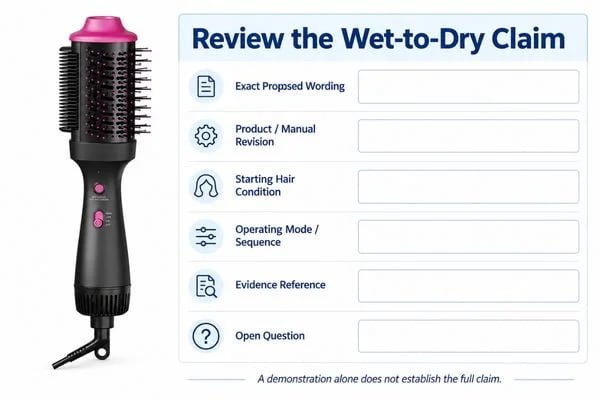
Before approving a wet-to-dry claim for a hot-air brush, heated straightening brush or combined platform, identify the exact promise, product version, permitted hair condition and operating mode. Match each part of that promise to the instructions and supporting evidence. The outcome may be to keep, narrow, hold or remove the claim. A demonstration alone does not establish every use the wording may imply.
Define the Exact Wet-to-Dry Claim
Start with what the customer is likely to understand, not just what the brand intends to say. A buyer may use “wet-to-dry” to describe a particular sequence of drying and styling. A customer may read it as permission to use every setting on freshly washed, dripping hair.
Write down the complete message you want to review. Include the headline, the nearby explanation, the product images, the video and the packaging. A photograph or demonstration can imply a use condition even when the words themselves are less specific.
| Proposed wording or presentation | What the review needs to establish |
|---|---|
| “Wet-to-dry styling” | The starting hair condition, mode, sequence and evidence for the described result |
| “For towel-dried hair” | How the hair is prepared and which functions the wording covers |
| “Dries and styles” | How drying and styling are assessed and whether the evidence covers the described routine |
| “Faster drying” | What the product is compared with, under which starting conditions and at what drying endpoint |
| “Less damage” | What is measured, which comparator is used and whether the treatment conditions are comparable |
| A video showing visibly wet hair | Which use conditions a reasonable viewer may take from the demonstration |
The output of this step is a complete claim to assess, including both the explicit wording and the impression created around it. That gives the technical, product and marketing teams the same question to answer.
Match Each Mode to the Permitted Hair Condition
The product's shape is not enough to establish its use. A heated straightening brush, a hot-air brush and a combined platform can have different controls and instructions. For a closer comparison of how these products work, see Hair Straightener Brush vs Hot-Air Brush: What Is the Product Difference?
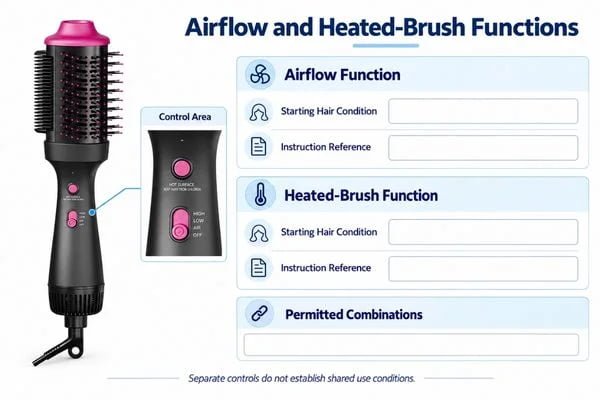
For a claim review, the essential question is narrower: which function is being promoted, and what starting hair condition do the matching instructions permit for that function? A combined device may offer more than one control, but that does not establish that every control or combination can be used under the same conditions.
What the KD311 Reference Guide Shows
The reviewed English-language KD311 reference guide for the KD311 hot-air straightening brush identifies separate air-brush and hair-brush controls. Its preparation section describes roughly drying hair with a towel. Its safety guidance also says not to use the hair comb when hair is wet and to make sure hair is dry before using it.
Those statements make mode-specific clarification important. Before a wet-to-dry claim or demonstration is approved, ask which starting hair condition applies to airflow alone, what the hair-comb restriction covers and whether a proposed combination is permitted. These passages alone do not establish which starting hair condition applies to each operating mode. The reference copy’s revision and applicability to the intended order remain unconfirmed, so it should not be used to establish the permitted routine for the configuration being purchased.
Until those points are resolved, the preparation step should not be used as blanket permission for a wet-hair routine. Separate controls can be described where supported; the broader use claim should wait for the relevant clarification and evidence.
Record the Starting Condition
“Wet,” “damp” and “towel-dried” can mean different things to different readers. The customer needs an instruction they can understand, while the evaluator needs a preparation method that can be repeated.
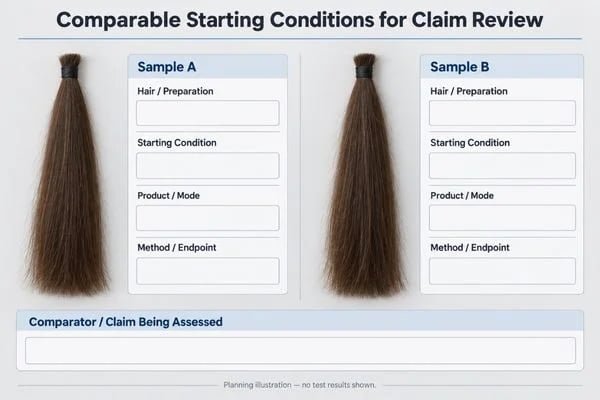
For a controlled tress evaluation, the record may include hair type and treatment history, section mass and length, water application, towel preparation and the interval before testing. Where a measured starting condition is needed, a protocol can compare tress mass using a defined reference and document the method and its limits.
That measurement supports comparison under the chosen protocol. It does not create a universal definition of “damp,” and it does not replace clear instructions for the customer. If evidence covers one prepared condition, the claim needs to stay within that scope.
Match Each Promise to the Right Evidence
The most efficient test plan starts with the question behind the claim. Air temperature, a drying result and a safety assessment can all be relevant, but each answers a different question. Collecting more measurements does not help if none addresses the promise on the package.
Drying, Styling and Comparative Claims
For “dries and styles,” define how each outcome will be assessed and whether the evidence covers the sequence described to the customer. The record should identify the product version, operating mode, hair preparation, test conditions, sample quantity, method, result and limits.
For a drying-time statement, agree on the endpoint and timing method before testing. A “faster” claim needs a defined comparator and appropriate, comparable starting conditions. A “less damage” claim needs an explanation of what is being measured, the treatment process and the comparison used. An appealing before-and-after video is not a substitute for those answers.
Where airflow and heated contact surfaces are both relevant, record them separately. A displayed brush setting does not describe every contact point or establish the temperature of the air reaching the hair. Measurements need their own location, instrument, timing and operating conditions.
Before a proposed hair trial begins, the responsible technical team should confirm that the sample, starting condition and settings are permitted for the procedure. If the intended routine extends beyond current instructions, qualified personnel need to assess and control the investigation. An unapproved wet-hair routine should not be improvised as a buyer demonstration.
Electrical Safety Answers a Different Question
A drying result does not establish that an appliance can be rinsed, immersed or used near a water-filled basin. Review the warnings and safety documentation for the selected configuration and destination market separately from styling performance.
The U.S. Consumer Product Safety Commission's guidance on hand-supported hair dryers addresses immersion protection and electric-shock hazards for products within its defined scope. Whether a particular styling appliance is covered requires a product- and market-specific assessment. General guidance does not establish that KD311 has a particular protection device or approval.
An electrical safety report also does not, by itself, prove a drying benefit or authorize every proposed hair condition. “Wet-to-dry” is not a synonym for “waterproof.”
For the separate care-instruction review, see our guide to beauty device skin-contact materials and cleaning. It explains how to define permitted cleaning areas, agents and liquid restrictions for the finished assembly. A styling tool still needs its own version-matched care instructions rather than a cleaning method borrowed from a facial device.
Approve, Narrow, Hold or Remove the Claim
Once the wording and evidence are side by side, the team needs a decision that can be carried into the product listing. These four outcomes give the review a practical finish.
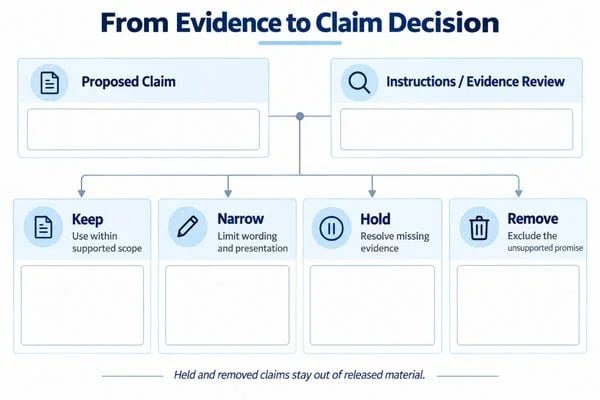
| Decision | When it fits | What the team does |
|---|---|---|
| Keep | The wording and its reasonable implications are supported for the identified product, mode and routine | Use the wording within the documented scope |
| Narrow | A more limited claim is fully supported, including its use conditions and promised result | Rewrite the claim to match that scope and check the complete presentation |
| Hold | Required instructions, safety evidence or performance results are missing or unresolved, and further review is planned | Keep the claim out of released material and record what must be resolved before reassessment |
| Remove | The claim conflicts with the applicable instructions or evidence, or will not be substantiated for the current release | Remove the promise and any equivalent implication from copy, imagery and video |
Planning to gather evidence later is not a basis for publishing the claim now. Both held and removed claims must stay out of released copy, images and video, even though their next steps differ.
An Illustrative Review
Assume that a hypothetical product’s approved instructions and relevant tests support drying and styling towel-dried hair in airflow mode. Its heated-brush mode is approved only for dry hair. The proposed headline, “Wet-to-dry styling in every mode,” exceeds that evidence.
The decision is to narrow the claim. A suitable description for this hypothetical case would be: “Airflow drying and styling for towel-dried hair. Heated-brush mode is for dry hair only.” The images and demonstration must show the same limits. An unassessed combined-mode routine must not be implied.
This example illustrates a claim decision; it does not describe KD311 or establish a routine for any specific model.
For U.S. advertising, the Federal Trade Commission explains that objective claims need a reasonable evidential basis before an ad runs. Requirements and review processes may differ in other markets, so the destination and the appropriate local advice belong in the project review.
Match the report’s sample, product identification, method and scope to the supplied configuration and proposed claim. Check the named applicant, manufacturer and other parties as recorded; possession of a report alone does not establish that it covers the product being offered. The manufacturing and quality review can help frame the broader discussion around the selected configuration and records.
Align Packaging, Listings and Demonstrations
The decision matters only if it reaches every place the customer sees the product. A narrowed claim in the approval record is of little help if the retail video still shows a broader routine or a translated box omits the condition.
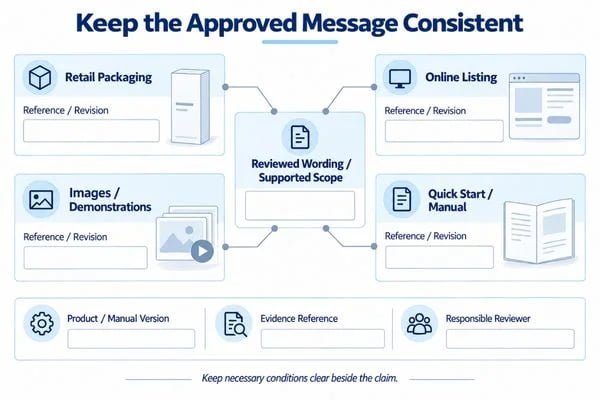
Read the packaging headline, online listing, images, demonstration, quick-start material and full manual together. If the approved wording is limited to a certain mode or starting condition, that limitation needs to remain clear in the places where the claim appears.
Place any necessary condition clearly and prominently alongside the claim. A qualification cannot contradict the headline or imagery. If the overall presentation implies an unsupported routine, revise the headline, images or demonstration as well.
If the evidence supports only a feature description, use that description accurately. The K·SKIN Global hair straightener brush options can help buyers compare project directions, but each model's instructions and evidence still determine its own permitted claims. Do not carry wet-hair wording across a range because the products share a category name.
Before releasing the claim, resolve any questions that affect its supporting evidence or permitted use. Record the final wording, product and manual versions, evidence references and person responsible for the decision. Keep any remaining questions that do not affect that decision in a separate follow-up record. Reassess the claim if the controls, configuration, instructions, imagery or target market change.
Frequently Asked Questions
Does “Towel-Dried” Mean the Same Thing in Every Test?
No. A test needs its own defined preparation method and, where relevant, a way to measure the starting condition. Customer instructions should also describe the supported routine clearly. Neither should be treated as a universal threshold for all styling tools.
Can a Supplier's Demonstration Video Support the Claim?
It can help show the presentation or prompt questions, but it may not establish hair preparation, settings, test method or repeatability. Ask for the applicable instructions and underlying evidence before using it to support a specific claim.
Does an Electrical Safety Report Prove a “Less Damage” Claim?
No. A safety report addresses the requirements and sample within its stated scope. A comparative hair-damage claim needs its own defined outcome, appropriate comparison and supporting evidence.
What If Only One Function Has a Confirmed Use Condition?
Limit the product message to what is supported for that function. Do not extend its use condition to a separate heated function or combined routine. Hold the broader claim until the missing scope has been clarified and supported.
Technical Sources
- KD311 Blow Dryer Brush, English-language reference guide, reviewed reference copy; revision and current approval status not identified. Relevant sections: Part Identification, How to Use, and Important Safety Instructions. The guide is a reference for its described configuration; the ordered version requires confirmation.
- U.S. Federal Trade Commission: Advertising FAQ's — A Guide for Small Business, for U.S. advertising claim substantiation and the overall impression of an advertisement.
- U.S. Consumer Product Safety Commission: Hand Supported Hair Dryers, for immersion protection and electric-shock hazards and the scope of the cited U.S. product category.