Your retail launch has a date. The sample looks close, and marketing wants to book photography. Before you book the shoot, find out which decisions are still open and what work depends on them.
Beauty device development lead time depends on how much of the base product can be retained, how many sample or tooling decisions remain open, and what must be verified before production. Build the schedule around those decisions. Identify who can approve each version, which tasks can run in parallel, and when the finished order needs to be ready to ship.
What Does Beauty Device Development Lead Time Include?
When a supplier gives you an estimate, ask which event it ends with. A date for the next sample tells you when you can review it. A production release date tells you when the approved product should be ready to move into manufacturing, subject to the agreed release conditions. A ship-ready date also has to allow for the production run, packing and release checks. If your deadline is a store launch or a warehouse arrival, allow for the work after shipment separately.
Start a schedule with the launch date, the date stock needs to reach the warehouse, and the date the finished order needs to be ready for dispatch. Then work back to the approvals that make those dates possible. For a seasonal range, the first useful question may be whether your team can approve the sample and the pack in time for the production window under discussion.
At K·SKIN Global, we start with the target market, the base product if one has been shortlisted, and the change the buyer wants to make. The feasibility review helps identify which parts of the product can stay, which need review, and which decisions will affect the schedule. That gives both sides a basis for discussing milestones and the assumptions behind them.
Which Steps Set the Pace of an OEM Project?
The schedule changes when a requirement reaches more parts of the product. A change to brand presentation can often be reviewed against an existing sample. Moving an enclosure joint or changing how a control works can reopen decisions about fit, assembly, instructions and validation.
When the existing platform already fits
Suppose a brand has found a styling tool that fits its range and needs a different finish and a branded box. The immediate questions are whether the finish is supported for that housing, which market version is proposed, and whether the box and insert fit the agreed device and accessories. A finish sample and a packaging proof can give the buyer clear decisions to make while the core product remains in place.
If the buyer can use an established model in an available configuration with its standard pack, the planning discussion shifts to current availability, order quantity, approvals for that configuration and production or dispatch arrangements. The work required for deeper development starts when the brief calls for a different structure, function or technical configuration.
When the product needs a new structure
Consider a proposed housing that changes how two parts fit together. The team first has to agree on the new geometry and check how it affects the components and assembly. If the change needs new or revised tooling, ask whether the quoted tooling lead time ends at the first trial parts or at acceptance of the corrected parts. The difference matters when the schedule includes a trial, a fit review and a possible correction.
A prototype that confirms size and handling can close the appearance decision. The project may still need parts made with the intended tooling and materials to assess fit or performance for production. Set the review criteria for each sample before it is made. When feedback comes back, tie it to the sample revision and record which items require a change, who will decide, and when the decision is due. If a late request changes the housing again, the team can then identify which fit checks, pack dimensions or tests need another look.
To review the budget alongside these milestones, see our beauty device OEM cost drivers guide. It explains how the scope of a change affects engineering, tooling and validation work, and how to separate one-time development fees from recurring unit costs when comparing proposals.
What Can Run in Parallel?
Packaging and instructions often contain work you can begin while engineering is still active. The buyer can provide artwork, preferred terminology, target languages and retailer requirements. The project team can start the layout and identify the information needed for the final pack. Leave product-specific details such as ratings, operating instructions and insert dimensions open until the matching version is agreed.
The published KD880 project for a German distributor shows how this can work. K·SKIN Global retained the existing tank and separate steam control while reviewing selected refinements with the customer. Work on localizing the packaging and instructions ran alongside the product work. The buyer approved the sample before the first production batch was supplied. The case illustrates how teams can prepare their retail materials while the product decisions are still being closed.
The same distinction helps with validation. Agree the questions, methods and responsibilities early, so that the team knows which sample and records it will need. Schedule the checks against the version specified in the plan. If a design decision is still open, let the buyer know which validation or production date could move when that decision changes.
How Can Buyers Build a Workable OEM Project Timeline?
Put the schedule in a shared record. For each milestone, write down who owns the decision, what they need to review and which later task depends on it. An estimated date becomes more useful when a buyer can see what has to happen to keep it.
| Stage | What the buyer confirms | What K·SKIN Global can help prepare | What can move forward |
|---|---|---|---|
| Requirements | Target market, intended use, launch window and essential changes | Review of relevant base platforms and feasibility questions | Scope review against the agreed brief |
| Design scope | Functions and appearance to retain or change, plus sample priorities | Proposed engineering scope, sample purpose and likely tooling or validation needs | Work on the agreed prototype |
| Sample iteration | Consolidated feedback on the identified revision | Revision record, proposed corrections and any effect on related work | Next sample or design approval |
| Tooling and validation, where applicable | Approval to proceed and acceptance criteria for the trial parts or product | Agreed tooling and trial plan, plus the validation scope and records | Review of the trial or engineering version |
| Pack and market materials | Artwork, language, contents and market-specific information | Packaging proof, instructions and fit review against the agreed configuration | Approval of the pack and supporting materials |
| Production release | Final reference sample, order configuration and inspection requirements | Release references, outstanding checks and production arrangements | Production under the agreed conditions |
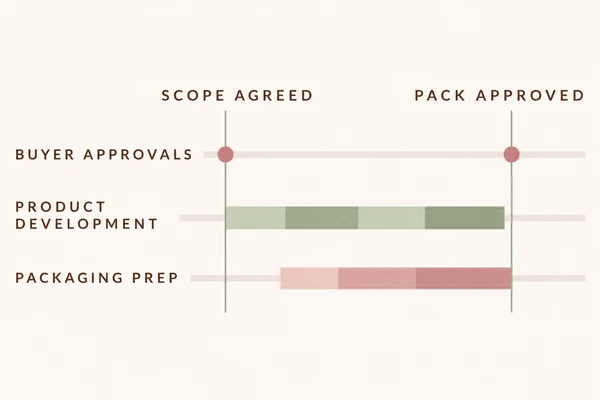
Stages can overlap. Packaging preparation can begin while a prototype is in review, for example, and production planning can identify a possible window while approvals are still open. Mark assumptions in the timeline and agree which dates become commitments as decisions are confirmed.
Give each unresolved item a decision owner and a due date. If the brand team wants a different finish while purchasing needs the current production window, the record should show which sample would be reviewed next and whether the new finish affects any pack or material approval. If the project can proceed with the existing finish, record that choice and defer the optional change. When a required approval slips, update the dates of the work that depends on it so both teams know what has moved.
At handover, the approved sample, specification, packaging revision and inspection requirements should point to the same product version. See how we approach that handover in Manufacturing & Quality.
What to share at the start
A useful planning discussion can begin with a short brief. Give the supplier enough information to link the launch date to the work the project actually requires.
- Share your preferred launch date, warehouse arrival target and when the order needs to be ready to ship, if known.
- Name the base product or share a sample reference, then identify the functions to retain and the changes essential to launch.
- Specify the destination market, intended use and known requirements for the electrical version, packaging and instructions.
- Share the expected first-order quantity and name the people who can approve the sample, product changes and artwork.
- Ask which tasks can start now, which dates assume a prompt decision, and what could affect the next milestone.
Our OEM/ODM development team can use that information to review the starting platform, outline the next engineering or sample decisions, and discuss a schedule suited to the scope.
FAQ
When does the development lead time start?
Ask which event starts the estimate for the stage under discussion. That could be an agreed brief, approval of the engineering scope, or authorization to start tooling. Record the starting event with the estimated finish date, especially if you are comparing proposals from two suppliers.
Can we plan product photography around an early sample?
Plan the shot list once the product direction is agreed. For images that will appear on the retail listing, check that the photography sample matches the approved finish, controls and accessories. If any visible detail is still open, agree when the final sample will be available before committing to a shoot date.
Can a production window be discussed before final sample approval?
Yes. Ask whether the proposed window can be provisionally planned, what approvals or materials it assumes, and when it can be confirmed. If you have a seasonal deadline, agree what to do if a design or packaging decision misses its planned date.
Can two market versions follow the same timeline?
They may share some work, such as an agreed housing or finish. Each version still needs its own review of the relevant electrical configuration, labeling, instructions and supporting documents. Ask which tasks can be shared and which approvals could affect only one version.
Conclusion
Work back from when you need the finished units, then identify the decisions that can move that date. The most useful timeline gives both teams a clear view of the sample version under review, the next approval and the work that can already get started.
If you have a launch window and a product direction, send K·SKIN Global the target market, base model or sample, essential changes and estimated order quantity. We can use those details to discuss what can carry over from an existing platform and what needs to be confirmed before planning production.
🌐 Website: kskinglobal.com
✉️ Email: info@kskinglobal.com