A retailer needs to explain more than how a blow dryer brush styles hair. Customers also need to know where hair collects, which openings need attention, and how to care for the tool without taking it apart.
To clean a blow dryer brush, switch it off, unplug it and let it cool completely. Remove loose, accessible hair from the brush head, then clean the air inlet using the method specified for that model. Treat these as separate tasks: the head may look clean while dust remains at the inlet. Never assume a filter is removable or washable.
How Do You Clean a Blow Dryer Brush?
Start with the instructions supplied with the product. The useful distinction is between surfaces you can reach from outside and parts that would require opening the appliance.
For routine care, work through this sequence:
- Switch off every operating function, unplug the appliance and allow it to cool completely.
- Look over the brush head and gently remove loose hair that lifts away without resistance.
- Identify the air inlet separately from the openings in the styling head.
- Clear accessible inlet debris with the tools and method permitted by the model's instructions.
- Check for remaining loose fibres, damage or signs of liquid entry before reuse or storage.
Do not soak the appliance or rinse it under a tap. If liquid may have entered the housing, leave it unplugged and contact the retailer or manufacturer rather than switching it on to test it.
These steps cover ordinary external maintenance. A tightly trapped strand, an inaccessible blockage or a damaged part needs a different response from loose hair on the surface.
Which Parts Need Different Cleaning Methods?
Look at the whole tool before choosing a cleaning method. On an airflow product, the brush head is only one area that needs attention.
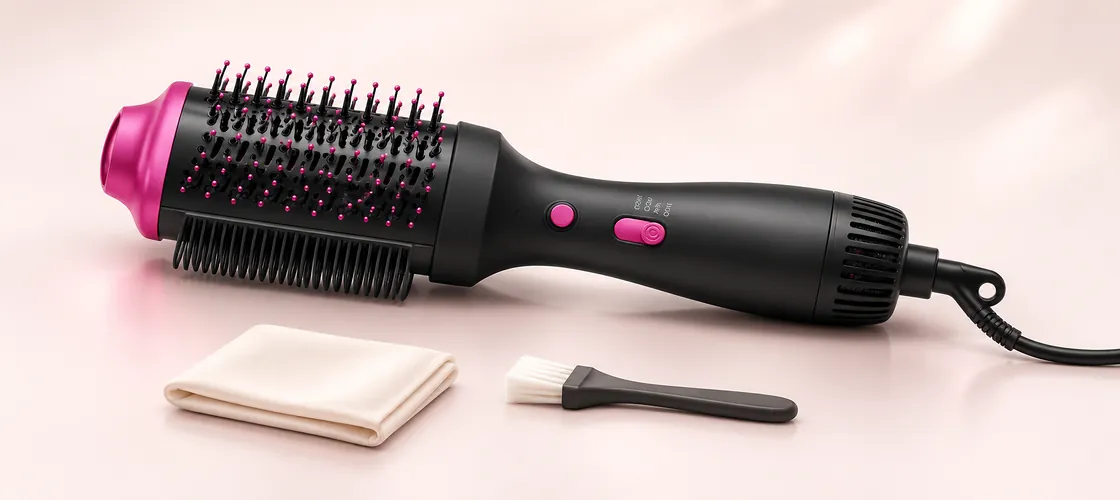
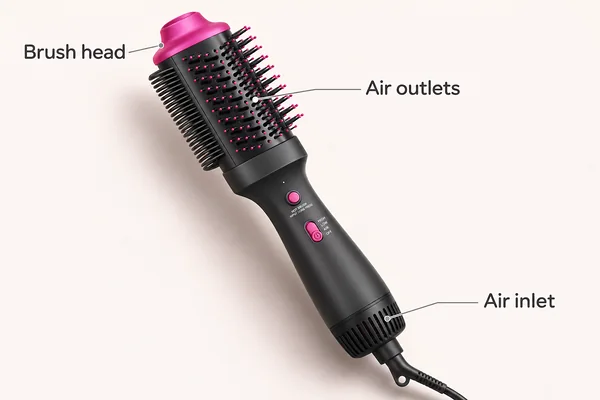
The KD311 hot-air straightening brush provides a useful example. Its English reference guide identifies brush surfaces and air outlets at the head, with an air inlet near the base of the handle. It also identifies separate controls for airflow and heated-brush operation. Turning off one function is therefore no substitute for unplugging the appliance before cleaning.
| Area | What to look for | Appropriate maintenance boundary |
|---|---|---|
| Brush head and teeth | Loose hair and visible surface residue | Work only on accessible surfaces; avoid pulling against teeth or bristles |
| Air outlets at the head | Strands or debris lying across openings | Remove only what is accessible without probing into the appliance |
| Air inlet | Dust, lint or hair on the outer intake surface | Follow the model's inlet-cleaning instructions and removal restrictions |
| Handle and controls | Surface marks, cracks or signs of liquid entry | Use the permitted exterior-care method; keep liquid out of openings |
| Cord and plug | Damage, distortion or burn marks | Stop using a damaged appliance and seek service advice |
This extra attention to the air path is one reason a hot-air brush needs different care from a contact-heated straightening brush. Our hair straightener brush vs hot-air brush guide explains the broader product difference; here, the focus is on maintaining the accessible areas.
How Should You Clean the Brush Head?
Loose strands and firmly attached residue need different treatment. Trying to remove both with the same forceful action can turn a small cleaning task into a damaged tooth or bristle.
Lift away loose hair without pulling on the brush
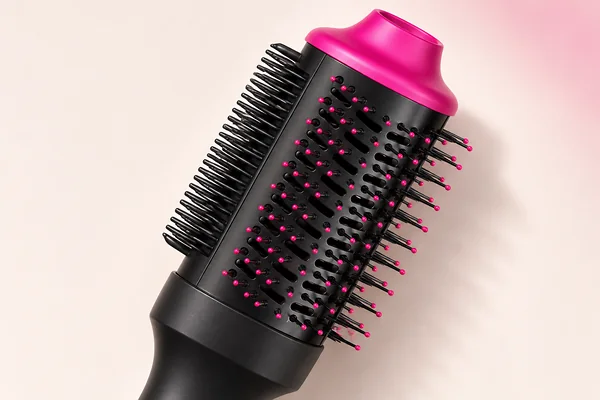
Once the brush is cool and unplugged, gently lift away hair that comes free easily. Work in small sections so you can see where each strand is caught.
If hair is tightly wrapped around a tooth, caught beneath a fixed part or disappearing into an opening, stop pulling. Do not use scissors or a pointed tool to reach inside the head. Ask for the model-specific method rather than improvising a way to prise the hair out.
Keep debris away from the air outlets as you work. The aim is to remove material from the outside, not push it through an opening where it becomes harder to reach.
Treat stubborn residue as a separate question
A patch that remains after loose hair has been removed may need an approved wiping method. The product's instructions should establish which surfaces and cleaning materials are suitable.
For KD311, the inlet instructions discussed below support dry surface cleaning. They do not establish that alcohol, shampoo or household cleaners are suitable for every part of the styling head. Avoid borrowing a cleaning recipe from a different model, even if the two brushes look similar.
If a mark will not lift using the permitted method, a clear photograph gives the support team a better starting point than a list of stronger cleaners already tried. There is no need to make the surface look new at the expense of its finish or construction.
For heated straightening brushes without airflow, our guide to how to clean a hair straightening brush covers loose hair, surface residue and model-specific wiping methods. Cleaner permissions should not be carried over to KD311, whose air inlet also needs its own documented cleaning method.
How Should You Clean the Air Inlet?
The inlet can be easy to overlook because it sits away from the styling surface. On KD311, the reference guide shows this area near the cord end of the handle and explicitly states that the inlet part is not detachable.
Use the documented external cleaning method
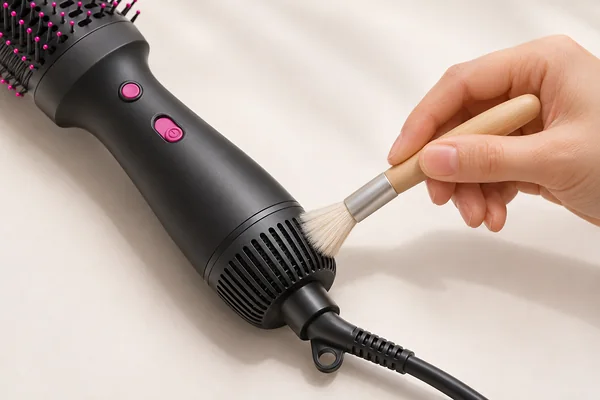
The KD311 English reference guide permits a dry, lint-free cloth, a soft brush or a toothbrush to remove debris attached to the inlet surface. For a brushing method, use gentle contact with the accessible exterior. Do not force bristles or another tool through the openings.
Keep the inlet assembly in place. The word “filter” in a manual does not, by itself, mean that the part twists off, slides out or can be washed separately. For this KD311 reference, cleaning means attending to the outside of the fixed inlet area.
If material remains behind the grille or cannot be reached without disassembly, contact support. Opening the housing is not an extension of routine customer cleaning.
Follow the model's maintenance interval
The same guide calls for inlet cleaning at least once a month. That is a model-specific instruction, not a universal schedule for all blow dryer brushes. Use the instructions supplied with the selected version when preparing a retail care guide.
A scheduled cleaning date is not a reason to ignore visible blockage or abnormal operation in the meantime. Inspect the accessible inlet when looking over the appliance, and stop using it if an obstruction or fault needs attention.
For retailers, a close-up showing the actual inlet and a simple external cleaning action is more useful than an instruction to “clean the filter regularly” with no indication of where it is or whether it comes off.
When Does the Brush Need Service Instead of Cleaning?
Cleaning can address visible external debris. It cannot tell you whether a motor, control, connection or protective component is working correctly.
The KD311 guide directs users to stop if operation becomes intermittent and to seek professional repair when normal operation cannot be restored after following its obstruction guidance. A customer should not be encouraged to keep restarting a tool that behaves abnormally.
Electrical Safety First's hair dryer safety guidance also advises unplugging after use, allowing the appliance to cool, keeping air openings clear and contacting the retailer or manufacturer if there are unusual smells, sparks or damage.
Reduced airflow alone is not a diagnosis. Visible inlet debris may deserve attention, but persistent weak airflow, unusual noise or repeated interruptions need support rather than a promise that cleaning will solve the problem.
For a retailer handling a complaint, useful information includes the model, a photograph of the rating label, the operating mode reported by the customer and photographs of the accessible head and inlet. Ask when the symptom began and whether the appliance was dropped or exposed to liquid. Do not ask the customer to recreate a potentially unsafe fault for a video.
What Should Buyers Check Before Ordering a Blow Dryer Brush?
A sample review usually gives plenty of attention to styling and handling. Set aside a few minutes for maintenance, too. It is a chance to discover whether the care instructions make sense with the actual product in hand.
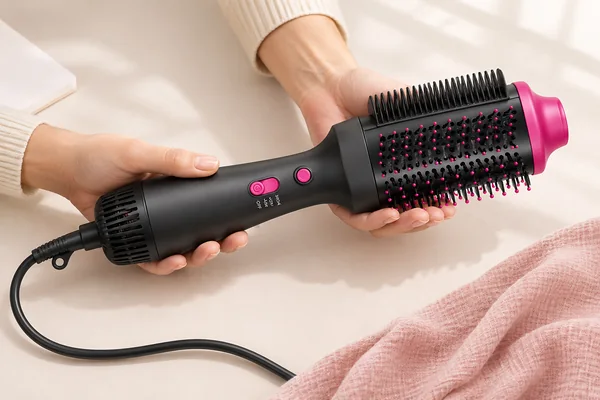
Ask someone who has not worked on the product to find the inlet using the supplied diagram. With the sample cool and disconnected, have them explain the permitted cleaning action. If they mistake the air outlets for the inlet or try to remove a fixed cover, the illustration or wording needs attention before the same confusion reaches customers.
| Sample-review question | What to examine | Why it matters to the buyer |
|---|---|---|
| Can the inlet be identified easily? | Product view, labels and manual diagram | Gives retail staff a clear location to show customers |
| Can the permitted surface be reached? | Grip, visibility and access with the approved cleaning tool | Reveals whether the documented action is practical |
| Is the removal boundary clear? | Fixed parts and any expressly removable components | Helps avoid instructions that invite unnecessary disassembly |
| Do the visuals match the sample? | Head, inlet, controls and supplied accessories | Keeps care material relevant to the product being sold |
| Is the service route understandable? | Stop-use advice and contact instructions | Gives customers a next step when cleaning is insufficient |
Before approving the customer-facing material, check that it includes:
- A clear picture of the correct product version.
- Separate identification of the brush head, outlets and inlet.
- The permitted tools, cleaning method and interval.
- Any restriction on removing or washing parts.
- A simple route for reporting damage or persistent problems.
These observations can inform product selection and support planning. They are not evidence that one design produces fewer returns or costs less to service; those conclusions need actual operating and after-sales records.
How Can K·SKIN Global Support the Selected Product?
For a brand considering KD311, the sample and its maintenance information belong in the same conversation. Seeing the inlet, brush construction and controls makes it easier to decide what the retail explanation needs to show.
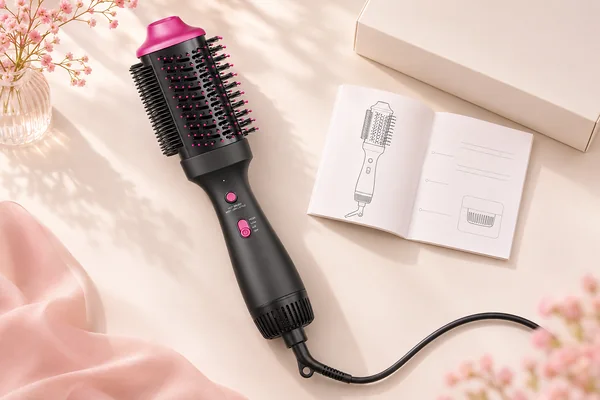
Build the customer information around the selected sample
K·SKIN Global offers KD311 as a hot-air styling option for brands, importers and distributors evaluating home-use ranges. Sample availability, electrical configuration, packaging and supporting information need to be agreed for the version being considered.
For a branded order, our private label options provide a route to discuss manuals, diagrams, packaging and language requirements alongside the product. A useful brief identifies the target market, sales channel and the maintenance questions the customer information needs to answer.
For example, a short care insert might show the inlet position and fixed-part restriction, while the full manual retains the complete instructions and warnings. If a retail demonstration is planned, it should show the same permitted action. Agree these materials against the selected sample before approving artwork for the order.
Turn access concerns into a defined development request
Sometimes the issue goes beyond wording. A brand may want a different inlet location, a different grip during cleaning or a revised approach to maintenance access.
Those requirements belong in an OEM/ODM development discussion. Describe the problem observed on the sample and the intended improvement so the engineering scope can be evaluated. A structural change needs feasibility and validation work; it should not be promised as a simple packaging or branding option.
FAQ
Can I use alcohol or shampoo to clean a blow dryer brush?
Only use a cleaning substance where the instructions for that model and surface permit it. Neither a familiar household cleaner nor an alcohol recommendation for another brush establishes suitability. The KD311 inlet method described here uses dry external cleaning.
Can I use compressed air or a vacuum on the inlet?
These methods are not established by the KD311 reference instructions used here. Stay with the documented tools rather than adding suction or pressure. Ask the supplier for a specific approved method if external brushing does not remove the debris.
Is a cleaning brush included with KD311?
The reference packing list identifies the main unit and user guide. Do not assume a cleaning accessory is included because a maintenance illustration shows one. For a commercial order, agree the actual packing list and any additional accessory separately.
Can one cleaning guide cover several hot-air brush models?
It can share general reminders, but the product illustrations, inlet access, removal restrictions and approved cleaning methods must match each model. A guide showing a detachable filter would be misleading for a version with a fixed inlet assembly.
Does regular cleaning make KD311 suitable for continuous salon use?
No. Maintenance does not change the intended use. The KD311 reference guide specifies personal home care. Selling through a salon or maintaining a demonstration unit does not establish suitability for continuous professional operation.
Conclusion
A blow dryer brush has two distinct maintenance areas: the styling head and the air inlet. Clear instructions show customers how to care for each accessible surface, which parts stay in place and when a problem needs service. For buyers, that clarity is worth evaluating alongside the styling experience.
If you are considering KD311 for your range, share your target market, sales channel and customer-support needs with K·SKIN Global. We can discuss the selected sample, available product information and the appropriate scope for branding or development, so the product and its care instructions can be reviewed together before an order is approved.
🌐 Website: kskinglobal.com
✉️ Email: info@kskinglobal.com