A retailer adding a hair steamer needs more than another heated appliance on the shelf. Customers should understand what it adds to their routine—and why they may still need a hair dryer afterward.
A hair steamer supplies steam for a defined hair-care routine, while a hair dryer uses airflow to help remove moisture and can support styling. They usually serve different stages rather than replace each other. For product buyers, the useful comparison is intended use, setup, accessories and customer expectations—not which appliance produces more heat or has the larger hood.
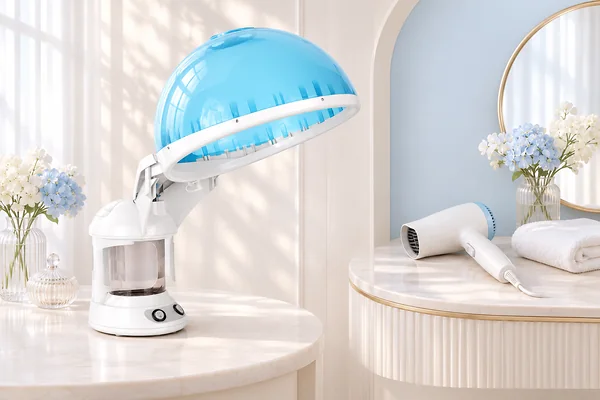
What Is the Difference Between a Hair Steamer and a Hair Dryer?
The main difference between a hair steamer and a hair dryer is the job each appliance is designed to do.
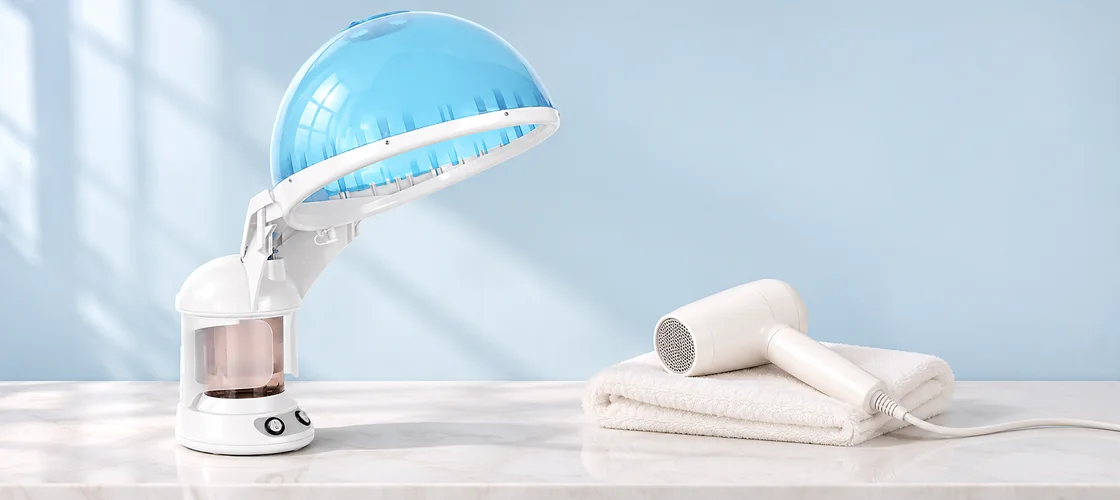
A hair steamer heats water and delivers steam through its intended attachment. A hood-style model creates a particular arrangement for a seated hair-care session. A hair dryer moves air through and around the hair to help it dry; depending on its design and attachments, it can also help the user shape a style.
Both may involve heat, but heat alone does not make them equivalent.
| Comparison point | Hair steamer | Hair dryer |
|---|---|---|
| Main task | Deliver steam for the specified hair-care routine | Help dry hair using airflow |
| Output to evaluate | Steam delivery through the supplied attachment | Airflow and available temperature settings |
| Typical arrangement | A steam base with a hood or another purpose-designed attachment | A handheld dryer or a purpose-designed hooded drying unit |
| Preparation | Water filling and assembly where required | Fitting the appropriate attachment and selecting permitted settings |
| Space considerations | Stable support, user position and room for the assembled attachment | Handling space for a handheld unit, or the installation needs of a hooded dryer |
| Care requirements | Model-specific water handling, cooling and cleaning | Model-specific inlet, outlet and attachment care |
| Retail promise | A clearly described steam-care application | Drying and any supported styling functions |
A hood can cause confusion. A hooded dryer and a hooded steamer may both surround the hair area, yet their output and purpose differ. Buyers should identify what the appliance actually delivers before choosing a category name or writing the product listing.
For customers, the simplest explanation is also the most useful: one product supplies steam for a care routine; the other helps get hair dry.
Can a Hair Steamer Replace a Hair Dryer?
Not as a general substitute. A steam-care session does not establish that the hair will be dry or ready for the customer's preferred finished style. Equally, directing warm air over the hair does not reproduce the documented steam function of a hair steamer.
For a brand already selling dryers, a steamer may therefore represent an additional product direction rather than a replacement SKU. The commercial question becomes whether customers want a separate care appliance and are willing to make space for that routine.
There is no need to portray blow drying as the inferior choice. If the customer wants to dry wet hair before leaving home, a product designed for drying addresses that task. A steam-care appliance needs a different explanation.
The comparison should also avoid promising that steam is automatically gentler. The American Academy of Dermatology's hair-care guidance advises limiting excessive heat exposure and using low or medium heat settings when blow drying. That advice does not establish that a particular steamer prevents damage or makes every heated care routine suitable.
A stronger retail message explains what the product does, how it is intended to be used and what the customer will still need afterward.
How Do Setup and Accessories Change the Experience?
The difference becomes much clearer when the products are placed where a customer would actually use them. A compact base can look convenient in a photograph, while the fully assembled hood needs considerably more thought about positioning.
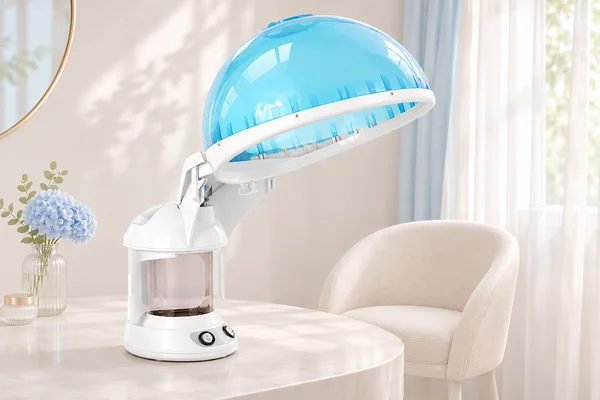
A seated setup needs more than a small footprint
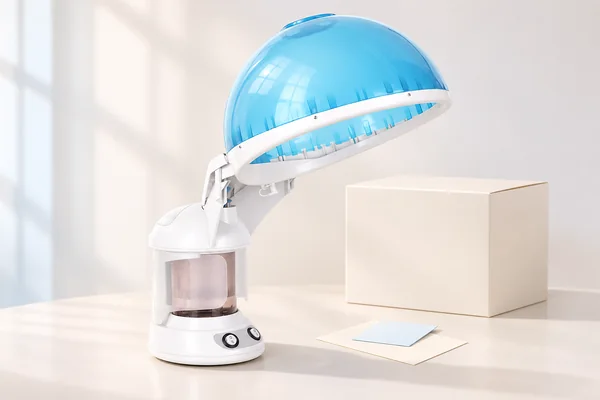
For a tabletop hair steamer, evaluate the complete arrangement: base, connector, hood, supporting surface and user position. The footprint of the base is only one part of the space requirement.
Can the customer sit naturally in the position described by the instructions? Are the controls accessible? Is there room to fill and handle the appliance without moving unrelated objects each time?
These questions matter for a home-care product. A shopper may like the idea of a dedicated routine but have nowhere convenient to leave the unit assembled. Showing the full setup helps them judge whether it fits their space.
Handheld drying involves a different kind of handling
With a handheld hair dryer, buyers will be more concerned with grip, control access, cord movement and handling during the intended drying task. Attachments may change how air is directed, but their role needs to be explained for that dryer.
A diffuser or concentrator should not be presented as a steam attachment simply because it changes the outlet shape. Nor should a steamer hood be described as a drying hood without a documented drying function.
The sample review should follow the task, not a shared checklist based only on appearance.
Storage is part of the product experience
Ask to see how the proposed steamer configuration is assembled and stored. If parts can be removed, the instructions should explain the permitted method and any cooling or draining steps before handling.
For an online listing, an assembled view and a clear view of the included parts can answer different questions. One shows how the appliance fits into a routine; the other shows what arrives in the box.
Avoid photographing an attractive collection of accessories that the advertised version does not include. The extra image may win attention, but it also creates an expectation.
Where Does Each Product Fit in a Retail Range?
A useful product range gives customers a reason to choose each item. Selling a steamer alongside a dryer can make sense when the two listings describe distinct tasks, rather than competing claims about which is universally better for hair.
For brands and distributors, start with the customer and sales channel. Then work backward to the product format, explanation and support material that channel needs.
Home-care ranges need a clear reason to add another appliance
A hair dryer has an easily understood purpose. A hair steamer may need a little more explanation, particularly for customers unfamiliar with a seated steam-care routine.
That explanation should be practical: the intended application, the assembled format, preparation and care requirements. Promises about repairing hair or improving product absorption should not fill the gap where a clear product demonstration is missing.
A home-care listing can show where the device sits, which attachment is fitted and what the customer needs to prepare. It does not need to prescribe an unsupported treatment schedule.
Retail and distribution buyers need consistent product information
A distributor may sell the same base model through several channels. If one retailer calls it a steamer, another calls it a dryer and a third shows attachments outside the quoted bundle, the product quickly becomes difficult to explain.
Give each commercial version a consistent name, accessory list and set of images. Keep the main purpose visible in the title and opening description, not buried in a specification tab.
| Range objective | Useful product direction | What the listing should make clear |
|---|---|---|
| Address everyday hair drying | A suitable hair dryer | Drying controls, intended handling and included attachments |
| Add a separate steam-care category | A hair-steaming configuration | Required setup, hair-care attachment and operating guidance |
| Offer hair and facial steam-care options | A platform with the corresponding approved attachments | Which attachments are included and how the configurations differ |
| Supply several retail channels | Clearly identified commercial bundles | Consistent model, electrical version, contents and packaging information |
A salon-supply channel introduces further questions about the intended operating schedule and environment. A product being sold through that channel does not, by itself, establish suitability for repeated professional sessions. That needs to be considered against the exact model's instructions and supporting information.
What Does KD2328A Offer for a Steam-Care Range?
For buyers considering this category, the KD2328A hair steamer with facial-care attachments provides a concrete model to evaluate. Its tabletop base accepts a hair hood with a connector, or the corresponding facial spray attachment, depending on the selected configuration.
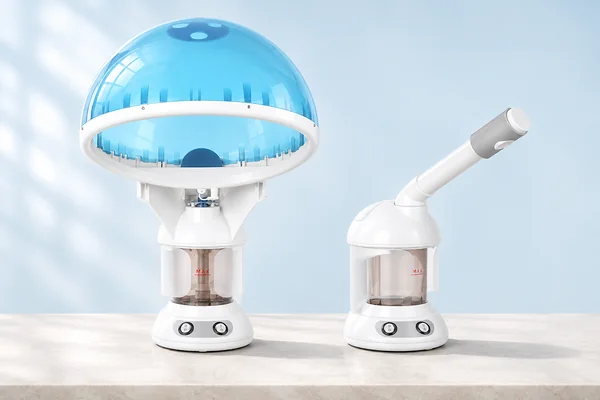
Start with the application your customers need
If the brief is for a hair-care product, the hair-steaming arrangement should lead the sample discussion and retail presentation. Show the assembled hood clearly and explain its role before introducing additional options.
If the brand is considering both hair and facial steam care, assess whether the broader offer genuinely suits its customers. More parts are not automatically a better proposition. They also require clear pack contents, understandable assembly information and images that distinguish the two arrangements.
KD2328A's configurable format gives the buyer a specific starting point for that discussion. It does not mean every order includes both attachment sets, and “2-in-1” does not mean steaming and drying.
When presenting the facial-care configuration, keep that application separate from room humidification. Our facial steamer vs humidifier comparison explains the differences in intended use, placement and operating limits, helping brands avoid turning a facial-steaming feature into an unsupported room-humidity claim.
Turn the attachment choice into a defined retail bundle
Before comparing prices, put the proposed contents in writing. The base, hood, connector and any selected facial attachment should be identifiable in the sample and quotation.
A brand planning a combined hair-and-facial offer can then check whether the box, instructions and product photography describe that same package. A hair-focused offer can keep its presentation simpler.
The deeper technical explanation belongs in our guide to how a 2-in-1 hair and facial steamer works. For this buying decision, the important point is what the selected configuration enables the customer to do—and what is actually supplied.
What Should Buyers Confirm Before Ordering?
Once the product direction is clear, a sample request can be specific without becoming complicated. Tell the supplier who the product is for, which configuration you want to evaluate and where it will be sold.
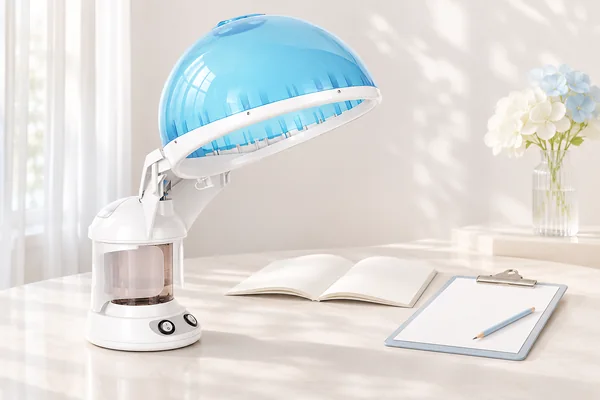
A practical review should cover the following:
- Identify the model, electrical version and attachment bundle being quoted.
- Compare the assembled sample with the proposed retail images and pack contents.
- Check attachment seating, handling and stability in the instructed setup.
- Review access for filling, permitted operation, cooling and water handling.
- Match the controls and indicators to the instructions supplied with that version.
- Record the space needed for use and the permitted storage arrangement.
- Request the product documents relevant to the selected version and destination market.
- Agree how any change to the sample or accessory list will be recorded before the order proceeds.
Keep evaluation criteria tied to the task. A successful assembly demonstration does not prove a hair-treatment result, and a visible steam plume does not establish a particular level of coverage inside the hood.
Electrical ratings also need context. A higher wattage is not a useful shortcut for deciding whether a steam-care product and a dryer are interchangeable. Compare each appliance with the requirements of its own application.
How K·SKIN Global can help move the project forward
For an existing-model project, we can start with KD2328A, your intended channel and the accessory bundle you want to assess. That gives the discussion a clearer basis than asking for a generic “hair-care machine.”
If the selected product fits your range, our bulk supply route connects the model and configuration with quantities, availability and commercial terms. Branding and packaging requirements can be discussed alongside the proposed order. Requests to change the structure or functions need a separate feasibility review.
For your initial enquiry, share the destination market, sales channel, estimated quantity and whether you want a hair-care bundle or a combined hair-and-facial offer. We can use those details to narrow the next sample and supply discussion.
FAQ
Is a hooded hair dryer the same as a hair steamer?
No. The hood describes part of the physical arrangement, not the output. A hooded dryer delivers air for drying, while a hair steamer supplies steam for its specified care application. Check the actual function and instructions rather than identifying the category from the hood alone.
Can conditioner or oil be added to the steamer's water tank?
Do not assume so. Applying a product to hair and adding it to an appliance's water system are different actions. Follow the exact device instructions and the companion product's directions. KD2328A's published guidance says not to add oils or herbal liquids to its tank.
Does a larger water tank mean a better hair steamer?
Not by itself. Tank capacity does not establish steam distribution, the permitted session length or suitability for a particular customer. Buyers should consider the complete setup and model-specific operating information rather than using capacity as a single quality score.
Does a 2-in-1 hair and facial steamer do both jobs at once?
The name does not establish simultaneous operation. For KD2328A, the selected attachment defines the corresponding arrangement. Specify the required parts in the order and follow the instructions for changing configurations.
Can the same product images be used for every accessory bundle?
Only where they accurately represent what is supplied, or clearly identify optional items. If the photograph shows a facial attachment that is absent from the advertised hair-care bundle, explain that distinction prominently. The customer should not need to guess which parts are included.
Conclusion
Choose a hair steamer or hair dryer according to the task your customer needs to complete. Drying and steam care can occupy different places in the same product range. A clear explanation of each purpose is more useful than presenting one as a universal upgrade over the other.
For a steam-care addition, KD2328A offers a model around which to discuss the intended setup and accessory bundle. Share your market, channel and preferred configuration with K·SKIN Global so we can help you move from a product idea to a focused sample request and supply discussion.
🌐 Website: kskinglobal.com
✉️ Email: info@kskinglobal.com